For the best part of nearly two hundred years the origins of the Boyds of Ballycastle has been pondered over and written of by a number of local historians. However that origin has been hidden behind the difficulties of studying family history in Ireland almost from it became a subject. Due to the scarcity of primary sources it may never be possible to say with a large degree of certainty what those origins are, however we will attempt to analyse those theories that have gone before against the available evidence and perhaps propose a new theory which we feel draws upon the majority of evidence available.
Theory 1 – Descent from Thomas Boyd of Carncoggy
One of the first notable sources to state the origins of the Boyds of Ballycastle was the well known ‘Genealogical and Heraldic Dictionary of the Landed Gentry of Great Britain and Ireland’ more specifically the 4th Edition, Part 1 (1862) where on p.140 it states:
“The family claims descent from the noble family of Boyd of Kilmarnock. WILLIAM BOYD (son of Hugh Boyd, Esq., and grandson of Thomas Boyd, who purchased in 1614 the lands of Cornacogie, co. Antrim) took holy orders, and was vicar of Ramoan, near Ballycastle.”
This theory was followed by Amy Isabel Young in her book ‘Three hundred years in Inishowen’1 and the noted Ballycastle historian Hugh Alexander Boyd (1907-96) in his 1929 article on the Boyds of Ballycastle.2
So this first theory states that the origin of the Boyds of Ballycastle was through Thomas Boyd of Cornacogie (Carncoggy) whose son Hugh Boyd was the father of William Boyd, vicar of Ramoan. However we know from our previous post on Thomas Boyd of Carncoggy that in 1657 his second son George Boyd successful applied to the Attorney General in Dublin to obtain his deceased elder brother Hugh’s lands in Carncoggy suggesting the absence of an heir of the body to Hugh and therefore dismissing the likelihood that William Boyd vicar of Ramoan could have been his son. The other issue of significance is naming conventions. In this we refer specifically to the first names given to male children of the Boyd family of Ballycastle (excluding those of Clare park). Beginning with Rev William Boyd of Ramoan the names of the heirs of the Ballycastle estate were:
- Adam, Hugh (1690-1765) and William
- William (predeceased his father Hugh before 1762), Daniel
- Alexander, Hugh, Ezekiel Davys (1740-1801), Daniel, William, James, Adam
- Hugh (1765-95), William, Francis, Ezekiel Davys, Charles, Francis
- Hugh (1788-1862), Alexander (1789-1868), Harriett (1790-1856)
- Sir John Augustus (1819-57), Frederick (1820-89)
- Sir Harley Hugh (1853-76)
- Frederick (1820-89)
N.B. The highlighted names are the persons producing the subsequent heirs
When looking at this list of male heirs and considering it against what we know of the Boyds of Portencross and the descendants of Thomas Boyd of Carncoggy and indeed his brother Archibald Boyd of Carncullagh, there is an abscence of the names Thomas, Archibald, George and Robert which occur through numerous generations of those families. It would seem therefore that despite the Boyds of Ballycastle and those of Carncoggy and Carncullagh living relatively closely in Co. Antrim for over two hundred years there seems to have been a conscious effort to avoid a commonality of first names. Surely this also points to the Boyds of Ballycastle having descended from Boyds other than of Portencross, or at least if there is a connection it is at distance and almost certainly before the 17th century.
Theory 2 – Descent from William Boyd of Dunluce
The second theory, which connects the Boyds of Ballycastle to William Boyd of Dunluce, was initially suggested by the late Ballycastle historian Danny McGill who in his 2002 article3 states:
“William Boyd was I believe the son of John Boyd listed in the 1669 Hearth Money Rolls for Drumawillen. He had married Rose McNeill around the 1670’s and had a son Adam who was one of the signatories of the 1690 Indenture. The other signatory Andrew Boyd was I believe, William’s brother. The Boyds had a substantial extended family at this time and had connections in business and the law in Scotland as well as in Dublin and elsewhere in Ireland. Family papers suggest that they were descended from a landholding family, the Kennedy’s, William Boyd of Dunluce, the Boyd’s of ‘Knockfergus’ and before that the 5th Lord Boyd. I intend presenting my extensive research into the descent of the Ballycastle Boyds at a later date.”
In this footnote Danny suggests that Rev William Boyd of Ramoan is a son of a John Boyd of Drumawillen and also that an Andrew Boyd was his brother, both men appearing on an indenture dated 10 June 1690 in which the McNeile estates are conveyed to Rev William Boyd of Ramoan by Bernard McNeile, brother to the deceased Hugh McNeile and in accordance with the terms of his missing will. Unfortunately Danny did not complete a specific article on the descent of the Boyds of Ballycastle before his death in 2013. However around 2007 along with his wife Jayne, Des Andrews, Danny Morgan and Mary Chambers, a Ballycastle Research Group was formed and an excellent historical pamphlet published called Col. Hugh Boyd’s Ballycastle. In the pamphlet a family tree was reproduced recording Rev William Boyd of Ramoan as the son of Adam Boyd, eldest son of William Boyd of Dunluce. As it would appear that the second theory is the more likely in explaining the ancestry of the Boyds of Ballycastle let us examine it further.
It is possible that Danny McGill arrived at his conclusion regarding Adam, son of William Boyd of Dunluce after finding the Will of Rev William Boyd of Ramoan dated 29 May 1701, amongst the Ballycastle Estate Papers. Within the will he confirmed the existence of an eldest son Adam who was heir at the time and that this eldest son was likely named for his paternal grandfather i.e. Adam Boyd, eldest son of William Boyd of Dunluce. However difficulties arise in this theory when placed against what little information we have on Adam Boyd, eldest son of William of Dunluce.
In our previous article on William Boyd of Dunluce our readers may recall the discovery of an important deed dated 18 November 1675.4
“The substance of the indenture states that in return for the surrender of the quarterland of [Ballykeele], originally held under lease to William Boyd of Dunluce from the Earl of Antrim (1609), Randall, Marquess of Antrim, for the consideration of £140 paid by the late Adam Boyd of Carnmoon, provides a lease of 41 years on the two quarterlands of Ballycubidell [Cubbindall], quarterland of Carnmoone [Carnmoon], quarterland of Stradbally [Straidbilly], quarterland of Carnboare [Carnbore], quarterland of Sleightcolman [Liscolman], quarterland of the Islands of Carmoone [?] and the quarterland of Ballyhomlin [Ballyhemlin] to Margaret Boyd alias Fullarton, relict of the late Adam Boyd and Francis Boyd, son to the late Adam and Margaret Boyd at a yearly rent of £44.“
This remarkable document specifically states William Boyd of Dunluce to be the father of Adam Boyd of Carnmoon. We further know that he was married to a Margaret Fullarton, and they had a son, Francis, both of whom were still living in 1675. Whilst this document does not refer to Francis as being the only child of Adam Boyd it does suggest that to be the most likely case and we also see no mention of a son William. Our conclusion therefore is that Adam Boyd, eldest son of William Boyd of Dunluce is not the father of Rev William Boyd of Ramoan, however it does not preclude the Boyds of Ballycastle being descended from one of Adam’s two known brothers, John and William which we will now investigate. Regarding Francis son of Adam Boyd of Carnmoon and Margaret Fullarton we will look at him in a later article by way of his being the likely ancestor for another significant Boyd family.
We know that John, second son of William Boyd of Dunluce was left rental income in his father’s will from lands in the townlands of Carnmoon and Ballyhemlin along with a legacy of £40 which was left in the care of Archibald Stewart of Ballelache (Ballylough, Billy Parish, Co Antrim) who was to oversee his education etc. However the above deed of 1675 suggests that the family holdings in those townlands had passed to his eldest brother Adam. Unfortunately no further detail is available but it might suggest that John had died before 1675 or earlier. Interestingly in the Muster Roll of 1630 a John Boyd mustering on the Earl of Antrim’s estate at Dunluce is identified5 by the researchers as being the second son of William Boyd of Dunluce. Of perhaps greater interest is examination of the Hearth Money Rolls of Antrim dating to 1669 in which we find a John Boyd recorded with two hearths in the townland of Drumawillin.6 As we will see when we look in detail at the Boyds of Ballycastle the townland of Drumawillin features strongly in the story of the family. However the problem of naming conventions provides an obstacle. If John Boyd was the ancestor of the Boyds of Ballycastle surely the name John would appear with a degree of prominance in the family. Surprisingly it does not.
Finally we turn to William, the third son of William Boyd of Dunluce. In his fathers will he is left a legacy of £60 in the care of William Dunlop of Craig in Scotland who is to ensure appropriate schooling along with the oversight of his mother. He is also left his father’s signet ring. The reason why William Boyd of Dunluce left his signet ring to third son William is unusual. Such items held great importance as they were used to identify the holder, often with an appropriate armorial. One would expect this would have gone to eldest son Adam as the will suggests his father intended him to take over his role as a Registrant for the Diocese of Connor or Notary in which the ring would likely be used to seal deeds and other legal documents. William’s guardian William Dunlop of Craig was a major merchant and burgess of the town of Irvine, Ayrshire, Scotland and it is possible he lived and was educated in Scotland for a period. However referring again to the Muster Roll of 1630 researchers suggest that he mustered on the Earl of Antrim’s estate in Glenarm.7 The researchers further suggest that he is the William Boyd identified in the testimony of Bryan McGee (21 April 1653) who was involved in the killing of the Irish on Island Magee on 8 January 1642.8 This reference to Glenarm is particularly interesting as in the will of William Boyd of Dunluce we see indirect references relating to that part of Co Antrim. Firstly we know that Revs William Fenton and William Wallace who had leading roles in the will held positions in the parishes of Ardclinis and Tickmacrevan in the Barony of Glenarm. It is also worth mentioning that amongst a list of those persons receiving denization on 9 February 1624/59 we find the following; William Wallace of Portcoman (Dunluce), parish minister, William Fenton of Carn Castle, minister, Thomas Boyde of Ballehackett, farmer and Bessie Trane of Dunluce. Messrs Wallace and Fenton we have already mentioned in the case of the Will of William Boyd of Dunluce, however we believe that the Thomas Boyd of Bellihabrett is likely a transcription error from Hill’s McDonnells of Antrim10 and that it is more likely Thomas Boyde of Ballehackett (Ballyhackett), farmer in the parish of Carncastle. Finally we can confirm that the Bessie Trane in the denization list is almost certainly the person who married William Dunlop Elder of Craig before 18 October 1639.11 This link to people and places in the Barony of Glenarm would seem to suggest that William, youngest son of William of Dunluce is the most likely candidate as ancestor of the Boyds of Ballycastle.
If we look again at the Hearth Money Rolls for Co Antrim in 1669 but sort under the name of Boyd and only those properties with two or more hearths we get a very interesting result:
Mr Adam Boyd of Carnmoon, Billy Parish
John Boyd of Drumawillin, Ramoan Parish
Thomas Boyd of Carncoggy, Derrykeighan Parish
William Boyd of Urbal, Billy Parish
It is very likely that the Thomas Boyd of Carncoggy is the third son of Thomas Boyd of Carncoggy (d.1634), former Provost of Irvine. The remaining names would link in quite well with the sons of William Boyd of Dunluce.
In the absence of consistant records covering the 17th and early 18th century we have created a chart of the persons we know to be descendants and those we suspect. A common denominator is the armorial bearings which are seen on gravestones, memorials and awarded by the Ulster of Arms:
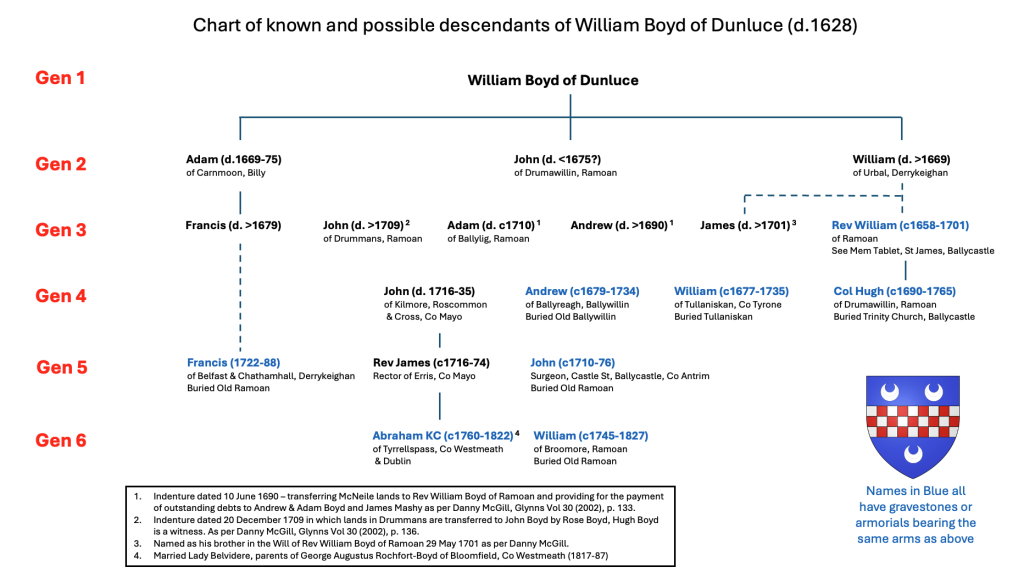
- Three Hundred Years in Inishowen. Being more particularly an account of the family of Young of Culdaff (2018 Ed.), ↩︎
- Ballymoney Free Press and Northern Counties Advertiser -7 March 1929, p.3 ↩︎
- 1690 AND THE McNEILLS OF CLARE CASTLE, The Glynns, Vol.30 (2002), p.136 ↩︎
- PRONI Ref. D2977/3A/3/1/29 ↩︎
- ‘Men and Arms’ – The Ulster settlers, c. 1630, edited by R J Hunter and prepared for publication by John Johnston (2012), p.113, No.320, footnote 44 ↩︎
- Heads and Hearths: the Hearth Money Rolls and Poll Tax returns for Co. Antrim 1660-69, S T Carleton M.A., p.71 ↩︎
- ‘Men and Arms’ – The Ulster settlers, c. 1630, edited by R J Hunter and prepared for publication by John Johnston (2012), p.117, No.140, footnote 105. ↩︎
- 1641 Depositions – TCD MS 838, fols. 198r-198v. ↩︎
- Letters of Denization and Acts of Naturalisation for Aliens in England and Ireland 1603-1700, William A Shaw (1911), p.331 ↩︎
- An Historical Account of the Macdonnells of Antrim: Including Notices of Some Other Septs, Irish and Scottish, George Hill (1873), p.393 ↩︎
- Particular Register of Sasines for the Sheriffdom of Ayr, 1635-1660 Vol II, p.421 – Vol 7, Fol. 260 ↩︎