As detailed in the article on the Boyds of Portencross, Thomas was son to Archibald 5th Laird of Portencross and Elizabeth Fairlie of that Ilk. He was likely born at Portencross Castle c1576 which has been surmised from his mother’s testament (1593) and his role as an executor alongside his brother Archibald. Scottish law and custom at the time allowed for someone, often a son, to take on the role of executor from the age of sixteen. He may of course have been a little older but his mother’s testament suggests some of his siblings to still be quite young.
As Thomas’ early life in Scotland is documented in our post on the Boyds of Portencross we pick up his story after it is presumed he and wife Katherine move to Co Antrim. Among the Inquisitions of Ulster published by the HMSO and edited by James Hardiman in 1829 we find two entries taken at Ballymeannagh (Ballymena, Co Antrim) on 6 January 1635 relating to Thomas Boyd1 viz:-
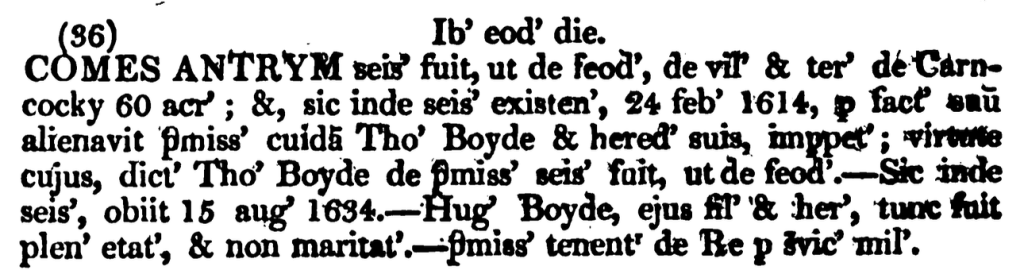
The first (No 36) records that the Earl of Antrim was seized in fee of 60 acres in the townland of Carncocky (Carncoggy, Derrykeighan Parish, Co Antrim) on 24 February 1614, he subsequently transferred it to Thomas Boyd and his heirs forever who was still in possession at his death on 15 August 1634 whereby it transferred to Hugh Boyd, his son and heir who was of full age and unmarried at the time. The property was held in fee and of ‘Knights Service‘ to the crown.
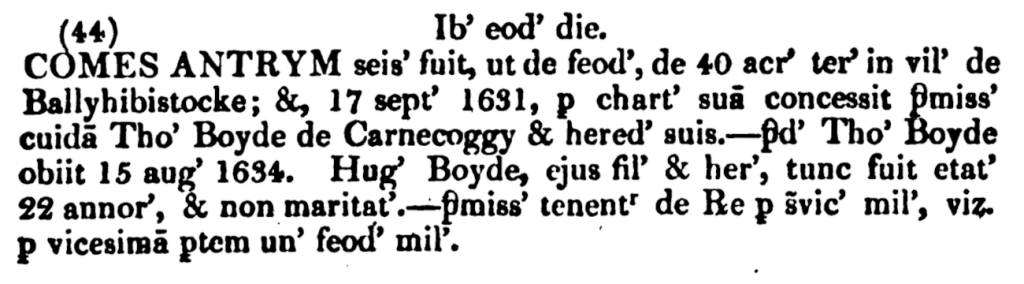
The second (no 44) records that the Earl of Antrim was seized in fee of 40 acres in the townland of Ballyhibistocke (Ballyhibistock, Derrykeighan Parish, Co Antrim) on 17 September 1631, he subsequently transferred or granted it to Thomas Boyd who was in possession of same when he died on 15 August 1634. Hugh Boyd, his son and heir, was then aged 22 years and unmarried and held the property of ‘Knights Service’ to the crown.
As previously stated these land transactions between the Earl of Antrim and Thomas Boyd were recorded at an Inquisition on 6 January 1635. However they are in part eluded to in an item recorded in the Calendar of the Patent and Close Rolls of Chancery in Ireland of the Reign of Charles the First dated 14 July 16362 i.e. 12th Regnal Year. It states:-
“Livery of seisen to Hugh Boyde son & heir of Thomas Boyde late of Carncogie in ye co of Antrim & pardon’g several alienations of lands in ye same County by Randal Earl of Antrim to Thomas Boyd & John Gemill”
This would appear to be Crown confirmation that the land acquisitions by Thomas Boyd from the Earl of Antrim and inherited by Hugh Boyd were acceptable to the Crown and from the work of John Lodge3 we can see that Hugh Boyd paid a fine (or Livery) of £15 to the crown for this confirmation of title in the eyes of the Crown. From these Post Mortem entries we can conclude that Thomas Boyd died on 15 August 1634 and that his son and heir Hugh Boyd was likely born in 1612. Also that Hugh’s mother was most probably Katherine Peiblis/Peebles.
As we know from the article on the Boyds of Portencross Thomas Boyds wife Katherine Peiblis/Peebles died 1 November 1615 and was buried in the old graveyard or church at Derrykeighan. At this time Hugh would only be around three years old and this likely prompted the necessity of Thomas marrying again to provide for his young son.
Within the Protocol Book of Robert Broun of Irvine we find the following entry4:-
“ABSTRACT
FOR ELIZABETH SMEYTOUN
Instrument narrating that a prudent man, Thomas Boyd, sometime provost of Irvine, but now dwelling within the kingdom of Ireland, com-peared personally upon the ground of his back tenement of land, lying within the burgh of Irvine, in the Kirkgate thereof, last occupied by John Barclay, tailor; also upon the ground of his fore tenement, likewise in the said Kirkgate, occupied and possessed by Hugh Lyne, merchant, lying between the lands of – ; and there the said Thomas, in view of the marriage already contracted between him and Elizabeth Smeytoun, relict of the late Mr. Alexander Campbell, minister of Stevinston, and by the favour of God shortly to be solemnized, and for the singular love, grace, and favour which he had towards the said Elizabeth his future spouse, did resign the said two tenements in the hands of an honourable man, John Blair, one of the bailies of Irvine, in favour of the said Elizabeth, and for this new seizin to be given to her of the same in liferent: and the said bailie having received the said resignation gave seizin of the said tenements to the said Elizabeth Smeytoun, who was personally present and accepted thereof: further, the said Thomas Boyd straitly bound himself to warrant the said tenements to his said future spouse, free from all wards and other burdens, to which warrandice the bailie interposed his judicial decreet and authority; whereupon the said Elizabeth took instruments: Done upon the ground of the said two tenements about the fourth hour after noon of the 3rd day of August 1616, the witnesses being Mr. Alexander Scrymgeour, minister of Irvine, John Campbell, governor, Oliver Broun, officer, and Alexander Bynning, son of Simon Bynning, burgess of Irvine.”
This wonderful source documents the intended marriage of Thomas Boyd and Elizabeth Smeytoun, widow and the tradition of the time that someone of Thomas’ social standing would secure an intended marriage with a settlement of liferent for his intended bride, in this case by way of property he owned in the Kirkgate of Irvine. From the Fastii Eclesiae Scoticanae5 we note that Elizabeth had several children to her former husband Mr Alexander Campbell, minister of Stevenston i.e. Alexander; Hew; Janet (marr. (1) 1621, James Bryding (2) John Peebles, younger, of Pethirland, Antrim, which marriage was annulled in 1632); Margaret; Marion and Annabell. Issues surrounding daughter Janet’s marriages will be covered shortly. We must presume that the intended marriage took place as we then find yet another entry in the Inquisitions of Ulster6.
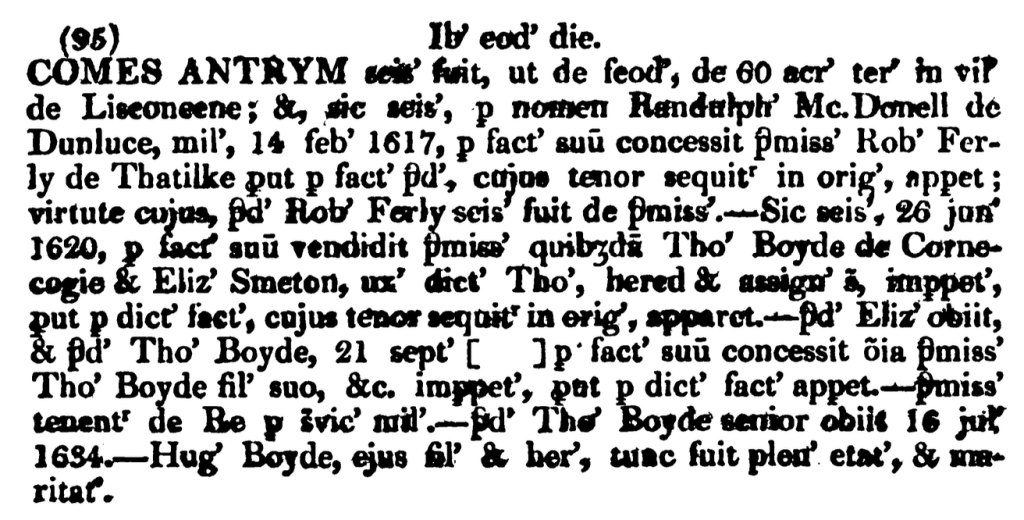
The Earl of Antrim was seised of 60 acres in the townland of Lisconeene (Lisconnan, Derrykeighan Parish, Co Antrim) on 14 February 1617 in the name of Randolph (Randall) McDonell of Dunluce who transferred the holding or premises to Rob’ Ferly (Fairlie) of that Ilk who was seised of the premises on 26 June 1620 at which time it was transferred to Thomas Boyd of Cornecogie (Carncoggy) & Eliz Smeton wife of the said Thomas and their heirs and assigns forever. The said Eliz died on 21 Sept [ ] after which the premises was transferred to Thomas Boyd their son forever who held the premises of Knights Service to the Crown. Referring again to the work of John Lodge we find his transcript of this transaction amongst the Pardons and Licenses of Alienation during the reign of Charles I as follows7:-
“And 14 February 1617 granted two quarters of Lisconeene of the small measure to Robt Ferly Gent & his heirs at the rent of £10 sterl who 26 June 1620 who assigned the premises to Thomas Boyde of Carnecoggy, gent and Elizabeth his wife & their heirs which Thomas 21 September 1624 settled the same on his third son Thomas and his heirs with divers other remainders – Inquisition at Ballymenagh 10 June 1636 – Fine £6 by said Thomas Boyd Junior, October 1, 1636”
Our next source for the life of Thomas Boyd is taken from a deed involving the Hutcheson family of Stranocum, Co Antrim reciting the historic title to the family’s estates in Antrim from George Hutcheon down to the year 17048. For the year 1622 it states “sometime previous to the death of George Hutcheon als Hutcheson. Administration of his Estate was committed to his widow Margaret Hutcheson als Fulton (possibly Fullarton) and mother of William Hutcheson who afterwards married Thomas Boyd“. It is likely that this Thomas Boyd is Thomas of Carncoggy suggesting therefore that his second wife Elizabeth Smeton had died prior to 1622. Once again Thomas is left a widower and this time with two sons recorded, Hugh and Thomas Jnr. The fact that Thomas Jnr was referred to as third son also raises the question as to the identity of Thomas Boyd of Carncoggy’s second son.
The next event in Thomas’ life relates to his stepdaughter Janet Campbell. It appears she was married or contractually betrothed to a James Bryding in 1621 and then contracted in marriage in 1627 to John Peblis, younger of Pedderland. A summary of a ‘decree arbitral’ from 1 May 1627 is summarised as follows:
“… on the ground of the lands of Pedderland and Moirshill where John Peblis younger of Pedderland had presented a decreet arbitral by the Reverend Doctor John Richardsoun and Edmond Cessane of the county of Culrayne [Coleraine] in the kingdom of Ireland, judge arbiters, who had been chosen by Thomas Boyd in Cairneroggie [Carncoggy] in the county of Antrim and John Peblis younger in Tullogrora? [likely Tullaghgore, County Antrim] there, both described as gentlemen. The date of the decreet is left blank.
Their judgment was that Jonet Campbell, wife of John Peblis younger was to be given half the freehold (free tenement) and liferent of the lands of Pedderland and Moirshill. The respective liferents of John Peblis younger and John Peblis elder, his father were reserved.
The sasine was witnessed by Gabriell Porterfield of Kipland, William Hamilton of Bru[m]mure, Mr James Fullerton, minister of Beith, Robert Peblis, notary in Maynehill, Robert Ker in Auch [rest obscured], James Ker in Swynrigmure and William Stewart in Hiefeild of Kersland.”9
This seemingly bigamous arrangement comes to a head in 1632 as follows:-
1 November 1632, registration of renunciation by Jonet Campbell, eldest lawful daughter of the deceased Mr Alexander Campbell, minister of the gospel at Stevenstoun, narrating her marriage with John Peibles, younger of Pethirland, indweller in the parish of Balliemony in County Antrim, Ireland, which took place in Ireland, and that the said John Peibles had lately obtained a decree of divorce against her before Mr John Monypennie, Doctor of Divinity. Principal officer and general commissary to Robert, Bishop of Down and Conner, because that she in the year 1621 been contracted in marriage and betrothed to the deceased James Bryding in presence of several witnesses, whereby she was found to have been married to him and so her marriage with John Peibles was found of nullity, which sentence of divorce was read and published in the parish kirk of Ballimonie on 6 October last in presence of Thomas Tayleour; notary, registrar of Troyist, and other witnesses; and now because the said John Peibles has repaid to her all the sums of money and others which were given by her and the deceased Elizabeth Smeittoun, her mother, and Thomas Boyd of Carncogie. Her spouse. Or others her friends in name of tocher with her, she discharges him thereof and renounces the liferent infeftment which received from him of the half of his lands of Pethirland in the parish of Beyth and bailiary of Cunningham, and also the joint fee of his lands of Tulloger held by the said John Peiblis of the Earl of Antrim in the parish of Balliemonie, with all right to an annuity of £5.11 shillings sterling, which John Peiblis of Peddirland, father of the said John, is obliged to pay to her after the said John’s decease in terms of a decree arbitral between the said John Peiblis, younger. And the said Thomas Boyd of Carncogie, dated 20 December 1626. The Renunciation is dated at Irvine 13 November 1632; witnesses Allan Dunlope, Provost of lrvine, William Cauldwell of Annanhill, baillie clerk of Cunningham, Christiern Cunningham, uncle to the laird of Robertland, Mr William Russell, minister at Kilbirney, Robert Broun, town clerk of Irvine, and Mathew Homill, his servitor.10
The circumstances or reasons as to how the two marriages came about is unknown but it would certainly appear that the renunciation above was intended to be an end to the matter for all parties and there is no evidence of any later disputes.
There is one other mention of Thomas Boyd of Carncoggy during this period i.e. 1620s and that is the testament and letter will of William Boyd of Dunluce dated 9 December 162411. A transcript was produced in Hill’s ‘MacDonnells of Antrim’. Hill states that Thomas Boyd was an executor to William Boyd’s will, and appointed therein ‘curator’ of Kathrine, a daughter of that gentleman. He was also bequeathed by the testator his ‘beste silver piece’ and ‘beste saddell and bryddell’. However, there is no mention in the will of any familial relationship between William Boyd and Thomas Boyd. Indeed, William Boyd refers to Thomas as one of his ‘faithfull and trustie friends’ and later as one of his ‘fatfull and well-loved ffreinds’. The use of the word friend in Scottish social custom of the time should be understood if we are to understand the likely role of Thomas Boyd in the will of William Boyd of Dunluce. At that time the mention of relationships in such documents was usually confined to the nearest relations, father, mother, son, daughter etc. Occasionally the use of cousin German i.e. first cousin but no language was usually employed for anything beyond first cousin. The use of the word ‘friend‘ however could refer to someone who was a blood relation or kinsman. The frequency and roles of Thomas Boyd in the will is highly suggestive that he was indeed a relation of William Boyd of Dunluce, perhaps a second or even third cousin.
Our final source for Thomas Boyd of Carncoggy comes from the Muster Roll of 1630 which is believed to contain the names of males from around 16 to 60 years of age who were capable of bearing arms. Under the muster for the Earl of Antrim on his estates in the Barony of Dunluce we find entry number 135 – Thomas Boyd with sword only. The muster was first compiled by the late R J Hunter but published12 posthumously by the ‘R J Hunter Committee’ with the grateful assistance of John Johnston.
We should perhaps at this stage draw attention to a what is almost certainly a long standing error that appears in the footnote of the muster entry for Thomas Boyd above but whose origin dates from Rev George Hill’s work ‘An Historical Account of the MacDonnells of Antrim‘. The error is referring to the father of Thomas Boyd of Carncoggy as being John Boyd, former Provost of Irvine and his wife Jane. The reasons for this error are unknown, ranging from a publishing error to a misreading of information on the gravestone or memorial of Katherine Peiblis/Peebles in old Derrykeighan graveyard. Unfortunately it was still being replicated as recently as 2015. We hope however that the evidence for Thomas Boyd’s parentage presented in this and earlier posts will bring its use to an end.
Unfortunately no will or testament has been found for Thomas Boyd of Carncoggy or indeed any of his wives, Katherine Peiblis/Peebles, Elizabeth Smeyton and Margaret Fullarton. In addition, only the grave of Katherine Peiblis/Peebles has been located. We strongly believe that the most likely location for Thomas’ burial is in old Derrykeighan graveyard and it is hoped that with further investigations it will be uncovered.
We move now to look at the children of Thomas Boyd of Carncoggy of which we know of at least two at this stage; Hugh born c1612 and Thomas born c1612-15.
Hugh Boyd
As eldest son and heir Hugh was destined to take over from his father in both the majority of his father’s holdings and probably mercantile interests. Unfortunately nothing has been found of the mercantile interests, if any, of Thomas Boyd of Carncoggy but we could suggest that his background as a burgess and Provost of Irvine had brought him into contact with the trading of goods in and out of the port of Irvine. The Ulster Port Books 1612-1513 give us a fascinating glimpse into the type, nature and extent of seaborne trade at this time, albeit that it is focused on the ports of Londonderry, Coleraine, Carrickfergus and the Lecale Ports. One possibility may be that Hugh was educated and apprenticed for a life of commerce, perhaps in international trade.
Unfortunately no definable entry in the usual university matriculations has been found for Hugh and he does not appear to be listed alongside his father in the 1630 muster. He certainly appears to be alive two years after his fathers death given the livery of July 1636 to his father’s lands but no residency is given for him. Interestingly a series of investigations into seaborne trade throughout Western Europe and transatlantic during this period by Prof Louis Cullen, Prof David Hancock and others provided us with one possible answer for Hugh’s whereabouts. During his many years of study in French archives Prof Cullen mentioned a Charter Party amongst the records of La Rochelle notary, Pierre Touleron, between Messrs Whyte and Boyd in 1635.14 This was later identified and with the kind help and assistance of Mr Guy Perron the document was recorded, transcribed and translated as follows:-
“Personally established Robert Whit (White?), mariner, of the place of (quirpatricq? Possibly Kirkpatrick) At _kingdom of Scotland, master after God of the boat named ‘The Gift of God’, said _place, being present in this city of La Rochelle. Which one willingly _and will, speaking through the organ of Jacques Jousson, merchant, from the place of Saint-Jean _de-Vie in Scotland, rented and chartered his said boat which he _said to be duly waterproof, provided and equipped with everyone _its equipment used for its navigation, to honorable man Heu Boyd, merchant, _of this said city, present and accepting. Of which master has promised, obliges and _will be required to receive his competent load of wine in the city of Bordeaux _where he will sail his said boat immediately after having made the said charge of _goods, being loaded into it in the city of Dublin, in Ireland, where it _is ready to go for the first good weather. Which wine is well packaged _following the bill of lading which will be made between the said parties. Said master _promises the first decent good weather, leaving from the said city of Bordeaux, _he return and carry on the right road instead of Dublin, in Ireland, and he _will stay for forty-eight hours (48 hours) to take orders from the said Mr. Boyd if he has to _ unload said wine. In which case, he will be required to stay for twenty suitable days _consecutive and, during them, make delivery of it to the said Mr. Boyd going _in the said boat, otherwise he will be the master required to go instead of Farly (?), in _Scotland, and he will stay three consecutive days to take notice of it, he says _Mr. Boyd if he will have to go with his said boat to the said place of Glasgow _or Rouen. At one of which places having arrived at the right discharge, will be held _make a similar stay there of twenty working days during which he _will have the said wine unloaded and delivered to the said Mr. Boyd, or to his order, _who will pay him as he promises and obliges immediately after the entire _discharge and delivery of it the sum of six hundred tournament pounds (600lt) for its freight _on the one hand and two pistoles for his shoes and bribe (gratification) of the said master _and besides, a pavilion weighing ten pounds. And for the little touches, _luffing and lifting and other small costs and advances will be paid to the us _and custom of the sea except for the costs of and damages which will occur _said Bordeaux which the said Mr. Boyd promises to pay and acquests the said master. And said _discharge and payment thus made will be discovered by the master at _place where he will make the said discharge and without return. And in the event of damage to said _wine or part of it by the fault and cause of the said master or his crew _or that the said vessel was not properly watertight, will be held liable for such loss or damage _ to say of people to this knowledgeable person. And where said boat would come to _shipwreck during the said voyage, God preserve, the said Mr. Boyd _The pound of what has been covered will contribute to the ground. And for _execution of this contract, the said master has elected his irrevocable domicile in this city _in the house of the undersigned royal notary to receive all acts and exploits of justice _required and necessary which will have such force and value as if they were made to its own _ordinary person and home. Everything above has been stipulated and accepted by the said _parts and to be made and accomplished through them, without coming on the contrary, barely _of all costs, damages and interest. Have obliged each other to each other their _present and future movable and immovable property of any kind, especially and expressly _the said master his said boat and equipment, without the generality being able to harm or _prejudicial to the specialty nor on the contrary. And besides, his person to be held in prison _as for royal money. And have the said parties respectively renounced all _ things to these contrary gifts after they have been declared and given to _hear said master from said sir Jousson the outfit and effect _which they promised and swore to hold and guide inviolably. Whose to be renounced _tried and sentenced. And done in La Rochelle, in the office of the said notary, before noon, on the twenty-fourth day of September one thousand six hundred and thirty-five. Present said Jousson // and _Pierre Bérault, merchant, residing in France. The said master declared that he did not know how to sign _ of this required but only made its ordinary mark. // And Guillaume Sombert _.“
In summary the vessel ‘Don de Dieu’ (Master Robert Whyte of Kirkpatrick?) had been chartered to transport wine from Bordeaux to Dublin by Messrs James Johnstone of St John? in Scotland and Heu Boyd of La Rochelle and thenceforth to possibly Fairlie, Ayrshire and Glasgow, Scotland and possibly Rouen, France.
We know from the previous post on the Boyds of Portencross that Thomas Boyd of Carncoggy had a younger brother George who had gone to La Rochelle, France by the early 1600s. Could it be that Thomas’ son Hugh had established his own mercantile links with La Rochelle? Unfortunately nothing more is known of Hugh Boyd. No further evidence has been found relating to Hugh in the years immediately following 1635/6. However a remarkable document15 was discovered in PRONI dating from 1657. Although severely damaged it has since undergone preservation by staff at PRONI and some degree of transcriptions is shown below:-
George Boyd (Plaintiff)
v
William Basie Esq., Attorney General (Defendant)
“Upon *** which pleadings the said case/cause proceeded to a
hearinge and was accordingly heard this day in
the presence as well of me Attorney General
as of the Council for the said plaintiff and upon
pleading the said pleadings and the evidence
[missing] produced in Court at the hearing
[missing] said case/cause whereby ** *********
[missing] *** [missing] the said late [partie] beinge
After whose decease the land descended unto the said
plaintiff as brother and heir of the said Hugh –
whereby the said plaintiff entered into *** ***** –
and is seized thereof upon due consideration
thereof and for that *** ***** of
[missing] was *** made to ******* to
[missing] Boyd [missing] ****** of the said plaintiff
[missing] [missing] land of Curicoggy
Any shall hereafter **** given at the Four
Courts Dublin the eight and twentieth of
**** in the year of our Lord God
one thousand six hundred fifty seven.
Jo [missing] [missing] ******* Milis ****
[missing] Copia ******
Executed by Wm Lands”
The document, a copy of a court order, in the case of George Boyd versus William Basil or Basie, Attorney General, made at the Four Courts, Dublin refers to lands at ‘Curicoggy’ (probably Carncoggy) and, interestingly, would appear to suggest that this George Boyd was a brother and heir of the late Hugh Boyd, deceased. This document may be the strongest evidence that this George Boyd was the previously unidentified second son of Thomas Boyd of Carncoggy and confirmation that Hugh Boyd had died before 28 December 1657 and likely without an heir of his body leaving brother George to make a claim on the family holding of Carncoggy, Co Antrim.
George Boyd
From the 1657 court paper above we have identified George Boyd as Thomas’ second son and possibly then resident in Carncoggy, Co Antrim from that date. Unfortunately no further evidence has been found to date on this George Boyd and we must consider the possibility that he died or moved elsewhere shortly after the court hearing. As we shall see later the Boyd family holding in Carncoggy appears to pass from the direct male family line by the early 1700s perhaps providing the strongest evidence that George had in fact died without a male heir.
Thomas Boyd Junior
We can confirm the existence of Thomas as third son to Thomas Boyd of Carncoggy from the records of the Inquisition of Ulster and more particularly from a transcription by John Lodge in the matter of a holding in the townland of Lisconnan, Derrykeighan Parish, Co Antrim.
“And 14 Febry 1617 granted 2 quarters of Lisconeene 60a of the small measure, to Robert Ferly, Gent & his Heirs, at the Rent of £10 Sterl; who 26 June 1620 assigned the Press to Thomas Boyde of Carmecoggy Gent & Elizabeth his Wife, & their Heirs, which Thomas 21 Septr 1624 settled the same on his third son Thomas & his Heirs, with divers other remainders, Inn at Ballymenagh 10 June 1636. Fine £6 by said Thomas Boyd Junior Oct 1, 1636.”
Before looking further at Thomas Boyd Junior it is perhaps worth looking at Robert Ferly who received the holding in Lisconnan from the Earl of Antrim in 1617. We know that Archibald Boyd 5th laird of Ardneil and Portencross and father of Thomas Boyd of Carncoggy was married to Elizabeth Fairlie of that Ilk. Could Robert Ferly have been a relation?
Amongst the indexes of the National Records of Scotland we find a number of references to a Robert Fairlie between 1605 and 1630 the most interesting of which16 dates to the 9 September 1630.
“Precept of clare constat granted by Robert Fairlie of that ilk for infefting James Cunninghame of Balliachane in the County of Donygald and Kingdom of Ireland, son of James Cunninghame in Kilmares then deceased as nearest and lawful heir of his father in the said mill
John Boyle of Kelburn is a witness“
The Cunninghames referred to in this precept are of course a branch of the Glencairn Cunningham’s of Ayrshire and interestingly it appears that Robert Fairlie had legal authority to grant the property referred to in the deed to James Cunninghame son of James Cunninghame in Kilmares (Kilmaurs, Ayrshire), said to be an uncle of Sir James Cunninghame of Glengarnock.17 James Cunninghame had been granted 1,000 acres called Moyaghe or Ballyaghan in the Precinct of Portlough, Co Donegal by James I on 19 July 1610.
Unfortunately it has not been possible so far to establish the exact relationship of Robert Fairlie to the Boyds but it is not unreasonable to assume he is a relation of Elizabeth Fairlie and it is most likely that this resulted in the transfer of the property in Lisconnan through Thomas Boyd of Carncoggy to his third son Thomas in 1624 and confirmed 1636.
On 10 December 1636 Randall MacSorley MacDonnell, 1st Earl of Antrim died resulting in the issue of new leases for many properties the following year from his son Randall, 2nd Earl of Antrim and his brother Alexander MacDonnell. Amongst these was a lease for property in Magheraboy in the Parish of Derrykeighan, Co Antrim on 21 July 1637 for 41 years to Thomas Boyd of Lisconnan.18. This townland no longer exists as Magheraboy but is known today as the townland of Derrykeighan within which the village of the same name lies.
From this lease it is wonderful to record the surviving signature of Thomas Boyd of Lisconnan.
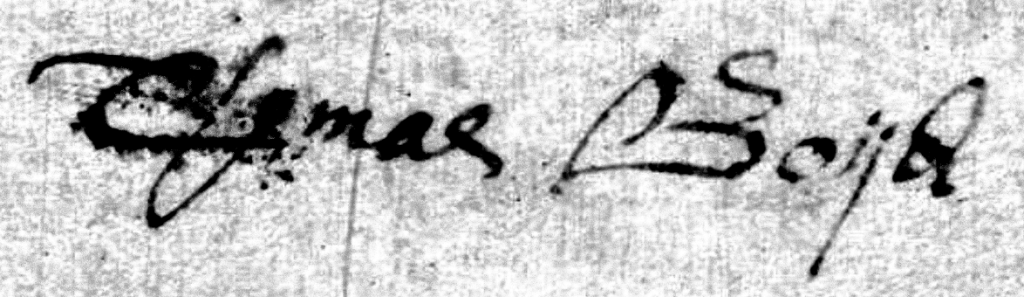
The 1637 lease of Magheraboy also includes the signatures of witnesses Archibald Stuart, Gilduff O’Cahan, Daniel McNaghten, Robert Strawbridge and one Archibald Boyd who is almost certainly the uncle of Thomas Boyd of Lisconnan who will be the subject of another post.
The 1st Earl of Antrim and his wife Alice had amassed major debts during their lives and on 25 November 1637 the Barony of Carey was held as security by guardians representing the Earl’s creditors with the 2nd Earl of Antrim reserving certain “severall ffeeffearmes, Rents, and services” incl. “Hugh Boyde, for the two quarters of Carncoggie, yearly, eight pounds fifteen shillings” and “Thomas Boyde for two quarters of Lasconane, yearely, fifteen pounds fifteen shillings.”19 Remarkably it was these large debts that would later provide a level of security for the 2nd Earl from the full rigours of being attainted and having all his lands confiscated as remaining creditors feared the losses that would result.
By October 1641 the Irish Rebellion had begun and it would fall harshly on the Scottish settlers of north Antrim. Amongst them was Thomas Boyd of Lisconnan, Co Antrim. In the depositions that followed the period of the rebellion and the wider turmoil of the Civil War we find a testament by Thomas Boyd of Lisconnan taken on 1 March 1653 as follows:-
“The Examinacion of Thomas Boyd of Lisconan in the parish of Derrickighan Gent taken before vs the first day of March & the yeare abovewritten
<19> Who being duely sworne & examined saith That upon the 4th day of January 1641 or thereabouts being a day or two after Portnaw Murder this Examinante entred the house of Ballentoy the which <C> house was then Commanded by Mr Donnell McNeile vpon the Thursday after being about the sixth day of the same Moneth the Enemy approached being commanded by James McColl McDonnell Allester McDonnell Gilduffe ô Cahan John Mortimer & others their Irish Confederates consisting of the number of about 1500 men with fifteene Colours Which James McDonnell wrote two severall letters to those who comanded the said house of Ballentoy to surrender the same house by the first letter threatening them to surrender it otherwise he would pull them out by the nose, by the second letter offering quarters to all Bootemen & highland men which letters being rejected a party <f> was sent of the Irish under the Command of Gillduffe ô Cahan to assault the Church of Ballentoy, which party killed one woeman through a spike hole in the Church wall by shooting her through the head That the same party was beaten of with the loss of three men, Gilduffe ô Cahans headpiece being battered & beaten in with a Cast of a stone from some in the Church as alsoe one John Delapp was killed neere the said Church by the said Party And further this Examinante saith that a second party was sent vnder the Command of John Mortimer vnto Horribane a rock where vnto the poore Brittish fled where he & his party stript them of all their goods & clothes; The next day there came two boats out of the Isle of Raghrie with men & Armes which the Garrison of Ballentoy apprehended & tooke & brought into the house of Ballentoy; Which boats with the said men & Armes the said McDonnell McNeale & the laird of ffreagh with their friends the next day tooke away from Ballentoy & carryed into the said Isle of Raghrie, And further this Examinante saith that Gilduffe ô Cahan Henry McHenry & Tirlagh oge ô Cahan about the fifteenth day of ffebruary 1641 being about fouer daies after the Murder in the lainy called black Friday did send a letter vnto the Garrison of Ballentoy to surrender the house which very letter being now shewed vnto this Examinante for further proofe he referrs himselfe therevnto And further this Examinante saith that their said letter being sheighted by the said Garrison, soone after James McColl McDonnell <H> Gilduffe ô Cahan & his sonnes Tirlagh, Manus & Connogher, Donnell grome McAllester & Coll McAllester his brother with about eight Companies came against the said house of Ballentoy bringing with him a sow of Timber & a brasse piece beareing a bullett of five or six pound waitt with which they shott twice against the said house & brought the said sow within a Muskett shott of the house where the Axletree broake & they therevpon retreated. ffurther this examinante saith That Tirlagh oge ô Cahan soone thereafter assaulted the Church of Ballentoy with his owne Company & digged out a peice of the wall but was beaten of And That Donnell grom{e} McAllesters Company whereof Coll McAllester was Lieuetenant was at the same time lying within halfe a mile or thereabouts of the said house & Church to give the said Tirlagh oge assistance & hinder the Garrison from sallying out. ffurther this Examinante saith That the said Gilduffe & Tirlagh oges men killed at severall times Donnell McKay & a Man & boy & two woemen (whose names he doth not certainly know) & one James Kerr & his sisters sonne within two miles, & neerer vnto Ballentoy And further he saith not (16)”
This remarkable testimony is proof that Thomas Boyd of Lisconnan fought in and survived the rebellion period. It is also worth recording that just four years before the Rebellion, Gilduff O’Cahan had signed Thomas Boyd’s lease of Magheraboy as witness before being amongst those besieging Ballintoy in January 1642.
The next document likely concerning Thomas Boyd of Lisconnan is found in the surviving records of Rev Andrew Rowan of Clough, Co Antrim (1635-1717). It is in the form of a Bond of Performance20 as follows:-
“(in margin)
*******
Bond
Carncogie
Memorandum the witnesses of his Deed of Carncogie to
Thomas Boyd, Du:[Duncan/Dunlop] Mcnaghton, Rt[Robert] Hoggisyard, Archibald
Stewart Bellimcfin [Ballymacfin], Ja’ Stewart Carnerly, Wm Kelso,
Date herof is 27 Septemb 1660. Date of Articles the
same Date of Bond of performance 28 of Jan 1660
The bond of performance to distrayn any pt[?] of Th:
Boyds, estate in said parish of Derrikeghan
7 years granted in the deed to assure the sam by
***** of concill [council] & no mor”
This document dated 27 September 1660 would seem to confirm that George Boyd, second son of Thomas Boyd of Carncoggy had likely died and perhaps with an outstanding debt or mortgage on the property in Carncoggy. It appears that a mechanism was put in place to prevent the loss of the Carncoggy property through debt and accordingly a bond placed for a period of 7 years against this possibility. It is not unreasonable to assume that the Thomas Boyd mentioned in the text is Thomas Boyd of Lisconnan who had given his testimony just seven years earlier.
If Thomas Boyd of Lisconnan was the third child of Thomas Boyd of Carncoggy and Katherine Peiblis/Peebles we know he was born 1612-15. Therefore by 1660 he would be in his mid forties so it is unsurprising that when we examine the Hearth Money Rolls of 1666 and 1669 for Co Antrim we find that a Thomas Boyd is recorded as resident in Carncoggy with two hearths.21 Interestingly if we examine the same records for the townland of Lisconnan we find no Boyds recorded so it would seem that Thomas had moved to Carncoggy to take up residence on the primary seat of the family’s estates in Co Antrim. We may perhaps presume that the Bond mentioned earlier had done as expected in preserving the property and it would now fall to Thomas, third son and his heirs.
Sadly evidence suggests that it is likely that the heirs of Thomas Boyd of Carncoggy failed in the line of all three of his sons. Although no records have been found for the property between 1669 and c1733 we find in the Will of Archibald Boyd of Lisconnan22 dated 12 March 1715/16 a clue to what had become of the property at Carncoggy. Within the transcript of the Will we find mention of John Duncan of Carncoggy. Unfortunately no mention is made of the relationship of John Duncan to the Boyd family. However we can be more confident of the identity of Archibald Boyd who as we shall see in another post a descendant of Archibald Boyd, brother to Thomas Boyd of Carncoggy.
On 17/18 October 1734 we find John Duncan of Carncoggy placing the property in Carncoggy as security in a mortgage of £300 sterling from Hugh Blair of Keely, Aghadowey, Coleraine.23 The mortgage was discharged on 17 March 1759 by John Duncan’s son and heir David Duncan. However on 23/24 March 1769 the property in Carncoggy was mortgaged again24 by David Duncan and his son Hugh Duncan to a John Walker of Ballydivity, Co Antrim for £400 sterling. A further mortgage on the property is recorded on 1 June 1790 by David Duncan to David White of Ballymoney, Co Antrim.25 This redeemed on 25 may 1792.26 However just a few days later David Duncan sold the lands in Carncoggy to Edmund Alexander McNaughten for £1,700.27
This final transaction would appear to be the end of the wider Boyd family’s ownership of the Carncoggy property after 178 years and it is remarkable that this sad ending is recorded in the letter of a distant Boyd relation, Rev John McCormick of Kilpatrick, Co Cork to an unidentified uncle on 9 September 1793. In the letter he states:-
“It is much pain and grief to me to hear from John Boyd [probably of Livery, Derrykeighan Parish, Co Antrim and father of John Boyd MP for Coleraine] of the misconduct of some of my friends at Carn Coggy, and of the distress occasioned to the worthy owner of that place by those whose duty it was to be the staff and comfort of his declining days. It is Lamentable indeed, to think that both places should become the property of strangers. Is there no way, my dear Uncle, of recovering the respect of our family? Must every branch of it be sunk at once into oblivion and become unknown in that country, where they were once so much regarded?”28
Although ownership of the property in Carncoggy was lost members of the extended family continued to lease property long into the 19th century. However it is likely that all connections have now died out or emigrated from Carncoggy since then.
- Inquisitionum in Officio Rotulorum Cancellariae Hiberniae Asservatarum Repertorium Vol II (Ulster), (Hardiman, 1829) ow Inquisitions of Ulster, Cha I, 36 & 44 – drawn primarily from the Inquisitions Post Mortem during the reigns of James I to Charles II ↩︎
- The National Archives (UK) TNA, Ref. T 1/6535B/2/4 – https://virtualtreasury.ie/item/TNA-T-1-6535B-2-4 ↩︎
- National Archives of Ireland NAI, Ref. Lodge/18/1726 https://virtualtreasury.ie/item/NAI-Lodge-18-1726 ↩︎
- The ‘Protocol Book of Robert Broun’, Archaeological and Historical Collections Relating to Ayrshire & Galloway, Vol. IX (1894), p.37-38 ↩︎
- Fastii Eclesiae Scoticanae Vol III, Glasgow & Ayr, P.122 ↩︎
- Inquisitions of Ulster, Cha I, 95 ↩︎
- NAI, Ref. Lodge/18/2170 https://virtualtreasury.ie/item/NAI-Lodge-18-2170 ↩︎
- Public Record Office of Northern Ireland (PRONI), Ref. D2171/10 ↩︎
- H.M.S.O., Index to the Particular Register of Sasines for Sherifdom of Ayr and Bailieries of Kyle, Carrick and Cunningham 1617-1634, Vol. 4, Folio 58 – transcription and summary by Diane Baptie. ↩︎
- David Dobson, Searching for Scotch-Irish Roots in Scottish Records 1600-1750 (Baltimore, 2007), p. 47. ↩︎
- Hill, An Historical Account of the MacDonnells of Antrim, p. 389 ↩︎
- ‘Men and arms’ – The Ulster settlers, c. 1630 (2012), p.111, [f.149v], No.135, footnote 20 ↩︎
- ‘The Ulster Port Books 1612-15′, Ed R J Hunter, Prep Brendan Scott (2012) ↩︎
- ADCM (Archives départementales de la Charente Maritime, La Rochelle) , répertoire of étude Teuleron, f.126 ↩︎
- PRONI Ref. D2977/5/1/2/26 ↩︎
- NRS Ref. GD3/1/10/84/3 ↩︎
- An Historical Account of the Plantation in Ulster at the Commencement of the Seventeenth Century, 1608-1620, Rev George Hill (1877), p.295 ↩︎
- PRONI Ref. D2977/3A/3/2/66/1 ↩︎
- Hill, An Historical Account of the MacDonnells of Antrim, p. 440 ↩︎
- PRONI Ref. D1614/3, p.27 ↩︎
- Heads and Hearths: The Hearth Money Rolls and Poll Tax Returns for Co. Antrim 1660-69, S T Carleton M.A. p.89 ↩︎
- PRONI Ref. T828/26 ↩︎
- Irish Deed Memorial – 69334 ↩︎
- Irish Deed Memorial 180070 ↩︎
- Irish Deed Memorial 276810 ↩︎
- Irish Deed Memorial 291110 ↩︎
- Irish Deed Memorial 291109 ↩︎
- From the archives of Anne Hopkins, Canada – see ‘A Genealogical Legacy’, North Irish Roots Vol 5, No.2 (1994), pp. 18-20 ↩︎
Another wonderful article. A tremendous piece of research. Thanks for posting. I am looking forward to your future articles.