Ardneil and Portencross
Before looking at the family it is important to understand the history and nature of the place they primarily lived. Ardneil and Portencross lie in the parish of West Kilbride, Ayrshire, Scotland. Paterson1 says of the area:-
“The ancient name of this property, which lies south of Hunterstoun, was Ardneill, usually spelled Arnele, from the Celtic, signifying a hill. ” Ard-neill, or Nell’s Knope,” says Pont, ” ye possession of Archibald Boyd, Laird of Portincrosse, and Ard-neill.” Latterly, it became better known by the designation of Portincross,* the name given to the promontory or bay where the ruins of the castle stand. Ardneill anciently comprehended part of the lands of Hunterstoun as well as of Portincross. The property, however, has long been limited to about 700 acres, extending on both sides of the promontory eastwards to within three quarters of a mile of the village of Kilbride. Ardneil, in early times, belonged to the family of Ross, whose possessions became forfeited after the triumph at Bannockburn.
* Supposed to be derived from “ Portus-crucis,” the port of the cross“
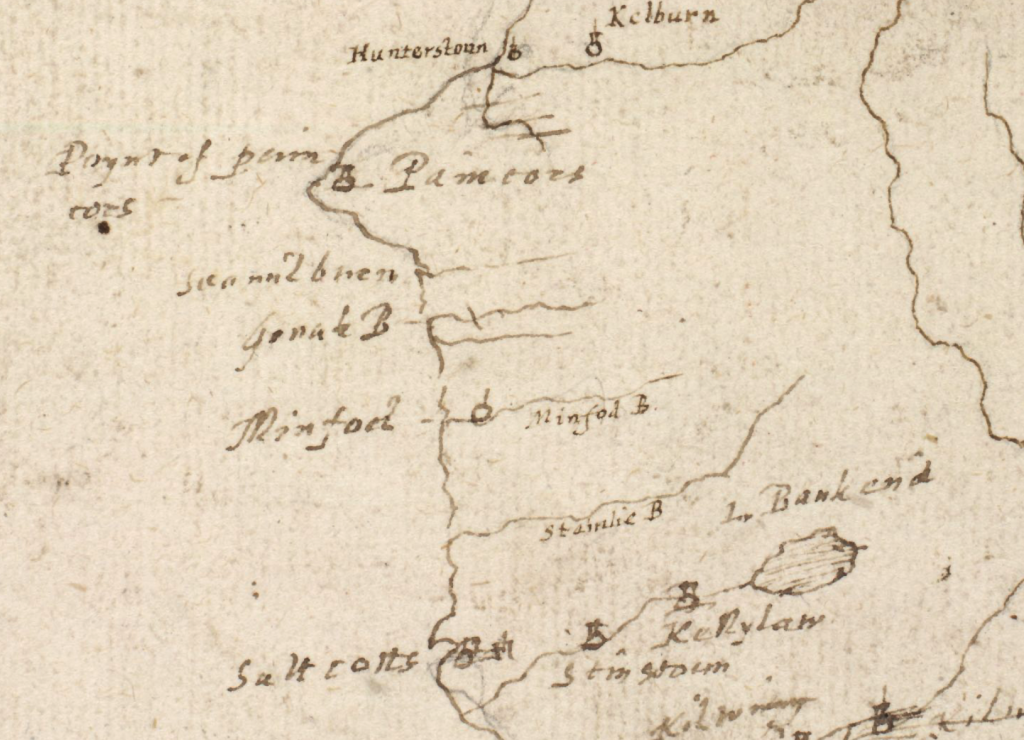
Fig.1 – Extract from map of Cunninghame by Robert Gordon c1536-62
Reproduced with the permission of the National Library of Scotland
On first examination the location and geography might suggest that the inhabitants lived in a remote coastal location of little importance. However the development of maritime trade in the late middle ages and proximity to Irvine, the Clyde and major Hebridean islands actually made the area quite significant. Historians such as John Fullarton, antiquary and editor of the Maitland club, also a descendant of the Boyds of Ardneill and Portencross, writes of Portencross Castle2:-
“Portincross was the chief messuage of the ancient barony of Ardneil , which unquestionably, from the settlement here of the De Morvilles , belonged to the great family of the De Rosses, sheriffs of Ayr. But, on their forfeiture by Bruce in 1306 , it was, along with Kilbride, and many other lands, conferred on Sir Robert Boyd of Kilmarnock , a distinguished follower of the victorious king . The walls of this old fortalice , though unroofed and neglected since about the year 1740 , are still nearly entire. It is seated on the bare rocks, washed by the sea, on the extreme projection of the promontory which goes by its name.” and further “Several royal charters of the first two Stuart kings bear to have received the sign manual “ apud Arnele, “ which , of course, refers to Portincross Castle”.
In the late 1980s archaeological investigations were undertaken at Auldhill and Portencross and evidence suggested that the current castle at Portencross was probably built in the mid-1300s3. In recent years Portencross Castle has been the subject of a major renovation project undertaken by the ‘Friends of Portencross’ hopefully protecting this historic building for many generations to come.
As part of the preparations for the renovation project a major investigation and report was undertaken in April 2008 by Glasgow University Archaeological Research Division (GUARD) of the building and its history. Renovation of the castle was undertaken with the assistance of the National Lottery, Heritage Lottery Fund and Historic Scotland. Today the castle is open to the public4.
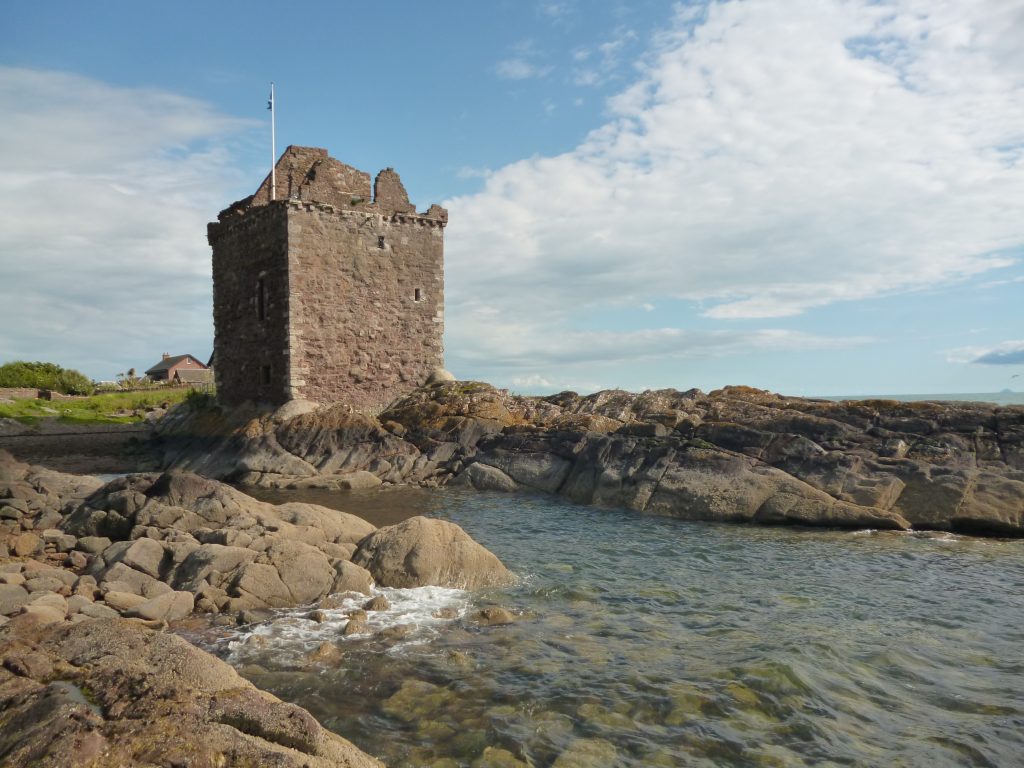
Fig.2 – Portencross Castle – Courtesy of Dr William Roulston
Family Origins and the 1st to 4th Lairds of Ardneil & Portencross
The earliest reference to the Boyds and the lands of Ardneil within which Portencross lies is found in a charter by Robert I dated 3 May 1315 which states:-
“Robert, king of Scots, has given his beloved and faithful, Robert Boyd, knight, the lands of Kilmarnock, Bonnyton and Hairshaw held by John de Balliol, of [West] Kilbride, and Ardneil held by Godfrey de Ros son of the late Reginald de Ros, and the land in the tenement of Dalry that was William de More’s, with seven acres of land in the tenement of Ardneil that were the late Robert de Ros’s, together with half of the lands of Blair, of Pitcon, of Dalry, of ‘Dogetlande’ and of Wallacetown, with the free tenants of the said lands and their services, namely the land of ‘Meneforde’ (Menford), the lands of Richard Brown, John of Kilmarnock, William of ‘Cobynschent’, the land of James of Templeton of ‘Achindalosk’, the land of Robert Scot in Ralston, the land of Laurence de More in the tenement of Dalry, and the land of ‘Inglisardnel’; in feu and heritage and in free barony. Moreover, he grants Robert Boyd and his heirs that they may hold Hairshaw in free forest. For the service of one knight in his army and one suit at his court at Ayr at the single pleas held.”5
From the Peerage of Scotland6 by George Crawfurd (1681-1748) we then find the following entry:-
“This Sir Robert was succeeded by Sir Thomas, his Son, who by [ ]; Daughter of [ ] left three Sons, Sir Thomas, his successor, William, Author of the Boyds of Badinheath, and Robert first of the House of Portencross in Ayshire.”
Crawford’s Peerage of course concentrates on the primary Boyd line of Kilmarnock, however in the National Library of Scotland we find his MSS on the Baronage7, the text of which is reproduced here:-
“Boyd of Portencross descended of Rob[er]t Boyd son to Thomas Boyd of Kilmarnock who got the lands of Arneill now Portencross from his nephew Thomas Boyd of Kilmarnock by his chater {sic} dated 20 June 1444 he designs him avunculo nostro he married Giles Crawfurd of the house of Achnames and had Robert Boyd of Portencross and he again of Robert in 1515 who cals Giles Crawfurd his mother in 1515 married Giles Campbell {of Dovecothill daughter written in margin} and so spouse to the second Rob[er]t and not the first This Robert Boyd of Portencross in 1515 married Giles Campbell and is his relict in 1531 (a) and had issue (a) and had issue Robert his successor who married Isobel Mure in 1552 daughter to Rowallan had Archibald sucedded and in 1582 married Eln Fairly daughter to David Fairly of that ilk and had Robert {written above the line} and Jean married to Hew Monfod of that ilk Secondly to John Darlieth of that ilk in 1614. Robert sucedded and married Eln daughter of Sir Robert Montgomrie of Skelmurly and had Rob[er]t sucedded Jean maried to Gavin Blair of Hally and Eln to Robert Montgomery of Smithston and had issue & Agnes married to John Bogle of Belickewn and had issue and anoth {sic} to Rob[er]t Jamieson of Crounar of Bute and on to James Banatyne brother to Kelly Rob[er]t sucedded & married Eln daughter of Allan Cuningham of Waterson & had Rob[er]t who dyed very aged near 100 years of age in 1721 he married a daughter of Mr Gavin Blair of Aldmure son to Law of Blair {his wife was a daughter of Stewart of Barscube his daughter Catherine Blair Mrs Hamilton I knew written in margin} & had a son {Robert written above the line} who married Antonia daughter to Sir Rob[er]t Montgomery of Skelmurly whose issue faild and a daughter married to Maclowie of that ilk in Aran alias Foularton of Maclowie and had Rob[er]t Foularton who sucedded his grandfather in his Estate soon dispatched it (a) writes of the house of Portencross”
{The following note is written in the margin}
“Robert Maol March[an]t in Glasgow a son of Aldhouse was married to Jean daughter of Boyd of Portincross was Great Gudfather to the Minister of Inchewen his Gudfather was minister at Macloan”8
Crawfurd’s MSS is undated but the extent of the chronology of the Boyds of Portencross suggests it was written sometime 1724-48. These notes by Crawfurd and or his Peerage are referenced in later works mentioning the Boyds of Portencross by Robertson (1820)9 and (1823)10, Maitland Club, editor John Fullarton of Overton, (1858)11, Paterson (1866)12 and Dobie (1876)13.
The consensus amongst this collection of research is that the origin of the Boyds of Portencross is through a Robert Boyd, third son of Sir Thomas Boyd of Kilmarnock who probably received the lands of Ardneill in patrimony from his father. The earliest known reference to this Robert is in a confirmation charter involving William Boyd son to the late Thomas Boyd and Malcolm Flemming of Biggar registered on 20 June 137214.
The charter states “In cujus rei testimonium sigillum meum una cum sigillo Roberti Boyd fratris mei presentibus est appensum” i.e. In witness whereof my seal is hereunto affixed, together with that of my brother Robert Boyd.
It’s at this point that the line of the Boyds of Kilmarnock has been challenged in recent years by the renowned researcher in medieval Scottish history Andrew B. W. MacEwen15. In his article MacEwan challenges the line of the Boyd family as stated by the Marquis de Ruvigny in ’ The Scots peerage: founded on Wood’s ed etc.’ (1908) Vol.5, pp. 136-147.
MacEwan’s main concern was the Marquis de Ruvigny appeared to have uncritically relied upon the work of predecessors i.e. Crawfurd (1716), Douglas (1764) and Wood (1813) resulting in errors. He states:-
“The most notable of these errors is the omission of an entire generation of the pedigree. Sir Thomas Boyd of Kilmarnock, knighted by David II in 1342 and taken prisoner at Neville’s Cross in 1346, appears to have married a sister of Sir Malcolm Fleming of Biggar. His son and heir was styled “Roberto Boyde, Domino de Kilmernok, nepote nostro carissimo,” in a charter of Sir Malcolm’s dating to the 1370s. It was Robert who married the Giffard heiress, third, but second surviving, daughter of Sir Hugh Giffard of Yester and his wife Joanna Douglas of Lothian. Robert was alive on 11 November 1372 when his seal was used at Cumbenauld on a charter granted by his brother William but dead before 15 November 1385, by which time his widow, Margaret Giffard, had married Sir William Cunningham the father”.
MacEwen continues:-
“Robert’s son and successor was Thomas Boyd, whom Ruvigny, like his predecessors, divided into two men, one seen only in 1409 (the supposed husband of the Giffard heiress), the other the well-known hostage for James I in 1424. Born about 1370, he first appears in 1398 or 1399 as “thoma Boyd domino de Kilmernok” witnessing a mortification by his cousin David Fleming of Biggar, while on 21 October 1400 “the seale of a nobil and wurthy man Thomas Bode Larde of Kilmernow,” was used at Dumbarton. On 1 August 1420, “Thomas Boyde cum consensu et assensu thome Boyde filii mei primogeniti et heredis” joined with the other “domini dominii de Zester porciales et compatroni vicissirn et alterius vicibus ecclesie parochialis de Bothanis vestre dyocesis filii humiles et devoti” in a petition addressed to Henry Wardlaw, Bishop of Saint Andrews, “craving the erection of the said Kirk into a College for a Provost and four Prebendaries” Ruvigny states that he died on 7 July 1432 and was buried at Kilmarnock having married Joanna Montgomery, citing “Mr. Timothy Pont, who visited Kilmarnock in 1609 [sic].
Thomas Boyd’s son and heir, another Thomas, third of that name, first seen with his father in 1420, was arrested briefly in 1424 for wasting the Crown rents. Born sometime in the 1390s and knighted between 1 March 1435/6 and 2 July 1438 (_perhaps at the coronation of James II on 25 March 1437), he is chiefly remembered for his slaying of Alan Stewart of Darnley and his own death the next year at the hands of Darnley’s uncle and cousins.”
This excellent piece of research, drawing on primary sources, calls into serious question the line of Boyd of Kilmarnock that has been recorded previously. In so doing it also alters the previously suggested origins for the Boyd cadet branch of Ardneil and Portencross.
It is important now to record a chronology of events in Scotland c1452-69 which deeply involved the Kilmarnock family in the affairs of the Monarchy and lead to their downfall, albeit temporarily:-
- 10 July 1451/May 1452 – birth of James III of Scotland
- c1454 – Robert knighted 1st Lord Boyd by James II of Scotland
- 3 August 1460 – James III ascended the throne following the death of his father at the siege of Roxburgh Castle
- March 1461 – First parliament of his reign appointed a council of regency consisting of James Kennedy, Bishop of St Andrews, the Bishop of Glasgow, and the earls of Angus, Huntly, Argyll, and Orkney. The government was led by the queen mother, Mary of Guelders, as regent.
- Autumn 1462 – it is believed that Kennedy and his supporters mounted a coup by taking possession of the 10-year-old James III following an armed confrontation with Mary’s supporters in Edinburgh.
- December 1463 – Mary of Guelders dies leaving Bishop Kennedy in undisputed control of government.
- May 1465 – Bishop Kennedy dies and his elder brother, Gilbert Kennedy, Lord Kennedy, assumed custody of James III
- 9 July 1466 – James III was seized by Robert, Lord Boyd and his son, Thomas, and was taken to Edinburgh Castle as the Boyds and their supporters mounted a coup to seize control of the government by gaining possession of the king during his minority. The Boyd faction made itself unpopular, especially with the king, through self-aggrandizement such as the creation of Lord Boyd’s son, Thomas, as Earl of Arran
- 1467 – Earl of Arran’s marriage to the king’s 13-year-old sister, Mary
- August 1468 – an embassy was sent to Denmark to secure a royal marriage. The ambassadors’ negotiations resulted in a treaty which provided for an alliance between Scotland and Denmark, and James III’s marriage to Margaret, the only daughter of King Christian I of Denmark and Norway
- July 1469 – James III married 13-year-old Margaret of Denmark. Previously Robert, Lord Boyd and his son the Earl of Arran had escaped to Europe in fear of arrest as the King had likely ended his minority and taken direct control.
- 22 November 1469 – Regarding Robert 1st Lord Boyd and Thomas Earl of Arran his son – “the said Robert and Thomas, for the said treasonable crimes perpetrated by them as has been stated, will forfeit their lives, and their lands, revenues and possessions, superiorities and offices, and all their other moveable or immoveable goods, from them and their heirs, to be set to the use and utility of us and our successors and assignees, heritably in perpetuity.”
- 27 November 1469 – At a sitting of the Parliament at Edinburgh – “it was statute and ordained that all and sundry the lordships, lands and castles, with their pertinents, designated by name below – namely the lordship of Bute, with the castle of Rothesay; the lordship of Arran; the lordship of Cowal, with the castle of Dunoon; the earldom of Carrick; the lands of Dundonald, with the castle of the same; the barony of Renfrew, with the lands and tenandries of the same; the lordship of Stewarton; the lordship of Kilmarnock, with the castle of the same; the lordship of Dalry; the lands of Noddsdale; the lands of Kilbryde, the lands of Nairston; the lands of Caverton, with all and sundry the annexes, superiorities and pertinents of all and sundry the earldoms, lordships, baronies and lands aforesaid, also Terringzean, Drumcoll, Trabeath with the fortalice of the same, will be united, annexed and incorporated to the eldest prince of the kings of Scotland our successors in perpetuity; also that the lands of Tealing, with the annualrent of Brechin, which formerly appertained to the said Lord Boyd, lying in the sheriffdom of Forfar, will be united, incorporated and annexed to us the kings of Scotland and the right of our crown in perpetuity, and by force of the present ordinance and statute be united, incorporated and annexed as property.”
This near twenty year period saw the heads of the Kilmarnock Boyds effectively seize control of Scotland only to be driven from its shores with the confiscation of all their lands and those of their subordinate cadet branches including the Boyds of Portencross.
Before graphically recording the origin of the Boyds of Ardneill and Portencross there are two important pieces of evidence to examine, the second of which is truly remarkable given the events of c1451-69.
Firstly Crawfurd states “I have seen a Charter on the 10th of June 1444, per Thomam Boyd de Kilmarnock dilecto avunculo suo Roberto Boyd terrarum de Arneill”16Sadly it has not been possible, to date, to find this charter amongst the Boyd papers or the Register of the Great Seal of Scotland. However evidence has been found from the year 1450/117. Robert Boyd of Ernele appears as a witness in an Instrument upon a Perambulation dated 22 March by Thomas de Cranstoun, Justiciar of the King etc. The place referred to as Ernele is undoubtedly Ardneil and indeed there are a number of variants to the name Ardneil found amongst Scottish records which have no doubt created problems for researchers.
Secondly, perhaps the most important piece of evidence as to the origins of the family is a charter seemingly undocumented by earlier historians. In the Registers of the Great Seal of Scotland we find No. 104918 dated at Edinburgh 2 February 1471/2 which states:-
“The king granted to Robert Boyde, son of the late Alexander Boyde, and his heirs, the 10 merk land of Ernele, in the bailiwick of Cunnyngham, county of Ayr; which Robert Boide, the grandfather of the said Robert, resigned:- reserving the free tenement to the said Robert the elder and the reasonable third of Elizabeth his spouse when it happened.”
This grant by the King exclusively to the Boyds of Portencross is significant as it bypasses their clan chief who would have to wait until 1482 before having his lands returned to him. Unfortunately the reason for this preferential treatment of a cadet branch is unknown. Had they played no part in the capture of the young King in 1466 or were their services at Portencross essential to the Monarchy.
If we incorporate this new evidence into the information from Crawfurd’s MSS and the revised evidence regarding the Boyds of Kilmarnock, as suggested by MacEwan, we can construct an early pedigree alongside the Boyds of Kilmarnock and the Monarchy.19
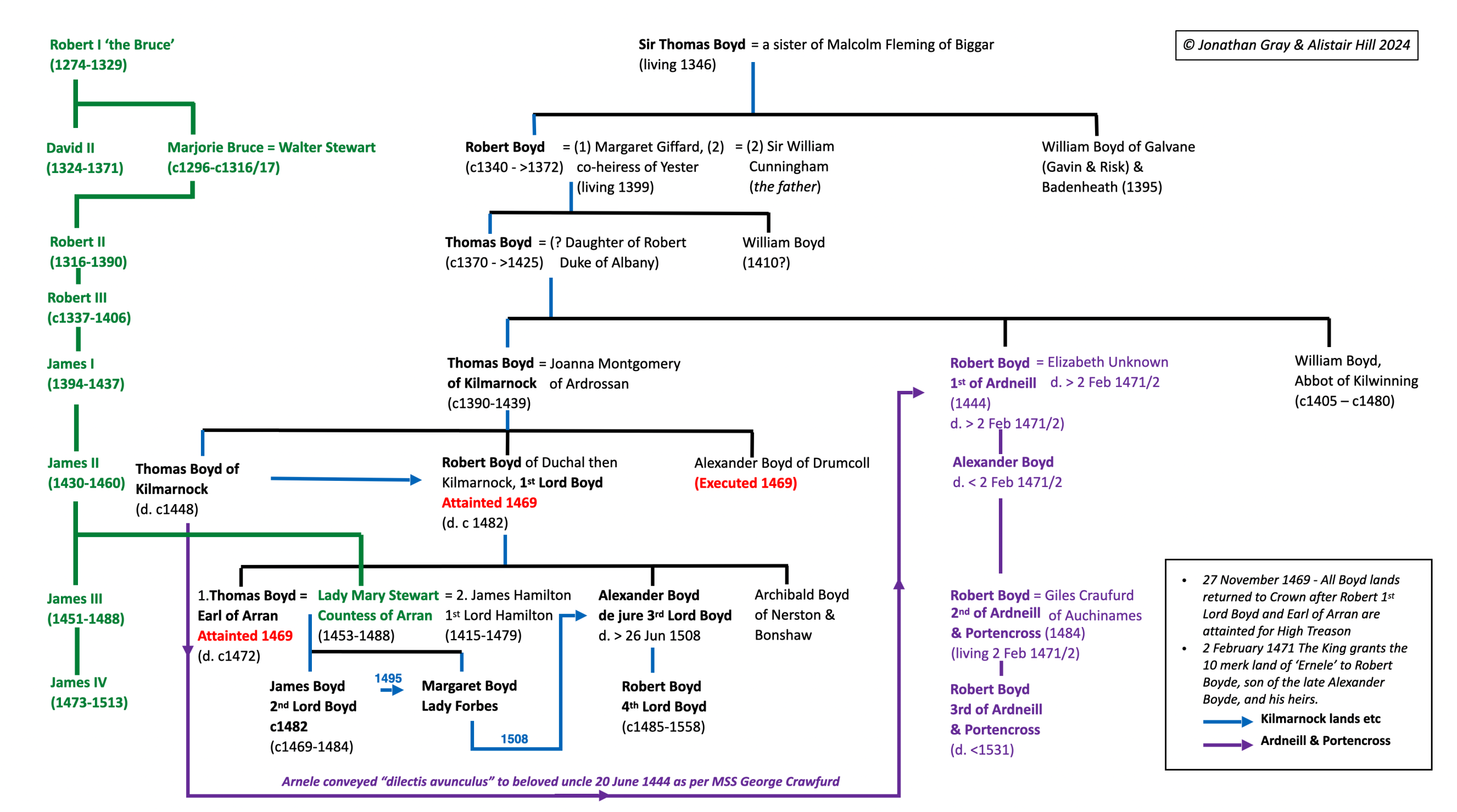
Fig.3 – The early lineage of Boyd of Portencross set against that of Kilmarnock and the Scottish monarchy
On 5 June 148420 we find what appears to be the first instance whereby the Boyd family is identified with Portencross. In an instrument of sasine following on a precept in favour of Hugh Motgomery we find as the first listed witness, as transcribed by William Fraser21, “Roberto Boyd, Domino Portincors”
Given the new information involving an Alexander Boyd who predeceased his father, the 1st Laird, it is likely it was his son Robert the 2nd Laird of Ardneil and also Portencross who married Giles Craufurd of Auchinames.
Their son Robert, 3rd Laird, is likely the one named as a witness in an acknowledgement by Cuthbert, Earl of Glencairn on 27 May 151022 and from Crawfurd, he who married Giles Campbell of Dovecothill (possibly Deucathall or Dovecothall), Stevenston in 1515. If Crawfurd’s notes are correct on this then the Robert Boyd of Portincors referred to in a Remission of 6 March 1515/1623 is also likely the 3rd Laird. It states:-
“Order of Remission to CUTHBERT EARL OF GLENCARN, William Cunynghaim his son, master of Glencarne, William Cunynghaim junior of Craganis, Robert Boyd of Portincors, Alexander Langmure, Thomas Crawfurd of Birkheid, William Berclay of Perstoun, and William Kelso, friends, partners and servants John, count of Levenax, and specially named in the signatures granted to him and his followers, for their art and part in the treacherous siege [etc. (i.e. Dunbarton Castle) as above in precept 2719], etc. . . . By Signet. Decided by the master.”
This remission is evidence of where the Boyds of Ardneil & Portencross stood at the time of the Regency of James V of Scotland which ran from 1513-1528. It is clear they stood against the Earl of Douglas who held the young King under his influence.
The 3rd Laird appears again during the Regency on 15 July 1526 in a charter of Respitt24 following a siege of Stirling Castle. A few years later in 1528 the young James V escaped from his stepfather the Earl of Angus and assumed direct control of his Kingdom. Crawfurd states that in 1531 Giles Campbell is referred to as relict of her husband suggesting the 3rd Laird had died 1526-31.
From Crawfurd the 3rd Laird and Giles Campbell appear to have had a son Robert who became 4th Laird of Ardneil and Portencross and the first evidence of him appears to be in an Instrument involving George Wallace of Berne on 30 November 153225.
“Instrument narrating that George Wallace of B(erne) well obliges himself and his heirs to give, seal and deliver letters of reversion in due form to Robert (Boyd of Portincors, his) heirs and assignees, upon the redemption of (? forty acres) of the lands of Manys of Elentoun called . . , akeris, containing the sum of 40 merks Scots, to be paid in the parish church of Air on 40 days’ warning. (Robert) Boyd asked an instrument. At Irvine 30 November 1532. Witnesses, John Or and Thomas . . ., 208a.”
Crawfurd states he married Isobel Mure of Rowallan in 1552. However the date of this marriage from Crawfurd is called into question by two other sources.
In the early 19th century a genealogy of the Mures of Rowallane was discovered amongst family papers. It was believed to have been written by Sir James Mure of Rowallane around 1657 or earlier. The text was subsequently published containing details of a charter naming Isobel Mure and Robert Boyd younger of Portencross in what appears to be a transfer of the lands of Knockindaill and Hellentoun :-
“Robertus boyd de portincorss,” * * ” dilectis Roberto boyd filio meo & heredi apparenti et Isabelli mwr ejus sponse * * apud kilmawr. Sexto die mens, maii anno dm. millessimo qunquagesimo vicesimo [1520].” i.e. Robert Boyd of Portencross * * my beloved son and heir apparent Robert Boyd and Isabel Mure his bride * * at Kilmaur, 6th May 1520. —Orig. Char, with the seal of the granter yet entire which we have seen”26
John Fullarton appears to mention this same charter in his account of Portencross except that he dates it to 6 June 1520.27 We can only presume that John Fullarton was aware of both the above sources and went with the information supplied by Sir James Mure albeit the differing month. If Crawfurd is correct in saying the 3rd Laird married Giles Campbell in 1515 then she cannot be the mother of the 4th Laird who must remain unknown for now.
James V of Scotland died on 14 December 1542 leading to further unrest on a national scale as his successor Mary was barely six days old. However it is an incident of more local inter-family conflict in which we next find evidence of the Boyds of Portencross.
A feud had been ongoing between the Montgomeries of Eglington and the Boyds of Kilmarnock since the death of James, 2nd Lord Boyd in 1484. This subsequently led to the death of Patrick Montgomerie in 1523 at the hands of Robert, 4th Lord Boyd. The next person to fall victim of the feud was Neill Montgomerie of Lainshaw who is said to have been killed on the streets of Irvine in June 1547 by the Boyds and their adherents. Amongst those adherents was Robert Boyd younger of Portencross son of the 4th Laird. The following year we see a Precept of Remission 11 December 154828 granted to:-
“Robert, Master of Boyd, John Brisbane of Bishopland, David Fairlie younger of that ilk, Charles Mowat of Busby, Robert Boyd, junior, of Portincross, Robert Boyd in Clerkland, Archibald Boyle and William Blair for absence from the army upon Gledsmuir, 20 Aug last for resistance to our old enemies of England and for art and part in the civil murder of the late Neil Montgomery of Lainshaw.”
It is believed those involved in the killing of Neill Montgomery went into hiding perhaps explaining their inability to present themselves for military service on 20 August 1548. All of this occurred amidst the backdrop of a national conflict and a power struggle surrounding the young Mary, Queen of Scots, referred to as the ‘Rough Wooing’ (Eight Years War in Scotland) whereby Henry VIII tried to secure a marriage between his son Edward and Mary. Even after Henry’s death in 1547 the conflict continued under the Earl of Somerset. It was not until 1551 before peace was concluded between England and Scotland/France at the Treaty of Norham.
Meanwhile returning to the killing of Neill Montgomerie, his son also Neill, made an attempt in 1560 to broker a peace between him and the Boyds. On the 11 February 1560, at Glasgow, a contract was entered into by Lord Boyd and Neill Montgomery by which Lord Boyd and his confederates were to appear in:-
“the toune of Irvine, in quhat maner the saidis Neile pleisses to devyis, at the mercat croce or kirk of the said toune …. and in plane audience of the people, thair upon thair knees, with reverence, as efferis, sail unfenzeitlie ask God forgifness for the saidis ofi”ence sail ofiir to the said Neile ane naikit swoirde be ye poynt, in taikin of thair repentance fra the boddum of their hartis and sail content and pay to the saidis Neile Mungumry the soume of auchtene hundre and fourty merkis moneye . . . .”29 30
It would appear the sum was paid and accordingly letters of slains issued31 with the proviso that the Boyds and their adherents depart from Scotland for a period to be determined by Neill Montgomery.
By 1567 tensions must have cooled between the two families and a letter of Relaxation was issued at Edinburgh on 11 December 1567 in favour of Robert, Master of Boyd, John Brisbane of Bishopton, David Fairlie younger of that ilk, Charles Mowat of Busby, Robert Boyd younger, of Portincross, Robert Boyd in Clerkland, Archibald Boyle and William Blair, who had been denounced rebels and put to the Horn, for the slaughter of Sir Neil Montgomery of Lainshaw32. Accordingly we must presume any imposed exile on Robert Boyd, younger of Portencross must have ended with the issue of this letter.
We must presume that the Boyds of Ardneil and Portencross like so many of their neighbours became embroiled in the events of 1568 culminating in the battle of Langside on 13 May 1568. They were undoubtedly supporters of Mary Queen of Scots as will be seen shortly in an extensive remission in late 1571.
However before this the family features in an interesting document referred to in Sir James Mure’s genealogy of the Mure family details a letter of sleance by an Alexander Cowper:-33
“Cowper.”—” Be it kend till all men be thir prt. Lres. Me Alexander Cowpair masone in killwyning nocht compellit coacted nor seducit be ony maner of waye but of my awin frie motiue and voluntarie will wyth consent and assent of honorable men Johnn fergushill of yat ilk, Johnn cowpair of brigend killwyning, thomas adameson, Blais tarbert in corshill, my cheife and capitall branchis bayth on my father syde and mother syde To haife remittit pardonit and frelie forgevin And be ye tennor heirof remittis pardonis and frelie forgevis Johnn mwre of rowallane, williame mwre his sone and air appeirand, Johnn mwre and mongow mwre his sonnes, also Archibald Boyd of portincorss zoungar, and patrik glasfurde, yair complices kin freindis allya assistaris and parttakaris, ye crewall wonding hurting and bluding of me ye said alexander to ye great effusione of my bluyde done and committit be ye sadis persones yair sruandis and complicis vpone ye day of februar ye zeir of god Jaj vc threscoir and ten zeris [1570].” subscribed, ” At Irwin and killwyning,” 16th. and 17th. March, 1571.”
The reference to Archibald Boyd of Portencross, younger suggests the 4th Laird and probably his wife Issobel Mure of Rowallane had at least two sons, Robert, who was to be heir, and Archibald. What became of Robert heir to the 4th Laird is brought into focus by a remission dated 8 September 1571 for those who took the Queen’s side at Langside which included the names of Robert Boyd of Portincross and Archibald Boyd, his son and apparent heir34. Accordingly we must presume the death of Robert son of the 4th Laird some time 1567-71, perhaps even at the battle of Langside and the succession of Archibald as 5th Laird of Ardneil & Portencross.
Archibald Boyd, 5th Laird of Ardneil & Portencross
The first source we find of Archibald, 5th Laird is an inquest into a Retour at Ayr on 10 July 1583 regarding Adam Boyd son of the deceased Adam Boyd of Penkill. Archibald appears amongst the witnesses as “Archibald Boyd of Pertinereac”.35
Archibald, 5th Laird, married Elizabeth Fairlie of that Ilk probably c1572-75. Unfortunately no record of their marriage has been found but it is thought she was the daughter of David Fairlie of that Ilk whose family had lived alongside the Boyds of Ardneil & Portencross for at least 200 years. The Fairlie family were well connected within the upper ranks of Scottish society. Elizabeth’s aunt Marion had married firstly Thomas Boyd of Lynn (brother of Lord Boyd) and secondly James Stewart, Chamberlain of Bute. It should be noted that from earlier references to the feud with the Montgomeries of Lainshaw that David Fairlie younger of that Ilk (probably Elizabeth’s father) was amongst the Master of Boyd’s adherents.
Archibald’s succession as 5th Laird is evidenced firstly by a contract dated at Leith, 19 Apr 157236 regarding the 10 merk lands of Ardneil & Portencross and then a resignation at Holyrood House37 on 11 March 1573/4 in both of which Archibald appears to now be 5th Laird of Ardneil & Portencross.
Research suggests that the death of Robert heir to the 4th Laird may have initiated a crisis within the succession to the Lairdship of Ardneil and Portencross. Unfortunately the details remain unclear but thankfully the testaments survive of Archibald Boyd 5th Laird of Ardneil & Portencross and his spouse Elizabeth Fairlie of that Ilk. The transcript of the testament38 of Elizabeth Fairlie dated at Portencross on 23 March 1593 below merits detailed examination:-
{written in margin – Eliza[be]th Fairlie Secundo Decembris 1594}
The testame[n]t testa[menta]r and Inve[n]tar of the guidis geir sowmes of mo[ne]y and dettis perteni[n]g to umq[uhi[ll Eliza[be]th Fairlie spous to Ar[chibal]d Boyd of Portincors the tyme of hir deceis quha deceissit upou[n] the xv day of Maij theyeir of god Jajvc Lxxxxiiij yeiris Fath[ful]lie maid and gevin up be hir self upou[n] the xxiij day of M[ar]che the yeir of god Jajvc Lxxxxiij yeiris In p[rese]ns of W[illia]m Cok minist[er] Ro[ber]t Cuny[n]ghame of Wattirsoun Joseph Cuny[n]ghame his bruder John Boill Mathow Losk Johne Symsoun & Jon Henrie w[i]th uth[e]ris di[ve]rs
In the first the said umq[uhi]le Eliza[be]th Fairlie & hir said spous had the guidis geir sowmes of money and dettis of the availl & pr[ic]es eftir following perteni[n]g to hir the tyme of hir deceis foirsaid viz xxij ky p[ri]ce of the pece viij li Su[m]a jc Lxxvj li Item xiij coddochis of yeir auldis p[ri]ce of the haill xL li Item four stottis of ane yeir auldis p[ri]ce of the pece ten m[er]k Su[m]a xxvj li xiijs iiijd Item xviij hoggis p[ri]ce of the haill xx li Item thrie horsis by the airschipe horsis p[ri]ce of the pece o[ve]rheid xxv m[er]k Su[ma] L li Item four boittis w[i]th th[air] furnitor estimat all to xiijxxm[e]rk Su[m]a L li Item xij do[zen] of Ireland buirdis p[ri]ce of the do[ze]n xxvjs viijd Su[m]a xvjli Item ane hogheid of beiff & ane hogheid of herring estimat bayth to xxvj li xiijs iiijd Item sawin on the ground sevin bollis & ane half beir estimat to the ferd corne extending to xxx bollis beir price of the boll w[i]th the fodder iiij li Su[m]a jc xxli Item mair sawin on the ground xxiij bollis blak aittis estimat to the thrid corne extending to Lxxij bollis aittis p[ri]ce of the boll w[i]th the fodder xLs Su[m]a jc xliiij li Item in the girnell xxx bollis beir {word crossed out} p[ri]ce of the boll {words crossed out} iiij li Su[m]a jc xxli Item mair in the girnell xx bollis meill p[ri]ce of the boll iiijsh Su[m]a Lxxx li Item in utencilis & domicilis w[i]th the abuilyeme[n]tis of hir body the airschipe being exceptit estimat to jc li
Su[m]a of the Inve[n]tar – jaj Lxxxij li xiijs iiijd
Followis the dettis awin to the deid
Item th[air] was awin to the s[ai]d umq[uhi]le Eliza[be]th Fairlie & hir said spous be George Montgu[m]rie x li Item be Ro[ber]t Allane in Ardneill of borrowit mo[ne]y viij li Item be Allane Jamie th[ai]r x li Item be Jonet Ritchie th[air]xx li Item be Robert Monfod th[air] xL li Item be Ar[chibal]d Wilsoun th[air] x li Item be Jon Adame th[air] x li Item be Jon McKie th[ai]r v li Item be Jon Lappie viij li Item be Johne Boyll th[ai]r vij li
Su[m]a of the dettis awin to the deid – Lxxxix li
Su[m]a of the Inve[n]tar w[i]th the dettis – jaj jc lxxxj li xiijs iiijd
Followis the dettis awin be the deid
Item th[air] was awin be the said Eliza[be]th Fairlie and hir said spous to Jonet Broun Liijs iiijd Item to Hew Kessane xl sh Item to Geillie Boyd jc li
Su[m]a of the dettis awin be the deid – jc iiij li xiijs iiijd
To be dividit in thrie p[air]tis deidis p[air]tis – iijc Lix li
Quhairof the quot is componit for – x li
{written in margin – Quotta componitur per – x li}
Followis the deidis Legacie and Latterwill
At Portincors the xxiij day of M[ar]che the yeir of god Jajvc Lxxxxiij yeiris The q[uhi]lk day Eliza[be]th Fairlie Lady Portincors maid hir Legacie & latterwill as followis viz Imprimis scho ordanis Tho[m]as Boyd & Ar[chibal]d Boyd hir sones onlie exe[cuto[ris & intro[mitto]ris w[i]th hir gudis & geir and thai tua be rewlit & gydit be Ar[chibal]d Boyd of Portincors & Jon Stewart of Askok th[a]t the geir may be furth cu[m]and to the foirnamit bairnes indifferentlie th[ai]r bairnes p[air]t of geir as thai sall except the thing scho hes gevin alreddie to Jane Boyd hir docht[e]r in the kist q[uhi]lk scho levis onlie to hir selff To Jon Boyd xx li To Barbara Boyd xx li To Ro[bert Boyd hir eldest sone gif he beis nocht be the law maid ane bairne of the hous tua hundreth m[er]k And gif he beis man be law ane bairne of the hous his bairns p[air]t of geir as it fallis him w[i]th the rest Ane boll of meill to the pure seik folk in the toun To Jonet Broun xLsh To Jonet Wylie hir reid wyliecoat Ite[m] scho ordanis George Montgu[m]ries obliga[tio]un to be delyverit to him q[uhe]n he payis it ten li Sic sub[scrivitu]r Mr W[illia]m Cok minist[er] at Largis & Kilbryde
We m[aiste]ris Johne Prestoun etc Be the tennor heirof ratifeis approvis & confirmis this p[rese]nt testame[n]t or Inve[n]tar insofar as the say[min] is deulie & lau[ful]lie maid of the gudis & geir abonespe[cife]it allan[er]lie and gevis & co[m][mittis the intromissioun w[i]th the the say[min] to the saidis Thomas & Ar[chibal]d Boydis exe[cuto]ris testa[menta]ris to the said Eliza[be]th Fairlie th[ai]r moder. Reservand compt to be maid be thame th[air]of as accordis of the Law and they being sworn etc and has fundin caution etc as an act beiris
Elizabeth died on 25 May 1594 and her testament was registered with the Commissary Court of Edinburgh on 2 December 159439. No known grave has been found for Elizabeth and her age when she died is unknown.
Regarding the testament the following observations can be made:-
- She is referred to as spouse of Archibald Boyd at the time of her death 15 May 1594.
- Perhaps surprisingly Archibald Boyd’s sole role in the testament is as guide or guardian to her sons Thomas and Archibald along with Elizabeth’s brother-in-law John Stewart of Askog.
- She appoints two of her sons, Thomas and Archibald as her executors and not her husband.
- Curiously her legacy states two possible outcomes relating to her eldest son Robert i.e. he is to get 200 merks if he is not made a lawful child of the house or if he is, his children are to receiver their father’s share of her estate as it falls to him.
- She leaves to Jon Boyd, we presume a son xx li.
To understand more we need to examine the testament40 of Archibald 5th Laird which was made on 13th April 1602 with his death the following day.
The testame[n]t testa[menta]r and Inve[n]tar of the gudis geir sowmes of money and dettis perteni[n]g to umq[uhi]le Archibald Boyd of Portincroce w[i]thin the parochin of Largis & S[her]efdome of Air the tyme of his deceis quha deceist upoun the xiiij day of Aprile the yeir of god Javjc tua yeiris Fath[ful]lie maid & gevin up be him self upoun the xiij day of Aprile the yeir of god foirsaid In pre[sen[c]e of the not[ar] & witnessis und[er]writtin
(rest of the document written in a different hand)
In the first the said umq[uhi]ll Archbald {sic} Boyd had the gudis geir sowmes of money & dettis of the availl & prices efter following perteneing to him the tyme of his deceis foirsaid viz
Item twa hors by the airschip hors price of the peice o[ve]rheid xiij lib vjs viijd Su[m]a xl m[er]kis
Item ane meir w[i]th ane foill price th[ai]rof w[i]th the foill xx m[e]rkis
Ite[m] fyve tydie ky at x lib the peice Su[m]a xl lib
Item four forrow ky at x lib the peice Su[m]a xl lib
Item ix thrie yeir auld quoyis at v lib the peice Su[m]a xlv lib
Item thrie stottis and thrie cowdoches at Liijs iiijd the peice Su[m]a xvj lib
Item twa yeir auld stirkis at xls the peice Su[m]a iiij lib
Item four auld hering fishing boittis w[i]th thair ornamentis at xx lib the peice Su[m]a Lxxx ib
Item sawing upoun the ground xxiiij bollis aittis estimat to the thrid corne extending to iijxx xij bollis aittis price of the boll w[i]th the fodder iiij lib Su[m]a ijct Lxxxviij lib
Item in the barne & barneyaird tuelff bollis beir price of the boll w[i]th the fodder v lib vjs viijd Su[m]a Lxiiij lib
Item in utenceillis & domiceills w[i]th the abuilyeme[n]tis of his bodie by the airship estimat to Lxxxxij lib
Su[m]a of the Inventar– vijct xix lib
Followes the dettis awand be the deid
Item thair was awand to the said umq[uhi]le Archbald Boyd be Robert Allane in Arneill of lent money xxvj lib xiijs iiijd
Item be Hew Boyd xij ib
Item be {blank} and remanent tennentis of the land of {blank} resten for th[ai]r f[er]mes in a[n]no 1601 yereis xxxij bollis beir price of the boll viij m[er]kis Su[m]a jct Lxx lib xiijsh iiijd
Su[m]a of the dettis awand to the deid – ijct ix lib vjs 8d
Su[m]a of the Invent[ar] w[i]th the debtis – ixct xxvij lib 6s 8d
Followes the dettis awand be the deid
Item thair was awand be the said umq[uhi]le Archbald Boyd to Hew Girven borrow clerk of Irvene iiijct m[e]rkis
Item mair to him aucht bollis meill at viij m[er]kis the boll Su[ma xlij lib xiijs iiijd
Item to Williame Schaw of Maynholme resten of his tocher guid ijct m[er]kis
Item to Hew Montfod of that ilk and Mr Johne Harper for thair releif of ane obligatioun gevin be thame to the said W[illi]a[me] Schaw Lxxxiij lib vjs viijd
Item to Johne Crawfurd elder of Crawfurdland of borrowit money jct x lib
Item to Jone Boyd his sone naturall left to him in legacie be umq[uhi]le Eliza[be]th Fairlie xx lib
Item to Hew Montfod of that ilk xl m[er]kis in pledge quhairof he hes ane silver peice in pledge Ite[m] to Jone Smyth under the Hill xxij m[er]kis
Item to Jone Russell burges of Irvene for m[er]chandice four pund
Item to Ninia[n] Holme for m[er]chandice four pund
Item to Alexr Cyunynghame for m[er]chandice Liijs iiijd
Item to Alexr Montgomerie for m[er]chandice ix lib
Item to Jonet Wilsoun xxviijs
Item to {blank} Tailyour xxxiijs
Item to Jone Boyd his sone ane boll beir price viij m[er]kis
Item mair to him xx m[er]kis
Su[m]a of the dettis awand be the deid – vijct xxxviij lib xvs 4d
Restis of frie geir dettis deducit – jct Lxxxix lib xjs 4d
To be devidit in thrie p[air]tis deidis p[air]t is – Lxiij lib iijs ixd
Quhairof the quot is componit for xlsh
{written in margin – Quotta componitur per – xlsh}
Followes the deidis legacie & lettrewill
At Portincroce the xiij day of Aprile 1602 The quhilk day The said Ar[chbal]d Boyd of Portincroce maid his testament & lettrewill vix Item he leves no[m[i]n]atis & constitutis Thomas and Archbald Boydis his sones exe[cuto]ris and Intro[mitt]oris w[i]th his guidis & geir & to be comptabill & anserabill thairfoir according to his legacie eftermentionat Item the said Ar[chbal]d Boyd of Portincroce leves his haill guidis geir (dettis being payit equallie amangis Thomas Ar[chbal]d and Hew Boydis his sones) Except furth thairof Barbara Boyd & Mr Johne Harper hir spous for his entres the equall half and portioun as the remane[n]t bairnes Intrometit w[i][th & gettis and farder he leves to the said A[rchbal]d Boyd furth of the haill heid the sowne of jct m[er]kis money by and attour that q[uhi]lk apertenes to him equallie w[i]th the rest This done day yeir & place w[i]thin contenet Befoir thir witnessis Johnne Stewart of Askog Hew Montfod of that ilk Hector Mcgemyll servitor to the said Jone Stewart and Robert Boyd of Portincroce at Mr Johnne Ha[m]miltoun minist[er] of Kilbryd Sic subscrivitur Ita est Ar[chbal]dis Connell no[ta]rius ac scriba in premissis de spec[ia]li mandato dicti Ar[chbal]di Boyd teste hoc meis signo subscriptione (Here follow the clerk of court’s copies of their signatures of the witnesses}
(Confirmation Clause)
We m[aister]is Jon Nicolsoun etc and gevis and co[m]mittis the intromissioun w[i]th the samy[n] to the saidis Thomas & Ar[chibal]d Boydis exe[cuto]ris testa[menta]ris to the said umquhi]le Ar[chibal]d Boyd th[ai]r fader Reservand compt etc and thay being sworne etc and Johne Harvie burges of Irving is becu[m] cautioune etc as ane act maid th[ai]rupoune beiris
Regarding the testament the following observations can be made:-
- Identical to his spouse Elizabeth Fairlie, he nominates his sons Thomas and Archibald as his executors.
- His remaining estate, after aforementioned legacies have been addressed, was to be divided equally amongst his sons Thomas, Archibald and Hew except a fourth to Barbara Boyd and John Harper her spouse (probably a dowry) and the remaining children.
- Robert Boyd of Portincroce is mentioned as a witness. But no mention is made of his relationship to the 5th Laird.
- The testament records a debt of xx li to John Boyd, his natural son, left to him in legacy by his mother, the late Elizabeth Fairlie.
Both Elizabeth Fairlie and Archibald 5th Laird refer to their executors, Thomas and Archibald as their sons. However only Elizabeth describes a kinship to Robert i.e. eldest son. Further, the legacy of twenty pounds left by Elizabeth Fairlie to son John is repeated in the testament of the 5th Laird except that John is described as a natural son of the 5th Laird.
Without further information, which is unlikely to be found, we cannot be certain of all the relationships descending from the 4th Laird Robert Boyd except that it would appear he had at least two sons Robert and Archibald. There is little doubt that Elizabeth Fairlie was married to Archibald 5th Laird at the time of her testament in 1593. Four children i.e. Thomas, Archibald (jnr), Hugh, Barbara and Jean would appear to be the issue of that marriage corroborated by their testaments. However a question mark hangs over the status of two other children i.e. Robert and John. Elizabeth clearly states Robert to be her eldest son but the mention of the phrase “Ro[bert Boyd hir eldest sone gif he beis nocht be the law maid ane bairne of the hous” or Robert Boyd her eldest son if he is not by the law made a child of the house raises questions. If Robert was born eldest son of the marriage of Archibald 5th Laird and Elizabeth Fairlie surely he would automatically be heir at law to the 5th Laird. So at the time of Elizabeth’s testament in 1593 some suggestion of illegitimacy lay over Robert. Nine years later however we almost certainly find Robert, designated as of Portencross, as a witness to Archibald the 5th Laird’s testament but nowhere in the testament is the relationship between the two recorded.
The simplest explanation for the mystery involving the origins of Robert, later 6th Laird and John are that they were both born to Archibald 5th Laird and Elizabeth Fairlie out of wedlock. Some online sources suggest that under Scottish law children’s illegitimate birth could be legitimated if their parents later married and at the time of conception of the parents were free to marry. Of course another possibility might be that Robert and John are sons born to Robert, Archibald 5th Laird’s brother and Elizabeth Fairlie. However reformation theology at the time would seem to bar this under the Old Testament biblical terms expressed in Leviticus 18:16 which were later enshrined in the Westminster Confession of Faith (1646), Chapter 24, Section IV.
So we must presume that by the time of Archibald 5th Laird’s testament in 1602 the question of legitimacy for Robert had been legally resolved and he was now designated as Robert Boyd of Portencross i.e. of that house and heir. The use of the term natural son for John in the same testament would suggest that he was also legitimated, although the term natural confirms his birth out of wedlock.
The suggested continuing line of descent for the Boyds of Ardneil and Portencross that takes in the information taken from the testaments of Elizabeth Fairlie and the 5th Laird is shown below.
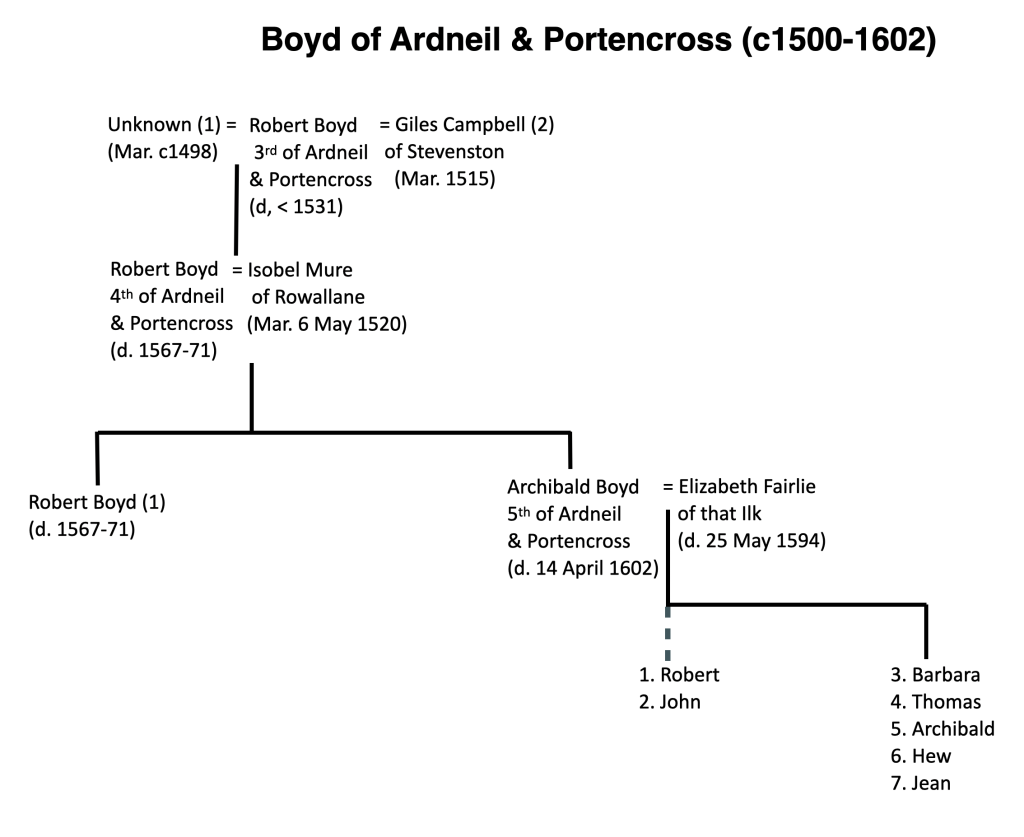
Fig. 4 – Suggested line of Boyd of Ardneil & Portencross, 3rd to 5th
It is believed that the Boyds of Ardneil & Portencross were buried in the old church of West Kilbride, but this has long since been replaced and it is likely that any burials have been built over by more recent builds. The Rev John Lamb stated that “there is a tradition that fifteen of this family (Boyds Portencross) of the name of Robert have been interred within one tomb in the parish churchyard of West Kilbride”.41
Before turning to Archibald’s heir it is worth recording what is known of the remaining children.
John Boyd, natural son
As mentioned earlier it would appear John was likely born out of wedlock son to Archibald, 5th Laird and his future wife Elizabeth Fairlie. John’s legitimation as Natural son probably allowed him to stand as a normal subject in owning property, conducting business etc. This seems to be evidenced by his likely appearance amongst the Muniments of the Royal Burgh of Irvine.
He must have become a burgess of Irvine at some point prior to 1595 as he is listed amongst the burgesses called to confirm their residency in the Burgh on 9 June 1595.42 This was due to a residency clause which required burgesses to be resident in the Burgh to obtain the usual privileges etc. However he must have been resident as his name does not appear amongst those burgesses who were subsequently deprived for non-residency. His name appears again in the Burgh records on 5 July 159943 which appear to indicate he was resident in Kilbride at that time. In the Burgh Accounts for 1601-02 he seems to be the subject of a fine of 10 pounds with his brother Thomas standing as cautioner (guarantor).44
There is no further information relating to him amongst the surviving Burgh archives nor has there been a testament found amongst Scottish records. However a curious entry appears in the testament of his brother Hew (Hugh) in 1610 whereby it states “Item thair was awand to the defunct the tyme foirsaid the particular debtis underwr[itt[]in to the particular persones eftirspe[cife]it viz … Item to Johne Boyd in Glenarme in Ireland fyftein li”. Could it be that John had moved to Ireland, more specifically Glenarm, Co Antrim and had he perhaps received some financial support from his brother Hew whom he now owed 15 pounds? If this was indeed John then this mention from 1610 is the last we find of him amongst Scottish records.
Thomas Boyd
As previously stated Thomas served as executor to the testaments of both his mother and father. From the point of view of practicality and experience it is reasonable to presume Thomas was at least 21 years of age at the time of his mother’s death in 1594. As mentioned earlier his name would seem to appear in the Irvine Burgh Accounts acting as cautioner for his brother John suggesting he had perhaps become a burgess of Irvine by then.
Amongst the Ayrshire Sasines we find an entry referring to a Renunciation at Irvine in favour of William Miller, made by Katherene Peblis and Thomas Boyd spouses, of the lands of Nether Maynes dated 27 November 1603.45 This Thomas Boyd is later referred to as a burgess of the Burgh. From this document we can confirm that there was a Thomas Boyd burgess of Irvine at this time, and he was married to Katherine Peebles, lawful daughter of Patrick Peblis (Peebles) burgess of Irvine. However is he the same Thomas as the son of the 8th Laird?
This question has proven perhaps the most challenging part of the research into the Boyds of Ardneil & Portencross as there are no direct references connecting Thomas to Portencross after the death of his parents. We believe this is because he appears to have had a rapid career in the mercantile life of Irvine and probably resided there, becoming a burgess by 1601/2 and then Provost by 1606. Unfortunately there are gaps in the Muniments of Irvine for this period, but evidence of the connection are suggested elsewhere.
On 15 November 1606 a Renunciation was registered46 in favour of Robert Boyd 6th Laird of Ardneil & Portencross by Hew Boyd, his brother. Amongst the witnesses was Thomas Boyd Provost. A few years later on 1 February 1609 we see Thomas Boyd Provost as witness to a Procuratory of Resignation in the hands of the Crown of the lands of Arneil Hunter, Campbeltoun and Annanhill Hunter in favour of the said Robert Hunter of Hunterstoun and his heirs.47 Another witness was Archibald Boyd in Underhill. Could these witnesses be the two brothers, Thomas and Archibald, sons of the 5th Laird?
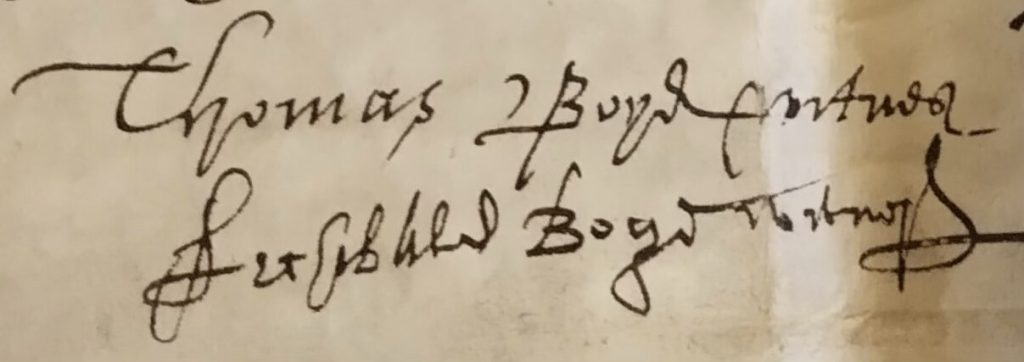
The signatures of Thomas and Archibald Boyd on the 1609 Hunterston deed mentioned above
Courtesy of Angus Cochrane Patrick, Hunterston Archives ©
If we concentrate briefly on Archibald Boyd in Underhill we find in the testament of Hew Boyd, son to the 5th Laird dated 26 October 1610 it was made “Befoir thir witnessis Robert Boyd of Portincors Ar[chibal]d Boyde Under the Hill his broth[er]”. This would seem to confirm that Archibald, son of the 5th Laird and brother to the 6th Laird, Thomas and Hew Boyd resided in a locality known as Underhill or Under the Hill.
In summary we have a Thomas Boyd acting as cautionar for a brother John listed in the Burgh accounts of Irvine 1601/2. We then find a Thomas Boyd burgess of Irvine recorded in a sasine of 1603 with his spouse Kathrine Peblis then in 1606 we see a Thomas Boyd Provost as witness to a renunciation involving Robert Boyd 6th Laird of Ardneill & Portencross and Hew Boyd. Finally we see Thomas Boyd Provost as witness to a resignation of Arneill Hunter etc. alongside Archibald Boyd of Underhill who we have identified as the son of the 8th Laird.
Referring back to the resignation involving Arneill Hunter a curious entry is found in the 1876 publication of Pont’s Cunninghame48 “On 2ndFebruary 1609 Sir William Stewart, Captain of Dumbartone Castell, complains that Robert Huntar of Huntarstoun, and Thomas Boyd, Prowest of Irwyn, had gone to the Isle of Comra with convocatioune of the lieges and tane away all the hawks thereon…” Interestingly this action occurs the day after the previously mentioned resignation of the lands of Arneill Hunter etc. by the crown to Robert Hunter of Hunterstoun which was witnessed by Thomas Boyd Provost. Apart from the fact that Ardneil & Portencross bordered the lands of Arneill Hunter this incident is suggestive of a degree of connection between the two men.
Returning to the previously mentioned renunciation in favour of William Miller of 1603 we note that Thomas Boyd’s spouse was Katherine Peblis, daughter of Patrick Peblis, and William Miller’s spouse was Margaret Peblis. After investigating Patrick Peblis we found that Katherine and Margaret were both daughters of Patrick Peblis of Broomlands (d.1585) and his wife Marion Mongomery of Hessilhead (d.1620). Margaret Peiblis, Thomas Boyd Provost’s sister-in-law had been married to Hugh Montgomerie of Smeithstoun before 9 January 1601 then William Miller of Milnehill, Kilwinning by 27 November 1603 and finally married Robert Hunter of Hunterston on 12 March 1615.49 Could perhaps Thomas have been involved in suggesting the marriage of his sister-in-law to Robert Hunter.
Among the accounts given in the Muniments of Irvine50 we can identify a clear tenure for Thomas Boyd as Provost from 1608-1610. This is also stated in the 1985 publication ‘The History of Irvine: Royal Burgh and New Town’51 in a list of the Provosts of Irvine compiled by James Dickie in 1896. However from other evidence we can conclude that he was Provost at an earlier period also i.e. probably 1607-08. The tenure of the Provosts of Irvine appears to have run from Whitsunday to Whitsunday. Whitsunday or Whitsun being the seventh Sunday following Easter. Therefore Thomas Boyd’s tenure as Provost probably ended on 27 May 1610.
Whilst the evidence is circumstantial, it would appear that Thomas Boyd, son of Archibald Boyd 5th Laird of Ardneil & Portencross and Thomas Boyd burgess and Provost of Irvine are one and the same person. His involvement with immediate neighbours the Hunters of Hunterston in deeds as well as witnessing important transactions is significant but most significant is his appearance as a witness alongside Archibald Boyd of Underhill.
Curiously we find very little mention of Thomas Boyd for some years following 1610 and he has no involvement in the testament of Hew Boyd later that same year and no further terms as Provost. No testament has been found to date and the name is absent from the Ayrshire Sasines after 1603. However the reason for his absence becomes clear on discovering a grave in the graveyard of Old Derrykeighan Parish Church, Co Antrim which was transcribed (probably by the Rev Hugh McNeill, incumbent c1890) as follows:-52
Copy of two parts of a flat stone now supporting a flat memorial slab to Margaret Boyde, 1625 :
“HEIR UNDERLIETH KATHRIN PE [stone
broken off] vE WIFE TO THOMAS | BOYDE OF
C [part gone] LATE | PROVOST OF IRVINE
WHO DEPARTED | THIS LIFE ON THE 11. OF NOVEMBER
IN | ANNO DOI 1615.”
Underneath this inscription are the indistinct remains of a coat-of-arms, with the letters T. B. on either side. The letters of the inscription are raised, and rest in a groove ; they run round the edges of the stone. The inscription is in good condition.
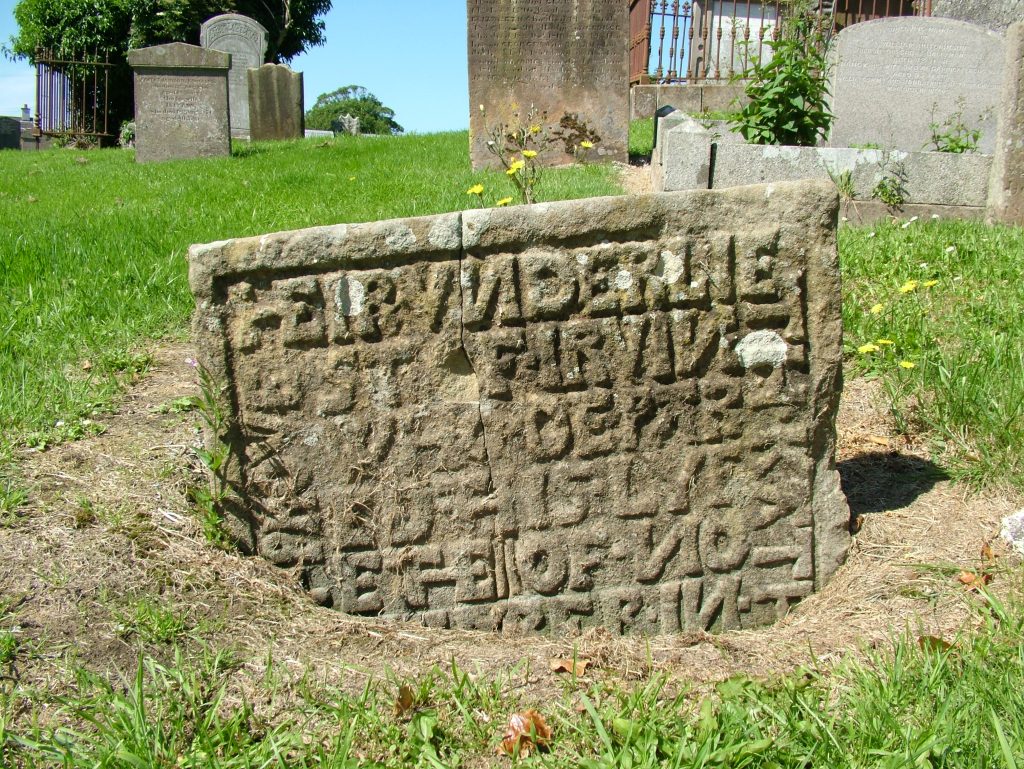
Fig.5 – The gravestone or more probably memorial stone to Katherine pebbles in
Old Derrykeighan Graveyard – Courtesy of Dr William Roulston
Rev Hugh McNeill (c1834-1893) who mentioned the grave again in his historical work on the Parish written c189053 states:-
“The Rev. George Hill says the deceased was Kathrin Peebles, wife of Thomas Boyde of Carncoggey (mentioned at page 14), and that this is the oldest monument to any of the Scotch settlers in County Antrim.”
As if to complete the connection a search amongst the State Papers of Ireland found the following entry regarding denizations for 161154:-
“LXXV – 41. Grant to John Stewart otherwise McRobert, John Oge Stewart, Thomas Boyde, Gillebert McPhedrishe, Will. Dunlopp, Anthony Kennedy, John Makneaghten and Alexander Stewart, that they be freed, &c. as in the preceeding article. – 29 Jan. 9th”
This would appear to explain Thomas’ absence from Irvine or indeed Scotland. He and wife Katherine likely moved to Co Antrim sometime between the end of his tenure as Provost of Irvine 27 May 1610 and his brother Hew’s death in October the same year. His life after leaving Scotland will be the subject of another post.
Archibald Boyd of Underhill
It would appear Archibald was the second lawful son born to the 5th Laird and Elizabeth Fairlie of that Ilk, his wife. He had served as co-executor with his elder brother Thomas to the testaments of his parents and witnessed the testament of his brother Hew in 1610.
The location of Underhill is most likely the property which is also known as Springside House which lies on the northern slope of Law Hill to the east of West Kilbride. The property was in the possession of the Bailie, Ferry and Hyndman families in the 18th and 19th centuries.
Unfortunately no mention of him is found in the Muniments of Irvine or the Protocol Book of Irvine Notary, Robert Broun. Also a search among the indexes of the National Records of Scotland or Commissary Court records of testaments for Glasgow and Edinburgh similarly draws a blank. Therefore the last evidence we have for Archibald Boyd of Underhill amongst Scottish records is his witnessing of brother Hew’s testament on 23 October 1610. Could Archibald have left Scotland with his brother Thomas and gone to Ireland, even perhaps, Co Antrim?
A search amongst the State Papers of Ireland55 reveals the following entry regarding denizations for 1617:-
“X – 26. Grant to the following persons, Scotchmen by birth or descent, that they be freed from the yoke of the servitude of the Scotch or Irish nation, and enjoy all the rights and privileges of English subjects:- George Mc Alexander of Ballyshenog, Hugh Blare of the same, Alex. Edmeston of Ardfrackan, John Dunbar of Knockfergus, and Archibald Boyde of Carntulin, Antrim co… – 28 Nov. 15th”
Remarkably, behind the grave or memorial stone of Katherine Boyd nee Peblis in the graveyard of old Derrykeighan Parish church we find the grave of Margaret Boyd daughter of Archibald Boyd of Carntullagh transcribed by Rev Hugh McNeill, incumbent of the parish as follows56:-
HEIR • LYITH THE CORPIS • OF I ANE • FATHFVL •
SISTIR • IN • THE • LORD • CALID • MARGRAT • BOYD •
DOGH I TER • TO • ARCHIBALD • BO I YD • OF •
CARNCOLAGH • AND • SVMTYM • WYF • TO • WILLIAM • I
HVCHISOVN • OF • STRO I NOCVM • 9H0 • DE I SIST •
THE • OI • OF • IVNE I 1625
“Copy from flat tombstone near S.E. corner of ruins of old Derrykeighan Church. Letters incised. Archibald Boyd got from Sir Randal M’Donnell (afterwards Lord Antrim) a lease of Carncollagh in 1612; he was one of the Protestant Scotch settlers. He is frequently named in the ancient records. The wife being called by her maiden name, is a custom still common in the neighbourhood.—(See Kilkenny Journal of Archaeology, page 49, 1858.)”*
*(Footnote) In the centre of this stone is a shield with arms, a fess cheeky, and in base 2 annulets (?) or rings, charged with a mullet each. The letters W . H are on either side of this shield, and M . B beneath it.”
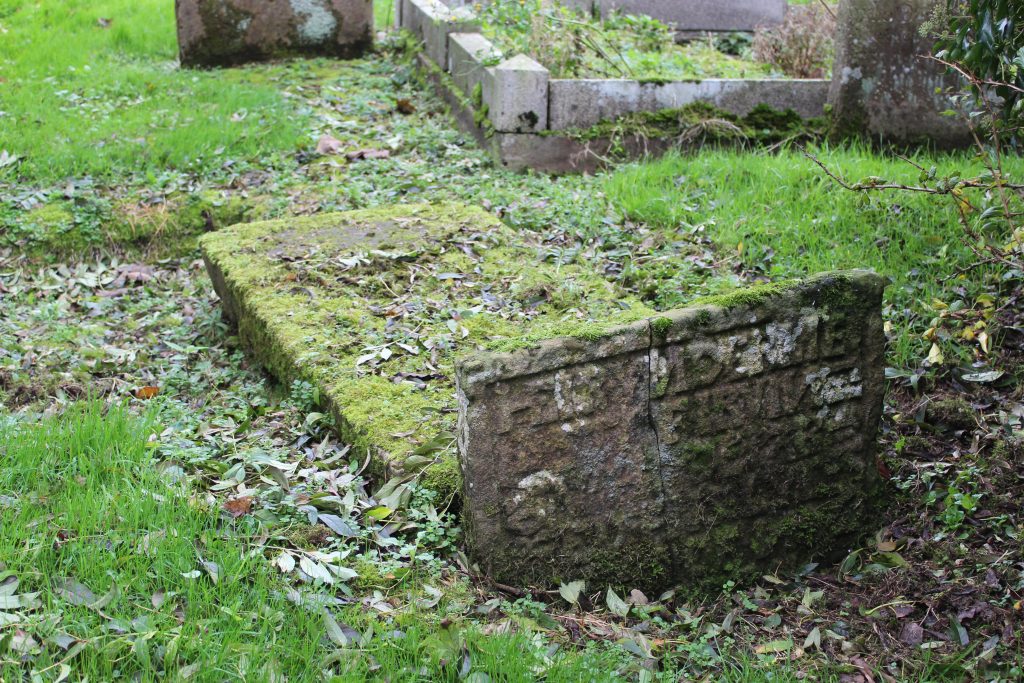
Fig.6 – The gravestone of Margaret Hutcheson nee Boyd behind that of Katherine Peblis in old Derrykeighan graveyard
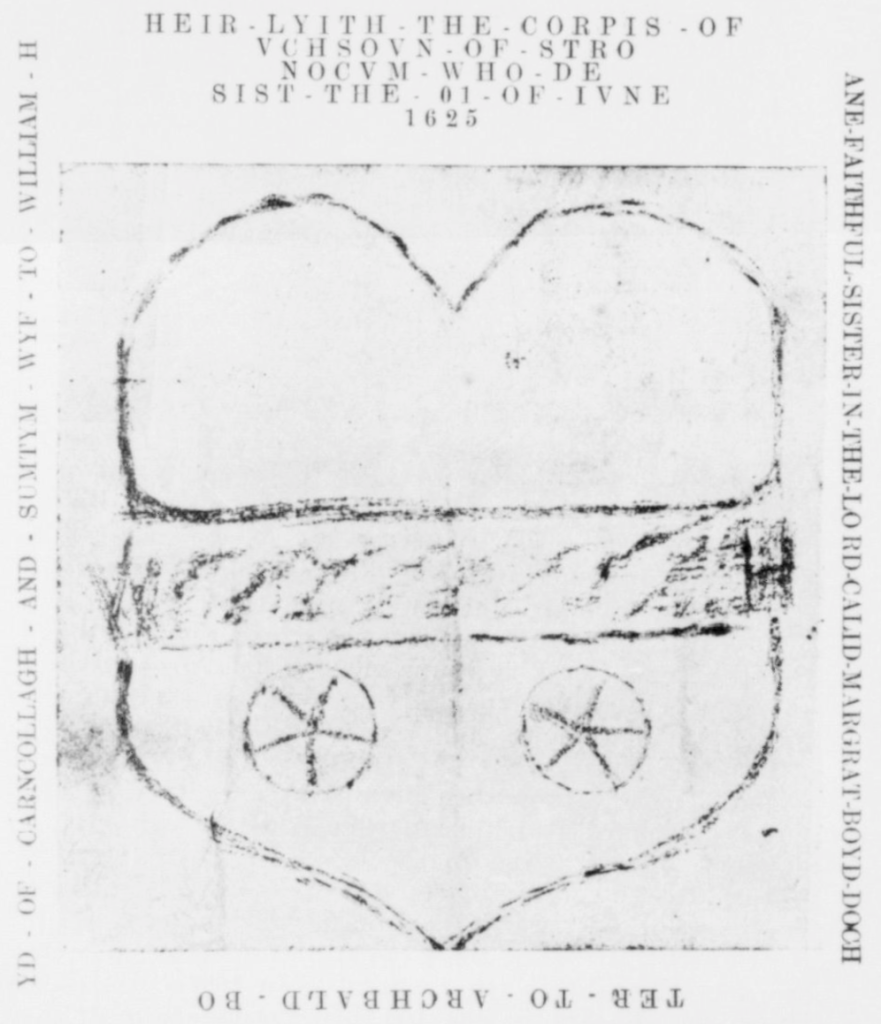
Fig.7 – A rubbing of the grave of Margaret Hutcheson nee Boyd likely made by Thomas Camac c190857
As with brother Thomas we will leave the life of Archibald Boyd in Co Antrim to another post.
Hew Boyd
Apparent third lawful son of Archibald 5th Laird he was known to be a burgess of Irvine and resided in the town all of which is gleamed from his testament given on 26 October 1610.58
Curiously Hew is not mentioned in his mother’s testament of 1594 but in his father’s testament of 1602 we find “Item the said Ar[chbal]d Boyd of Portincroce leves his haill guidis geir (dettis being payit equallie amangis Thomas Ar[chbal]d and Hew Boydis his sones)”.
Sadly there are no references to Hew amongst the Muniments of Irvine but, as previously mentioned, amongst the Ayrshire Sasines we find a Renunciation in favour of the Laird of Portencross dated 15 November 1606.
The renunciation relates to a bond of obligation of 158959 in which Robert Boyd, his brother, and Robert’s wife Jean Montgomerie along with Archibald 5th Laird of Ardneil & Portencross undertook to infeft Hew in an annual rent of 100 merks from the “Ten m[er]kland of Portincroce and Arduall and threttie sh[illing] land of Maynes of Eglintoun half mylne half land and multuris thairof The tua m[er]kland of the mure of Eglintoun ane fourtie sex sh[illing] viijd land of Knokindaill or any pairt of the said respective with the pertinents Lyand within the baillierie of Cuny[n]ghame and Sherefdome of Air” Hew accordingly renounced this obligation in return for a single payment of 1,000 merks by Robert 6th Laird of Ardneil & Portencross and his wife Jean Montgomerie which was to serve as an ‘entres’ (marriage portion) in Hew’s recent marriage to Marion Ros.
From this transaction we know that Hew married Marion Ros probably in 1606. Marion was the daughter of Thomas Ros of Broadland and widow to Ninian Barclay of Warrix, burgess of Irvine, whom she married in 1588 and bore at least four sons, John, Ninian, Robert and Hew Barclay all of whom appear in the testament of Hew Boyd. There does not appear to have been any children born to Hew Boyd and Mairon Ros. Sadly there is no further information on Hew Boyd except to examine some of the Inventar of his testament60 which may provide some clues about his life.
Inventar of Hew Boyd
Ane gray naig, by the airschipe hors, pryce xxvj lib.
Item, tway ky, with the stirks, pryce xxvj lib. xiii s. iiii d.
Item, thrie zoung ky in Ire- land, estimat to xxx lib.
Item, in the borne and bornezaird, Ten bolls beir, pryce of the boll v lib., inde 1 lib.
Item, threttie bolls aittis, pryce of the boll, with the foddir, iiij lib., inde jc xx lib.
Item, sex bolls salt, pryce of the boll xl s., inde xij lib.
Item, twa kists of hog-heids, with als mony rungis to set thame vp, pryce of all xvj lib.
Item, auchtein iir daills, pryce of thame all nyne lib.
Item, auch dussane of Ireland buirdis, at fourtie shillings ilk dussane, inde xvi lib.
Item, twa stanes of woll, pryce of the stane v lib. xiii s. iiii d., inde Ivi lib. xiii s. iiii d.
Item, sax feddir beddis, by the airschipe. pryce of the piece, with their furnitour, xiiij lib., inde fourscoir four lib.
Item, Tuentie t’U’a pair of scheittis, by the airschip, pryce of the pair ourheid, xx s., inde xxii lib.
Item, buird claithes. and fyve dussane of serveitts, by the airschip, pryce of all xiii lib. vi s. viii d.
Item, thrie dussane and ane half of pewdir plaitts, with twa dussane and thrie trunscheouris, all estimat to xxxvi lib.
Item, an brasin basen, by the airschip, estimat to 1 s.
Item, thrie pynt stopis and thrie choppein stopis, by the airschip, all estimat to aucht pund.
Item, twa brasyne chandleris, by the airschip, estimat to xx s.
Item, thrie litle kists and ane chyre, by the airschip, estimat to xx s.
Item, sax sylwir spwnis, by the airschip spwne, with twa brokin spwnis, pryce of thame all xx lib. Item, thrie auld gunis, by the airschip, estimat to iiij lib.
Item, the abuilzement of the defunct’s bodie, by the airschip, estimat to ane hundrith punds,
Summa of the foirsaid inventar vi c. Ixxxxvii lib. iii s. iiij d. (697 pounds 3 shillings 4 pence)
The most striking thing in Hew’s Inventar is the number of items described as by the airschipe which we presume to mean he had inherited them from his father and mother. However of particular interest is the reference to three young ky or cows in Ireland. As mentioned earlier it would appear Hew was owed 15 pounds by his brother John in Glenarm, Co Antrim. Could the reference to the cows suggest that these cows may be in John’s keeping. Moreover had Hew been involved in regular trade with Ireland through his brother John?
Jean Boyd
Research reveals that Jean married at least twice, firstly to Hugh Montfode of that Ilk and secondly to John Darleith of that Ilk. Confirmation of her marriage to Hugh Montfode is found among the Ayrshire Sasines dated 13 December 160261 in which she is referred to as lawful daughter to Archibald Boyd (5th Laird) and now Lady Montfode. The Montfode family lived at Montfode castle just north of Ardrossan, Ayrshire and are believed to have been associated with the De Morvilles in the C12th. Hugh Montfode had inherited the families estates from his father John in May 160062 and it seems likely his heir Hugh was born to Jean Boyd. Hugh Montfode, husband of Jean Boyd appears to have died 1602-21 as their son Hugh succeeds in the family estates on 8 February 1621.63 The Montfode family died out in their estates of Montfode by the late 1600s.
With the death of Hugh Montfode (1602-21), Jean remarried to John Darleith of that Ilk from the parish of Bonhill in Argyll & Bute. Interestingly a John Darleith younger of that Ilk was Procurator to Lord Boyd in 160064 who may have been Jean Boyd’s future husband. Sadly there appears to be little information regarding John Darleith and Jean Boyd after their marriage. And it is not until we examine her testament of 166365 that we learn more.
Jean Boyd, Lady Montfod, relict of the late John Darleith of that Ilk is how she is described in her testament of 3 August 1663. It further states she died in January 1662 and her testament was given up by John Darleith of that Ilk, son to the defunct, thus confirming the birth of at least one child to Jean Boyd’s marriage to John Darleith. Also in examining the Sasines66 it seems likely that Jean gave birth to at least two other children, Arthur and Jean. It is possible the Glasgow testament of a John Darleith of 20 July 1658 may be that of Jean Boyd’s husband. It is said that a John Darleith sold the property of Darleith to John Yuille of Inverary in 167067 who developed the property from its original pele house structure to an extensive manor house.68
Grissel Boyd
Most of the information found for Grissel Boyd daughter of Archibald 5th Laird of Ardneil & Portencross comes from the Ayrshire Sasines. She first appears on a sasine69 dated 5 October 1601 alongside her father Archibald Boyd (5th Laird) and husband William Schaw younger of Mayneholme and in three further Sasines70, the last one dated 7 March 1632. It is likely that the Mayneholme referred to is Mainholm lying just east of the town of Ayr in the parish of St. Quivox. Unfortunately searches of various Scottish records has revealed nothing further of Grissel Boyd or her husband William Schaw after 1632. No testament has been found for either of them and it is possible they may have left Scotland, perhaps for Ireland.
Barbara Boyd
The first mention of Barbara Boyd is in her mother’s testament of 1594 in which she received a legacy of 20 pounds. The next is in 1602 by the testament of her father in which she receives a fourth part of his estate by way of a probable marriage portion along with her husband Mr John Harper. In examining the Ayrshire Sasines we see a sasine of 8 March 160071 involving Barbara Boyd and John Harper, Minister of Kilbride72 confirming they were married prior to that date. Barbara must have died before 13 July 1621 as John Harper entered into a marriage contract on that date with Mary, daughter of John Hamilton of Stonehouse. No testament has been found for Barbara Boyd nor are there any further sasines after 1600.
George Boyd (d. c1628, probably in La Rochelle, Charente Maritime, France)
Before turning to the 6th Laird of Ardneil & Portencross it should be noted that there is significant evidence that Archibald 5th Laird had a son George. He is not named on either the testament of Elizabeth Fairlie or that of the 5th Laird. However he has been named on a family tree created, most likely, in the early 1700s, possibly in France. However more significantly he has been named on a birth brief or genealogy recorded in the Office or Court of the Lord Lyon in Edinburgh c1726. His lineage will be the subject of an additional and extensive future post on the Boyds of France.
Robert Boyd, 6th Laird of Ardneil & Portencross
Robert Boyd, eldest son and heir to the 5th Laird succeeded to the estates of Ardneil & Portencross on the death of the 5th Laird on 14 April 1602. He had previously married Jean Montgomery, daughter of Sir Robert Montgomery of Skelmorlie, c1580 as confirmed by their marriage contract.73 Together they had at least nine children, six boys and 3 girls.
Robert’s marriage to Jean Montgomery at first appears unsurprising, after all they were neighbours. However when considering that his grandfather had been a member of the party involved in the killing of Neill Montgomery of Lainshaw the match only proves the paradoxical nature of family feuds in late medieval Scotland. If the marriage was successful it could help maintain peace and indeed prosperity for all the families involved.
Sadly no birth or marriage records survive from this period in West Kilbride, so historians are reliant on other sources to ascertain details of the children born to Robert 6th Laird of Ardneil & Portencross and Jean Montgomery.
Robert Boyd (c1582 – March 1634)
Eldest son and heir to the 6th Laird of Ardneill & Portencross and Jean Montgomery of Skelmorlie, he was likely born in the first few years following his parent’s marriage contract of 1580. He is mentioned in his mother’s testament74 “And to our eldest sone Robert, ane undrith merks, and ane broune naig..” It is interesting to note that Robert receives one of the smallest monetary legacies from his mother’s testament and the significance of the ‘broune naig’ or horse is unknown. Perhaps it was simply that Robert as eldest son would inherit the family estates and the mother’s legacy was mainly targeted at his siblings.
Sadly Robert predeceased his father in March 1634 and never became Laird. However from his testament75 we can confirm that he married Elizabeth Cunninghame, daughter of Alexander Cunninghame of Waterstoun in 1631. All three are named along with the 6th Laird in two Ayrshire Sasines dated 5 March 163176, the first of which details the transfer of Thirdpart Ardneill from the 9th Laird to his eldest son Robert with a liferent to the 6th Laird and his second wife Jean Ezat and the second transfers Thirdpart Ardneill to eldest son Robert and his wife Elizabeth Cunninghame.
Robert and Elizabeth appeared to have at least two children in the brief years of their marriage, firstly a daughter, Elizabeth, and then a son Robert. Robert would go on to succeed his grandfather as 7th Laird of Ardneil & Portencross in 1658.
Interestingly Robert Boyd, son of the 6th Laird’s death is marked by two separate testaments in 1634 and 1635. The first testament dated 24 June 1634 appears to have been registered by the daughter of one of Robert’s creditors “Faythfullie maid & gevin up be Jeane Broune dochter Lauchtful to umq[uhi]le Robert Broune of Burrowland Lauchtful creditor to the defunct Inswafar as the said umq[uhi]le Robert Boyd was justlie addebtit & awand to the said Jeane..” It would seem that Robert had died owing a substantial debt totalling 270 merks and 40 pounds since 4 June 1630 to Jeane Broune and with the authority of John Boyle of Kelbourne, Commissar of Glasgow she was empowered to recover the debt from his estate. Later his primary testament was registered on 26 February 163577 in the name of Robert Boyd fiar of Portincross. The reference to Robert as fiar was simply recognition that he would have been due to inherit the lands of Portincross from his father, the 6th Laird, had he lived.
This second testament is “Faythfullie maid & gevin up Be Allexr Conyngha[m]e of Watterstoune guidchir to Elizabethe Boyd dochter Lauchtfull to the said umq[uhi]le Robert Boyd of Portincors In name & behalf of the said Eli[zabe]th Boyd quha is exe[cut]rix dative…” This line confirms that the testament was registered by Alexander Cunninghame of Waterstoun, Robert’s father-in-law, as grandfather to Elizabeth, Robert’s daughter, and on behalf of Robert’s widow and executrix, Elizabeth Cunninghame. However there is no mention of the son Robert who would go on to be 7th Laird. Sadly this second testament makes no mention of a legacy to Robert’s children and instead appears to include further items of the estate and debts that had been omitted in the first testament of 1634.
Gavin Boyd (d. aft 19 December 1621)
Possibly the second eldest son of the 6th Laird, he is mentioned in his mother’s testament78 (partially transcribed in Paterson’s History of Ayr & Wigton Series79) registered in 1623 which states “to Gavin thrie hundrith merks.” Sadly there is no further record of Gavin Boyd found to date.
Agnes (Nans) Boyd (d. aft. 8 August 1622)
Agnes or Nans as she was referred to in her mother’s testament was likely the eldest daughter of the 6th Laird and she received 800 merks at her mother’s death. We also know that she was married to John Boyle of Ballikewn/Ballykewn or Ballycown on the island of Great Cumbrae just off the Ayrshire coast.
Col. Boyle in his history of the Boyles of Kelbourne (using an extensive range of sources) states of John Boyle of Ballikewin80:-
“(i) John Boyle, who, as his son and heir-apparent, had sasine, with his future spouse, of half the lands of Ballikewin, 22 August 1622. He succeeded his father, and was designate ‘of Ballikewin’ 31 March 1648. He married, contract dated 8 August 1622, tocher 1400 merks, Agnes Boyd, daughter of Robert Boyd of Portincross, and seems to have been succeeded by a son :—
a. Robert Boyle, who appears on 4 May 1667 designate as ‘of Ballikewin.’ The next of this family who appears was
(a) James Boyle of Ballikewin, who was a Commissioner of Supply for Bute in 1696, and 1704. On 31 March 1721 he disponed to John, Lord Boyle, the 5 merk lands of Ballikewin and Culoch, Par. Meikle Cumbrae, being designate eldest lawful son and heir now on life of the deceased – Boyle of Ballikewin. He died before 12 June 1740. He married Janet Bannatyne, and by her had issue :—
α. John Boyle, clerk of the customs at Irvine. He married Marion Glasgow, and by her had issue: –
(α*) Agnes Boyle, born 12 December 1742.
(β*) Janet Boyle, born 10 June 1744.
β. Elizabeth Boyle, who was proclaimed 12, and married 23, June 1740 to Robert Bannatyne, son to Robert Bannatyne, sometime of Loubas ; being designate daughter to the deceased James Boyle of Ballikewin.”
Before leaving the line of Agnes Boyd it is interesting to note from Col Boyle’s history that John Boyle’s father William “On 1 November 1614 he leased the lands of Moyle in the manor of Donboy lying in the precinct of Portlough, co. Donegal, from John (afterwards Sir John) Cunningham of Crawfield, his brother-in-law, who was one of the undertakers for the settlement of Ulster.”81 Once again we see a connection, albeit indirect, between the Boyds of Portencross and Ulster.
Elizabeth Boyd (d. aft. 30 May 1665)
Elizabeth may have been the second daughter of the 6th Laird, and she features in her mother’s testament in receiving a legacy of 700 merks. At some point after her mother’s death in 1621 and 1625, Elizabeth married Robert Montgomerie of Smeithstoun (Kilwinning Parish). This is evidenced by a Sasine dated 12 July 1625 involving Elizabeth, her father the 6th Laird and her husband Robert Montgomerie.82
Two further sources can be identified in the National Records of Scotland involving Elizabeth, firstly, at Kilwinning on 27 February 1661, a Charter granted in implement of a disposition by Robert Montgomery of Smithston “with the consent of Elizabeth Boyd his spouse in favour of Hugh Montgomery of the said lands reserving as foresaid”83 Hugh Montgomery is not immediately identifiable. However his identity is brought into focus by our second source, a Heritable bond of relief by Hew Montgomery, younger of Smithstoun recorded at Irvine on 30 May 1665, “whereby on the narrative that Mr Robert Montgomery, elder of Smithstoun, his father and he as principals and Gabriel Porterfield of Halpland and Mr Hew Peblis (Peebles), late minister at Kilwinning as cautioners had by their bond dated 27th May then instant bound themselves to pay to Mr Ralph Rodger in Kilwinning, late minister at Glasgow he being in life and after his decease to Marie and Margaret Rodger his two bairns for 1200 merks; he binds himself to infeft the said Gabriel Porterfield and Mr Hew Peblis and either of them their heirs assignees and successors whomsoever in the said lands of Nether Smithstoun, Woodsyde and Whitehirst; reserving to his said father and Elizabeth Boyd his mother their respective liferents of the lands of Woodside, redeemable on his disburdening them of their said cautionary obligation.”84 This excellent source provides further proof of Elizabeth’s marriage and that she and Robert Montgomerie had at least one child, Hew. It further shows that Elizabeth and her husband were still alive in 1665.
Further confirmation of the marriage of Robert Montgomerie and Elizabeth Boyd also comes by way of a letter from Robert Boyd 7th Laird of Ardneill & Portencross to Gabriel Porterfield of Hapland dated 15 April 1721 in which he writes “I received your query you desired me to peruse my papers and look out and contract of marriage betwixt Robt Montgomerie of Smithston and Elizabeth Boyd daur to Robt Boyd of Portincorse yet I did accordingly and is dated at {?] the 4 July 1623 written by John Brown for to Rot Bri[?] not pub: and witnessed by Thomas Bannatyn of Kelly, Hugh Smith in [?] in Kilwinning and Ninean Neven br German to the Laird of Montcredden ….”
Unfortunately no testament has been uncovered so far for Elizabeth or her husband and further investigation is required to ascertain if descendants existed beyond that of Hew Montgomerie after 1665.
George Boyd (d. aft. 5 May 1623)
In his mother’s testament he was left 300 merks. In addition his mother had arranged that he would receive part of the moveable goods and gear of her estate shared with his sisters and brothers Archibald, William and James.
The only other evidence found of George is that he was witness to a charter recorded on 5 May 1623 relating to his father’s marriage contract with Jean Ezat the previous year and concerning the rent of the 5 merk land of Thirdpart-Arneill or Arneill Cunnynghame85. Jean Ezat was the 6th Laird’s second wife who will be discussed later. Unfortunately no other information has been found concerning George.
Archibald Boyd (d. aft 19 December 1621)
As with brother George, Archibald was left 300 merks in the legacy of his mother’s testament of 1623. Unfortunately no other evidence has been found concerning Archibald to date.
William Boyd (d. aft 19 December 1621)
Interestingly no specific legacy of money was given to William in his mother’s testament. Instead he is included with George, Archibald and James along with his sisters as receiving an equal share of his mother’s moveable estate. No reason has been found for his omission in receiving a direct amount from his mother and no other evidence has been found concerning William to date.
James Boyd (d. aft 19 December 1621)
As with brothers George, Archibald and Gavin, James received 300 merks by the legacy of his mother’s testament. The next information we have on James is his appearance in an Ayrshire sasine dated 6 July 164386 along with Gavin Blair of Haly.
Marriage of Robert Boyd, 6th Laird of Ardneil & Portencross to Jean Ezat
With the death of Jean Montgomery in December 1621 the 6th Laird remarried to Jean Ezat, daughter of Thomas Ezat, messenger of Kilwinning. The marriage contract was referred to as taking place in 1622 in an entry in the Register of the Great Seal.87 It would appear that, as part of the marriage contract, the 6th Laird’s new bride was to receive the rents of Thirdpart Ardneil alias Ardneil Cunninghame. The arrangement seems to have been confirmed at Thirdpart Ardneil on 6 May 1623 before notary and witnesses including George Boyd, son to the 6th Laird and his first wife Jean Montgomery. The transaction was registered under the Great Seal in Edinburgh on 1 August 1636 probably as a result of the death of Robert, eldest son of the 6th Laird in 1634.
The 6th Laird and Jean Ezat appear to have had at least three children i.e. sons Thomas, John and Robert, all of whom seem to have survived to adulthood.
Thomas Boyd (d. 1660-1673)
Thomas appears in a concurrent series of three Ayrshire Sasines dated 27 September 166088 in which he is referred to as “brother german” of Robert Boyd mentioned along with Geills Brisbane, his spouse, Robert Boyd of Portencross (7th Laird) and David Boyle of Kelburne. The Sasines appear to refer to lands in Ardneill and the sum of one thousand merks which is likely an obligation relating to Thomas’ marriage to Geills Brisbane. The next record we find of Thomas is an Argyll Sasine89 dated 29 December 1673 in which Geills Brisbane is described as relict of Thomas Boyd in Kilwinning confirming Thomas’ death was 1660-1673. No other records of Thomas and Geills have been found to date.
John Boyd (d. aft. 11 May 1642)
John appears on an Ayrshire Sasine dated 11 May 164290 in which he is described as second lawful son of Robert Boyd of Portencross (6th Laird) and Jean Ezat. In the Sasine John was represented by Hew Smith, portioner, as his actuary. The other parties were his father the 6th Laird and Alexander Cunninghame of Montgreenan. It concerns the forty shilling land of Hullerhill of old extent heritably held by Alexander Cunningham and certain annual rents due under a bond of obligation by Alexander Cunningham to the 6th Laird and John Boyd for 1000 merks. Remarkably an original copy of this transaction is available in the National Records of Scotland.91 This may have been part of a series of actions which relate to debts surrounding Alexander Cunninghame of Montgreenan which included letters of horning and poinding at the instance of Robert Hunter, fiar of Hunterston, against Alexander Cunningham on 3 May 1643.92 No other record of John Boyd has been found to date.
Robert Boyd (c1627 – aft. 7 September 1659)
Robert is recorded in the Ayrshire Sasines93 on 7 September 1659 as having previously married Christian Stewart, daughter of the deceased (d. Nov 1647) James Stewart younger, merchant burges of Glasgow styled of Largs94 and also niece to David Boyle of Kelburne who had given consent to the marriage, probably in the role of guardian. Christian’s mother was Jonet Boyle, sister of David Boyle, originally of Halkishirst and then Kelburne. Jonet Stewart nee Boyle died c164395 while Christian was still a child. It is interesting to note this marital connection to the Boyles in addition to the marriage of Agnes daughter to the 6th Laird who married John Boyle of Ballikewn.
Robert Boyd, 7th Laird of Ardneil & Portencross (d. 1713-1721)
Amongst the Retour of Heirs96 we find an entry dated 29 July 1658 viz “Robert Boyd of Portincross, heir of Robert Boyd of Portincross, his guidsir, (grandfather) – in the 5 merkland of Ardneill, within the parochine of Kilbryd and bailyiarie of Cunynghame: – O.E. 3l. 6s. 8d. N.E. 20l – The 30 shilling land of the Maynes of Hellingtoune (Helenton, Parish of Symington); – the half of the myln of Hellingtoune; – the 2 merk land of the Muir of Hellingtoune; – the 46 shilling 8 penny land of Knockindaill (Knockendale, Parish of Symington); – the 4 merk land of Harrickhill of old extent within the bailyiarie of Kylestewart. – O.E. 7l. 16s. 8d. N.E. 39l 3s. 4d.”
We know that prior to 16 April 1657 Robert, 7th Laird, married Marie Blair as a Sasine was registered97 on that date involving them and also Anna Blair, daughter of Gavin Blair of Auldmure and Andrew Lin of that Ilk, Anna’s spouse concerning the 20 shilling lands of Maynes of Overlin, Parish of Dalry then heritably in the possession of Andrew Lin and his spouse Anna Blair. A further Sasine98 dated 1 October 1657 also includes Robert and his spouse Marie Blair concerning lands in Ardneill.
An interesting item amongst the indexes of the National Records of Scotland99 dating from the year 1686 provides evidence of the 7th Laird’s involvement in the Covenanter Rebellion of 1679. At this stage the document has not been examined but will be included in any further study into the life of the 7th Laird.
It is believed that at least two children were born to Robert 7th Laird and Marie Blair, Robert and Grizel who we will discuss shortly. It is not known for sure when the 7th Laird died as no testament for either him or Marie Blair has been found. However there is evidence Marie Blair likely predeceased the 7th Laird as a document100 dated 27 July 1713 states the 7th Laird’s spouse to be a Janet Boyde. John Fullarton in the 1858 publication ‘Topographical Account of the District of Cunningham, Ayrshire etc.’ suggests that this Janet Boyd was of the house of Pitcon101 but no primary sources have so far been found to corroborate this. Fullarton further states that there was no issue from this second marriage.
Returning to the likely year in which the 7th Laird died, Crawfurd states in his MSS102 that the 7th Laird “dyed very aged near 100 years of age in 1721”. We certainly know he was alive on 24 July 1713 from the document previously mentioned which was a Signature of the five merk land of Ardneill in favour of William Boyde alias Fullarton of Portincross, grandson to the 7th Laird. Remarkably no testament has been found for either the 7th Laird, Marie Blair or Janet Boyd his second wife.
Robert Boyd (d. April 1696)
Robert was born to the 7th Laird and his first wife Marie Blair probably c1657-1660. He married Antonia Montgomerie, second daughter of Sir Robert Montgomerie of Skelmorlie, 3rd Bt c1690. Antonia was baptised 2 February 1668 in Edinburgh.
Thankfully the baptisms of the children born to Robert Boyd and Antonia Montgomerie coincides with the earliest records that have survived of the church at West Kilbride, and we can confirm the birth of two of the four children and their subsequent baptism i.e. Hugh, 29 March 1694 and Lilia, 15 September 1695. Two other children namely Robert and Anna where mentioned by William Fraser in his major history of the Montgomerie’s Earls of Eglinton.103 Fraser states that the children Robert, Anna and Lilias “had a bond of provision from Robert Boyd of Portincross, their grandfather, dated 14thNovember 1696.” Hugh’s omission from the bond is suggestive of his having previously died as an infant.
The purpose of the bond was no doubt resulting from Roberts earlier death. This is confirmed in a testament dated 1 March 1703 which states “The testa[men]t dative and Inv[enta]r of the goods and debts perteaneing to um q[uhi]le Ro[ber]t Boyd younger of Portincorse within the parochin of Kilbryd who deceist in Holland in the moneth of Apryll 1696…” Roberts death in Holland indicates his being there either in a mercantile capacity or more likely as a serving military officer. Further investigation revealed that a Captain Robert Boyd had served under Sir Charles Graham’s Regiment of Foot with the Alliance in Flanders during the Nine Years War.104
Grizzell Boyd (c1660 – 14 March 1722)
Grissell is the only other child we know of born to Robert 7th Laird of Portencross and Marie Blair. The year of her birth is unknown but likely to have been c1660. It would appear she married Alexander Fullarton of Kilmichael in Arran c1680. Their marriage is confirmed by an inscription on a gravestone in the old churchyard of Kilmichael in Arran which reads:-
| This stone is erected by Alexander Fullarton Esqr of Kilmichael in memory of Grace Hamilton his spouse who died 16th February 1663 Lies also here the corpse of Grizil Boyd his second Wife who died 14 March 1722 A.F.K. 1663 As also Ladovicus, Donald, James, Robert, Margaret, Katren Fullarton’s Children to James Fullarton of Kilmichael. | 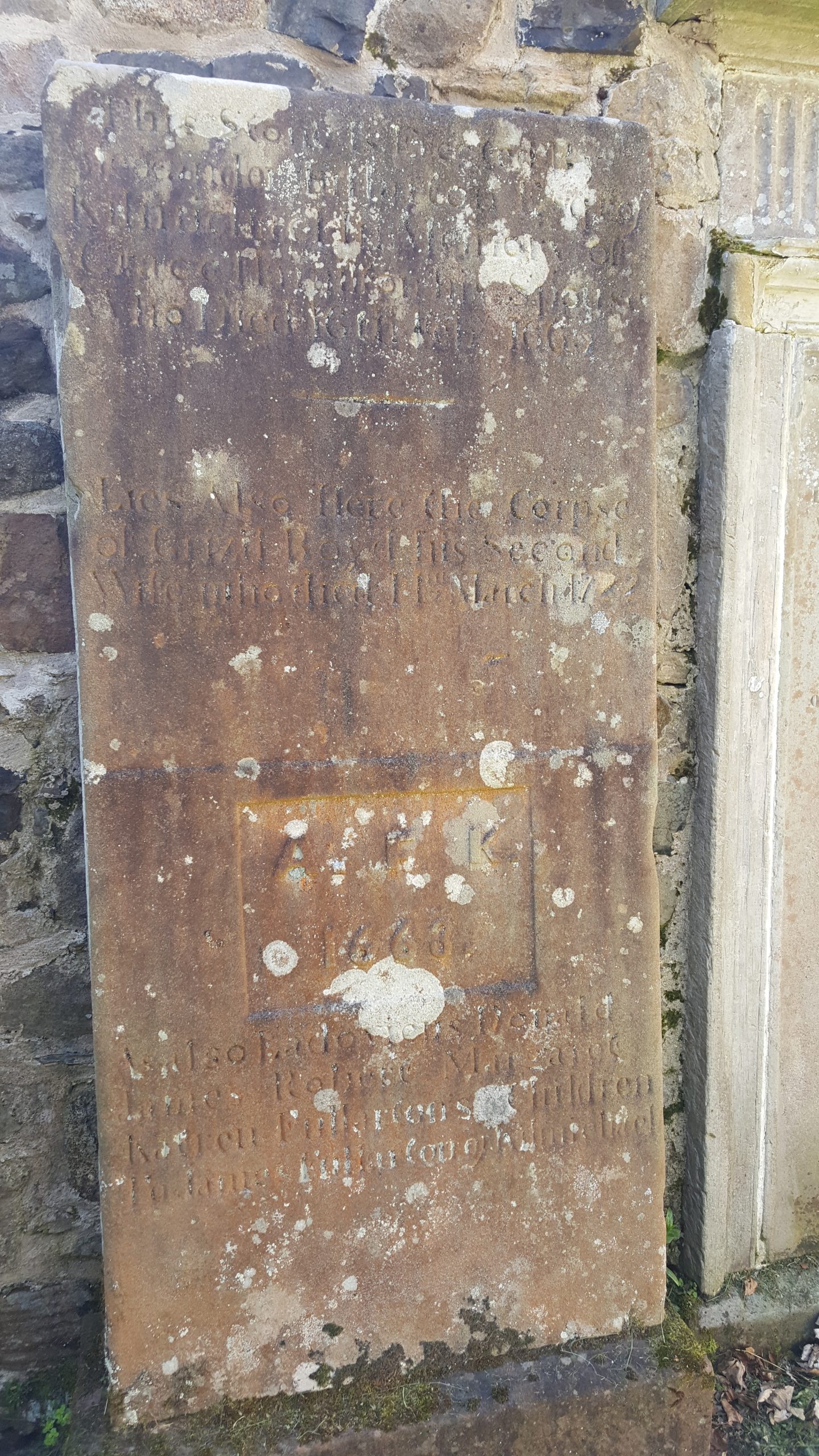 |
Fig.8 – The grave of Grizzle Fullarton nee Boyd in the old churchyard of Kilmichael in Arran
Alexander Fullarton and Grizzell Boyd had seven children during their marriage, William, Robert, Janet, Margaret, Geils, Antonia and Grizel.105
With the death of the 7th Laird’s eldest son Robert in April 1696 and the tragic death of Robert’s sons, Robert and Hugh by 1713 the 7th Laird had to look to his daughter Grizzel and her husband to find a male heir by which the estate of Ardneill and Portencross could descend. The document recording his wishes was as mentioned earlier dated 27 July 1713 i.e. Signature of the five merk land of Ardneil.
The document stated the terms by which, on the death of the 7th Laird, the estate or five merk land of Ardneill would pass to William Fullarton, eldest son of Alexander Fullarton of Kilmichael in Arran and Grizzell Boyd. William would, upon receiving the Boyd estate, change his name to Boyd also taking the Arms of Boyd of Portencross in so doing.
Robert Fullarton in Saltcoats and of Overton (1693-1750)
Before moving to the story of the 8th Laird of Portencross it is important to record the family of his brother Robert who, under the Signature to the Five Merk Lands of Arneill of 27 July 1713 was also accorded right to the Boyd estates, name, arms etc. in the event of a failure in his brother’s line.
Paterson states Robert’s birth was on 8 June 1693.106 He married Anna Cunninghame daughter of Henry Cunninghame of Carlung in West Kilbride on 17 January 1723.107 Paterson states108 they had two children, Henry and Grizel who both died in infancy. He further states Anna Cunninghame died on 15 January 1728.
Robert secondly married Anne King in West Kilbride on 8 August 1732.109 The birth dates for six of Robert Fullarton and Anne King’s children is recorded in the registers of West Kilbride as follows and where Robert is sometimes referred to as “in Saltcoats”.110 :-
William – 6 February 1734
Anne – 18 January 1736
James – 3 March 1738
Robert – 7 April 1742
Katherine – 17 July 1743
Elizabeth – 28 April 1747
William Fullarton of Overton (1734-c1793)
Again from Paterson regarding Robert Fullarton “About the period of his first marriage, he acquired the lands of Overton, part of the estate of Carlung; and dying in June, 1750, was succeeded by his eldest son of the second marriage viz., William Fullarton of Overton, who, in consequence of the
death of his cousin-german, became the nearest heir male of the marriage betwixt Mrs Grizel Boyd of Portincross and Alexander Fullarton of Kilmichail. This William had a disposition from his father of the lands of Overton, May 6, 1749. He married, in the year 1783, Mary Tarbet, West Kilbride111, and left issue three sons and a daughter —
1. John, his successor.
2. Francis, who went young to sea, and was some time a midshipman on board H. M. brig Tigress
3. William, writer in Glasgow.
4. Robina.”
William Fullarton died in 1793, and was succeeded by his eldest son. William appears to have been a Master Mariner as evidenced by the death registration of his eldest son John.112
Captain John Fullarton (1789-1873)
John Fullarton was born on 15 August 1789, probably at Overton, West Kilbride. He achieved the rank of Captain in the 71 Regiment.
John was a keen antiquarian and after his army career acted as an editor for various publications by the Maitland Club. His works included the ‘Topographical Account of the District of Cunningham, Ayrshire compiled about the year 1600, by Mr Timothy Pont with notes and an Appendix (Glasgow, 1858) and ‘Historical Memoir of the Family of Eglinton and Winton together with Relative notes and illustrations (Ardrossan 1864), to name but a few. He also played a major role in the 1860s towards creation of a monument through public subscription to Professor Simson of West Kilbride.
John Fullarton died single and without issue at Overton, West Kilbride on 26 March 1873. His estate valued at around £125 was left to his executors by way of a will of 1869 and codicil of 1872 who included Robert Gemmell, banker of West Kilbride, Lewis Fullarton, timber merchant, Arthur Guthrie, publisher, both of Ardrossan, John Copland, teacher of Kilwinning and David Cunninghame, farmer of Chapelton.
Robina Fullarton (1786-1861)
Robina was born on 13 December 1786 at Overton, West Kilbride.113 She married William Alexander at West Kilbride on 23 December 1805.114 The couple had six children born in West Kilbride between 1807 and 1820, Mary, Alexander, John, Archibald, Janet and Robert. We then find William, Robina and at least two of their children Archibald and Janet emigrating to Canada via New Brunswick in 1839.115 Descendants of Archibald Alexander are currently living in Canada.
William Fullarton Boyd, 8th and last Boyd Laird of Ardneil & Portencross (c1690-c1765)
As mentioned previously the heirs male line of Portencross failed with the death of Robert Boyd 7th Laird c1721 and under the Signature to the Five Merk Lands of Arneill of July 1713 the estate and lairdship of Portencross fell to William Fullarton, son of Alexander Fullarton and Grizzel Boyd.
From the writing of Capt. John Fullarton above who states “In the year 1714 he married Grizel Campbell, only daughter of Angus Campbell, Captain of Skipness, by Jean, daughter of Sir James Stuart, ancestor of the present family of Bute, by whom he had a son, John Boyd, younger of Portincross, and four daughters. He resided mostly at Ardneil, until he sold the estate, November 19, 1737. He afterwards resided at Balinakill, in Kintyre, where he died about the year 1765”.116
Dobie records that the 8th Laird sold the ancient estate at Portencross to Patrick Craufurd of Auchenames.117 It is likely that he and his family then moved to Kintyre where he had purchased land in Balinakill.
Amongst the National Records of Scotland is a curious letter118 from William Boyd of Arneill to Gabriel Porterfield of Hapland dated 15 April 1721. It refers to a previous query by Porterfield regarding a marriage contract of 1623 between Robert Montgomerie of Smithstoun and Elizabeth Boyd daughter of Robert Boyd of Portincross. William Boyd confirms the date and details of all parties and signatories. One must presume that the existence of the document perhaps needed to be confirmed over a potential dispute involving Gabriel Porterfield.
There are also two sasines indexed in the name of William Boyd i.e. firstly,119 between Hector McAllister of Loup with consent of his interdictors in favour of William Boyd of Portincorss, of annual rent of 150 merks Scots, corresponding to principal sum of 3,000 merks Scots, furth of the 2 merk land of Barravallie and corn and suck mills thereof with pertinents in parish of South Knapdale and sheriffdom of Argyll, with actual possession of the lands themselves in security for payment, witnessed at Ardpatrick, 15 October 1734. Secondly involving William Boyd of Portincorss, Anne Campbell nee Miliken, Archibald Campbell, advocate, Dugald Campbell at Lochranza and Duncan Campbell of Glencarradell, 9 January 1750.120
Unfortunately no details have been found for either burial or testamentary records for either William Boyd or his wife Grizel. It appears they were survived by a son John and four daughters, Elizabeth, Jean, Grizel and a daughter married to one Macpherson of Edinburgh who appears to have predeceased her brother John.
John Boyd 9th and last known Boyd of Portencross (c1715-c1785)
With the ancient seat of Ardneill and Portencross sold in 1737 John could not inherit the position of Laird of Portencross. However he was able to inherit the name and arms as per the Signature of 1713. We must presume he continued to reside in Kintyre at Balinakill. He does not appear to have married and he is the last person known to have inherited the name and arms of Boyd of Portencross.
A sasine is on record121 dated 3 June 1765 bearing his name and before his father’s death as he is referred to as John Boyd of Portincross, younger. The sasine also includes John Duke of Argyll, Ann Campbell relict of Colin Campbell of Skipness, James Earl of Kintyre, Donald Omey preacher and Duncan Omey.
Of particular interest is correspondence c1770-1776 between John Boyd of Balinakill and Alexander McAlester of Barmore, Cumberland County, North Carolina.122 They refer to each other as Dear Cousin. The letters mention the period of upheaval in America leading up to the War of Independence. The papers held in the North Carolina State Archives include two genealogies showing McAlester links to Fullarton of Corse and McNeill’s of Taynish and Lossit.
John Boyd died some time c1785 and his testament was recorded in the Commissary Court of Argyll on 21 February 1794.123 His testament was faithfully made and given up by Elizabeth Boyd, relict of the deceased John MacDonald late Collector of Excise at Campbelltown, Jean Boyd relict of the deceased John MacBachanan[?] sometime merchant in Campbelltown and Grizel Boyd relict of the deceased William MacAlister in Greenock, sisters german and Executors dative.
The inventory of the will recorded that John Boyd was owed £100 sterling by Angus MacAlester Esq. of Loup regarding a bond dated 7 May 1784. The interest of the principal totalling £25 had been paid since John Boyd’s death to the deceased Mrs Macpherson of Edinburgh, his sister. The total of the inventory was then £75 and payable to the executors i.e. the surviving sisters of John Boyd.
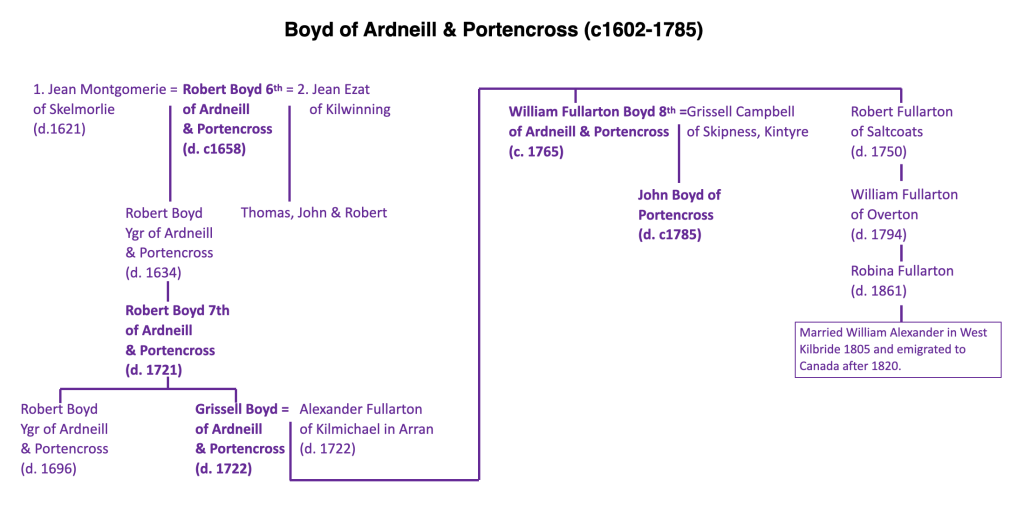
Fig. 9 – Suggested line Boyd of Ardneill & Portencross, 6th to 8th
In grateful memory
Rev George Hill (1810-1900)
Rev Hugh McNeill (d.1893)
Charlotte Violet Trench (1878-1948)
Amy Isabel Young (d.1949)
Hugh Alexander Boyd (1907-1996)
Danny McGill (1944-2013)
Dianne ‘Dee’ Ressinger (1943-2018)
Acknowledgements and thanks
National Archives UK
National Records Scotland
National Library Scotland
Archives Départementales de la Charente-Maritime
Archives Départementales de la Gironde
Public Records Office of Northern Ireland
The College of Arms
The Court of the Lord Lyon
National Archives, St Kitts
Causeway Coast & Glens Borough Council
Waterford City and County Archives
Sligo County Museum
Huguenot Society of South Carolina
Glens of Antrim Historical Society
NIFHS – Causeway Coast & Glens Branch
West Kilbride Museum
The Friends of Portencross
Isle of Arran Heritage Museum
Stephen Goodhart (Boyd Estate, Co Antrim)
Peter Fullarton (Fullarton Archives, Co Antrim)
Jayne & Andrew McGill
Cheves Leland
Renee Marshall
Kate Connolly
Dorothy Arthur
Vivienne Costello
Sharon Oddie Brown
Stephen N Stuart
Peter Hutchinson
Alma Daigle
Shayne Van Rensburg
Diane Baptie
Dr Claire Jarvis
Guy Perron
Billy Kerr
Alistair Hill
Angus Cochrane Patrick (Hunterston Archives)
Stephen Brown
Jeff Holmes
Prof. Louis Cullen, Royal Irish Academy & Trinity College Dublin
Dr Linde Lunney (Dictionary of Irish Biography)
Prof Eileen Murphy (Queens University Belfast, School of Natural and Built Environment)
Dr Colm Donnelly (Queens University Belfast, School of Natural and Built Environment)
Dr William Roulston (Ulster Historical Foundation)
Dr Nic Wright (Ballycastle Museum)
- History of the Counties of Ayr and Wigton, Vol. 3: Cunninghame Pt II, James Paterson (Edinburgh 1866), p. 317 ↩︎
- Topographical Account of the District of Cunningham, Ayrshire compiled about the year 1600, by Mr Timothy Pont with notes and an Appendix, Maitland Club, Ed. John Fullarton (Glasgow 1858), p.159 ↩︎
- Archaeological Journal, Volume 155, 1998 – Issue 1 – Auldhill, Portencross – David H. Caldwell, Gordon Ewart, Jonathan Triscott, Irene S. Cullen, Julie A. Franklin, Fraser Hunter & Leonie Paterson ↩︎
- Portencross Castle – http://www.portencrosscastle.org.uk/ ↩︎
- Amanda Beam, John Bradley, Dauvit Broun, John Reuben Davies, Matthew Hammond, Neil Jakeman, Michele Pasin and Alice Taylor (with others), People of Medieval Scotland: 1093–1371 (Glasgow and London, 2019), www.poms.ac.uk [accessed January 2024], Document 1/53/75 (RRS, v, no. 67) ↩︎
- The Peerage of Scotland Containing an Historical and Genealogical Account of the Nobility of that Kingdom (1716), p.242b ↩︎
- National Library of Scotland (NLS) Ref.Adv.MS.34.3.9, p.58 ↩︎
- Transcription of Crawfurd MSS by Diane Baptie ↩︎
- Topographical Description of Ayrshire; More Particularly of Cunninghame: Together with Genealogical Account of the Principal Families in the Bailiwick, George Robertson (Edinburgh, 1820), Ardneil pp.124-127 ↩︎
- A genealogical account of the principal families in Ayrshire, more particularly in Cunninghame Vol I, George Robertson (Edinburgh 1823), pp. 112-121 ↩︎
- Topographical Account of the District of Cunningham, Ayrshire compiled about the year 1600, by Mr Timothy Pont with notes and an Appendix, Maitland Club, Ed. John Fullarton (Glasgow 1858), pp. 29, 40, 159-162 ↩︎
- History of the Counties of Ayr and Wigton, Vol. 3: Cunninghame Pt II, James Paterson (Edinburgh 1866), pp. 317-321 ↩︎
- Cunninghame Topographized by Timothy Pont A.M. (1604-1608) with continuations and illustrative notices by the late James Dobbie of Crummock F.S.A. Scot and edited by his son John Sheddan Dobie (Glasgow 1876), pp.357-359 ↩︎
- Registrum magni sigilli regum Scotorum : The register of the Great seal of Scotland, A.D. 1306-1668 / published by the authority of the Lords commissioners of H.M. Treasury v.1 (1306-1424) (Edinburgh, 1912), No.477, p.169 ↩︎
- ‘THE BOYD TOMB AT KILMARNOCK’ – Andrew B. W. MacEwen, American Society of Genealogists ‘The Genealogist’ Spring 2010, pp.52-64 ↩︎
- The Peerage of Scotland Containing an Historical and Genealogical Account of the Nobility of that Kingdom (1716), p242, footnote (c) ↩︎
- Calendar of Writs Preserved at Yester House 1166-1503, Sottish Record Society Ed. Charles Harvey (Edinburgh 1916), No.95, p.56 ↩︎
- Registrum magni sigilli regum Scotorum : The register of the Great seal of Scotland, A.D. 1306-1668 / published by the authority of the Lords commissioners of H.M. Treasury v.2 (1424-1513) (Edinburgh, 1882), No.1049, p.218 ↩︎
- We would like to acknowledge the kind assistance of Mr Alistair Hill who brought McEwan’s article to our attention and assisted us in drawing up the revised lineage for the Boyds of Portencross. ↩︎
- National Records of Scotland (NRS) Ref. GD3/1/1/20/1 ↩︎
- Memorials of the Montgomeries, Earls of Eglinton, William Fraser (Edinburgh 1859) Vol. 2, p.46 ↩︎
- NRS Ref. GD3/1/1/15/14 ↩︎
- Registrum secreti sigilli regum Scotorum. The register of the Privy seal of Scotland, Livingstone (Edinburgh, 1908), No.2721, p.419 ↩︎
- Ibid, No. 3440, p.520 ↩︎
- The Scottish Record Society, Protocol Book of Gavin Ros N.P 1512-1532, (Edinburgh 1908), No. 1362, p.242 ↩︎
- The History and Descent of the House of Rowallane, Sir Wm Mure (Glasgow 1825), pp.76-77 ↩︎
- Topographical Account of the District of Cunningham, Ayrshire compiled about the year 1600, by Mr Timothy Pont with notes and an Appendix, Maitland Club, Ed. John Fullarton (Glasgow 1858), p. 16 ↩︎
- NRS Ref. GD8/140 ↩︎
- A genealogical history of the family of Montgomery : including the Montgomery pedigree, Thomas Harrison Montgomery, (Philadelphia 1863), p.63 ↩︎
- NRS Ref. GD8/167 – see also GD8/24 ↩︎
- ibid. GD8/170 ↩︎
- Ibid GD8/196 ↩︎
- The History and Descent of the House of Rowallane, Sir Wm Mure (Glasgow 1825), p.77 ↩︎
- NRS Ref. GD8/222 ↩︎
- NRS Ref. GD1/26/16 ↩︎
- NRS Ref. GD8/227 ↩︎
- Registrum secreti sigilli regum Scotorum. The register of the Privy seal of Scotland, Livingstone 1546-1580 (Edinburgh, 1886), No.2201, p.580 ↩︎
- Register of Testaments of Edinburgh Commissary Court – CC8/8/27 images 207-8, transcribed by Diane Baptie ↩︎
- Testaments of the Commissary Court of Edinburgh – ScotlandsPeople – Ref. CC8/8/27 images 207-8 ↩︎
- Register of Testaments of Edinburgh Commissary Court – CC8/8/37, images 79-81, transcribed by Diane Baptie ↩︎
- West Kilbride, Annals of an Ayrshire Parish, Rev John Lamb (1st Ed. 1896) – (Paisley 2007), p.114 ↩︎
- Muniments of the Royal Burgh of Irvine Vol II, Ayrshire & Galloway Archaeological Association (Edinburgh 1891), p.37 ↩︎
- Ibid, p.41 ↩︎
- Ibid, p.242 ↩︎
- Index to Secretary’s Register of Sasines for Sheriffdom of Ayr and the Bailiaries of Kyle, Carrick and Cunninghame (Ayrshire Sasines) 1599-1609, p.15 ↩︎
- Ayrshire Sasines 1599-1609, Vol. 3 Fol. 388 ↩︎
- Some Family Papers of the Hunters of Hunterston, M S Shaw W.S. (Edinburgh 1925), p. 37 ↩︎
- Cunninghame Topographized by Timothy Pont A.M. (1604-1608) with continuations and illustrative notices by the late James Dobbie of Crummock F.S.A. Scot and edited by his son John Sheddan Dobie (Glasgow 1876), p.190 ↩︎
- Some Family Papers of the Hunters of Hunterston, M S Shaw W.S. (Edinburgh 1925), pp. 45-46 ↩︎
- Muniments of the Royal Burgh of Irvine Vol II, Ayrshire & Galloway Archaeological Association (Edinburgh 1891), pp.245-251 ↩︎
- The History of Irvine: Royal Burgh and New Town, John Strawhorn (Edinburgh 1985), p.244 ↩︎
- Journal of Association for the Preservation of the Memorials of the Dead in Ireland, Vol I, (1888-91), p.127 ↩︎
- The Annals of the Parish of Derrykeighan from AD 453 to AD 1890, Rev Hugh McNeill M.A. (Belfast 1910), p. 76 ↩︎
- Calendar of Close & Patent Rolls of Ireland – James I, Morrin p.209 ↩︎
- Ibid p.339 ↩︎
- Journal of the Association for the Preservation of Memorials of the Dead in Ireland, Vol I (Dublin 1891), p.291. ↩︎
- History of Derrykeighan Parish for Three Centuries by Thomas Camac (1908) ↩︎
- Testaments of the Commissary Court of Glasgow – ScotlandsPeople Ref. CC9/7/8 image 485-8 ↩︎
- Ayrshire Sasines 1599-1609, Vol 3, Fol. 388 ↩︎
- Register of Testaments of Glasgow Commissary Court – CC9/7/8 image 485-8, transcribed by Diane Baptie ↩︎
- Ayrshire Sasines 1599-1609, Vol. 2 Fol. 52 ↩︎
- Inquisitionum Ad Capellam Domini Regis Retornatarum, Quae in Publicis Archivis Scotiae Adhuc Servantur, Abreviatio (Retour of Heirs) Vol I, Ayr No.37 as ↩︎
- Retour of Heirs Vol I, Ayr No. 200 ↩︎
- NRS Ref. GD8/458 ↩︎
- Testaments of the Commissary Court of Glasgow – ScotlandsPeople Ref. CC9/7/33, Image 238 ↩︎
- Index to particular register of Sasines for Argyle, Dumbarton, Bute, Arran and Tarbert, 1617-1780, p.342 ↩︎
- The book of Dumbartonshire: a history of the county, burghs, parishes, and lands, memoirs of families, Joseph Irvine (Edinburgh & London 1879), pp. 210-211 ↩︎
- https://canmore.org.uk/site/42497/darleith-house ↩︎
- Ayrshire Sasines 1599-1609, Vol. 1 Fol. 143 ↩︎
- Ibid Vol. 3 Fols. 223 & 347 and Vol. 5 Fol. 247 ↩︎
- Ibid Vol. 1 Fol. 20 ↩︎
- Fastii Eclesiae Scoticanae Vol III, Glasgow & Ayr, p. 128 ↩︎
- NRS Ref. GD3/2/10/26 ↩︎
- Testaments of the Commissary Court of Glasgow – ScotlandsPeople Ref. CC9/7/19, Image 447-450 ↩︎
- Testaments of the Commissary Court of Glasgow – ScotlandsPeople Ref. CC9/7/26, images 565-7 ↩︎
- Ayrshire Sasines 1617-1634, Vol 5 Fols. 58 & 59 ↩︎
- Testaments of the Commissary Court of Glasgow – ScotlandsPeople Ref. CC9/7/26, images 843- 5 ↩︎
- Testaments of the Commissary Court of Glasgow – ScotlandsPeople Ref. CC9/7/19, Image 447-450 ↩︎
- History of the Counties of Ayr and Wigton, Vol. 3: Cunninghame Pt II, James Paterson (Edinburgh 1866), pp. 31 8-319 ↩︎
- Genealogical Account of the Boyles of Kelbourne, Earls of Glasgow by Colonel the Hon. Robert Boyle (1904), p.4 ↩︎
- Ibid ↩︎
- Ayrshire Sasines (1617-1634), Vol. 3 Fol. 373 ↩︎
- NRS Ref. GD3/1/3/47/4 ↩︎
- NRS Ref. GD3/1/3/47/17 ↩︎
- The Register of the Great Seal of Scotland (1634-1651) Vol. 9 (Edinburgh 1897). No. 587, P.211 ↩︎
- Ayrshire Sasines (1635-1660), Vol. 7 Fol. 549 ↩︎
- Register of the Great Seal of Scotland Vol 9 (1634-1651), p.211 No. 587 ↩︎
- Ayrshire Sasines (1635-1660), Vol 9, Fols 557, 557A & 557B ↩︎
- Index to the Particular Register of Sasines of Argyll, Dunbarton, Bute, Arran & Tarbert (1617-1780), Vol.1 Fol. 20 (Dunbarton) ↩︎
- Ayrshire Sasines (1635-1660), Vol. 7 Fol. 443 ↩︎
- NRS Ref. GD3/1/12/21 ↩︎
- NRS Ref. GD3/2/32/7 ↩︎
- Ayrshire Sasines (1635-1660), Vol.9 Fol.464 ↩︎
- Testaments of the Commissary Court of Glasgow – ScotlandsPeople Ref. CC9/7/30, Images 312-313 ↩︎
- Testaments of the Commissary Court of Glasgow – ScotlandsPeople Ref. CC9/7/28. Images 1020-1021 ↩︎
- Retour of Heirs Vol I, Ayr No.505 ↩︎
- Ayrshire Sasines (1635-1660), Vol.9 Fol.196 ↩︎
- Ayrshire Sasines (1635-1660), Vol.9 Fol.265 ↩︎
- NRS Ref. JC39/92 ↩︎
- NRS Ref. SIG1/14/31 – Signature to the five merk lands of Arneill ↩︎
- Topographical Account of the District of Cunningham, Ayrshire compiled about the year 1600, by Mr Timothy Pont with notes and an Appendix, Maitland Club, Ed. John Fullarton (Glasgow 1858), p.161 ↩︎
- National Library of Scotland (NLS) Ref.Adv.MS.34.3.9, p.58 ↩︎
- Memorials of the Montgomerie’s Earls of Eglinton, William Fraser (Edinburgh 1859), p.163 ↩︎
- Scots-Dutch Links in Europe and America, 1575-1825, Volume 1, David Dobson, p.13 [NAS.RD4.78.621] ↩︎
- Cunninghame Topographized by Timothy Pont A.M. (1604-1608) with continuations and illustrative notices by the late James Dobbie of Crummock F.S.A. Scot and edited by his son John Sheddan Dobie (Glasgow 1876), p.359 ↩︎
- History of the Counties of Ayr and Wigton, Vol. 3: Cunninghame Pt II, James Paterson (Edinburgh 1866), p. 320 ↩︎
- ScotlandsPeople – Old Parish Registers – Marriages 620/ West Kilbride, Page 97 of 246 ↩︎
- History of the Counties of Ayr and Wigton, Vol. 3: Cunninghame Pt II, James Paterson (Edinburgh 1866), p. 320 ↩︎
- ScotlandsPeople – Old Parish Registers – Marriages 620/ West Kilbride, Page 107 of 246 ↩︎
- Ibid – Old Parish Registers – Births 620/ West Kilbride, pp. 143, 154, 164, 182, 194 and 208 of 453 ↩︎
- Ibid – Old Parish Registers Marriages 620/ West Kilbride, Page 166 of 246 ↩︎
- Ibid – Statutory Registers – Deaths 620/9 (1873) ↩︎
- ScotlandsPeople – Old Parish Registers Births 620/ West Kilbride, Page 373 of 453 ↩︎
- Ibid – Old Parish Registers – Marriages 620/ West Kilbride, Page 202 of 246 ↩︎
- A Dictionary of Scottish Emigrants to Canada before Confederation. Toronto: Ontario Genealogical Society. Volume 2, Donald Whyte (1995) ↩︎
- Topographical Account of the District of Cunningham, Ayrshire compiled about the year 1600, by Mr Timothy Pont with notes and an Appendix, Maitland Club, Ed. John Fullarton (Glasgow 1858), p. 162 ↩︎
- Cunninghame Topographized by Timothy Pont A.M. (1604-1608) with continuations and illustrative notices by the late James Dobbie of Crummock F.S.A. Scot and edited by his son John Sheddan Dobie (Glasgow 1876), p.359 ↩︎
- NRS GD214/705 ↩︎
- NRS GD437/151 ↩︎
- Index to the Particular Register of Sasines of Argyle Dunbarton Bute Arran and Tarbet 1617-1780, Vol.8 Fol.98, Argyle ↩︎
- Ibid Vol.9 Fol.452 ↩︎
- State Archives of North Carolina – Collection: McAllister Family Papers, Ref. PC. 1738.1-2, 1747—1935 ↩︎
- ScotlandsPeople – Wills and testaments Reference CC2/3/12, Argyll Commissary Court, Image 229 Last image 231 ↩︎
Pingback: The Boyds of France (Part I) – Derrykeighan and Beyond