As mentioned in our previous post on the The Boyds of Ardneil & Portencross, Ayrshire, Scotland, the youngest son, George, of Archibald 5th laird of Portencross went to France, possibly before 1603. This is supposed from a form of memoir dating to c1760, possibly relating to Jacques Boyd, Chatelain de Cantenac who will be discussed later, held in the archives of the Archives Bordeaux Métropole.1 It appears to provide a brief summary of the Boyd family in France as follows:
« Memoire sur l’etablissement, en France,de la famille de M. BOYD.
Les auteurs du s. BOYD n’ont jamais eté sujets de la couronne d’Angleterre.
Son trisayeul, Ecossois, vint s’etablir en France, avant la reunion de l’Ecosse à l’Angleterre. Il se maria à La Rochelle, son fils, ayant quelque tinture du comerce vint s’etablir à Bordeaux où naquit le pere de celuy dont il s’agit. Lequel etoit d’une reputation sy bien etablie qu’on luy accorda, en 1670, des lettres de bourgeoisie.
La famille du sr Boyd n’a jamais eu besoin de lettres de naturalité. Son trisayeul, suivant le traitté d’amitié qui subsistoit alors entre la France et l’Ecosse, ayant joui, à son arrivé en France, de tous les privileges de la nation (renvoi en marge ^). Le s. BOYD est François d’origine, depuis deux cens ans, et ce n’est que par une meprise qu’on a pû le comprendre dans la liste des Anglois, Irlandois et Ecossois.
Le s. BOYD destinant ses enfants au meme comerce qu’il fait, il luy a eté obligé de les envoyer, en bas age, en Irlande pour aprendre la langue, ainsy que le pratiquent les negociants françois
(en marge ^ : confirmés par plusieurs arrets des conseils)
qui comercent en Angleterre. Le sr BOYD a, cependant, eu attention de n’envoyer deux de ses enfants qu’après en avoir obtenu la permission du Roy. Ces deux enfants, l’ainé agé de 20 est de retour depuis trois ans ; le cadet, agé de 19, revint l’année derniere de Hollande, où il a resté 3 ans. Ils sont actuellement auprès du pere, qu’ils aydent dans son comerce ».
We are grateful to Mr Baptiste Etienne – Paléographe for a transcript of the document.
Memoir on the establishment, in France, of the family of Mr. BOYD.
The ancestors of Mr. BOYD were never subjects of the English crown.
His great-great-grandfather, a Scotsman, came to settle in France before the union of Scotland with England. He married in La Rochelle; his son, having some involvement in commerce, came to settle in Bordeaux, where the father of the one in question was born. This latter man had such a well-established reputation that he was granted letters of citizenship in 1670.
Mr. Boyd’s family never needed letters of naturalization. His great-great-grandfather, according to the treaty of friendship that then existed between France and Scotland, enjoyed, upon his arrival in France, all the privileges of the nation (in the margin ^).
Mr. Boyd has been French by birth for two hundred years, and it was only through a mistake that he was included in the list of English, Irish, and Scottish citizens.
Mr. Boyd, intending his children for the same trade he himself engages in, was obliged to send them, at a young age, to Ireland to learn the language, as was the practice among French merchants
(in the margin: confirmed by several rulings of the councils)
who trade in England. Mr. Boyd, however, was careful to send two of his children only after obtaining the King’s permission. These two children, the elder aged 20, have been back for three years; the younger, aged 19, returned last year from Holland, where he had stayed for three years. They are currently with their father, whom they assist in his business.
*Translation via Google
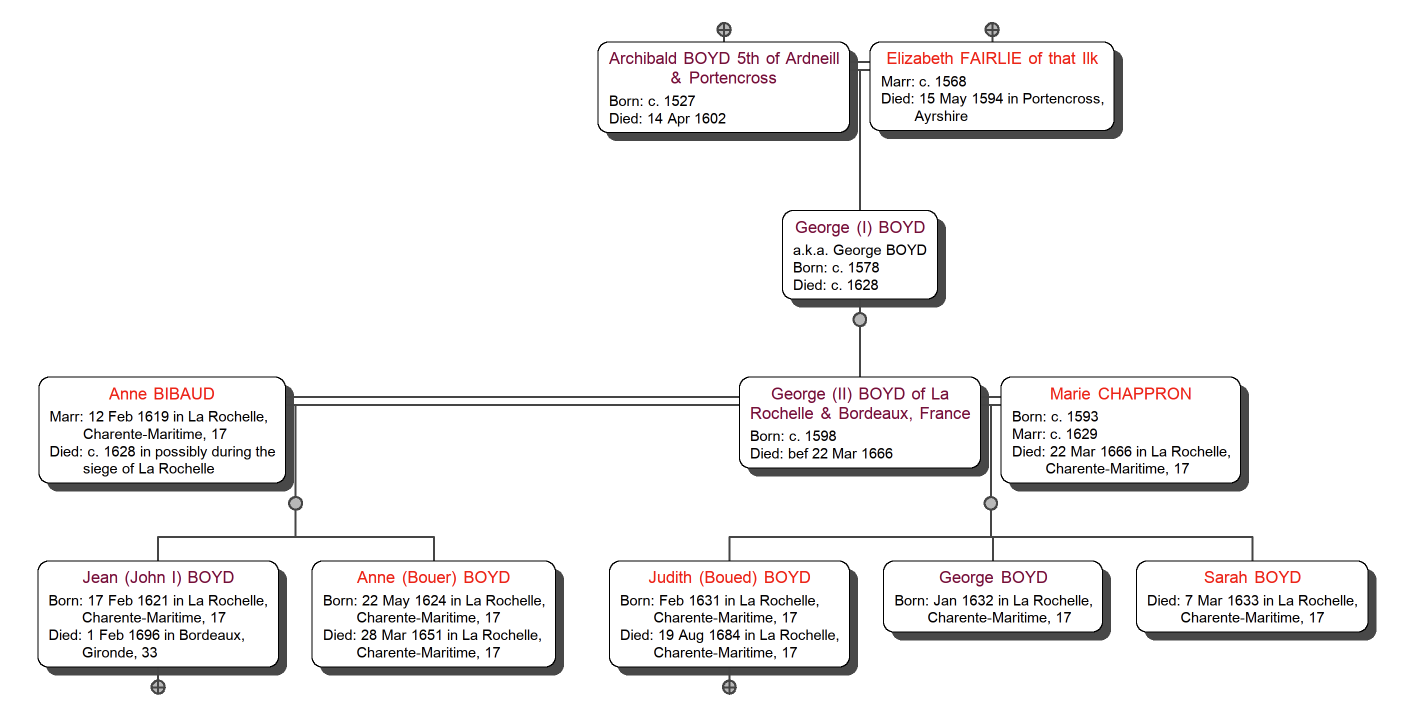
George (I)2Boyd (c1578-c1628) of La Rochelle, Charente Maritime, France
Unfortunately details of George Boyd (I), son of Archibald 5th Laird have not been found amongst the archives of la Rochelle to date, however the marriage (see p.72 of 91 in Register) of his son George (II) was found dating to 12 February 1619 in the Temple St Yon, La Rochelle recorded as George boid et Anne bibault. The officiating minister was Michel Blanc who signed the register. George Boyd (II) marriage to Anne Bibault o/w Bibaud was by all appearences a most fortuitous connection. Anne’s brother Jacques had also married in 1619, Louise Gassen, and by 1640 he had received letters from the bourgeoisie of La Rochelle on 8 July 1640. Jacques Bibault’s elevation into the bourgeoisie provided certain benefits within the mercantile and civic structures of the city. Louise’s uncle was the famous french banker Pierre Tallemant and Jacques would go on to hold civic titles as well as a successful career in banking. Such connections would no doubt prove priceless in the development of any Boyd family business.
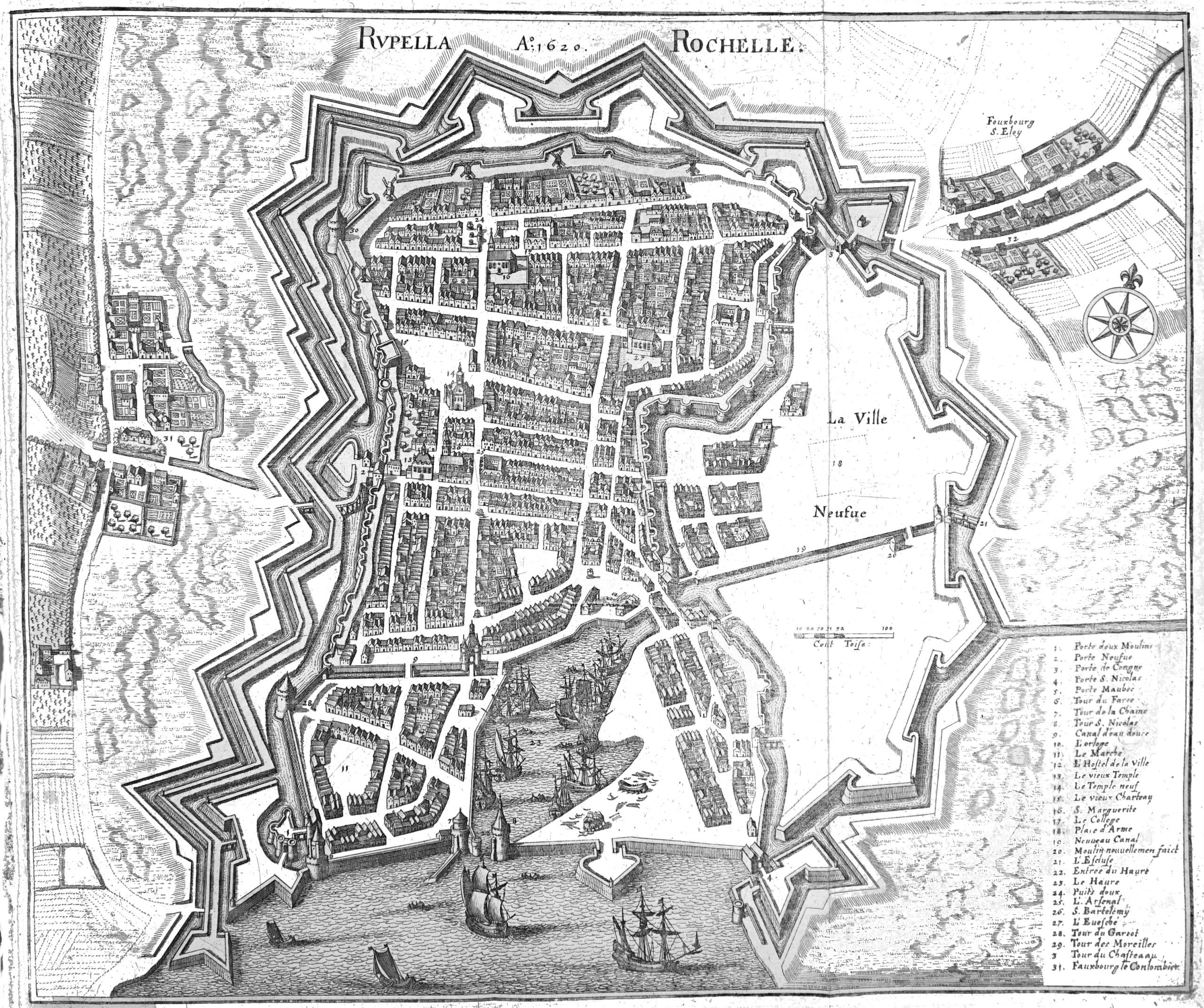
La Rochelle was one of the most important ports and commercial centres in France by the mid 16th century. Physically it’s relatively deep water port next the sea gave it an advantage over other river born ports. Also its location on the west coast provided fast access to transatlantic trade and competition with the Spanish. The colonization of New France from the 16th century was a strategic business connection for La Rochelle and the first french colonial empire. It comprised New France (including Canada and Louisiana), French West Indies (including Saint-Domingue, Guadeloupe, Martinique, Dominica, St. Lucia, Grenada, Tobago and other islands) and French Guiana. Salt and wine were the the two main exports from La Rochelle with the port also importing coal and leather from Scotland, textiles from England and the low countries as well as salted beef, butter and herrings from Ireland. There is little doubt that the Boyd family of Portencross were more than aware of the opportunities available to them in La Rochelle and how their likely mercantile contacts in the British Isles could be of enormous help. Alongside other scottish merchants, La Rochelle also attracted merchants from England, Wales and of course Ireland. Another possible attraction for British merchants in particular was the religious makeup of La Rochelle at this time.
In 1568, La Rochelle became the capital of French Protestantism. In 1571, it hosted the first national synod of the Reformed Churches, which adopted the Confession of La Rochelle, a founding text. The protestant community within La Rochelle were mainly Huguenots and many of the british merchants would quickly integrate into the Huguenot congregations in the city and intermarry thus creating a remarkably international community. However relations between the Huguenots and the french crown had a stormy history resulting in the french wars of religion. This would lead to one of the most notrious events in european history the Siege of La Rochelle (10 September 1627 – 28 October 1628). The siege resulted in the death of around 22,000 inhabitants (perhaps 80% lost to the conflict, disease and famine) and around 5,000 troops under the command of George Villiers, 1st Duke of Buckingham. In a later testimony Jean (I) Boyd would refer to being sent away as a boy to Scotland to live with family. Perhaps Jean (I) being sent to Scotland was a reaction to worsening tensions in La Rochelle, prior to the siege.
George (II) Boyd (c1598-c1658) of La Rochelle, Charente Maritime, France
George (II) Boyd remained in La Rochelle with wife Anne Bibault and on 19 February 1621 we find record of the baptism (see p.85 of 183 in Register) of what we believe was their first born, a son, Jean (hereafter we refer to him as Jean (I)) who was recorded as Johan by the officiating cleric, who was possibly Dutch, in the Temple St Yon, La Rochelle. The register also recorded that a Johan (John) Vaughan was the godfather, who duly signed the register. We will return to the life of Jean (I) Boyd in more detail in a later post.
Three years later on 24 May 1624 we find the baptism (see p.78 of 173 in Register) of a second child, Anne and Jacques Bibaud appears as godfather. The birth of Anne was just a few years prior to the siege of the city and there is little chance that the Boyd family would emerge from this catastrophe unscathed unless steps had been taken to leave the city before the siege. Unsurprisingly it is not until February 1631 before we find the next child born to George (II) Boyd. However it would appear that George (II) wife Anne Bibault had probably died in the siege for the baptism (exact date unknown – see p.10 of 87 in Register) is for Judith daughter to George Boyd and Marie Chappron in the Temple de Villeneuve. Sadly to date details of the likely death of Anne Bibault have not been found and likewise for George (II) Boyd’s marriage to Marie Chappron.
George (II) Boyd and Marie Chappron remained in La Rochelle and we must presume that despite the horrors and deprivations of the siege he must have managed to retain some degree of business to support his family. On 4 January 1632 we find the baptism (see p.36 of 87 in Register) of a son George in the Temple de Villeneuve. But sadly the following year in 1633 we find record of the burial (see p.8 of 137 in Register) in La Rochelle of a previously unknown daughter Sarah. Perhaps she was merely a baby at the time.
Nearly 20 years pass before the next record of the family is found in the form of a burial (see p.42 of 291 in Register) in La Rochelle for Anne on 28 March 1651, aged 27 years. Some time after this must have been the death of George (II) Boyd as on 22 March 1666 we find the burial (see p.251 of 291 in Register) of Marie Chappron, widow of George (II) Boyd aged 74 yeaars in La Rochelle. Unfortunately no record of George (II) Boyd’s death has been found to date but we must presume it occurred (1651-66).
Judith Boyd (1631-1684) of La Rochelle, Charente Maritime, France
As mentioned earlier Judith was born in February 1631 in La Rochelle. With both her parents deceased it likely fell to her to take up her fathers business as it appears her younger siblings George and Sarah had both predeceased her. Just 3 months after the death of her mother on 12 June 1666, Judith married (see p.556 of 559 in Register) Edward Moore, a merchant from Bristol involved in the salt trade, in the Temple de Villeneuve in La Rochelle.
Edward Moore appears to have had extensive dealings with George McCartney of Belfast. In a series of letters3 from 1 January 1660 to 20 December 1667 George McCartney writes on many subjects typical of the merchant trade of the time e.g. on 25 September 1663 he writes:
“Says he will pay him what he owes in butter which he is sending in the “William”, John Boyd being the master. Says “that business of Thos. Pottinger was a bad voyage… he brought me in debt”. Says Thos. Pottinger is now married. Tells him that the “Angel Gabriel” is ready to set out for Cadis and on her return, if corn is dear, he will send her loaded with wheat to Moore. Does not know if he will send for wine for he has sent butter to Rouen and if the wine there is good he will get it there. Says he will pay Mr. Trustin from Rouen.”
George McCartney also wrote to Edward’s brother Thomas Moore in Bristol. Outgoings from La Rochelle included salt and brandy which were traded throughout europe and the British Isles but also transatlantic.
In 1663 we find an incident4 involving a vessel owned by Edward Moore:
“Another curious and interesting incident took place in this country.-year 1663. The authorities of Brouage (Charente Maritime) seized an English ship on the Seudre river, the ‘Samaritan’ of Bristol, for compensation for the seizure of a ship from La Rochelle in Wales. Now, the Samaritan belonged to an English shipowner, Edward Moore, established in La Rochelle and was commanded by William Corkil, also an Englishman from La Rochelle. It was loaded with salt. The damages claimed amounted to 5,830 livres”
On 15 February 1668 we find the baptism (see p.9 of 1493 in Register) of a son Edward Moore Jnr in La Rochelle. Present where godparents, half-uncle Jean (I) Boyd and paternal grandmother Marie Vaughan.
Judith’s husband Edward Moore was a close friend of André or Andrew Stuckey5 (b.c1633) a Cornish born merchant living in La Rochelle who married Magdeleine Freyhoff (The Freyhoffs were a Dutch merchant family living in La Rochelle involved in european and transatlantic trade) on 21 October 1668 in La Rochelle. Edward was a witness to the wedding. Later the same year on 30 December 1668 we find the baptism (see p.70 of 1493 in Register) of Edward and Judth’s second child, a son Jean and present were godparents William Flament, a merchant of La Rochelle and Christine Freyhoff. Sadly Jean Moore survived only 2 days and was buried (see p.71 of 1493 in Register) on 31 December 1668 in La Rochelle.
On 19 August 1670 we find the baptism (see p.288 of 1493 in Register) of Edward & Judith Moore’s likely third child, Elizabeth Judith, in La Rochelle. The godparents were Thomas Moore Jnr, merchant of Bristol (Edward’s brother) and Christine Freyhoff in place of Jeanne Pascaud, wife of Jean (I) Boyd, merchant of Bordeaux who was Judith’s half-brother. Just 3 days later a son, André, to André Stuckey and Magdeleine Freyhoff was also baptised in La Rochelle.
On 20 September 1671 we find the baptism (see p.372 of 1493 in Register) of Edward and Judith’s fourth child, Marie, in La Rochelle. The godparents present were André Stuckey and Marie Vandermeer and then on 15 January 1673 we find the baptism (see p.490 of 1493 in Register) of Edward and Judith’s last child, Jean, in La Rochelle. The godparents present were Guillaume (William) Flamang [Flamant] and Madelaine Boyd (perhaps a previously unidentified half-sister of Judith and sister of Jean (I) Boyd).
The following year on 24 March 1674 we have the death ( see p.597 of 1493 in Register) of Edward Moore in La Rochelle, aged just 44 years. His burial was attended by Guillaume Flamant and Charles Davis, merchants of La Rochelle. Just a few weeks later we have the death (see p.598 of 1493 in Register) of baby Jean, aged just 15 months in La Rochelle. Again Guillaume Flamant and Charles Davis were in attendance. Still in 1674, 16th June we see the death (see ppp.48 & 49 of 961 in Register) of Charles Davis, aged just 22, who had attended the last two Moore funerals. It records that he was a native of Wales and his parents were Charles Davis, merchant and Sarah Moore. The burial was attended by Abraham Duport and William Baird, merchants and friends of the deceased. Finally in what had been a tragic year for the Moore family on 5 August 1674 we find the death (see p.627 of 1493 in Register) of Marie Moore aged just 3 years in La Rochelle. The burial was attended by William Flamant and Abraham Duport merchants of La Rochelle and cousin and friend of the deceased.
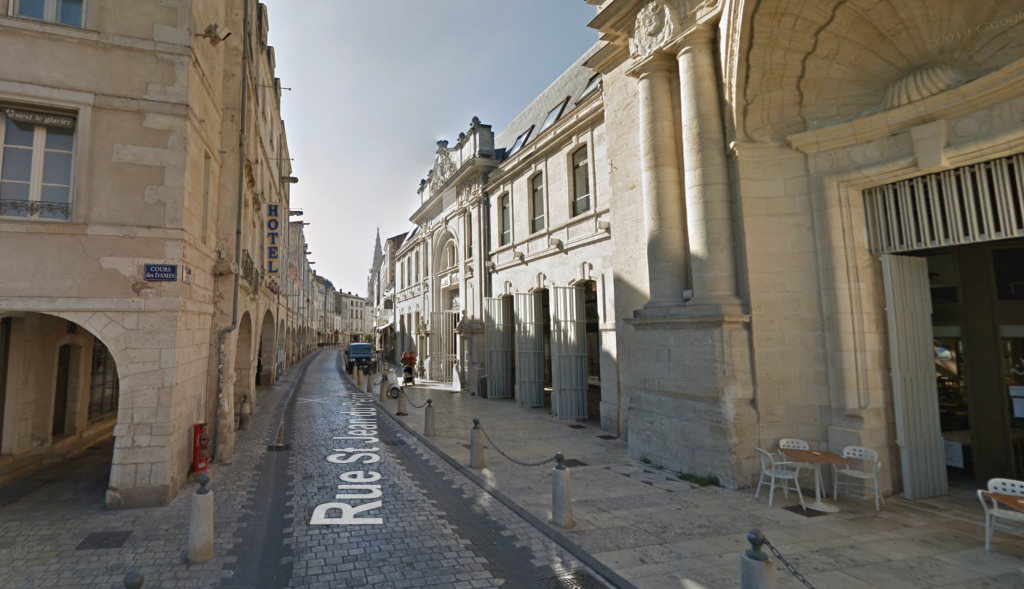
Thanks to the work6 of the late La Rochelle historian Bernard Coutant we have a record of where Judith Moore was living after her husband’s death:
“Behind the coastal walls, and facing the street, one encountered an old tennis court, and next to it a house that had belonged to the Augustinans; then in 1669, to Ozée Nesson, and, in 1673, to Billard. The next house was that of the widow Simon, née Cazeaubon, heiress of Pierre Simon and Lebeau, his wife. Richard Butler had, in addition to his new house, with three wings, on Rue du Pont de la Verdière, a house on Rue du Perrot [now Rue de St Jean du Perot], which adjoined that of Judith Bois, widow of Edouard Moor, who owned a large enclosed property at Lafont, at Gué Brouart, adjoining the road to Marsilly.”
By the end of 1674 Judith was left a widow with her only son Edward Moore just six years of age. She appears to have entered into business with local merchant Abraham Duport. According to Prof. David Hancock7 the firm of Duport & Moore where brandy exporters based in St Martins de Ré on the island of Isle de Ré off the coast of France at La Rochelle.
Thanks to the survival of the correspondance of William Freeman, a London based merchant, we have a remarkable insight into Abraham and Judith’s business. Three letters including two written directly to Madame Moore & Abraham Duport (notice Judith’s name appearing first may indicate she was the senior partner) are as follows:
- Captain William Clayton [Commander of the Adventure]
London, September 30, 1678
Wee doe herby order you to sayle with the first fayre winde to the port of St. Martins in France and, at your arivall there, to apply yourself to Mad.m Moore and Mr. Abraham Duport, and deliver our letter to them, wherein wee have given necessary orders to them for the ladeing your vessell with brandy and salt, and for the giveing her a speedy dispatch, which being accomplished you are to sayle with the first faire winde to the port of Watterford in Ireland, and to apply yourselfe to our corispondent, Mr. Hen. Alland, whome wee have given order to discharge your ladeing of salt, and to relade upon you 100 barrells of beefe and some pipe staves if to be procured. Which after you have taken on bord and received your orders from Mr. Hen. Alland, you are to sayle directly to the port of Mountsarat, where if you receive any orders from our freind & partner Mr. Robert Helmes, to whome wee have given advise of your comeing & have desired him to leave such orders with Mr. John Bedingfeilde, Mr. W.m Fox or Mr. Otto Curtis of whom you are imeadietly to make inquiry, without makeing the least discovery of your ladeing except of beefe from Ireland, and what orders you shall receive from s.d Helmes. If any there lyinge for you, you are to observe and follow, either in unladeing your vessell at that island or in proceedeing to any other as he shall direct, without any delay of time. But in case s.d Helmes hath left noe orders for you at Mountsarat affores.d, then you are imeadietly to way your ankors, and sayle directly to Nevis and apply yourselfe to our affores.d p.tner Mr. Robert Helmes, from whome you are to observe and follow such orders as you shall rec.e from him in discharging your ladeing there or, if he shall thinke fitt to order you to any other port or place to discharge your ladeing, you are alsoe to observe his orders therein. And, haveing soe discharged your ladeing, you are to follow such further orders as you shall receive from him in reladeing your vessell at the affores.d island of Nevis or any other as he shall direct, and to retourn to England or any other port of place as he shall order you. But in case of the death (which God forbid) or the absence of Mr. Robert Helmes upon the s.d island of Nevis, you are then to apply yourself in the same maner as affores.d to Mr. W.m Helmes, and to deliver letters directed to Mr. Rob Helmes to him s.d W.m Helmes and follow his orders in maner as affores.d. Now, at your arivall in Watterforde, you must give out that you are bound to Tangier, and not to acknowledge any other place, and at your arivall in the West Indies at Mountsarat, Nevis, or any other island, you are to enter and give out you come from Ireland and that your ladeing is beefe. But upon entry of the brandy in the Custom Howse, if thereunto required, you must produce your cockett out of this Custome Howse for the same which you have hereinclosed, and offer me the ladeing of it by & at this port accordinge to the tenor of the cocket. Which you must be carefull of but not produce it at any port or place whatsoever upon any tearmes until you arive in the West Indies. If in Ireland or any other port of England they should question the bale of goods contained in the same cocket, rather suffer the s.d bale to be taken on shore than produce the cocket, alleadgeinge you have lost the same. Now at your arivall in the West Indies, you must be carefull to keepe all your men on bord your vessell and suffer them not to have the least converse with any other seamen whatever; and, if at any time [Page 032] there be a necessity for your owne goeinge ashore, as upon your first arivall to wayte upon the governor, be sure to laye a strickt charge with your maete to p.rforme the same dureinge the time you are unladeing or reladeing of your vessell. If your bote caryes any goods on shore or fetches any on bord, be very carefull to goe allwayes with your bote and keepe your men constantly at theire buisness that soe they may have noe oppertunity at any such times, to converce with any other seamen, and leave always the same strickt comand with your men to be kept on bord, dureinge the whole tim of your being there. And alwayes be ready with your vessell to slipp and runn out of the rode upon the least notice from Mr. Helmes if any such occation should happen. This instructions and all other matters [p. 29] relateing to our intrest, we intreat you to be very carfull in observing the manadgem.t thereof and of the whole designe we comitt to your care and prudent manadgem.t, not doubting your diligence in this affare. We hartily wish you a good voyage and subscribe ourselves. - Madame Moore & Abraham Duport [St. Martin’s, France]
London, September 30, 1678
By the recomendation of my good freinds Mr. Ben. Skutt and Mr. Andrew Slirty, Jun.r, I have consigned unto you the ketch Batchellor, burthen about 50 tunns, W.m Clayton, Master, who is now ready to sayle with the first faire winde and at her wished arivall with you at St. Martins, pleas to lade on bord her the quantity of 80 hhds. the very best St. Martins brandy. & If you have occation to draw it of the peeces on bord, if you put good part of it in barrells about 30 or 32 gallons & sume in smaller caske, it may not be amis but rather the better for our purpose. & For the remaind.r of her ladeinge, please to fill up with salt. By the vessell shall give you orders to whome to consigne it, & that you may take the advantage of the market & be buyinge at the best hand as you see cause are the vessell arive. I have herwith sent you a Bill of Exchange drawne p.r Mr. Peter Barr for one thousand crownes at double usance payable in Parris, which doubt not you may negotiate to your sattisfac.ion. & What further you are in disburs I shall take care to sattisfie you by good bills, or answere your draught upon me as you finde sutable for your occation. … - Madame Moore & Abraham Duport [St. Martin’s, France]
London October 2, 1678
The foregoeing lynes is what wrott your p.r the last post. This now accompanyes the ketch Bachelor, William Clayton, Master, of whome I advised you in the foregoeing and whome I desire you to lade the said quantyty of eighty hhds. of St. Martins brandy, the very best you can procure, in such cask as are most my advantadg. And take a Bill of Lading for the same, consigneing it to Mr. Charles Collier in Tanjer. And to fill up said vessell with salt, as much as she can conveniently carry. And to consigne the same to Mr. Henery Alland, Junior, in Waterford in Ireland. We also desire you to writte Mr. Charles Colier, p.r the Master of the vessell. And inclose the Bills of Lading to him, but send the letter to said Collier open under cover of Mr. Henery Allands letter, to whome I intreat you to writte a line or two, also. And inclose him a Bill Lading [Page 033] for the salt. And as sone as you have given the Master & vessell theire dispaches, please to draw upon me what more you shall be in disburse for lading said vessell, beside the 1,000£ already remitted you. Pray give her all dispaches posible. …
The reason for what appears to be a distinctly clandestine business arrangement is due to the recent prohibition of various french exported goods including brandy by an act of the english parliament on 20 March 1678.
Judith Moore stood as godparent at the baptism of Josué, son of Josue Chenailler and Anne Masson in La Rochelle on 21 May 1679 but just five years later on 18 August 1684 we find a record of her death (see p.1471 of 1493) in La Rochelle. She was 53 years old. Her burial was attended by her son Edward and former business partner Abraham Duport.
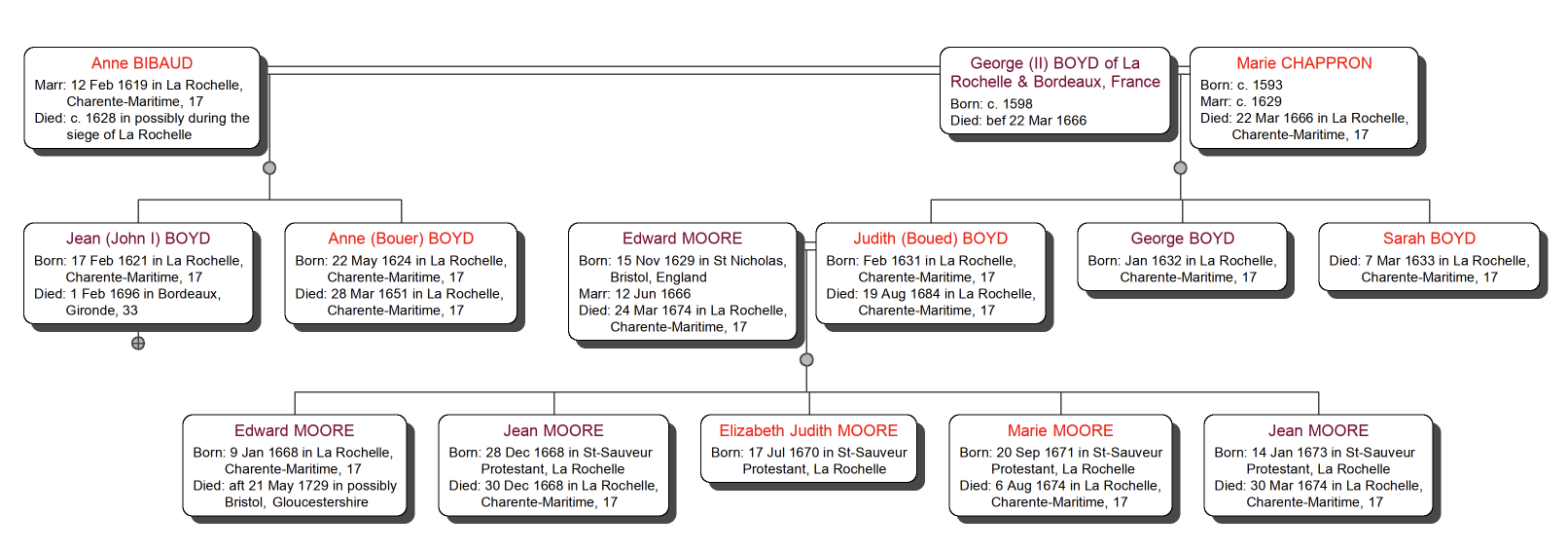
When Judith died her only apparent surviving child was Edward Moore Jnr. He was only sixteen at the time of his mothers death so we must assume he was supported by the wider family until such time as he could manage on his own. Edward’s half-uncle, Jean (I) Boyd, was still alive and we know he said in a later statement of 1686 that he had returned to La Rochelle when he was 22 therefore c1643. Unfortunatley little information has been found of Jean (I) Boyd in la Rochelle and it would seem he moved to Bordeaux some time before 1670.
J F Bosher states of Edward Moore Snr:8
“E.M. owned a house at L.R., rue du Perrot, next door to Richard BUTLER, and a country house at Lafond on the road to Marsilly, both seized when his son and heir went to England in May 1699, never to return except briefly as “trésorier” in the service of John Dalrymple, earl of Stair, envoy extraordinary negotiating the peace before 1713.”
Bosher draws from the text mentioned earlier by Coutant, however he adds that the properties concerned were seized when Edward Moore Jnr went to England in May 1699. Following this we know he was successful in receiving naturalisation9 by oath from the english crown on 24 March 1700/01:
“EDWARD MOORE, born in Rochel in France, son of Edward Moore by Judith, his wife.”
Then as if to corroborate Bosher’s finding a reference is found in the work of Charles Edmund Lart on the Registers of the French Churches of Bristol, Stonehouse and Plymouth10 in which he states in the introduction:
“In 1722 one Edward Moore, a British merchant, petitioned to be reinstated in some property,consisting of certain houses in La Rochelle and the neighbourhood, which he had inherited from his father, who had gone to La Rochelle in 1668, and married in the same year at Paris, Judith Boyd, daughter of a Scottish merchant. He had been dispossessed on the ground that he had left France ‘à cause de religion.’”
In 1728 we find the Will11 of Thomas Moore of Bristol Esq., (cousin of Edward Moore Jnr) amongst the text of which we find the following entry:
“Item I give unto the said Edward Moore the sume of five hundred pounds more to be paid to him out of my personal Estate by my Executor hereafter named within twelve months next after my decease. But it is my Will that he the said Edward Moore doe within six months after my decease in due forme of law seale and execute a deed of release unto my executor of all amounts and earnings that were formerly depending between my late father, myself and his late father Edward Moore and Abraham Duport of Rochelle Merchants and in case Edward Moore shall refuse or neglect to execute such release then my Will is that neither of the said five hundred pounds hereby given or appointed for him shall be paid to him.”
This suggests that some financial arrangement was outstanding from the time of Edward Moore senior and appears to have had some bearing on whether or not his son would receive a legacie from his cousin.
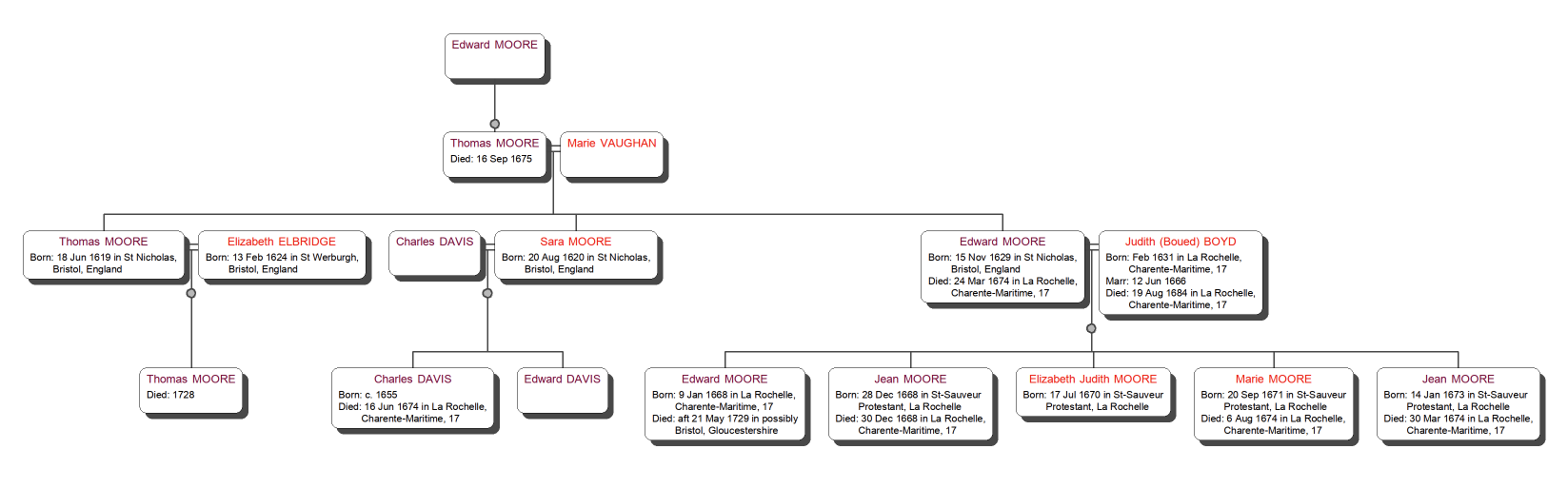
In 2009 a symposium was organised by the London Borough of Bexley at Danson House the former seat of the Boyd family. Various researchers of the Boyd family contributed to the symposium which shed new light on the Boyd families of La Rochelle & Bordeaux in France, French Santee in South Carolina, USA, the family of Hugh Boyd of Ballycastle, Co Antrim, Northern Ireland and the Boyds of Danson Hill, Kent, England. Thanks to the researchers who contributed to the symposium and further research since we now know of the connectivity between all these histories and the ancient Boyd cadet family of Portencross, West Kilbride, Scotland.
One of the most remarkable discoveries was found amongst the Ballycastle Boyd Estate Archives by Danny and Jayne McGill of Ballycastle in the form of a family tree which was referred to at the symposium as ‘Judith’s Tree’.
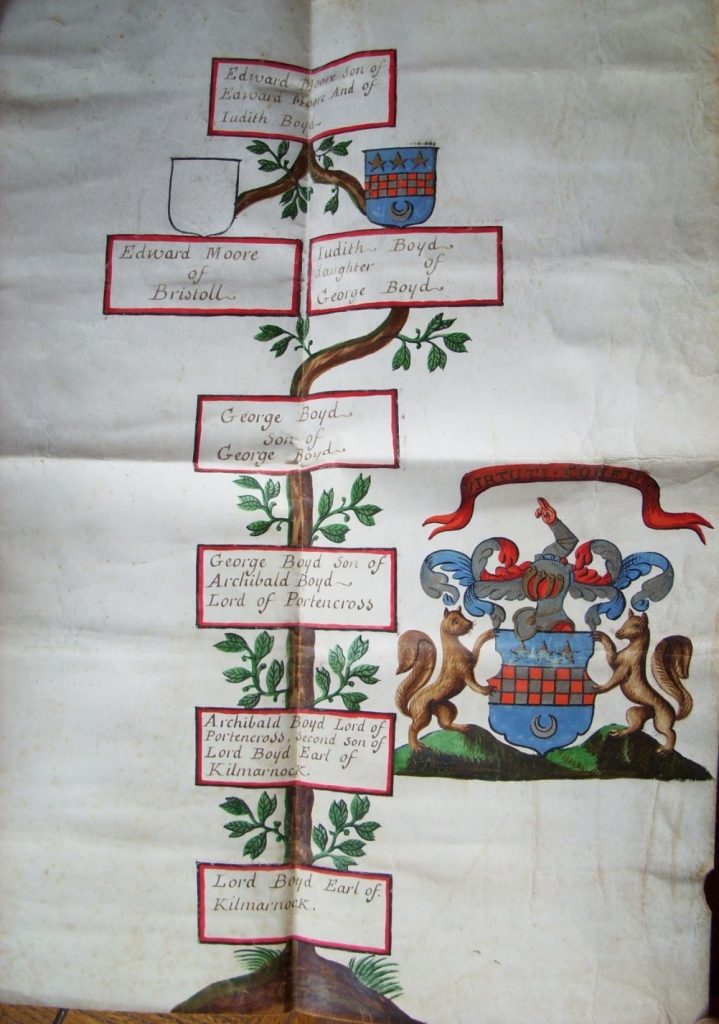
© Ballycastle Boyd Estate Archive – Courtesy of Mr Stephen Goodhart, owner & custodian.
(NOT FOR REPRODUCTION WITHOUT OWNERS PERMISSION)
The document is unfortunately undated but we can surmise a period probably in the early 1700s. The tree ends at Edward Moore Jnr (1668->1728), son of Edward Moore Snr (1629-1674) and Judith Boyd (1631-1684). The spelling of Bristol, England with two l’s had ended by around 1735 so this would support a date for the document during the life of Edward Moore Jnr but more likely towards the end of that period perhaps as a proof of his scottish noble heritage in depicting the origin with the Earl of Kilmarnock which is of course erroneous. Of greater interest is the Arms shown which are almost identical to those awarded to John Boyd, Baronet of Danson Hill in 1775. But perhaps most interesting of all is the trees placement of Archibald Boyd of Portencross as a progenitor although he was a Laird and not a Lord and definitley not the second son of any of the Earls of Kilmarnock. Who created the document or where it was created is still unknown but it has provided a wonderful and important piece in the great jigsaw puzzle of researching the Boyd family.
- Archives Bordeaux Métropole – Ref. Bordeaux II 124 ↩︎
- As the name George passes through the family over a number of generations we will use a numeric suffix for each George to aid identification. ↩︎
- PRONI Ref. MIC19/1 ↩︎
- Bulletin de la société de l’histoire du protestantisme français (1914), p.700 ↩︎
- See Huguenot Merchants and the Protestant International in the Seventeenth Century – Author(s): J. F. Bosher, Source: The William and Mary Quarterly, Jan., 1995, Vol. 52, No. 1 (Jan., 1995), pp. 77-102 ↩︎
- la Rochelle – essais sur la naissance d’unquartier 1628-1689 – Cahier No.1 ↩︎
- The Letters of William Freeman, London Merchant, 1678-1685, ed. David Hancock (London, 2002) ↩︎
- Men and Ships in the Canada Trade 1660-1760, J F Bosher, p.97 ↩︎
- Denizations & Naturalisations of Aliens in England and Ireland, Wm A Shaw (1911), p.309 ↩︎
- Registers of the French Churches of Bristol, Stonehouse and Plymouth (1912) ↩︎
- NA Ref. PROB 11/621/414 ↩︎
This is wonderful – I wish Dee Ressinger were alive to see it. You all have done massive research – very impressive – Thank you.
Cheves
Hi Cheves
Adrian and I certainly wish Dee could have been with us but you both should be proud of the valuable research you did together which was fundamental in allowing us to break new ground and I feel there is more yet to come as I hope that more french notarial records are put online.
Many thanks
Jonathan & Adrian