In our previous post we looked at the earliest member of the Boyd family of Portencross to live in France, George (I) Boyd and then his son George (II) Boyd, both of whom probably resided or were based in La Rochelle, Charente Maritime, France. The previous post (part 1) looked mainly at the descendants of George (II) Boyd’s second marriage to Marie Chappron. Now we turn to look at the son Jean (I) Boyd born to his first marriage to Anne Bibaud on 17 February 16211 and baptised (see p.85 of 183 in Register) 19 February 1621 in La Rochelle.
It would appear that Jean (I) Boyd was sent away whilst still a child to live with family in Scotland. This was declared by him in later life. He also stated that he did not return to France untill the age of 22 therefore c1643. It is of course possible that whilst spending time in Scotland he may have received a formal education there and this was suggested by the late Dianne Ressinger2 in an unpublished essay, possibly dating to 2009. In it she states:
“There is listed among the alumni of the University of Edinburgh, for the year 1642, the name John Boyd. Could he in fact be our Jean Boyd I who claimed to have spent his childhood in Scotland? According to the librarian there, they have no further information on the man, but the years fit perfectly.”
Until very recently there appeared to be very limited information on Jean (I) Boyd from 1642-70. However evidence has come to light which appears to show him working for his uncle Jacques Bibaud, and the banking empire of the Tallemant family, probably from the time of his return from Scotland. In a relatively short while Jean would find himself involved in one of the great financial scandals of 17th century France. However before looking at this in more detail it is perhaps worthwhile recording the principle members of the families involved.
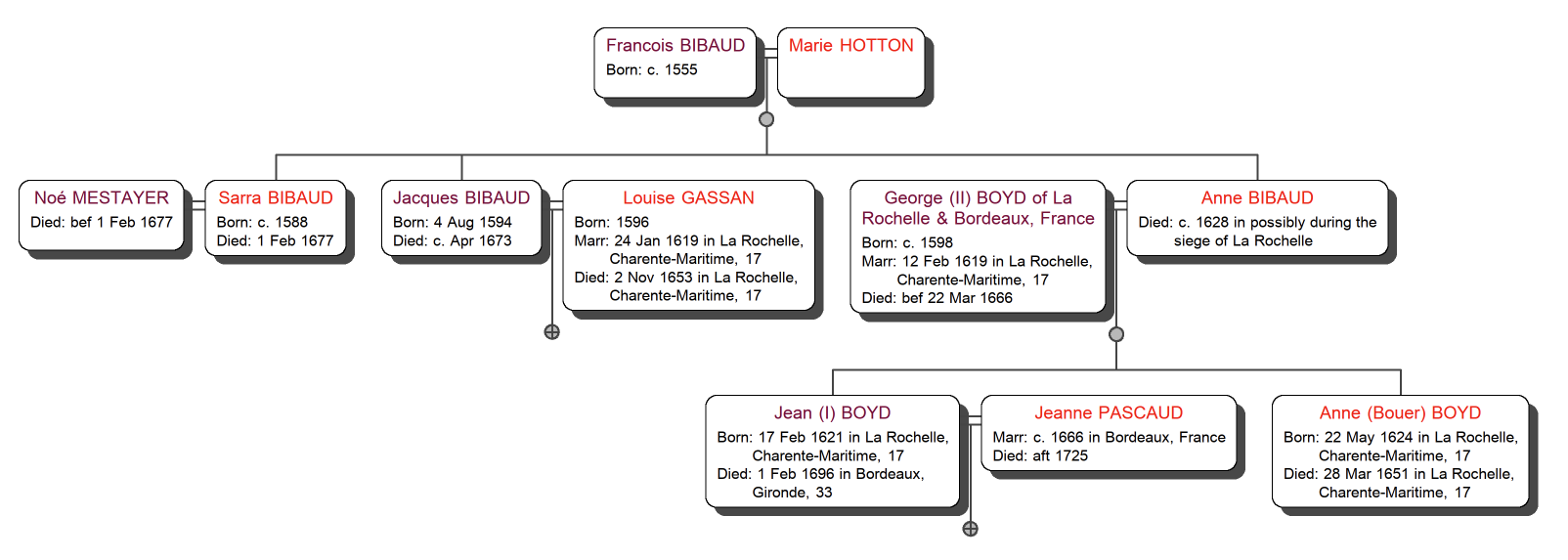

This insight into a major event in the life of Jean (I) Boyd is thanks to the work of Émile Magne. In his research into the life of Gédéon Tallemant des Réaux (1619-92) he writes3 of a developing crisis in the merchant bank of the Tallemant family which involved Jacques Bibaud and his nephew Jean Boyd.
The story begins prior to the death of Henri Bardet in 1619. Bardet had been an agent of the Tallemant family trading post and banking business founded by François Tallemant (a native of Tournai in present day Belgium). François Tallemant had fled to La Rochelle in the late 16th century due to his calvinistic beliefs and from La Rochelle grew a considerable mercantile and banking concern. He had previously married Louise Thevenin. After François’ death in 1609 he was followed by his sons Jacques (died 1626), Gédéon I (died 1634) and Pierre.
By the 1640s the business had grown considerably with a presence in La Rochelle and Bordeaux as well as Paris which included connections and administrative offices held in the court of Louis XIII. Pierre had also been Mayor of La Rochelle in 1600. In 1605 Pierre had married firstly Elisabeth Bidault to whom he had at least two sons and a daughter. Eldest Pierre, later Sieur des Boisneau and Paul, later Sieur des Lussac. Elisabeth Tallemant nee Bidault died some time before 8 September 1619 at which date Pierre Tallemant married Marie Rambouillet. This marriage had issue at least two sons and one daughter. Marie married Henri de Massue (1st Marquis of Rouvigny), Gédéon II (later Sieur des Réaux) and François (Abbot of Val-Chrétien and Prior of Saint-Irénée of Lyon, Chaplain to King Louis XIV and the Dauphine).
As mentioned earlier Henri Bardet died c1619 at which time his widow Louise Gassan took the place of her deceased husband in managing the Tallemant business affairs in La Rochelle. Louise remarried to Jacques Bibaud on 24 January 1619 in La Rochelle after which her husband also assumed a role in the Tallemant business. By 1642 Pierre Tallemant Snr was probably looking to pass greater responsibilty to his sons Pierre des Boisneau and Paul des Lussac. It also appears that by 1642 Jacques Bibaud and wife Louise had moved to Bordeaux. Magne writes4:
“Since the contract of December 24, 1642, Tallemant de Boisneau, Des Réaux’s elder brother, effectively managed the Tallemant trading post and bank, regularly receiving, twice a week, correspondence and account statements from Jacques Bibaud, the partner based in Bordeaux, from Henry Bardet, the partner based in La Rochelle, and then, after his death, from his widow Anne Gassan. Tallemant de Lussac, his younger brother, provided him with modest assistance.”
It appears that the various Tallemant family members involved in the business and their agent Jacques Bibaud operated under a contract which we presume spelled out terms, responsibilities etc. On the death of Pierre Tallemant Snr on 17 June 1656 it seems it was generally agreed between the various remaining parties to the contract to continue on the same basis. Magne writes5:
“Pierre Tallemant, had taken to his bed, stricken with a serious illness. The old man was 75 years old. Neither the science of Guénault, nor that of Menjot could keep him alive in this world. He passed away like a patriarch, surrounded by the pastors of his faith and his twenty children and grandchildren. He had been a hard worker, a man of genius in business, a solid pillar of the Protestant edifice. The body of the old Huguenot was taken at night, as was customary, to Charenton where he was buried in the cemetery for people of quality. Pierre Tallemant, Sieur de Boisneau, now became head of the family. He had long awaited this moment, suffering under the inflexible domination of his father. The latter left behind a fortune entirely invested in business, his position as secretary-counselor to the king, substantial furniture, and papers. A commissioner at the Châtelet had placed the seals in his house. They were removed and an inventory was taken in the presence of all the heirs, La Grossetière himself, who had come from his estate in Saint-Escobille. The office of advisor to the king was sold. The furniture, clothing, linens, and silverware were divided. It was decided to leave the family’s funds in the bank where they would continue to grow. Following these arrangements, Boisneau and Lussac retained, without oversight, the management of the bank and the business, while Jacques Bibaud and Anne Gassan, widow of Henri Bardet, continued to manage the branches in Bordeaux and La Rochelle. All members of the family maintained their own capital in the business.”
This apparent desire to leave the business structure, as was, would turn out to be a serious error. Over the next few years it would become apparent that the business was now primarly in the hands of two competing parties, Pierre Tallemant des Boisneau and Jacques Bibaud. Both men would pursue ambitious paths courting favour and lucrative goals. It did not take long for matters to come to a head. Magne writes of the two men:
“It seemed that no event, however disastrous, could shake the colossus entrenched in his silver citadel. Yet these appearances of strength were deceptive. Often Boisneau’s face reflected strange preoccupations. But who would have suspected the deadly gravity of these worries?
Boisneau had not strictly observed the terms of the contract of December 24, 1642, indefinitely renewed, which bound him to Jacques Bibaud and the Bardet family and which obligated the partners not to “conduct any business directly or indirectly with the king or anyone else that was not for the benefit of the company, without any reservations.” Bibaud, in collusion with the widow Bardet, had acted likewise. He justified himself by Article IV of the contract, which allowed the partners to dispose of their money for Inheritance purchases, setting up children or loans to friends, he had generously endowed his daughter Madeleine by marrying her to Georges Pellissari, lord of Gravigaan, treasurer of the navy, and, having made his son Henri a councilor-secretary to the king, he had kept him close to him to realize his plans for wealth.
For this man, in turn, dreamed of founding an independent trading post, of which he would be the head and which his prolific lineage would exploit. No one, except perhaps Pierre Tallemant the father, had understood the genius for commerce that animated the man. Little by little, secretly, Bibaud was preparing his apotheosis. The Tallemants had taught him how to use front men and straw men. Having acquired influential patrons, he had successively, under the names of his son and son-in-law, secured, for 1,062,500 livres, the contract for the Bordeaux Convoy Farm and, with the help of other considerable sums, other management positions in the recovery of the domain, the Treaty of the Court of Aids of Gahors, and the customs of Valence. He was one of the main stakeholders in the Five Large Farms of France, wrested from the Tallemant and Rambouillet families. When all the lucrative businesses in the southwest had belonged to him without the Tallemant trading post profiting from them, he had advanced towards the capital, had won the friendship of Colbert by participating in the founding of the Compagnie du Nord; finally, in the year 1658, he had, in defiance of his contract, settled in Paris.
No doubt, Boisneau had asked for explanations. By that time, difficulties were already apparent in his business. He even found himself obliged, having enormous overdrafts, to borrow significant sums to settle the accounts of impatient clients. Bibaud had reassured his partner and the quarrel had subsided. Boisneau, however, remained suspicious, suspecting an adversary in this relative of the family. He had more closely monitored his actions, but Bibaud continued, as before, the business in his Bordeaux branch. However, they were unable to obtain the annual payments from him. Bordeaux owed Paris considerable arrears The situation was such when the event occurred which, according to Des Réaux, brought about the “rout of the family”. He knew nothing about the bank’s affairs. He simply collected in installments, on Rue Neuve-des-Fossés-Montmartre, the income from the 60,000 livres entrusted to his elder brother.“
Before the wider Tallemant family could discover the full effects of this apparent power struggle Pierre Talemant des Boisneau died in July 1661. Magne writes of Gédéon Tallemant des Reaux:
“And then suddenly, on a beautiful day in July 1661, while he was recalling his last conversation with the Reims canon, he was informed of Boisneau’s death. This news devastated him. He had little affection for this authoritarian brother, closed to all the subtleties of mind and heart, but he sensed that the family’s well-being was departing with him. Tallemant de Lussac, weak, frivolous, lacking initiative, would never replace him: he was only a stand-in. He alone, however, being well-versed in the affairs of the bank, could run it. With Boisneau buried, no thought was given to sealing the offices or his belongings. A family council heard Tallemant de Lussac’s account and, having learned nothing alarming, decided to leave him in charge of the branch. Besides, no one would have accepted an intrusion by outsiders.
For two months, Tallemant de Lussac, somewhat overwhelmed by his unexpected responsibilities, presided over the bank’s affairs; but, lacking intuition, he failed to discern the shady dealings carried out behind the scenes that were disrupting its smooth operation. He was nonetheless surprised that depositors, in ever-increasing numbers, were coming to claim their accounts and withdraw their funds. He paid them out without seeking the reason for this behavior.
Then one day, there was a stampede, a general assault. By the hundreds, depositors, seized by an incomprehensible panic, flocked to the counters. They all demanded immediate payment. In vain were they urged to be patient. They shouted, gesticulated, and threatened. They even confronted Tallemant de Lussac in his office. From their words, he understood that a covert campaign had been launched to ruin the bank’s credit. Who, then, stood to gain from it?
Lussac didn’t understand a thing. They paid. But a bank, involved in a thousand transactions, doesn’t hold all its capital in cash. Soon the till was empty. Lussac summoned Bibaud, inviting him to help in this desperate situation; but he immediately saw that he would get nothing out of it. The man claimed to have no money, stalled, and evaded. When forced to settle the debts of the Bordeaux branch, amounting to several million livres, he quibbled, asking for time to draw up accounts and, if necessary, raise the required funds. It was complete abandonment, betrayal. This poor man, saved from poverty by Tallemant, this clerk brought into the family through marriage, enriched by it, this old man on the verge of death, forgetting the past, responded to kindness with the most cynical ingratitude. Even better, taking advantage of the disarray in the offices on Rue Neuve-des-Fosses-Montmarîre, Bibaud sent, under the pretext of conciliation, his nephew and clerk, Jean Boyd, who stole the accounting records of the Bordeaux branch. He thus destroyed, by throwing them into the fire, all proof of his debt. From then on, de Lussac understood the source of the plot against the Tallemant bank. Bibaud had found a fraudulent way to regain his freedom while retaining the full profit from their joint business dealings.”
Of course the details of these events, as documented by Magne are principally coming from the perspective of the Tallemant family. However there is little doubt that the Tallemant business was in a major crisis and it would appear that Jean (I) Boyd was working directly to Jacques Bibaud, his uncle, in a supporting capacity.
It did not take long for the crisis to attract the attention of the crown and parliamentary authorities. Again Magnes writes:
“Panicked, fearing violence from the depositors, dreading the seizure of his books by the lawyers, Lussac warned his family and took refuge, under the guidance of Ruvigny, who was passing through Paris, at the Hôtel de Turenne where the Marshal took him under his protection. All the Tallemants rushed to his side, Des Réaux among the first, and the Rambouilets, and Antoine Menjot, and some friends, Lord de Saint-Alban among others. A council was held. There was not enough money to meet sudden payments; but the bank held securities, annuities, and interest in numerous financial and commercial ventures. They would file for bankruptcy while striving to safeguard everyone’s assets. Menjot, as a creditor, offered to have seals affixed, as a precautionary measure, to the houses of Boisneau and Lussac. This was accepted. It was then agreed to seize Bibaud and Boyd and to place their homes under seal, as well as those of Henry Bibaud and Georges Pellissari, Lord of Gravignan, son and son-in-law of the former. Ruvigny and Saint-Alban would obtain the king’s authorization. Meanwhile, Lussac would request Colbert’s intervention.
The action began furiously at once. Commissioner La Vigne, at Menjot’s request, came to the bank to conduct proceedings while simultaneously warning the creditors of their inability to pay them. Lussac met with Colbert and appealed to his cause. There was a failure to appear before the Châtelet, where a miser was already trying to drag Madame Tallemant de Boisneau into the proceedings. Ruvigny and Saint-Alban, aided by a powerful creditor, the Duke of Navailles, obtained a warrant for the arrest of Jacques Bibaud from the king. This warrant was immediately put into action. Around seven o’clock in the evening, a group of light cavalrymen and guards abducted the old, cunning man from his home and dragged him, along with his clerk Jean Boyd, before Dreux d’Aubray, a civil lieutenant and neighbor of the Tallemants in the parish of Saint-Eustache. Dreux d’Aubray briefly interrogated the prisoners and then immediately imprisoned them.”
After protests to the civil authorities messrs Bibaud and Boyd were released. However on 14 December 1661 Bibaud was imprisoned in the For-l’Évêque and Jean (I) Boyd, in the Grand Châtelet. Their houses were sealed and garrisoned.6
It is not known for how long Jacques Bibaud and Jean (I) Boyd were imprisoned but it would appear the legal ramifications continued until 1665 when on 15 June a settlement was proposed between the parties. Magne writes:
“..at the home of Barthélémy Auzanet, lawyer, on Rue de la Bûcherie, the notaries Séjournant and Le Semeîier drew up, in the presence of about forty creditors, the deed of settlement. As a matter of principle, the directors still asserted Bibaud’s joint liability for the Tallemant family’s debts, and Bibaud denied it. Both sides cited, as justification for their settlement, their desire to avoid ruin by pursuing legal action. Bibaud agreed to pay 270,000 livres in exchange for which his books and papers would be returned to him, and he would be freed from all subsequent demands, actions, claims, it was even promised that he would be protected against the claims and violence of the Tallemants. Shortly after, by petition presented to the Chamber of the Edict, it was requested that this contract be ratified and that the Tallemants and the dissenting creditors be invited to recognize its validity. The court acquiesced to this request, but the Tallemants failed to appear, thus refusing their assent to an unjust pact that released the worst of thieves from his obligations. Ruvigny, having returned from England, had signed this pact. Perhaps he alone, absorbed by important political affairs, held no grudge. Moreover, he did not remain inactive.”
However following the trial of Nicholas Fouquet an emboldened administration decided to act in the Tallemant case with remarkable severity. Magne writes:
“…the chamber of justice that had condemned Fouquet prosecuted en masse all the partisans who had participated, under the Superintendent’s direction, in financial affairs of interest to the State. Forced to make them pay up, it taxed the Tallemant family at 400,000 livres, the Rambouillet family at 700,000 livres, the Bibaud family at 300,000 livres, the Monceau de Lestang family at 60,000 livres, and the Menjot family at 300,000 livres. This measure, useful to the treasury but impolitic, immediately ruined bankers and contractors, cut off their credit, and even placed the Crown in a prolonged state of inability to borrow; it also ruined all the creditors of those taxed, the royal claim taking precedence over theirs.”
The details of the final outcome of the Tallemant business crisis are limited. However it appears to have had no major lasting negative effect on the lives of either Jacques Bibaud or Jean (I) Boyd. Regarding Jacques Bibaud, he became a Director of the General Company of the West Indies and died in Paris in April 1673.
Turning now to Jean (I) Boyd we can recover some additional information on his life from 1653 thanks to the work of Paul Louis Coÿne.7 It would appear he was living8 on the aristocratic Rue du Chapeau Rouge in Bordeaux in 1653 probably supporting his uncle Jacques Bibaud, initially in the firm of Tallemant. In 16669 he was associated with Gabriel Reau, another Bordeaux merchant of Rochelaise origin. In 1668, he was elected elder to the Bordeaux Consistory10 and was received bourgeois of Bordeaux on 13 September 1670.11
Some time c1660 it is thought Jean (I) Boyd married Jeanne Pascaud, daughter of David Pascaud and Suzanne Bouteiller, in Bordeaux. Unfortunately no marriage contract or register entry have been found to date but we can be certain they married prior to 19 August 1670 as the baptism (see p.288 of 1493) of Elizabeth Judith Moore (Jean (I) half niece) in La Rochelle records that Christine Fryhoft stood as godmother in place of Jeanne Pascaud wife of Sr Jean Boyd, merchant of Bordeaux. Sadly there is also a lack of information on the birth/baptismal dates for their children i.e. Magdalen, Jacques (I), Jean (II), George (III) and Gabriel who we will discuss later. Information on the age of some of the children suggests birth dates ranging from c1663 to perhaps c1673.
With the likely end of Jean (I) Boyd’s involvement in the Tallemant business by 1665/6 it would appear he had become owner of a sugar refinary in Bordeaux’s Chartrons district where he likely lived.12 Sugar refining would from this point become a significant aspect of the business of the Boyd’s of Bordeaux.
Within the wider Boyd family in France by the 1660s/70s we had Judith Moore involved in an import/export business (most likely mainly brandy) with Abraham Duport on Isle de Ré, La Rochelle and of course her elder half brother Jean (I) Boyd in sugar refining in Bordeaux. It is reasonable to presume the two branches of the family remained in contact and there is some evidence for this in the baptism of two of Judith’s children. On 15 February 1668, Jean (I) Boyd was present as godfather to Edward Moore Jnr in La Rochelle. Then at the baptism of Elizabeth Judith Moore on 19 August 1670 in La Rochelle the register records that Jean (I) Boyd’s wife Jeanne had been intended to be present as godmother. Her place however was taken by Christine Fryhoft. Perhaps Jeanne was unable to attend through illness or possibly she was heavily pregnant at the time.
Coyne states that around 1670, Jean (I) Boyd “took into his service a relative of his wife, François Thévenin, Sieur de Lamothe13, to whom he later entrusted the management of the refinery.” Unfortunately the only major event in the life of Jean (I) Boyd for which records survive is his involvement as executor to the will of his uncle and former mentor Jacques Bibaud who died in Paris in April/May 167314 15. Then in 1682 we find Jean (I) collecting debts on belhalf of the Bibaud brothers16, Henri, “formerly involved in the general finances of His Majesty,” and Jacques, both living in Paris, and Eyme, residing in Geneva, Switzerland. A few years later there then followed a major development in french history in October 1685 brought about by the revocation of the Edict of Nantes.
Jean (I) Boyd and his family, like many of his Huguenot neighbours and business associates, was now in a time of peril and crisis. As well as outlawing the protestant faith the french crown and administration placed severe restrictions on travel and property unless they abjured i.e. to formally renounce, reject, or take back one’s Protestant faith. For the wealthier Huguenots in France a chosen path was for the senior member of the family to abjure and attempt to retain as much of the family’s business interests as possible. However as the ferocity of the revocation became apparent many decided to seek means to spirit their families away to safer shores such as England or America. Under the terms of the revocation it was strictly forbidden for protestants to leave the country without authority so such actions could carry sever consequences if caught. Into this period of fear and anxiety Jean (I) Boyd made his decisions and awaited the consequences.
His first thoughts probably turned to his wife and children and realistically to get them out of France. A memory of this period has survived in the memoirs of Samuel de Pechels, sieur de La Boissonade (1645-1732), son of Jean Horace de Pechels, Conseiller du Roi of Montauban. His son Jacob would later marry a grandaughter of Jean (I) Boyd. Samuel de Pechel recalls:17 18
“[At the end of August, 1685] … my house was plundered with so much fury that in a few days I was stripped of all the fortune which it had pleased God to bestow on me … I was turned out of doors with my wife who was close to giving birth and four little children, without being able to take anything with us but a cradle and some linen for the soon to be born child … On 14 January 1686 M. Murasson, the consul, attended by several soldiers and sergeants, came to the house where our family had taken refuge and forcibly carried off my youngest sister with great violence and shut her up in the convent of Ste. Claire in Montauban. My dear mother was dragged there at the same time … Early the next morning an official and four of his officers came into the room to inform me that they had orders from the Intendant to take me to prison unless I would abjure my religion.”
The documents regarding many of those who chose to abjure are still held in archives throughout France and remarkably we can look at those specifically concerning Jean (I) boyd and other papers in which he is questioned on other events at this time. Firstly we can turn to his abjuration on 20 September 168519, a translation20 of which is below:
“I declare that I renounce all the errors and heresies of Calvin and all the other heresies which were and are condemned by the Catholic, Apostolic and Roman Church and that I embrace all of the virtues of the faith which it teaches, wishing to live and die faithful to it.
J.Boyd
Brenof present Benthman present
[Illeg.] virginal. For having given absolution for the heresy to the said sieur
Boyd this 20 September 1685.”
In November 1685 it appears likely that Jean (I) Boyd’s wife Jeanne and their daughter Magdalen had escaped to England. Coyne refers to a French Admiralty investigation into escapes aboard a ship, the Providence, of Ramsgate, England.21
On 18 February 1686 Jean (I) Boyd is interrogated22 by the church authourities over the disapearence of his wife and daughter. A transcript23 of the interrogation was published by the Huguenot Society of South Carolina as follows:
“Questioned: about his name, age, status, abode and religion.
Answered: that his name is Jean Boyd, a Scot, bourgeois of Bordeaux living at Avaleu of Bordeaux, St. Remy parish, age 65 years less 9 [should be ‘less a day’ i.e. 17 February 1621] days, professing the Catholic,Apostolic and Roman religion.
Questioned: if he does not know that it is forbidden for all sorts of people to help in the escape of those of the So-called Reformed Religion under penalty of 1000 Livres fine.
Answered: that he knows the things that are forbidden by the declarations of His Majesty – not to help in the escapes of those of the So-called Reformed Religion but he did not know of the fmes imposed by these declarations against those who go against them.
Questioned: [Boyd is] said to know the Calverac women and their young daughters, and if he had not received them in his house and how long they had stayed there, and whether it was not with his help and aid that they set out to escape from the kingdom.
Answered: that he knew them to be debtors of sieur Bibaud de Lignon and that it might have been a month or thereabouts, not remembering exactly the day; that coming back from Bordeaux he went into the house of sieur Denis the hour being a little late. And not long afterwards he was told by someone from his house that he had company at home. And, having asked who the persons were, he was
told that they were the de Calverac women and their young daughters which caused him great displeasure and trouble in spirit. This made him resolve to not go back to his house as long as they were there. And for this reason he sent [someone] to look for his bonnet de nuit and slept at the house of sieur Denis and did not go back to his house until he was told that they had left. And they stayed in his said house only one and a half days and he did not work or help either in their embarkation or their escape, not knowing from whence they came nor what became of them.
Questioned: why, when someone told him that the said de Calverac women were in his house and that they came there without his knowledge, he did not tell Monsieur I ‘Intendant or the municipal magistrates.
Answered: that when he was told that the said de Calverac women were in the house it was to inform them and to let them know that he would not enter the house until they were gone, that if they had not quickly withdrawn he would have told Monsieur I ‘Intendant or the magistrates.
Questioned: whether the magistrates searched in his house or elsewhere?
Answered: that he had said yes, they could look under his house [in margin] but they [the women] had been gone several days when someone told him [that they had left].
Questioned: if it was not with his consent that the young lady his daughter went to England, on what ship she embarked, from what place, who are the boatmen who took her on board and ifhe has had news from her?
Answered: that the last grape harvests in the month of October towards the end of the fair his daughter had returned from Bautiran from harvesting with her mother; he who is answering was eating, his daughter appeared and told him goodbye as she was accustomed to do when she went to the country to some of their houses. Some days later one of the valets from Bautiran came to town – he asked him for news of his daughter. [The valet] told him that they had not seen her for some time which persuaded he who is answering [Boyd] to believe that his said daughter had gone to Perigord. All the better that his nephew Dozilier was in his [Boyd’s] house, getting ready to leave to go home. This meant that he did not worry, seeing that the said sieur Dozilier would be able to wait for his cousin
[ the daughter] at Libourne. What’s more, he did not know if she had embarked from this port, or elsewhere, nor in what port, nor who were the boatmen. It is quite true that he has heard some news of her after her arrival in England where he believes she still is.
Questioned: if it is not true that his wife left with her company the same day as his said daughter said good night to him.
Answered: that he has already told us that it was towards the end of October that his said daughter told him good night and that on the 28th November last that Messieurs de Merignac and de Jean, Municipal Magistrate and Procurer, having gone to his house as he who is answering [Boyd] was returning to Bordeaux. They made him get into their carriage and led him to his house where, having arrived, they met his wife to whom Sr. de Merignac said he was there to take her with them to which the said dmlle his wife answered that she was ready to follow them, at the same time the said Sieur Merignac and Jean de Boyd with the demlle his wife went up to his bedroom. Once there, and as soon as they had entered, he [ de Merignac] asked the said respondent [ifhe could] go into his office to see his books. The respondent led him into his office where he examined the books of the respondent for half an hour more or less during which the said Sr. de Merignac examined the said books. The said Sieur de Jean, who had stayed in the bedroom, with the [wife] standing with him, appeared and went into the office and applied himself to examining several books, following the example of Mr. de Merignac at which time one of their footmen came to tell them that the demlle Boyd had escaped somewhat undressed. In fact, forthwith, the said Srs. de Merignac and de Jean sent for the watchmen who came in the number of eight or ten whom the Respondent, in company of the said Srs. led to all the most hidden places in the house, even to the [sugar] refinery and orangerie, having begged them to make a most thorough search as semmed necessary to them.
Questioned: whether the Respondent had forbidden them to go into places where the demlles his wife and his daughter were?
Answered: that he was not at all at the point of abondoning the few ties which he [had] in the province and that it would be impossible for him to join his wife because he did not know where she was. When he had the plan to withdraw to Scotland near his relatives he would not have undertaken it, he would not have done it without the express permission of His Majesty.
More had not been asked, and a reading was made of his hearing as contained herein.“
Interestingly the interogation of Jean (I) Boyd makes no mention of his sons or there whereabouts suggesting that they were thought to be still in France at this time. However it would appear from later correspondance that they had mostly likely left France before the interrogation and most likely in January 1686.
On 9 March 1686 Jean (I) boyd made an attempt through official channels to secure a passport to leave France. In a letter24 to Monsieur Fresur whom he refers to as cousin he writes:
“What do you say, Monsieur my cousin, of my importunities and of all the trouble I make for you? I am happy with all that you have done for me, and if you have not succeeded in obtaining all that I have asked for, I am fully persuaded that the business was found to be much more difficult than I was told. Am I to believe that a man who spent his childhood and even his young manhood up to the age of 22 in Scotland with his relatives, the son of a man who was never naturalized in France – am I to believe, I
say, that I should have difficulty in obtaining the passport I have asked for? I think it is because we never believe that the things we most fervently ask for will be difficult until we wish for them even more. I beg you, Monsieur my cousin, do not put this off. If one course of action has failed, please take the trouble to find another. This might be to get the passport through the Ambassador from France [to England]. I do not know if you are acquainted with Monsieur the Marquis de Bonrepaus. I have the honor to be known to him and he has given me signs of his good will. Perhaps if he would join with you in asking the Ambassador 11 for that which I require, he might be able to obtain it. If it is not too much trouble, I beg you to try this means. If it should fail I will have to have patience. (I would not want you to feel the same obligation as if you had succeeded in my behalf). It is my daughter who will have the honor of delivering this letter; she will join her prayers to mine. However, I beg you, Monsieur my cousin, to be persuaded that there is no one who esteems and honors you more than I or would more willingly be your very humble and obedient servant than
Jean Boyd”
This letter to Dr James Fraser (1645-1731), who was Royal Librarian to James II of England at the time, was an attempt by Jean (I) Boyd to acquire a passport to travel to England or indeed Scotland. Unfortunately his enquiry came to nothing although there is no record of a reply from Fraser to Boyd.
Jean (I) Boyd answered an enquiry on behalf of the Archbishop of Bordeaux regarding attendance at Easter services by ‘New Converts’ to which he replied, most probably in March 1686 as follows:
“Monsieur Jean Boyd, Scottish owner of the refinery, sieu François Thévenin, sieur de Lamothe, demoiselle Anne Pacot, niece, aged 26 years. The workers in the refinery Herard Jaugent and his wife Françoise Daurens, called Duran, Herm Douvestalie, Christian Sanest.
The said sieu Boyd answered that he begs the Monseigneur not to wish to hurry the work of God, and gave his answer in writing which he did not want to sign.”
With daughter Magdalen and possibly his wife in England it remained for Jean (I) Boyd to see to the safety and future of his remaining children Jacques (I), Jean (II), George (III) and Gabriel. It seems likely that all of the remaining children travelled to England to be with their sister Magdalen and probably their mother Jeanne. George (III) boyd appears to have remained in England but brothers Jacques (I), Jean (II) and Gabriel joined other Huguenot and Swiss refugees in setting sail for Carolina, America where they arrived in Charles Towne “at sunrise on 28 March 1686“.
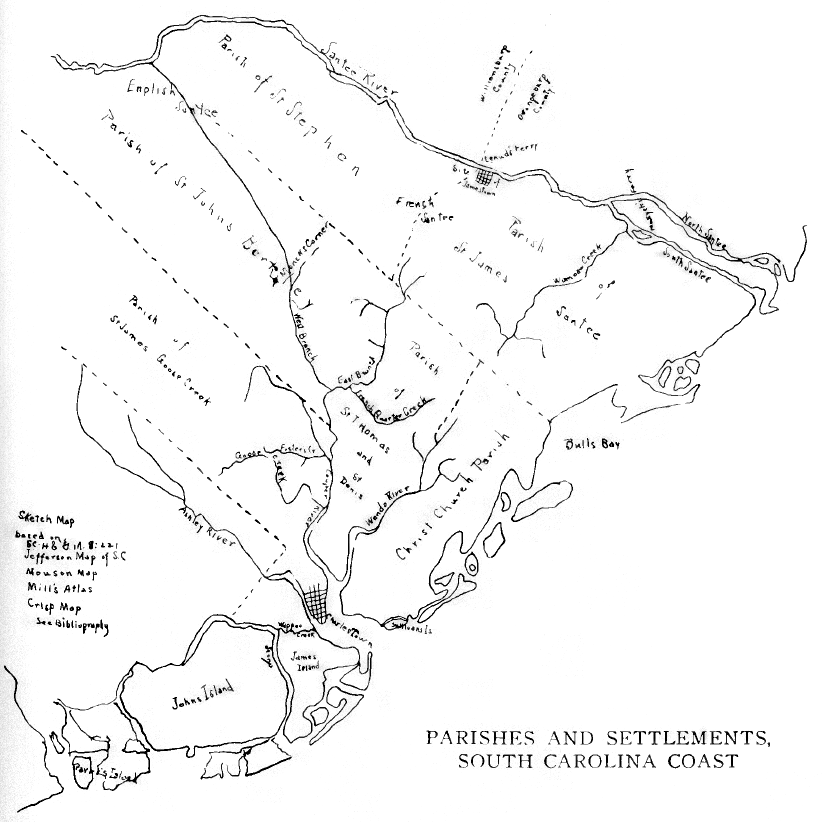
Within a few months we see Jacques (I), as defacto head of the family in America, receiving a grant of 626 acres from the Lords Proprietors of the colony25 on 13 July 1687, most likely in the area of French Santee along the Santee River. The Boyd brothers had brought vines with them with the intention of planting a vineyard in the colony.
Back in England on 16 December 1687 brother George (III) Boyd, along with many others, received denization under Royal warrant.26 This would seem to suggest that George (III) boyd’s intention was to remain in England or at least operate any future business from England. The situation in France remained desperate and for now it was unlikely that any of Jean (I) Boyd’s family had immediate aspirations to return home.
Turning to Jean (II) Boyd in Carolina, a remarkable item of correspondance in his hand has survived in the collections of Aberdeen University, which was published in the journal of the Huguenot Society of South Carolina.27 The letter to his sister Magdalen in London is undated. At the top of the first page (in an unknown hand) it states “A letter giving an account & description of Carolina in the West Indies written by an ingenious French gentleman. Anno 1691″. The letter is thought to be the earliest known written account of this part of South Carolina along the Santee River. In the letter he provides an early map of Charles Towne and wonderful sketches of local plants and comments on the indigenous people.
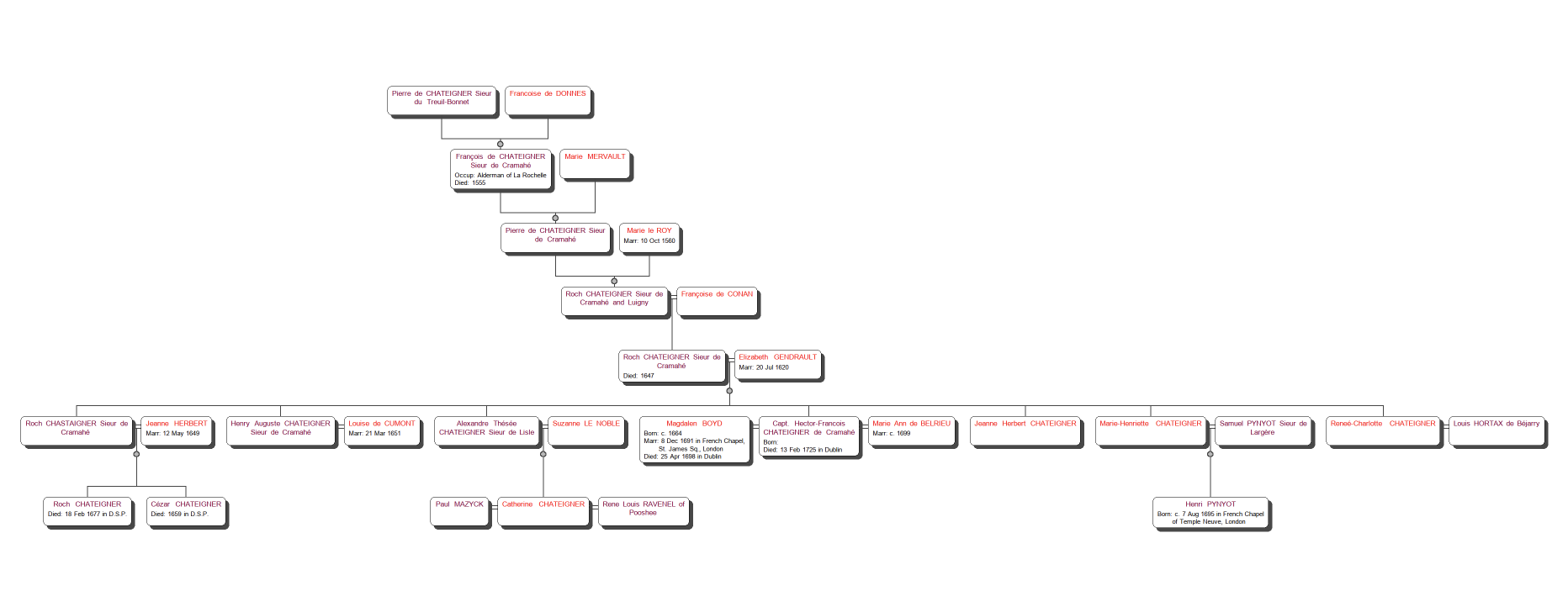
Later the same year Magdalen married Capt. Hector-François Chateigner de Cramahé in the french chapel of St James Square., London on 8 December 1691. The marriage license record stated that Magdalen was a spinster and about 28 years old at the time suggesting a birth year of 1663. The marriage to Chateigner28 is of interest as Hector-Francois’ brothers Henri Auguste and Alexandre Thésée travelled to Carolina where they held land grants and were also involved in the administration of the colony. Sadly Magdalen died and was buried in Dublin on 25 April 1698 aged about 35 years old. There is no record of any children to her marriage to Hector-Francois Chateigner who married again shortly after her death to Marie Anne de Belrieu to whom he had a large family.
Returning to Jean (II) and George Boyd we find on 3 July 1693 the two brothers receiving passports to travel from England to Holland.29 We must presume therefore that Jean (II) had left Carolina for England previously. The journey to Holland was likely to develop trade links with their father’s business at home in Bordeaux and perhaps in Carolina where brother Jacques (I) likely remained with their remaining brother Gabriel. Back in Carolina we find on 27 December 1694 record of a substantial land grant of 3,000 acres in Craven County to Jacques (I) Boyd.30 The grant was said to have been prompted by the Boyd brothers apparent success in cultivating a usable crop of grapes and perhaps the Lords Proprietors felt that they should be encouraged further in their endeavours.
Sadly by 1695 in Bordeaux Jean (I) Boyd’s health was likely fading and he recorded his will on 25 August.31 He then died on 2 January 169632 in Bordeaux. Coyne states “In his will, he asked Sieur Lamothe-Thévenin to render to his wife the same services he had rendered to her, and instituted his said wife as heiress, in charge of handing over his succession to their sons Jacques, Jean, Georges and Gabriel Boyd, “in case they return to the kingdom“. His father’s death appears to have prompted the return of George (III) Boyd to Bordeaux, perhaps to assist his mother with the family’s business in Bordeaux. He would later marry in Bordeaux in 1699. His story will be covered in the next part of the Boyd’s of France.
In 1697 we find evidence of the Boyd family in a list of 154 families in Carolina seeking to become naturalized English citizens. It has survived in the form of what is referred to as the St Julien Liste33 The list was found amongst the family papers of Daniel Ravenel. (The published entry is given first below and then a translation in english with additions to better identify the persons detailed):
3, JACQUES BOYD.
Jean Boyd, Gabriel Boyd, frères néz à Bourdeaux, et fils de Jean Boyd et de Jeanne.
Jeanne Berchaud, femme du dit Jean Boyd.
Jeanne Elizabet Boyd, Jacques Boyd, Jean Auguste Boyd, enfans du dit Jean Boyd, et de la dite Jeanne
Berchaud, néz en Caroline.
3, JACQUES (I) BOYD (Head of household)
Jean (II) Boyd, Gabriel Boyd, brothers born in Bordeaux, and sons of Jean (I) Boyd and of Jeanne [Pascaud].
Jeanne Berchaud, wife of said Jean (I) Boyd.
Jeanne Elizabet Boyd, Jacques (II) Boyd, Jean Auguste Boyd, children of the said Jean (II) Boyd, and of the said Jeanne Berchaud, born in Carolina.
Further entries are given as follows with original publication and english translation etc. as before:
75. JAQUES BOYD )
76. JEAN BOYD ) – fils de défunt Jean Boid et de Jeanne Boyd, de Bordeaux province of Guienne
77. GABRIEL BOYD )
Jeane Boyd femme de Jean Boyd, fille de Élie Berchaud et Jeanne Berchaud de la Rochelle: province d’Onis.
Jeanne, Élizabeth, Jacques, Jean Auguste, enfans, de Jean, et de Jeanne Boyd, néz en Caroline.
75. JACQUES (I) BOYD )
76. JEAN (II) BOYD ) – sons of the late Jean (I) Boyd and of Jeanne Boyd, of Bordeaux province of
77. GABRIEL BOYD ) Guienne
Jeane Boyd wife of Jean Boyd, daughter of Élie Berchaud et Jeanne Berchaud de la Rochelle: province of Onis.
Jeanne Élizabeth, Jacques (II), Jean Auguste, children of Jean, and of Jeanne Boyd, born in Carolina.
The existence of the St Julien List is important in that it details the family of Jean (II) Boyd and his marriage to Jeanne Berchaud of La Rochelle, France. It is possible Jean (II) Boyd and Jeanne Berchaud likely married in France and before their departure in 1685/6. Unfortunately no record of a marriage has been found to date. The list would seem to suggest that their children Jean Elizabeth, Jacques (II) and Jean Auguste were all born in Carolina. In the case of Jean Elizabeth this is supported by the entry for her marriage later in Dublin in 1713 in which she is referred to as being born in Craven County, South Carolina. We will cover the lives of Jean (II) Boyd, his wife Jeanne nee Berchaud and their children in a future part of the Boyds of France.
Regarding Jacques (I) Boyd we know that he sold 2,800 acres of his land in Carolina on 10 April 1699 to John Gaillard. Dee Ressinger believed this to be the last evidence of Jacques (I) Boyd in Carolina and further Carolina references appear to state him as being an absentee. This seems to be proven by a marriage record found in the Archives of the Walloon Reformed Church in Rotterdam, Holland. We find the marriage of Jacques Boid to Marie Palot on 8 December 1700. Two baptismal entries are then found for Lidie Marie Boid on 5 October 1701 and Jean Boijd on 3 July 1707. It is fairly certain that the Jacques Boyd recorded in these entries in Rotterdam is Jacques (I) Boyd. His wife as stated was Marie Palot and if we examine the baptism of Lidie Marie Boyd we can see that a witness was Moijse Palot. This is almost certainly Moïse Palot of Bordeaux. Coyne records34 some significant information on the Palot family of Montauban which confirms the marriage of Marie Palot to Jacques (I) Boyd and stating Marie’s father to be Jean Palot and mother Isabeau Minvielle along with brother Moïse 35Palot. Unfortunatley no further record of Jacques (I) Boyd has been found or for son Jean born in 1707. We do know that daughter Marie Lidie Boyd died in Bordeaux aged around fifty according to her burial (see p.89 of 97) entry of 26 June 1750.
Gabriel, the youngest of the sons of Jean (I) Boyd was said to be in Ireland by 1710 at which time he was included amongst many people receiving denization36 under ‘The Act of 1692 for Encouragement of Protestant Strangers to Settle in Ireland”. Unfortunately this would appear to be the last known information we have on Gabriel Boyd.
Before concluding this part of the Boyds of France it remains to mention the final years of Jeanne Pascaud, widow of Jean (I) Boyd. As mentioned earlier Jean (I) Boyd had been an executor to the will of his uncle Jacques Bibaud and as such had received a benefit from the will in 1695. However as stated by Coyne:
“But in 1701, Jean Boyd’s widow, Jeanne Pascaud, definitively repudiated this inheritance37. However, Jacques Bibaud du Lignon [son of Jacques Bibaud] had established roots abroad: in 1716, Sir Manlich de Bettens, colonel in the Swiss regiment of Castelles (?), as father of Angélique de Bettens, the latter
daughter of the late Madeleine Bibaud, daughter of Jacques Bibaud du Lignon, and the latter heir of Henri Bibaud, his brother, gave Jeanne Pascaud a receipt for the interest on sums belonging to the
estate of Henri Bibaud under the assumed name of Jacques Boyd, which Jeanne Pascaud had collected and transferred to Jacques Bibaud or to the said Manlich de Bettens, her son-in-law38.”
Coyne mentions Jeanne Pascaud, widow, and Georges Boyd, her son, sold property39 on 24 April 1711 located in ‘Cars en Blayais’ for 20,000 livres and he further states that she was still living in 1716 as evidenced by a receipt dated 19 March.40 Unfortunately no record of her death or testament has been found to date.
In the next part we will look at the life of George (III) Boyd from his return to Bordeaux following his father’s death and the development of a wine growing and import/export business with stong links to Dublin, Ireland.
- This date is not indicated on the baptismal record but comes from Jean (I) Boyd’s own testimony 18 February 1686. ↩︎
- Dianne ‘Dee’ Ressinger was a board member of the Huguenot Society of South Carolina. She wrote many articles on Huguenot history before her death in 2018 ↩︎
- ‘La Fin Troublee de Tallemant Des Reaux’, (7th Ed.), 1922, Emile Magne, pp.231-301 ↩︎
- Ibid, p.233 ↩︎
- Ibid, p.230 ↩︎
- Ibid, p.276 ↩︎
- DICTIONNAIRE DES FAMILLES PROTESTANTES DE BORDEAUX AU XVIIe SIECLE, (2000), Paul Louis Coÿne – see under BOYD ↩︎
- Archives Bordeaux Metropole – Contract of 27/8/1653, Dubourg (Notary), Ref. 3 E 4830 ↩︎
- Archives Bordeaux Metropole – Termination of a lease of 1666, 14/10/1684, Loste (Notary), Ref. 3 E 13509 f° 505 ↩︎
- Session of 13/6/1668, 5th book of the Consistory ↩︎
- Livre des Bourgeois de Bordeaux (XVII ET XVIII SIECLES), Societe des Archives Historiques de La Gironde (1898), XVIII Siecle, p.23 – “November 6. — No. 1023. Boyd (Jacques and Jean-Auguste),
brothers, presented the letters patent of citizenship of Jean Boyd, their grandfather,
dated September 13, 1670.” ↩︎ - See Note 9. ↩︎
- The Thévenin family came from the Chalais and Aubeterre region (Charente), on the borders of Saintonge and Angoumois, whose genealogy for the 17th and 18th centuries was published by F. and P.-A. Biscarrat, was represented in Bordeaux in the 17th century by only two of its members, a brother and sister. François Thévenin, Lord of Lamothe, sometimes called “Lamothe-Thévenin,” born around 1651 in Aubeterre, son of Abraham Thévenin, the King’s Attorney in Aubeterre, and Anne Bernard, came to Bordeaux around 1670 to live with his cousin by marriage, Jean Boyd, a bourgeois and merchant of Bordeaux, who employed him as an agent and in whom he had complete confidence. François Thévenin abjured his faith on April 5, 1686. He appears with Jean Boyd and the staff of his refinery in the 1686 list of new converts in the Chartrons district, parish of St-Rémy. After the death of Jean Boyd in 1696, François Thévenin, described as a “bourgeois merchant,” traded on his own account, notably with the islands of America. He was still living in Bordeaux in 1717. See Archives Bordeaux Metropole – Ref. 6 B 1040 – 16/1/1686, François Thevenin said he knew the daughter of Sr Bouet (Boyd), escaped, “for fifteen years that he has been in his father’s house” – DICTIONNAIRE DES FAMILLES PROTESTANTES DE BORDEAUX AU XVIIe SIECLE, (2000) ↩︎
- DICTIONNAIRE DES FAMILLES PROTESTANTES DE BORDEAUX AU XVIIe SIECLE, (2000) – he died in Paris in April or May 1673, having made his will on April 26, 1673, before Routier and Saifray, notaries at the Châtelet ↩︎
- Archives Bordeaux Metropole – Ref. Selon inv. du 18/5/1673, Deferrand (Notary), 3 E 4093 f° 1183 ↩︎
- Ibid – Ref. 27/3/1682, Deferrand (Notary), 3 E 4102 f° 786. ↩︎
- Percy Burrell, “Castle Goring,” Sussex Archaeology Collections, Vol. 26 (1875), pp. 113-
147 – see also TRANSACTIONS OF THE HUGUENOT SOCIETY OF SOUTH CAROLINA No. 114 ↩︎ - See also ‘Mémoires de Samuel de Pechels (1685-1692) et Documents sur la Révocation a Montauban’, (1936) ↩︎
- Archives Bordeaux Metropole – Ref. G895 ↩︎
- TRANSACTIONS OF THE HUGUENOT SOCIETY OF SOUTH CAROLINA No. 112, p.24 ↩︎
- Archives Bordeaux Metropole – Ref. 6B 1040 ↩︎
- Ibid – Ref. G 898 ↩︎
- TRANSACTIONS OF THE HUGUENOT SOCIETY OF SOUTH CAROLINA No. 112, pp.27-31 ↩︎
- University of Aberdeen – Library Ref. MS K 257/44/9 ↩︎
- A sketch of the history of South Carolina : to the close of the proprietary government by the revolution of 1719, p.320 ↩︎
- ‘Lists of Foreign Protestants, and Aliens, Resident in England 1618-1688′, Wm Durrant Cooper (1862), p.43 ↩︎
- TRANSACTIONS OF THE HUGUENOT SOCIETY OF SOUTH CAROLINA No. 110, pp.5-22 & 26-35 ↩︎
- Hirsch in his ‘Huguenots of South Carolina’ on p.220 states “….the family of de Chastaigner Seigneurs de Cramahé (or Cramahais) and de Lisle, also of the nobility. Their prominence in the Huguenot colony in Dublin is shown in nearly fifty entries in the nonconformist registers of that place. In the register of the Peter Street Church, Mademoiselle Charlotte Chastaigner de Cramahé is noted as godmother to a child of M. Daniel Belrieu, Baron de Virazel. Three brothers, Cramahé, De L’Isle, and Des Roches, arranged to escape from France at the repeal of the Nantes Edict. The two former succeeded and settled in England, but Des Roches was detected, seized, flogged, mistreated, plundered, and cast into prison. After twentyseven months of confinement he was banished. Two other brothers, Henry Augustus Sieur de Cramahé and Alexandre Thésée, Sieur de Lisle, went to South Carolina. They were the sons of Roche Chastaigner de Cramahé of the ancestral chateau, five miles from La Rochelle. Henry Augustus was denizened in London, April 9, 1767, and is listed as Henry Augustus Chastaigne de Cramahé. Alexander Thésée Sieur de Lisle (alias Thésée Castaigner) was denizened March 5, 1685-6. He is found in London as early as 1681. In South Carolina these gentlemen immediately took conspicuous positions in provincial business affairs and politics. Alexander is found in the Assembly as early as 1693 and Henry Augustus appears on the Governor’s Council. The name of an elder brother, Hector, was in 1698 on the list of applications for naturalization in Dublin. ↩︎
- Calendar of State Papers Domestic: William and Mary, 1693, p. 304 ↩︎
- Calendar of State Papers Colonial, America and West Indies: Volume 14, 1693-1696, ed. J W Fortescue (London, 1903), pp. 413-421 ↩︎
- Archives Bordeaux Metropole – Ref. Deferrand (Notary), 3 E 4114, f°405. ↩︎
- ↩︎
- Liste des Francois et Suisses from an old manuscript list of French and Swiss Protestants settled in Charleston, on the Santee, and at Orange Quarter, in Carolina who Desired Naturalisation Prepared probably about 1695-6 – printed by Wm G Mazyck (1868), pp. 20 (No.3) & 26 (Nos. 75-77) ↩︎
- “PALOT
I – Jean Palot, son of Joseph Palot, a bourgeois of Montauban, and Jeanne Dallègues, came to Bordeaux seeking his fortune, where in 1662 he was a clerk for Pierre Minvielle, a bourgeois and merchant of Bordeaux; he was a cousin of Minvielle’s wife, Catherine de Lafitte. He had a brother, Moïse Palot, who was exiled from the kingdom in 1700 for religious reasons. In 1664, Jean Palot contracted a marriage contract under the Reformed Church (RPR) with a first cousin of his employer, Isabeau Minvielle, daughter of the late Pierre Minvielle and Françoise Chirac; the dowry was 1000 livres.
“Mr. Palot, his wife and family” appear on the 1686 list of new converts on Rue de la Rousselle, in the parish of St-Michel, whose priest noted them as “willing” (to fulfill their Catholic duties). However, after sending four of his children abroad and transferring 64,000 livres to them, Jean Palot reportedly tried to join them but was only stopped at the border: Jean Palot, described as a bourgeois and merchant of Bordeaux, and Isabeau Minvielle made a mutual will on September 6, 1700. Their two sons and two of their three daughters were then abroad. Jean Palot died five days later.
Isabeau Minvielle continued her husband’s business. But in 1715, she found herself in difficulty: having defaulted on payments, she obtained from her creditors a reduction of a quarter of her debts and permission to transfer her business, assets and liabilities, to her son Moïse, who had returned to France. In 1722, she attended the marriage contract of her grandson Jacob Pan with Esther Germé. She was still alive in 1725.
…Marie, born around 1678. She married abroad, after 1700, Jacques Boyd, “Ecossais habitant Bordeaux de père en fils” and returned to France in 1717. A widow, she died a Protestant in Bordeaux on March 25, 1743.” ↩︎ - Archives Bordeaux Metropole – Ref. 23 January 1713 – Lenfumé (Notary), 3 E 8677 ↩︎
- Letters of denization and acts of naturalization for aliens in England and Ireland by Huguenot Society of London; Shaw, William Arthur, 1865-1943, p.226 – 28 January 1709/10. ↩︎
- Archives Bordeaux Metropole – Ref. 18 February 1701, Deferrand (Notary), 3 E 4117 f° 17 ↩︎
- Ibid Ref. Quit. 24 December 1716, Lemoine (Notary), 3 E 8659 f° 240 ↩︎
- Ibid Ref. Sale of 24 April 1711, Benoist (Notary), 3 E 1177 ↩︎
- Ibid Ref. Receipt of 19 March 1716, Bernard (Notary), 3 E 13534 f° 452. ↩︎
The (St. Julien) Liste was probably completed in 1697 based upon some of the citations in it. Contact the Huguenot Society of South Carolina for more information.
Hi Cheves
Many thanks for this update on the St Julien Liste. We will update the post accordingly.
Jonathan & Adrian