For those who have read of or researched the history of Co Antrim in the 17th century they have likely come across the subject of our post. This is principally thanks to the work of Rev George Hill and his book on the MacDonnells of Antrim.
Thanks to Hill we are able to see a transcript of William Boyd’s will of 16241 which is extensive and detailed providing important information about him, his family, career and associates. Indeed we will use the transcript of his will as a framework with which to record much of what we know about him and his descendants.
The origins of William Boyd of Dunluce have as yet remained uncertain. However our research has shown a strong correlation between the early Scottish settlers in North Antrim and the town of Irvine in Ayrshire, Scotland. One source for material on Irvine in the early 1600s are the Protocol Books of Robert Brown. In a transaction2 involving Egedia Tueidy and property in the town we find the following entry:-
“FOR ALEXAIIDER BAILIIE, SKINNER
Instrument narrating that a worthy damsel, Egidia (Geillis) Tueidy (Tweedy), eldest lawful daughter of David Tueidy, sadeller, burgess of lrvine, compeared personally upon the ground of that piece of waste land, upon which a house was formerly built, now belonging to her heritably, and formerly to William Boyd, lawful son and heir of the late Adam Boyd, burgess of the said burgh, lying within the burgh of Irvine, in the Bridge-gate thereof, on the north side of the common royal way, between the tenement of Alexander Lowrie on the east and the tenement of Alexander Baiilie on the west; and there the said Egidia, with express advice and consent of the said David, her father, as by right her lawful administrator, tutor, and governor, and of Robert Dunlop, smith, burgess of the said burgh, her uncle, for certain sums of money paid to her and to her said father and uncle in her name, by Alexander Baillie, skinner, burgess of the said burgh; and for observation of their part of a disposition granted by her, with consent as aforesaid, to the said Alexander, of the date hereof, did resign the said, piece of waste land, with yard thereto adjacent, in the hands of an honourable man, Allan Dunlop, provost, in the absence of both the bailies of the said burgh beyond this kingdom of Scotland, in favour of and for this new seizin of the same to be given to the said Alexander Baillie and his heirs whatsoever heritably and irredeemably; which resignation so made being admitted and received by the said provost, he gave seizin accordingly by delivery of earth and stone of the said piece of waste land and yard adjacent thereto, to the said Alexander Baillie, who was personally present and accepting thereof.
These things were done upon the ground aforesaid, about the fourth hour after noon of the 9th day of the month of March 1620, the witnesses being James Cunynehame, Robert Lyn, John Cruikes, merchants, burgesses of Irvine, David Walker, skinner, William Stevinsoun and John Ryburn, serjeants.“
This evidence is far from conclusive but it does establish that there was a William Boyd lawful son and heir to an Adam Boyd, burgess of the burgh of Irvine prior to 1620. Unfortunately no entries have been found amongst the Muniments of Irvine or Sasine Registers regarding this father and son.
Our first proven records of William Boyd of Dunluce begin with Hardiman’s Inquisition of Ulster.3
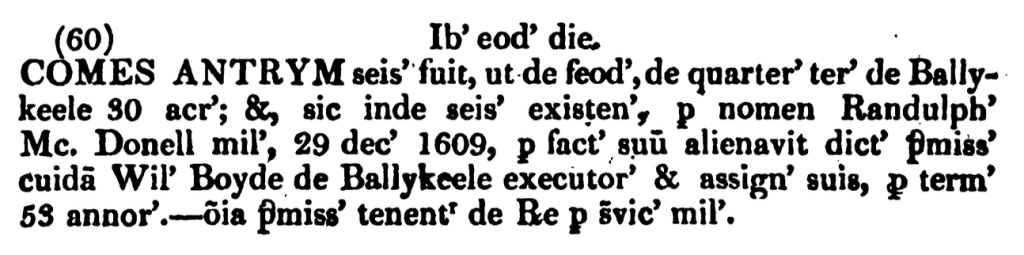
Th entry above states that 30 acres of land in the quarterland of Ballykeele was held by the Earl of Antrim in the name of Randolph(Randal) McDonnell on 29 December 1609 it was then alienated to William Boyde of Ballykeele his Executors and Assigns for the term of 53 years and in lieu of Kings Service. However this same entry appears to have been examined by John Lodge who records the following:-

It is more likely from similar transactions on the Antrim estate in the 1600s that the term of the lease to William Boyd for the 30 acres in Ballykeele was 503 years and not 53 as recorded in Hardiman’s Inquisition. We also need to identify where Ballykeele is as no other information on Barony or Parish is given. The most likely candidate is Ballykeel in the Parish of Dunluce lying roughly mid way between the town of Portrush and Dunluce Castle to the east. Then a further entry in the Inquisitions.4
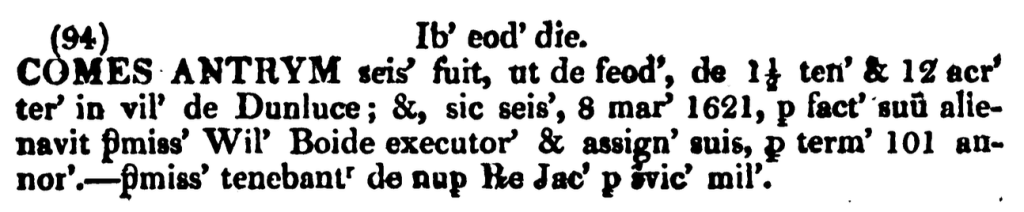
Here we see that the Earl of Antrim was seised in fee of 1 1/2 tenements and 12 acres in the town of Dunluce on 8 March 1621 whereby he alienated the premises to William Boyd, his executors and assigns for a term of 101 years and again in lieu of Kings Service. The town of Dunluce was the subject of an extensive archaeological investigation c2011-13 and details of one of the reports by Queens University Belfast, Centre for Archaeological Fieldwork can be seen here. Sadly the village was badly burned during the 1641 Rebellion and little was known of the location, layout etc. until the extensive digs by QUB and the NIEA. It was believed the town was developed and encouraged by the Earl of Antrim from around 1608. However as it became clear it lacked an accessible harbour for shipping and a significant connectivity to other centres such as Ballymoney and Coleraine it was possibly doomed to fail from the start.
The Will of William Boyd of Dunluce – 9 December 1624
We will go through the transcript of the will as recorded by Rev George Hill and elaborate where possible on elements on the life of William Boyd of Dunluce. To date no testament has been found of William Boyd of Dunluce amongst the various Commissary Courts in Scotland so we must presume that the will was recorded in Ireland only and evidence of this is found in an abstract by William Betham5 and an entry in the Indexes6. It is likely that the will or a copy had survived for Rev George Hill to transcribe it, however it is also likely that the will or copy was destroyed in the fire in the Public Records in 1922.
“The testament and letter will off Wm. Boyd in Dunluce, given up be his owne mouth att Dunluce, the nynthe off December, anno. 1624 ; given up befor these witnesses under wryttin. In the name off God, I Wm. Boyd being sick off body and good and perfect memorie and understandinge, do make this my last will and testament. First, I comitt my sowle to almightie God, maker off heaven and earthe and all yt yr in is, on (one) true holy eternall and infinit god yxistinge off three persins—the Father, Sone, and Holy Ghoste, my creator off nothinge, my redeemer, when for my owne sine I was deservedly lost, and my yternall preserver since my conception wt ot whose helpe and providence every minute off ane hoare I should be readie to fall in utter destruction of Bodie and soal. In wch holy God and Blessed Trinitie I stedfastly beleive, hopinge assuredly yt he will receave back againe in his mercie this my soale to Glorifie him in His heaveins for ever. As to my Body, I bequeath itt to the earth from whence it came, to be buried in ane Christian Buriall yr (where) itt shall please God.“
The introduction to the will or preamble is typical of many of the time where the person involved is of the reformed faiths. At the time the teachings of John Calvin still had some sway within the Anglican faith and some historians have been known to refer to this period in Ireland and probably more particularly Ulster as a Prescopalian period.7 Basically this involved the acceptance of clerics into Anglican parishes who were overtly or largely Presbyterian in their theology. However the period did not last particularly long and by the restoration of the Monarchy in 1660 the two theologies were distinct and separate in Ireland. The early years of the 17th century in Co Antrim were ones where a considerable number of the reformed clerics settling in the county were of the established Anglican theology. It would not be until the arrival of the Scottish forces in 1642 and the establishment of the first Synod of Presbyterian ministers that a change would emerge. However as we shall see it would appear that William Boyd of Dunluce was distinctly associated with the Anglican and Established Church in Ireland as opposed to many of his Scottish neighbours.
“As to my goods and chatteles, I bequeathe them as followeth
First, I do appoynt and ordaine my weil beloved wyffe Catharine Mcgdmartine and my faithfull and trustie freinds Wm. Dunlapp laird off Crage, and Thomas Boyd off Carncogie, and Mr. Wm. Wallace to be exeacutors off this my will underwryten and intromettary wt my wyff jioyntlie and severally wt all my goods and chattelis rightis and creditis whatsoever (to the performing my will as heireunder is expressed). Inprimis, my will is yt all the debt wch I do justly owe shall be payed wt the reste of my creditis:
Item, my will is yt my wyffe shall have during her mortal lyfe my houses and gardens in the towne off Dunluce w’ the furnitewre and land y unto belonginge, beinge the aqual halfe off the ffeild called Macheranecrossie and Dollnabrade ; and after her decease I leave the same to the eldest off my sones then livinge, ther heirs exrs or assignais wch failinge to be devyded amongst my dauchters and ther heirs.
Item, my will is, and I ordaine yt my wyfe shall have all the plenishinge insighte and goods whatsoever wch shall be wh in my hoase the tyme of my decease, reservinge money and plate and other reservationis under wrytten, and yt be ffull satisfaction off all dower joynter and thirds wch she may clame ; as also I leave unto her ffowre off my best kowis, and she to injoy the same by the sighte off the overseers, and advise off them whom I do appoynte as after followeth.“
Firstly William Boyd appoints the executors to his will, namely his wife Catherine Mcgdmartine (probably McMartin), William Dunlapp (Dunlop) Laird of Crage (Craig8), Thomas Boyd of Carncogie and finally Mr William Wallace.9 Unfortunately nothing further has been found of Catherine, William Boyd’s wife. The name is unusually spelt in the will and it could be McMartin or McGilmartin which may be suggestive of her having come from Argyll. A form of the same name also originates from Galway but the most likely source for Catherine is Argyll. Regarding William Dunlop of Craig we can say that he was a significant figure in the parish of Kilmaurs, Ayrshire and descendants also had a leading role in the commercial life of Irvine. It would appear William Dunlop received denization on 29 January 1611 along with Thomas Boyd of Carncoggy and the testament of his first wife Jeane Campbell10 provides remarkable insight into his connections with Ireland at the time (1621). Thomas Boyd of Cancoggy we have already mentioned in an earlier post and finally William Wallace who was curate in the Parish of Ballymoney at the time of the will. The nature of executorships in wills at this time, indeed at any time, meant that the persons placed in such a role were among the most trusted in the life of the person making the will. More often than not they were immediate family, kin, trusted business partners or local clergy. William Boyd referred to William Dunlop, Thomas Boyd and William Wallace as “my faithfull and trustie freinds” and as outlined in our earlier post on Thomas Boyd of Carncoggy the word friend was often used in Scots culture at the time to denote a familial connection, perhaps at a cousin level. Unfortunately as yet the exact connections to these three men remain elusive.
The remainder of this section of the will itemises provision in the way of goods and property for his wife Catherine and stating “ffull satisfaction off all dower joynter and thirds wch she may clame” refers to financial provisions probably detailed in a previous marriage contract between him and Catherine and likely giving Catherine a right to an annuity or part of his property if she survives him.
The next part of the will refers to William Boyd’s eldest son Adam:-
“Item, my will is yt my son Adam shall have and injoy the qrterland off Ballebreill, the Salmon fishinge off Portnein and Lands ; the Towne land of Carvelly wt all the titles and ryghts qch I leave to him, his heirs, exrs and assignais ; and I do appoynte and ordaine my faithfull and weilbeloved friends Mr. Andrew Monypenny, Archdeacon of Coner, and Mr. Wm. fentwine, preacher off God his word att Cam Castle, to be curators to him and possess the profits off the sd land and fishinge duringe his minoritie, to be pute and qnverted towards the honest aducaoine off him, and in wch tym I will and desyre yt the sd Mr. Monypenny (iff not being burdensome unto him), and Mr. Wm Fentwine jointlie and severallie shall keip him att schooles and to breed him according as they schall in y discretion think fitt, to quhome jointlie and severallie (Mr. Fentown being less distracted by uther occasions y” the ryt worschipfull Mr. Monypenny) I comitt him and his portione.
Item I do leave all my plate to my sone Adam, togither wt on furnisched fether bedd wt the apportunances necessarilie belonginge, my brewinge kettill, my aquavits pott, always reserving the use of them to his mother until he shall come to perfect age, or be married, iff she shall live so longe, prayinge the sd Mr. Monypenny and Mr. Fentowine to acceptt off this charge jointlie and severally to direct my sd sone as they schall think wreite (and iff the sd Mr. Monypenny be promoted to greater dignities or remove himself hence) I recommend him and his portion to the care and fidelitie of Mr. Fentowne, desyring my saide sone to doe nothing w’ot the direction and advyse off them the sd Mr. Monypenny or Mr. Fentowne.“
William leaves the quarterland of Ballebreill (Ballykeel) which he held under lease from the Earl of Antrim from 1609. He further includes fishing rights i.e. “Salmon fishinge off Portnein and Lands“. This is most likely the area known as Portneen, Co Antrim which lies at the neck of the Portrush peninsula (eastern shore) and which remained a salmon fishery right up to the 20th century but is now holiday lets. The final property William bequeaths to Adam is the townland of Carvelly (probably Corbally, Parish of Ballywillin, Co Antrim). Unfortunately no lease has as yet been found for the townland of Corbally to William Boyd of Dunluce before 1624. This section of the will is completed by naming two curators to manage Adam’s education and affairs until he reaches his majority i.e. Mr Andrew Moneypenny, Archdeacon of Connor11 and Rev William Fenton.12 The nature of the appointment of two clerics as curators raises the question was this simply because the two men, “weilbeloved friends“, of William Boyd of Dunluce just happened to be clerics or was it possibly due to them having a working relationship with William. The answer is revealed as we study the will further. The section concludes with bequests of some specific goods to Adam with reservations to his mother and we see that the curators are entrusted with Adam’s education.
The next part of the will concerns son John:-
“Item, I do leave my sone Johne the Townelande off Carmoohen and the qrterland off Bellihemlein, togither wh the somme off Fowrtie pownde ster., and if it can be so acquired by the advyse of my exrsnott hurting the portions off the rest off my children, I leave him twenty pownde ster. more to make up three score pownds ster. in whole off my goods, and do comitt the educaoine, Tutorship, and Curatorship, until he be auchtein yeirs owld, to my weilbeloved and fatfull friend, Ard Stewart off Ballelache, whom I pray to bring him up att schoolis and cawse breed honestli’e wt the profites off the sd land and the use off the three score pownds abovementioned as he shall think fitt, and att the auchteenth year off the sd Johne his age, the sd Archibald is to pay unto the sd Johne the sd Three score pownds, and to this effect the sd Ard is ather to give in surties for the re-delyverie off the sd thrie score pownds, or put it in sufficient men ther hands att the sicht, discretion, and advyse off the overseers undernamed.“
As with Adam we see William Boyd of Dunluce bequeath property to son John i.e. the townland of Carmoohen probably Carnmoon, Billy Parish, Co Antrim) and the quarterland of Bellihemlein (Ballyhemlin, Billy Parish, Co Antrim). Similar to John no leases have been found for the properties in Carnmoon and Ballyhemlin to William Boyd of Dunluce before 1624. A further bequest of £40 sterling to John and a further sum of £20 sterling provided there are sufficient funds to be paid to him on reaching the age of 18. Finally William places John and his education etc. in the care of Archibald Stewart13 of Ballelache (prob Ballylough More, Billy Parish, Co Antrim).
The next part of the will concerns son William:-
“Item, I ordaine and will yt my sone Wm. schall have three score pownd ster. off my goods, and my silver signett, and do comitt him and his portion to my weilbeloved and faithffull freind, Wm. Dunlap, off Creig, in the Realm off Scotland, qn he is readie to putt to schoole, and till then I ordaine my wyfe his mother to keip him upon the use off his portion, alwayes provyded yt surties sufficient be given for his breeding and aduca°ine, as weil as for the payment off the portion when he schall come to the age of auchtein yeir old, and this to be done be the sight and advyce off the undernamed overseers.”
It appears by this stage in the will there is no further property to be bequeathed and therefore son William is to receive £60 sterling of his fathers goods (when he reaches the age of 18) and a silver signet or ring. As with Adam, William and his education is entrusted to someone as a curator etc. In this case William Dunlop of Craig who is possibly the son of the William Dunlop, Laird of Craig who acts as Executor and we note that the will refers to him being in Scotland.
The next part of the will concerns William Boyd’s daughter Katherine;-
“Item, my will is, yt my daughter Katharin schall have the thrie score pownds wch is in Anthonie Dobbine his hand, for wch I have ane howse in morgage, wch payeth ten pownde per anum wt twentie pounds more besyd the remaner of the whol goods being caste up, provyded sche do bestow her selfe in mariage be the advyce off my exrs or any two off them, qr off Thomas Boyd, off Carncogie, to be on (one), and I leave the sd Katharin, wt her portion forsdt to the sd Thomas Boyd to be aducatt and bred, he the sd Thomas giving in sufficient surties, as weill for her aducaine as for the re-delyverie off her portion att the day of her mariage, and this to be done by the advyse and direction off the afternamed overseers.“
Similar to William we see a bequest of £60 to Katherine but it is to be funded from an outstanding mortgage due from an Anthony Dobbine which pays £10 per annum with £20 more besides, possibly a reference to the interest. This is to fund a dowry on any future marriage and until such time he places the responsibility for these elements and Katherine’s education in the hands of Thomas Boyd of Carncoggy and one other executor.
The next part of the will concerns daughter Issobel:-
“Item, I leave to my dawghter Issobel thrie score pownd ster. wheroff fowrtie pownde is owinge me in larne, and the other twentie of the rediest off my goods quhom wt her portion I putt in trust (to her good educa°ine) to my beloved and trustie freinds as curators for her, Archibald Boyd oft Carncualagh , and Johne logan, off the Bosth milnes, jointlie and severallie, provided yt they give in surties for her educa°ine and re-delyverie off her portion att the day off her mariage, and all yt aforsd to be done att the discretion off the overseers after specified.“
As in previous bequests daughter Isabel is to receive £60 sterling, however £40 of this is referred to as an outstanding debt in larne (Larne, Co Antrim) with the remainder to be taken from the goods of William Boyd of Dunluce. The will further states that the bequest in the form of a future dowry and education of Issobel are to be held in trust by curators Archibald Boyd of Carncullagh and John Logan (brother-in-law of William Boyd of Dunluce) of the Bosth Milnes (Bushmills, Co Antrim) jointly and severally.
The next part of the will concerns daughter Margaret:-
“Item, I will yt my daughter Margaret schall have thrie score pownde ster. off my goods for her portion and for her educa°ine; I recomend the charge of her to my weilbeloved sone-in-lawe, Walter Kennedie, wh her portion, the use qr off is to be bestowed upon her aduca°in and for her better breding ; the sd Walter is to give surteis both for her upbringing and also for re-delyverie off her portion at the day off her mariage as it schall be thocht fit by the undernamed overseers.“
Once again a bequest of £60 sterling (to be taken from the goods of William Boyd of Dunluce) to daughter Margaret and as with Katherine and Issobel to be provided by way of a dowry with her education etc. in the care of son-in-law Walter Kennedy who is married to William Boyd of Dunluce’s daughter Janet.
The next two sections of the will enforce the requirement for the curators, executors etc. to produce sureties to provide for the legacies to William Boyd of Dunluce’s children. They further make provision that if any of the children die before reaching the age of 18 or before marriage then their bequest is to be divided equally among the surviving children.
“Item, my will is, yt the childrens portionis schall be putt in honest men ther hands, to bring good surteis for the same, and the yearly use for y aduca°in in the fear off God as shall be thocht fitt by the overseers.
Item, my will is, yt iff any off my children schall departe this naturall lyff before they have issue off their owne Bodies, yt yn the portion off the deceased schall be devyded equally amongst my survivinge children and ther heirs, exrs, and assignais.”
The next section of the will in the main concerns William Boyd of Dunluce’s son-in-law Walter Kennedy and what appears to be outstanding elements of a likely marriage contract in his marriage to Janet Boyd:-
“Item, I ordaine, and will yt my sone-in-law, Walter Kenidie, schall have ten pownde ster. Over and above his mariag goods, behind unpayed as yett, ot off yt lease wch I have off the tythes off Magherafopa, att the expyring off the sd lease, as also yt the sd Walter schall have his mariage goods, unpayed as yett, ot off the first paymentis off those tythes and qt is superpaid, my sd sone, Walter, is to be anserable for itt to my exrs, his mariag goods being first payed, and this to be don be the advyse off the overseers ; as also I leave to him ane cleashoch or harpe qche I have. Ite, my will is, that iff my goods schall amounte to more then to pay my debtis and suche portionis as I have alreadie nominated to my sd children, then I ordain the superplus to be equallie devyded amongste my thrie youngest Dauchters and thrie sones, saving the reserva°nis followinge.“
Unfortunately the lease concerning the payment of tithes for a property called Magherafopa is as unidentified.
The next section of the will is a strange recognition by William Boyd of Dunluce towards his landlord the Earl of Antrim i.e.:-
“Item, I leave to the Ryt honorable the Earl off Antrym my gray stoned horse as ane herriot, praying his Lsp for God his sake to be kind to my wyff and children.“
Perhaps this element is a sad reminder of the feudal background to the times and the inclusion of a heriot or tribute by William Boyd of Dunluce to his landlord.
The next section of the will is perhaps the most interesting, albeit that it is quite brief. However it goes to explaining the likely profession of William Boyd of Dunluce who up until now has been regarded by many researchers and historians as purely a merchant. It also offers a curious insight into the mind of William Boyd of Dunluce as it perhaps hints at his desire to hold a debt due from the Bishop of Down & Connor as a security in the continuance of a Robert Thomson (William’s servant) in the Office of Registership:-
“Item, my will is, qt so longe as the ryt reverend the Lord Bishop off Down and Coner schall suffer my servant, Rot. Thomson, to injoye my office off registerschip wch I have off his (Lp.) then my lord Bischop to keep the thirtie pownde ster. wch his (Lp.) stands indebted unto me, and qn it please his (lop.) to putt another into the place, then I will my ex” to delyver to ye sd lord Buschop his band off thirtie pownde ster. he paying unto them twentie pownde ster. off the sd Band due unto me.“
The Bishop of Down & Connor at this time was Robert Echlin14 whose daughter Jane married secondly the Ven William Fullarton,15 Rector of Derrykeighan from 1629-66. The reference to William Boyd’s servant Robert Thomson and Boyd’s office of “registerschip” is very significant as in this statement we discover what is probably William Boyd’s principal job and career and that is as a Registrar to the Anglican or Established Church, Diocese of Connor.16 We later discover from the work of Sir William Betham that Robert Thomson probably died c163617 resident in Carnemohein (prob Carnmoon, Billy Parish), Co Antrim and in his will he is described as a Public Notary, perhaps eluding to his earlier role as mentioned in Boyd’s will.
The next item involves a bequests to Andrew Moneypenny:-
“Item, I leave to Mr. Andrew Monypenny my pasing naige qch I bocht from Mr. Arthur Monypenny.“
This bequest to likely Rev Andrew Moneypenny was probably William Boyd’s regular horse that he used most in local travel. We presume Arthur to be a relative of Andrew Moneypenny.
The next item in the will appears to elaborate more on the Registrar role of William Boyd mentioned earlier:-
“Item, I leave to Rt. Thomson thirtie bolles off oates owing me in Larne, wt all my waring apparell except my grogram suit, and my best blak cloak, and the next best cloak qch leave to his father, David Thomson, wt my rappier, and all the books off my office, to be used be him to extract all precedents and wrytt them in my great blak book off precedents, qch I ordaine to be keipt to my eldest sone, and the sd Rot. Thomson to extract ane book for his owne uses, and I ordaine the sd Rot- so long as it pleaseth the lord off Downe to give him liciene to exercise my place off Registerschip under his (lop.), qtsoever fees he getteth as due to the office to be cowntable to my exrs off the samin to my exrs, his charges being deducted for him selff, he beinge served wt ane horse ; also I will the sd Rot- Thomson to serve my wyffe so long as he is bownde by indentwr, sche furnishing him the mean quhyle wt meat, drink, and apparell, as also I ordain the sd Rot- to oversie the Salmon fischinge yearly, to the use of my son Adam, for wch I ordain him ane Barrell off Salmon yearly.“
This wonderful section of the will elaborates further on what we previously stated was the likely role and career of William Boyd. Although it begins with bequeathing more usual items of food, clothing and even a sword to Robert Thomson. William Boyd then bequeaths “all the books off my office, to be used be him to extract all precedents and wrytt them in my great blak book off precedents“. This statement would appear to confirm William Boyd’s role as a Registrar for the Diocese as the ‘Book of Precedents’ traditionally held things such as legal forms, standardised drafts and examples for various legal documents, such as contracts, indentures, and writs as well as procedural records, notes and abstracts of rules, orders, and procedures of specific courts or government bodies etc. It effectively was a lawyers handbook although in this case targeted at matters of law surrounding the diocese.
The will further states the ‘Book of Precedents’ is to pass to William’s eldest son Adam suggesting his intention that the role should pass to Adam when he is ready. In the interim the will records that Robert Thomson is to use a separate book for his own case work provided that the Bishop agrees to allow him to take on William Boyd’s former role. William Boyd leaves arrangements that Robert Thomson can retain some fees for himself but it also appears to confirm Robert Thomson in a role as an indentured servant to the Boyd household whereby William’s widow is to maintain Robert Thomson in food and clothing. Finally William Boyd ordains that Robert Thomson will manage the Salmon fishing on behalf of Adam and be allowed one barrel of salmon yearly for his own use and expense.
There then follows several bequests of personal items of importance left to friends and family which are a fascinating insight into the level of living that William Boyd must have enjoyed, certainly well above the life of a rural tenent farmer:-
“Item, I leave to Thomas Boyd off Carncogie, my best silver peice and my best saddell and Bryddell.
Ite, I leave to Wm. Duniape, the lard of Craige, my grein worsted stokkingis, wch ar new, and ane paire off grein taffatie garters, wt broad band lease upon them.
Ite, I leave to Mr. Wm. fentwne my best blak cloak.
Ite, I leave to Mr. Wm. Wallace my blak turbrie grogram suit, ane pair of russett worse stokkingis, ane paire off blak towris silk garters, wt ane paire of schooes.
Ite, I leave to Johne Logan, my Brother in law, ane new cloak off browne Inglisch cloath, not mad wt lease and Buttonis to itt, and ane schooting peac qch he hath off myne.
Ite, I leave Sr. Wm. Kennidie my best sword.
Ite, I leave to my sister Issobell, thrie milk kowes, and willes my heirs exrs to suffer her to possess and dwel still in Ballebred so long as sche liveth, nott paying any rent or dutie.“
The next section of the will refers to what appears to be active cases and accounts in which William Boyd was dealing with at the time of the will:-
“Ite, concerning Robt. Longmure his portion itt is on (one; Thowsand marck Scottische money, qch appeareth by billis, bookis, and Bonds, wch ar bunt togither into ane bunche wt ane linninge rage in my quhyt (white); boxe. As for my accomptes wt the lard of Crage they will seim perfyt in my papers betwixt him and me, excepe the Salmon fisching for this year 1624, wt duis amount to ane Tun of salmon, and ane Barrell, qch barrell was foysted and remaines unsowld, the particular accomptes appears amongst my papers.“
The next section is important in that it establishes the overseers to the will and particularly on matters of interpretation (probably disputes) he clearly states that two people have an elevated role in decisions i.e. Thomas Boyd (probably of Carncoggy) and Mr Rev William Wallace:-
“Lastly, I will and appoynt my fatfull and well-loved ffreinds, Mr. Andrew Monypenny archdeacon off Coner, Wm. Dunlape the lard of Crage, Thomas Boyd off Carncogie, Archibald Boyd off Carncualagh, Archibald Stewart off Bellilachmore, and my son in law, Walter Kennidie, John Logane off the Bosthmilnes, Thomas Boyd off Bellihabrett (possibly Ballyhackett, Carncastle Parish, Co Antrim), to be overseers yt this my will and laste Testament shall duly be performed in all poynts reservinge the interpretaone off itt to them or any fowre or more off, iff any question shall happen to arise, qr off Thomas Boyd and Mr. Wm. Wallace shall be two.“
Finally the will finishes with some further bequests of personal items:-
“Ite, moreover I leave Mr. Moore one silver goblett qch is in my howse.
Ite, I leave to Ard Stewart ane long fowling-peice, qch I brought ot of Knokffergy.
Ite, I leave Ard Boyd ane young browne cowlte, qch I have off the Earle off Antrim for his food.
Ite, I leave my sister Margaret yt litell silver goblet qch sche hath in possession off.
Ite, I leave to John Wallace that schooting piece wch he hath of myne.
The will is witnessed by Rev William Wallace and Thomas Boyd (prob of Carncoggy)
Sir William Betham records that the will was administered on 18 June 1628 meaning that William Boyd of Dunluce had likely died some time previously.
The family of William Boyd of Dunluce
Jonet Boyd (b. c1606)
Jonet or Janet was most likely the eldest child born to William Boyd of Dunluce and his wife Catherine McMartin. It would seem that before William Boyd prepared his will in December 1624 he may have been aware of failing health. In an effort to put his affairs in order he may have sought to confirm the marriage of his eldest daughter. In the Index to the particular Register of sasines of Ayr we find a contract of marriage dated 24 August 1624.18
“{written in margin ‐ Sasine Jonet Boyd of lands of Balsarroch}
Registered at Irvine on the 24 August 1624. On the 20 August, in presence of the notary and witnesses underwritten, compeired Walter Kennedy of Balsarroch, heir to the deceased David Kennedy of Balsarroch, his grandfather and presented a contract of marriage to the notary in order for it to be put into action. It had been drawn up at Dunluce in Ireland between him and Jonet Boyd, with consent of her father, William Boyd of Dunluce on the 25 May 162{4?} She was to receive the liferent of Balsarroch and Stabrauchan with houses, yards and pertinents, lying in the parish of Kirkoswald, Bailliery of Carrick and Sheriffdom of Air. Then Laurence Kennedy in Balsarroch, acting for Jonet Boyd was given sasine a handful of earth and stones of the ground.
This took place at 4 in the afternoon before witnesses, Alexander Kennedy of Culzeane, David Fulton in Chappeltoun, James {?} in Balsarroch and Thomas Ramsay in Lytiltoun”
This reference to a marriage contract for William’s daughter is later confirmed in his will but first it is worth knowing a little more about the contract and the Kennedys of Balsarroch. The basis of this contract was to ensure Jonet’s financial security in the event of the death of her intended husband, Walter Kennedy. Walter Kennedy was of the Kennedy cadet branch of Balsarroch, descended from David, 3rd Lord Kennedy (c1464-1513) and James Kennedy of Brunston.
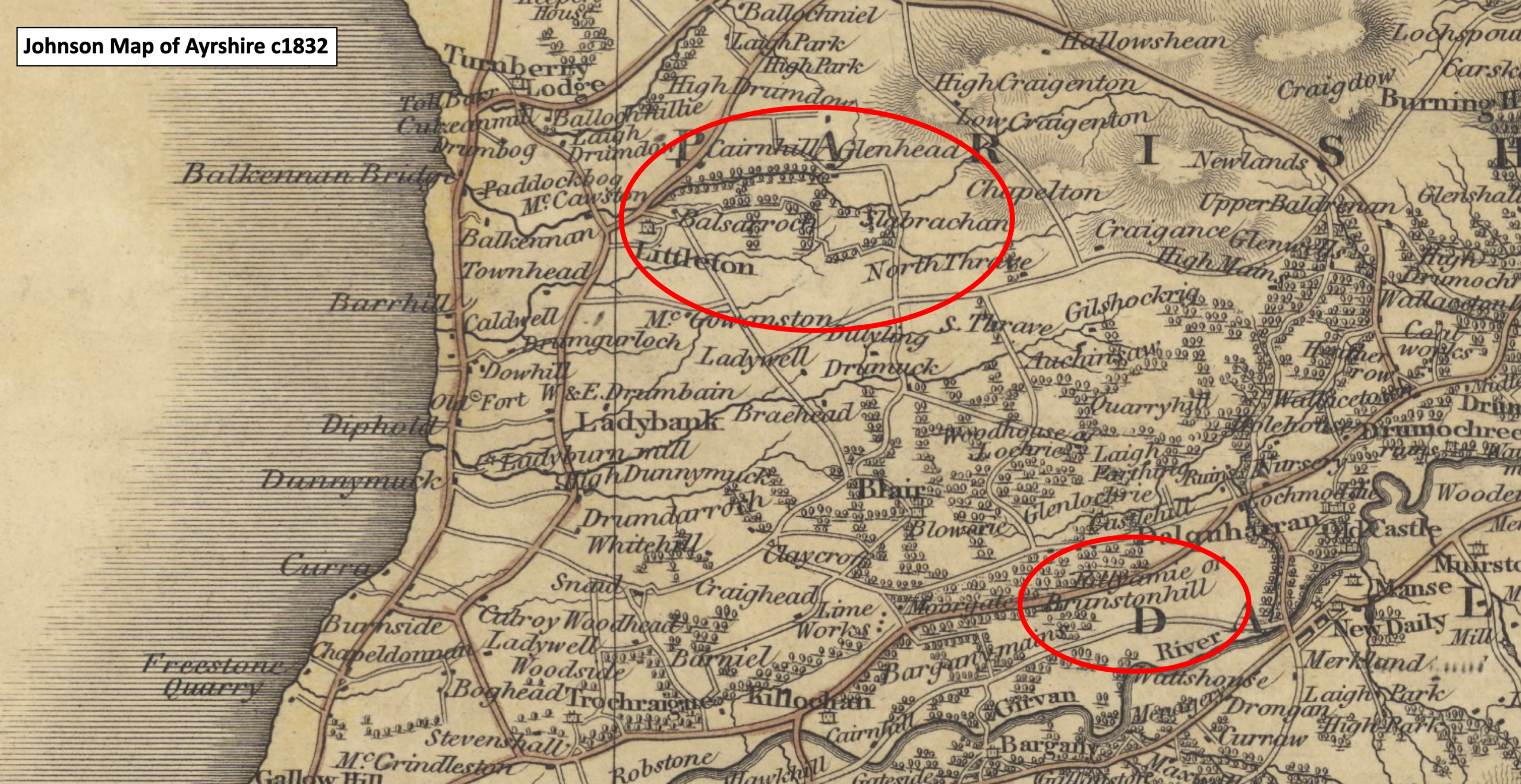
– Reproduced with the permission of the National Library of Scotland
On 1 September 156919 Alan Stewart, Commendator and Abbot of Crossraguel Abbey for the sum of 500 merks granted the 40 shilling 8 penny land of Balsaroch and Slabrachan and 20 shilling land of Littleton to David Kennedy of Balsaroch with right of inheritance to his heirs and that of his brother, William Kennedy in Brunston and his heirs. David Kennedy of Balsarroch had two sons, Anthony and Lancelot. Anthony Kennedy Senior had two sons, Anthony younger of Balsarroch and Walter. Anthony Kennedy Junior received denization on 29 January 1611 alongside non other than Thomas Boyd of Carncoggy:-
LXXV – 41. Grant to John Stewart otherwise McRobert, John Oge Stewart, Thomas Boyde, Gillebert McPhedrishe, Will. Dunlopp, Anthony Kennedy, John Makneaghten and Alexander Stewart, that they be freed, &c. as in the preceeding article. – 29 Jan. 9th”
and received leases of land in Ballyloughbeg, Billy Parish, Turnarobert and Mill & Five Acres, Armoy Parish and Mosside, Grange of Drumtullagh Parish all in Co Antrim from the Earl of Antrim.20
Anthony Kennedy Junior likely died in Ballyloughbeg on 3 December 1620 as he was buried, probably within the old church in Billy Parish. In 1858 his gravestone was unearthed within the walls of the old church and a sketch made of the inscription and armorial etc.21
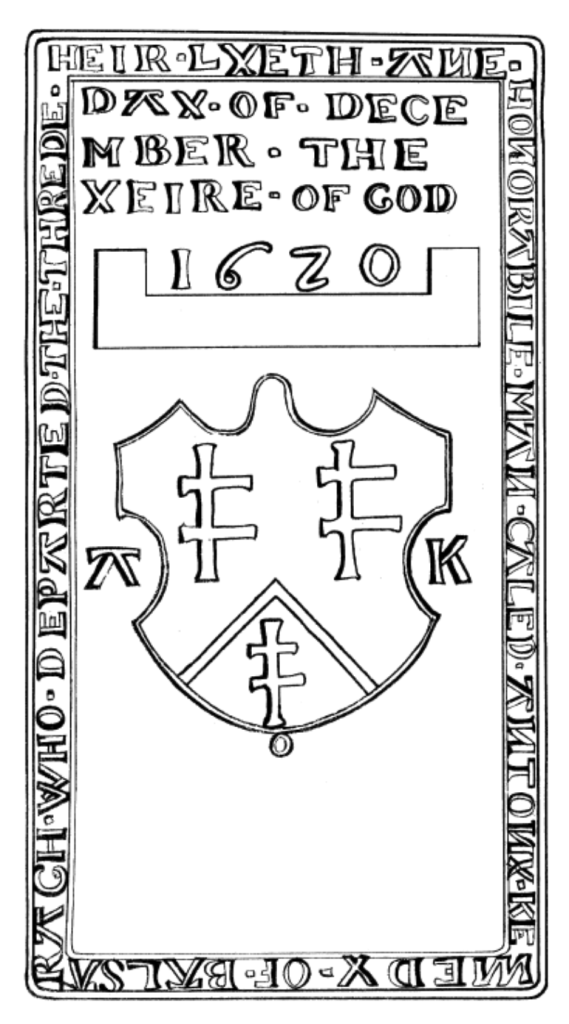
It is believed that Anthony Kennedy, Senior of Balsarroch died 1 August 1625 from the Inquisitions leaving Walter the next male heir to Balsarroch. However it could be that the Inquisition date is wrong because the marriage contract between Walter Kennedy and Jonet Boyd dated August 1624 appears to indicate that Walter is already heir to his deceased grandfather David Kennedy of Balsarroch.
This connection between William Boyd of Dunluce and Walter Kennedy through the marriage to Jonet will prove of significance as we shall find in a later post on the Boyds of Ballycastle.
Adam Boyd (c1609-c1672)
As we have seen previously from the will of William Boyd of Dunluce, Adam was possibly around 15 at the time of his father’s death and the will requests that his guardians make provision for his education. We also know from the will that it was his father’s wish that Adam be prepared for the role of a Diocesan Registrar and most probably the Diocese of Connor. It is likely that Adam would require a university education and tuition in latin and the law but as yet we have been unable to confirm if he was matriculated at any of the principal universities. However one possibility is that Adam and his father were matriculated in St Andrews University, Scotland and until now the matriculation records before 1747 are as yet unpublished. It will require a direct search of the university’s archives to confirm if they were admitted.
If we turn to the Muster Rolls of 1630 we find an Adam Boyd mustered in the Barony of Dunluce with a sword only.22 It is not unreasonable to presume that this is indeed Adam son of William Boyd of Dunluce. He would have been around 21 at the time and his name appears close to Archibald Boyd of Carncullagh and Thomas Boyd of Carncoggy both of whom featured in his father’s will.
By 1637 we find a lease dated 17 August between the Rt. Hon. Randal Earl of Antrim to Adam Boyde, Gentleman, of Coleraine, Co. Londonderry, of the quarterland of Liswatticke [Liswatty Upper & Lower, Ballyrashane, Co Londonderry]. Yearly rent 40s.23 Wonderfully the signature of Adam Boyd is on the foot of the deed.
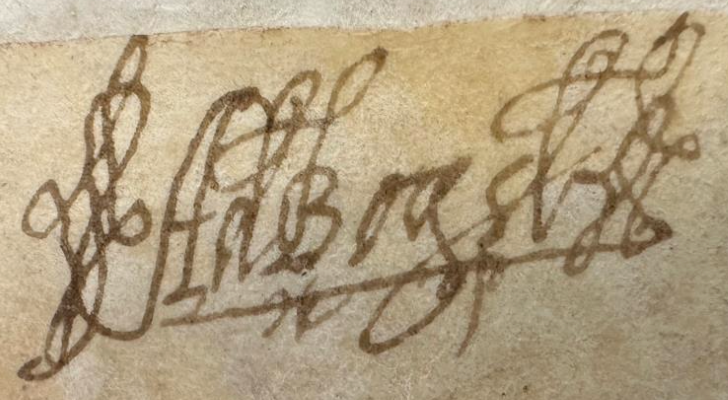
Thanks to the survival of part of the rent records of the Earl of Antrim’s estate for May 1641 we find further evidence for Adam Boyde. 24
“9 Lisvattick [Liswatty, parish of Ballyrashane, County Londonderry], Thomas Sterlinge, yeoman, holds from Adam Boyd, a quarter of a town, arable and pasture 119, meadow 7, moss 34, in all 160 …”
To date nothing has been found so far amongst the depositions of the 1641 rebellion which may suggest he might have left the country as did many others. By 1656 we find Adam as an overseer to an agreement in a dispute involving the Hutcheson family of Stranocum.
Amongst the records of the Public Record Office (PRONI) we find an agreement25 dated 30 October 1656 which appears to have followed an earlier Chancery Court hearing regarding the estate of William Hutcheson of Stranocum, Co Antrim dated 2 May 165626 in which William, James, Thomas and Robert Hutcheson (sons of the late William Hutcheson of Stranocum) were plaintiffs and Alice Hutcheson (widow and likely second wife of the late William Hutcheson of Stranocum) and Archibald Hutcheson (only son of William Hutcheson of Stranocum and his first wife Margaret/Mary-Ann Boyd and father of Archibald Hutcheson famed for his bequest following his death in 1740) the defendants. The overseers or witnesses to the agreement were Daniel McNeale, Minister of the Gospel (likely the person recorded as Vicar of Ramoan, Culfeightrin and Loughguile in 1661) and Adam Boyd of Bushmills Gent. The agreement is badly worn but still legible and at the foot of the document we find Adam’s signature and seal (see below). Although this document comes round 20 years after the Liswatty lease the similarity in the signatures is unmistakable. Unfortunately the associated seal is less revealing.
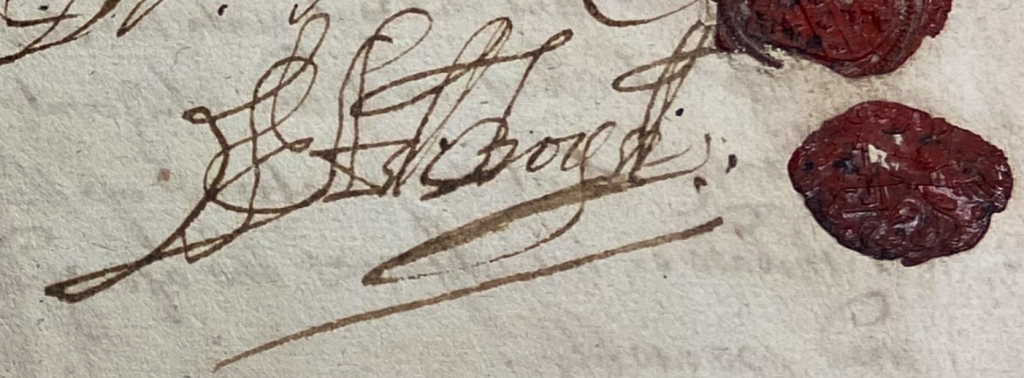
In the Court of Chancery Bill Books 1655-1659 is found a Bill entered on 30 June 1657 by Adam Boyd (Plaintiff) against Captain John Galland. Captain Galland was an English Cromwellian soldier who was resident in the townland of Artiforty, Finvoy Parish, Co Antrim at the time of the 1659 Survey. The details of the Bill are as yet unknown.
We next find an item amongst the National Records of Scotland.27 It is described as a receipt by Adam Boyd of Bushmills to Sir Andrew Agnew for a lease of several lands in he Barony of Glenarm granted to the latter’s father (Sir Patrick Agnew) by the late Earl of Antrim dated 16 October 1657. Wonderfully Adam’s signature (see below) survives at the foot of the receipt
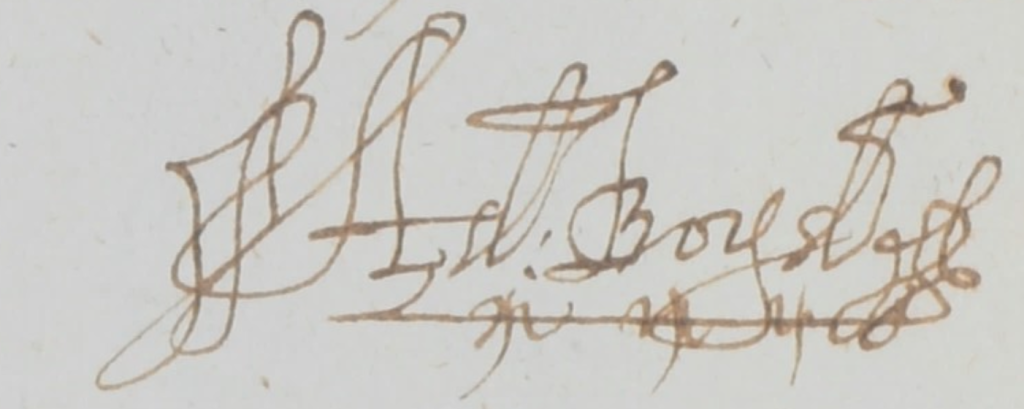
An examination of the Poll-Money Ordnances for 1660 and 1661 lists an Adam Boyd, Gent of Co Antrim.28 Unfortunately there is no further detail as to his residence. However there is greater detail on the Hearth Money Rolls for Co Antrim29, where we find Adam Boyd Esq. in the townland of Carnmoon, Billy Parish, Co Antrim in 1666 with two hearths and again in the same place in 1669 as Mr Adam Boyd with two hearths.
On 4 July 1668 a bill is entered in the Chancery Court in Dublin by John Bradborne30 gent (Plaintiff) against Randall Marquess of Antrim, Ellis (Alice) Countess Dowager of Antrim, Daniell McNeale Esq., Daniell McNeale, Brice Dunlapp, Neile McNeale and Adam Boyd (Defendants). The bill was for the recovery of £1571.10 paid by the plaintiff out of the lands of Ballycastle for and on account of an annuity or rent charge of £1200 payable to the defendant Ellis and chargeable on said lands.
Next, among the PRONI records, we find an indenture31 dated 18 November 1675. The substance of the indenture states that in return for the surrender of the quarterland of [Ballykeele], originally held under lease to William Boyd of Dunluce from the Earl of Antrim (1609), Randall, Marquess of Antrim, for the consideration of £140 paid by the late Adam Boyd of Carnmoon, provides a lease of 41 years on the two quarterlands of Ballycubidell [Cubbindall], quarterland of Carnmoone [Carnmoon], quarterland of Stradbally [Straidbilly], quarterland of Carnboare [Carnbore], quarterland of Sleightcolman [Liscolman], quarterland of the Islands of Carmoone [?] and the quarterland of Ballyhomlin [Ballyhemlin] to Margaret Boyd alias Fullarton, relict of the late Adam Boyd and Francis Boyd, son to the late Adam and Margaret Boyd at a yearly rent of £44. This remarkable document provides a contemporary source confirming Adam Boyd of Carnmoon as son of William Boyd of Dunluce and that he had likely died between 1669 and 1675. We further know that he was married to a Margaret Fullarton, and they had a son, Francis, both of whom were still living in 1675. It is possible that Margaret Fullerton was a daughter of Rev William Fullerton (see fnote 15).
On 6 February 1679 we see a lease32 from the Rt. Hon. Randal, Marquis of Antrim to Robert Cusack Esq. of Dunluce, Co. Antrim, of the one quarter of Seconmore [Seacon More] (late in possession of Robt. Collwill), two quarters of Dunevernon [Dunaverney] (late in possession of Adam Boyd, decd), one quarter of Ballinrock [Ballyrock] (late in possession of Daniel McNaghten, decd), two quarters of Innisgrame [Inshinagh?] (late in possession of John McNaghten of Benvarden), three quarters of Ballyvrockes [Ballyrock] (late in possession of William McPheadris] and one quarter of Ballywatt [Ballywatt] (late in possession of Guilbert McPeadris) for 41 years. Fine £460. Rent £50.
Despite extensive searches no record has been found to date of the will or administration of the estate of Adam Boyd and if he had died in Carnmoon, Billy Parish, Co Antrim he would likely have been buried in or close to the old parish church, similar to Anthony Kennedy (d.1620). Unfortunately, no such grave has been found to date.
At this point the only child of Adam Boyd that we can be certain of is Francis Boyd from the 1679 deed and it is perhaps worth making an attempt to trace any possible lineage from him. A search through various records for the Connor Diocese reveals an Index entry for an Administration Bond concerning a Francis Boyd of Belfast in 1723. The name Francis is quite rare amongst the Co Antrim Boyds in the 17th and 18th centuries and although this Francis was likely resident in Belfast he could be the son of Adam Boyd of Carnmoon. Interestingly we find that the lands secured by Adam Boyd for his wife and son mentioned in the 1675 indenture above are leased33 by the Earl of Antrim to Alexander Andrews of Carnkirn in 1712 suggesting that by that date Margaret and Francis Boyd have either died or sold on their interest. Perhaps one explanation is that Margaret has likely died and Francis has moved to Belfast. One clue suggesting this possibility comes in the form of another Francis Boyd whose grave/memorial can be found today in old Ramoan Parish graveyard, Ballycastle, Co Antrim (see below).
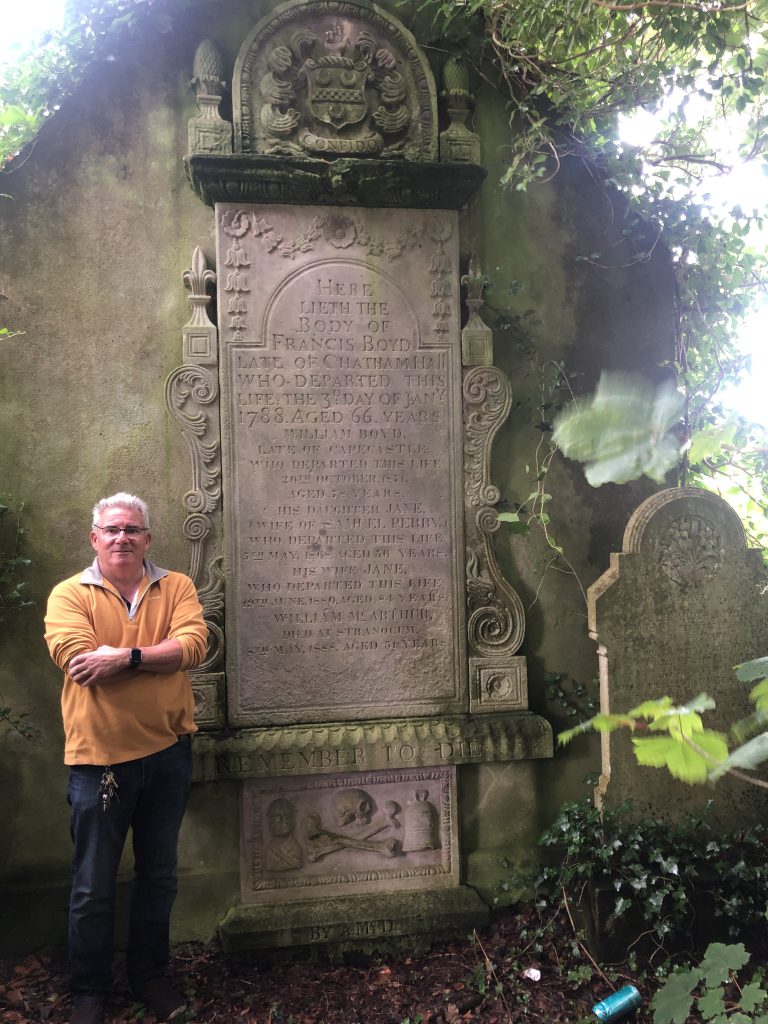
As can be seen from the photo above the impressive scale of the memorial/gravestone standing at over 12 feet high and the quality of carving are what one would expect from a successful merchant family of some standing. However it begs the question that we have a Francis possible son of Adam Boyd of Carnmoon died 1723 in Belfast, Co Antrim and a Francis Boyd born c1722 died 1788 and buried in Ramoan, Ballycastle, Co Antrim. It is certainly possible that the Francis referred to on the memorial/gravestone might be the son of Francis died in Belfast 1723 but there is considerable distance between Ballycastle and Belfast suggesting that they may not be related at all. However in an Irish deed memorial No. 246663 dated 1 March 1785 we find Hugh Dunlope of Carrukeel (Carrowkeel ow Chatham hall, Derrykeighan Parish, Co Antrim) conveying the townland of Carrukeel to Francis Boyd of Belfast for the remaining term of 41 years from 1 November 1782. We can now say that the Francis Boyd mentioned on the large memorial/gravestone in old Ramoan was resident in Belfast prior to 1785. Of course we cannot be certain from this information that Francis Boyd d.1788 is the son of Francis Boyd d.c1723 and accordingly son of Adam Boyd d.c1672. However the evidence certainly makes it a possibility and as we shall see later another clue to this lineage is the armorial carved at the top of the memorial/gravestone i.e. Azure a fesse chequy Argent and gules between three crescents of the second.
Before leaving this potential descendant line of Adam Boyd through a son Francis Boyd we should mention one further Irish deed memorial No. 274172 dated 16 January 1790 in which it states “John Boyd and Adam Boyd sons and Admins with the will annexed of Francis Boyd late of Chatham Hall“.
Before leaving Adam we want now to turn to the research of the late Danny McGill, his wife Jayne and son Andrew. Danny and the family researched much of the local history of north Antrim before Danny’s death in 2013. This included research into the Boyd’s of Ballycastle, Co Antrim and we are much indebted to them for the huge and important legacy of research that we were fortunate to access in recent years. Perhaps the culmination in this research, apart from a series of articles published in the periodical of the Glens of Antrim Historical Society, was a project guide published in 2007 called Col. Hugh Boyd’s Ballycastle. This excellent pamphlet produced by Danny and the family along with others was the work of the Ballycastle Research Group under the chairmanship of Des Andrews. On page 9 of the pamphlet Danny produced a family tree for the Boyds of Ballycastle and in it he records his belief that Col. Hugh Boyd of Ballycastle (1690-1765) was the son of a Rev William Boyd and grandson of an Adam Boyd and great grandson of William Boyd of Dunluce. Danny’s conclusion was founded on the discovery of the will of Rev William Boyd of Ramoan, Co Antrim dated 29 May 1701 (proved 2 March 1701/2) amongst the legal papers of the Boyds of Ballycastle. The detail of the will is to be the subject of a future post on the Boyds of Ballycastle but for now we can say that it records his eldest son as being called Adam who appears to witness the will. The will also records the remaining children of Rev William Boyd including Hugh and James the brother of Rev William Boyd. It appears that Adam did not long survive his father and thus the family estate passed to Hugh after he received his majority c1721.
Before concluding our text on Adam Boyd and looking at the remaining children of William Boyd of Dunluce it is perhaps worth recording a possible lineage from the information already mentioned. In the tree below we have incorporated both the McGill research and our own based on the available evidence suggesting in particular that Adam Boyd son of William Boyd of Dunluce had likely married twice with Rev William Boyd and James Boyd being children of the first marriage.
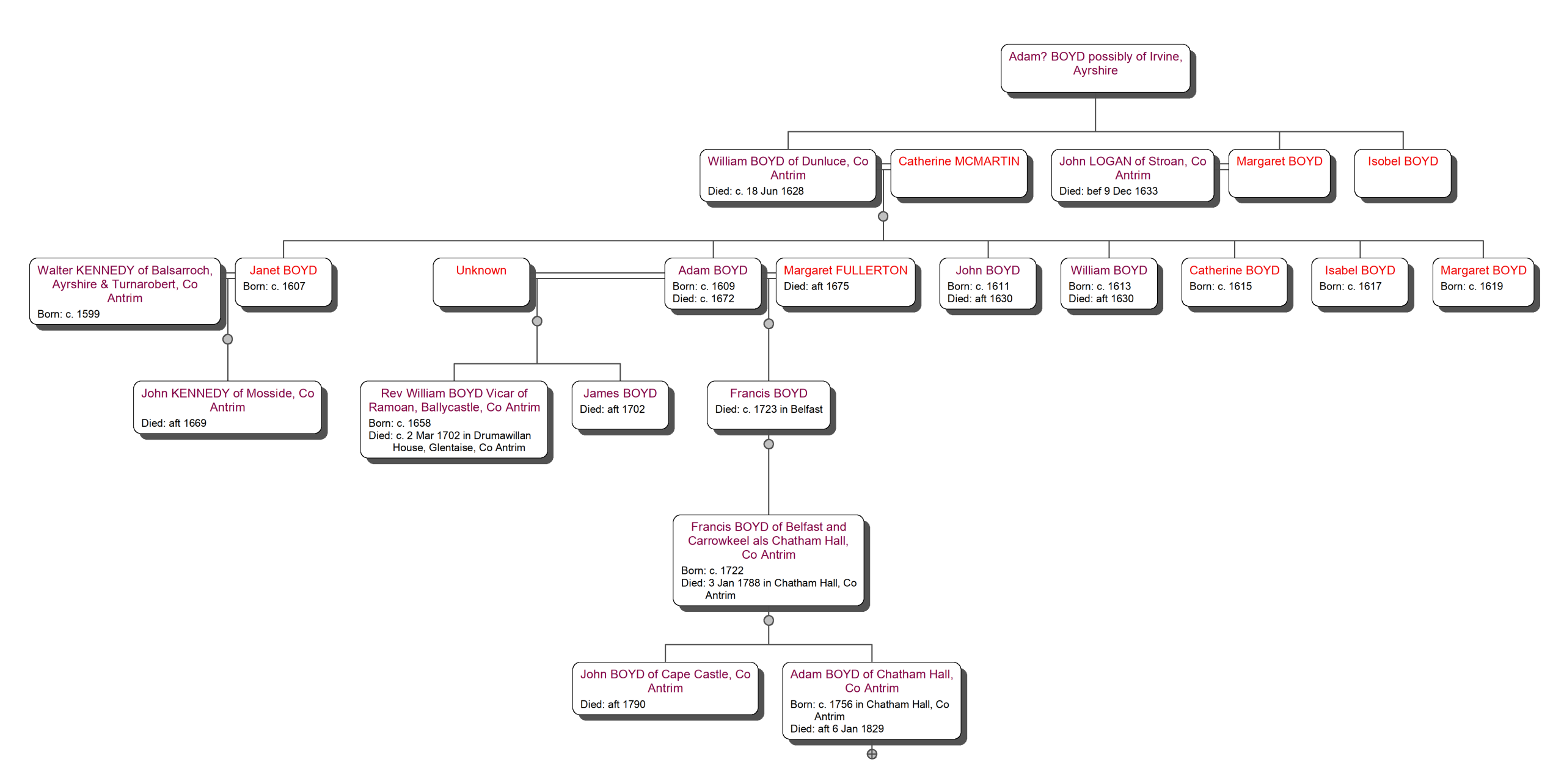
The remaining children of William Boyd of Dunluce
Sadly very little information has been found on John and William, the remaining sons of William Boyd of Dunluce except to say that they have both been included i.e. John34 and William35 in the ‘Men and Arms’ publication on the Muster Roll of 1630. Of particular interest is the statement in the footnotes that William Boyd son of William Boyd of Dunluce was “One of the perpetrators of the killing of the Irish on Island Magee, 8 January 1642 (Examination of Bryan McGee, 21 April 1653 [TCD MS 838, folks 198r-198v]”. However this association with William son of William Boyd of Dunluce is far from certain, not least because there appears to have been a James Boyd implicated in the crime also and Bryan McGee’s statement said both men where from Island Magee. Records show the existence of Boyds in the Glenarm area from the early 1600s and it is possible this is where William and James Boyd mentioned in the 1641 depositions originate from. The testimony of Robert Boyd of Glenarm may go some way to confirming this. Of the remaining daughters, Catherine, Isabel and Margaret, again little is known.
- Hill, An Historical Account of the MacDonnells of Antrim, p. 389 ↩︎
- Abstract from Protocol Book of Robert Broun, Archaeological & Historical Collections of Ayrshire and Galloway Vol IX, p.189 ↩︎
- Inquisitionum in Officio Rotulorum Cancellariae Hiberniae Asservatarum Repertorium Vol II (Ulster), (Hardiman, 1829) ow Inquisitions of Ulster, Cha I, 60 – drawn primarily from the Inquisitions Post Mortem during the reigns of James I to Charles II ↩︎
- Ibid Cha I, 94 ↩︎
- Genealogical abstracts of records of the Prerogative Court of Armagh – Genealogical Abstracts Prerogative Wills. (Philliphs Mss) B. 1581-1766. & Misc ↩︎
- Ireland Diocesan And Prerogative Wills & Administrations Indexes 1595-1858 ↩︎
- Alumni of St. Andrews and the Settlement of Ulster by A. F. Scott Pearson – Ulster Journal of Archaeology, Third Series, Vol. 14 (1951), pp. 7-14 ↩︎
- “Kraig” in the parish of Kilmaurs, and part of the barony of Robertoun, also occurs on the map, and belonged in 1576 to William Dunlop, who in that year was serverd heirs to his grandfather, Adam Dunlop of Craig. William Dunlop, younger, of Craig, is appointed a Sub Commissioner for valuing the Teinds in the Presbytery of Irvine in 1630. William Dunlop of Craig, and William Dunlop, younger, of Craig are mentioned as bailie and witness in the infeftment of Mr William Cauldwell as heir of his father William, in the 20s land of Annandhill, 1638 (Broun’s Protho. Buik). “Robert Montgumrie Laird of Haishilhead and Williame Dunlop laird of Craig reuling elders” in the Presbytery, occur in the Act, 1641, Charles I., anent the New Kirk of Kilmarnock.
{Source: Cunninghame, topographized by Timothy Pont… 1604-1608, with continuations and illustrative notices by …J Dobie edited by J S Dobie (1876), p.302} ↩︎ - WILLIAM WALLACE – probably born in Scotland; MA – d 14 Jun 1614 p 16 Jul 1614; C Ballymoney (Conn) 1622; add V Dunluce in 1629 (RV); inst to Dunluce 17 Feb 1630; still here in 1633 and probably until 1635; also C derrykeighan and V Ardclinis (27 June 1633). He appears to have had strong Presbyterian tendencies and it is probable that in 1634 or 1635 he emigrated to New England – Clergy of Connor, Canon J B Leslie, (1993 Ed), p.639. See also Alumni of St. Andrews and the Settlement of Ulster by A. F. Scott Pearson – Ulster Journal of Archaeology, Third Series, Vol. 14 (1951), p8 – Matric. St. Marys, St Andrews University. 1607; probably M.A. Glasg. 1607. ↩︎
- Scotlands People – Ref. CC9/7/17 – Summary – 15 March 1621 – Testament Dative of Jeane Campbell spouse to William Dunlope of Craigs in parish of Kilmaurs, who died in January 1621, given up by the said William in name of Allan, Grizel, Jean, Janet, Archibald and Elizabeth Dunlope, their lawful children. The estate is valued at £824, being farm stock and plenishing. There was due to them £513:6:8, including sums by his tenants in Ireland and John Louk in Netherbyre; they were due £2080, including sums to Mathew Homill, burgess of Irwen [Irvine], now in Dunbug in Ireland, Hew Thomsoune, burgess of Lundondarie [Londonderry], and Mr. John Dunlope, minister at Ratho [Rapho?], James Blair, burgess of Irvine, William Cauldwell of Annandhill, Andrew M’Cluir [McClure] in Ireland and others. So the debts exceed the goods. Confirmed, William Cauldwell of Annanhill, cautione ↩︎
- ANDREW MONEYPENNY – b Scotland; appears to have been MA and DD, d and p 1613 (RV 1633), Preb of St Andrews (Down) 1615/16; Archd of Connor 1616/17; Nicholas Todd disputed possession with him for several years (PR and SP 7 Jun 1624 and 19 Feb 1629/30) and Moneypenny was again president by the Crown 19 Feb 1629/30; R and V Billy 1622 – Clergy of Connor, Canon J B Leslie, (1993 Ed), p.504. See also Alumni of St. Andrews and the Settlement of Ulster by A. F. Scott Pearson – Ulster Journal of Archaeology, Third Series, Vol. 14 (1951), p8 – MA St Andrews University. 1605 ↩︎
- WILLIAM FENTON – St Andrews University MA 1612, V Tickmacrevan and Ardclinis (Conn) 1621; also V Kilwaughter Skerry and Racavan 1622 (RV) – Clergy of Connor, Canon J B Leslie, (1993 Ed), p.327. ↩︎
- ARCHIBALD STEWART Esq – Among the earliest leases granted by the first earl, was one to this gentleman of lands in Ballylough, near Bushmills, containing 120 acres. Mr. Stewart also held lands by lease, of the same extent in Ballintoy. He became lord Antrim’s principal agent on the death of John Macnaghten in 1630, and held that situation until after 1665. He also had a lease, dated May, 1621, of the five quarters of Cavanmore, Cabragh, Coolremony, Craigballyvenoge, and Goyse, containing 70 acres, for a term of 101 years, at the annual rent of £11 5s 0d – Hill, An Historical Account of the MacDonnells of Antrim, p. 438 Note (4) ↩︎
- ROBERT ECHLIN (1576-1635) – b in Scotland a native of Fifeshire; ed St Andrew’s Univ MA 1596; was in charge of 2nd congregation of Inverkeithing 1601; app Bp Down and Connor by Pat 4 mar 1613 (PR). he exerted himself to repair the wastes made in the See property by his predecessor in which he was assisted by a Royal Commission in 1616; allowed to hold the Prec of Connor in commend 1618-20 which he exchanged for the Treasurship of Down in 1620. he drew up a report on the State of the Diocese for the Royal Visitors in 1622; had much trouble with non-conforming Presbyterian ministers and ejected some in 1634. he was s of Henry Echlin laird of Pittadro Fifeshire by Grizel (or Grissel) day of Robert Colville of Cleish Kinross; m Jane daughter of James Seaton of Latrisse (or Lathrisk). Issue 1. John m Mary day of Sir Francis Stafford of Mount Stafford Co Antrim from whom descended the Echlins of Ardquin 2. Hugh m Magdalen daughter of Robert Cowell of Co Armagh 3. Margaret m Ben Robert Maxwell Archd of Down and later Bp of Kilmore ancestor of the Earls of Farnham 4. Isabel m Archibald Stewart of Ballintoy 5. Jane m 1st Henry Maxwell of Finnebrogue Co Down ancestor of Maxwell of Ballyrolly (BLG I 1912) She m 2nd Ven William Fullerton Archd of Armagh 6. Euphemia. He died at his house the Abbacy Ardquin Co Down 17 July 1635 and was bur at Templecany Co Down – Clergy of Connor, Canon J B Leslie, (1993 Ed), p.31 ↩︎
- WILLIAM FULLERTON – 1666 – d and p on the same day 1628 by Archbishop Ussher; Preb of Cairncastle and R Derrykeighan (Conn) 1629-1666; R Ahoghill 1633 (4 Apr and 12 Nov); Archd of Armagh and R Aghaloo and Cartel 1633; John Kinneere was his Procurator while Preb of Cairncastle. [He commanded the protestant refugees who held out in Ballintoy Church in 1642 until they were relieved by the Scottish Army of Munro. He signed the Solemn league and Covenant in 1644 and was probably not ejected from his home parish. Tablet to him in Derrykeighan Old Church. This WF should not be confused with another of the same name (possibly a cousin) who was pre of Loughgall (Arm) and was murdered in 1641] m Jane day of of Bp Robert Echlin qv. Issue 1. Robert 2. William 3. John 4. Jean 5. Margaret 6. Euphemia 7. Isobel 8. Mary 9. Agnes Died 29 Sep 1666 – Clergy of Connor, Canon J B Leslie, (1993 Ed), p.339 ↩︎
- In 17th-century Ireland, the diocesan registrar was an officer of the established Church of Ireland (Anglican) responsible for maintaining official diocesan records, which were considered public records at the time. These records included bishops’ registers, visitation returns, legal papers, and records of church lands. – Google AI ↩︎
- FindmyPast – Genealogical abstracts of records of the Prerogative Court of Armagh – Genealogical Abstracts Prerogative Wills: (Phillips M S S) S. 1583-1699. T. 1582-1699 Uv. 1582-1699. W. 1551-1632 ↩︎
- Ayrshire Sasines- (Vol 1, 1617-34) – Vol.3,Fol. 138 – transcript by Diane Baptie ↩︎
- National Records of Scotland (NRS) Ref. GD25/732 & 733 ↩︎
- Inquisitionum in Officio Rotulorum Cancellariae Hiberniae Asservatarum Repertorium Vol II (Ulster), (Hardiman, 1829) ow Inquisitions of Ulster, Cha I, 38 & – drawn primarily from the Inquisitions Post Mortem during the reigns of James I to Charles II ↩︎
- Leanings in Northern Church-Yards Author(s): George H. Reade, Source: The Journal of the Kilkenny and South-East of Ireland Archaeological Society, 1858, New Series, Vol. 2, No. 1 (1858), pp. 48-54 ↩︎
- ‘Men and arms’ – The Ulster settlers, c. 1630 (2012), p.111, [f.149v], No.127, footnote 17 ↩︎
- PRONI Ref. D2977/3A/6/14/1 ↩︎
- DIRECTORY OF IRISH FAMILY HISTORY RESEARCH, No.43 (2020), Names of tenants on part of the Earl of Antrim’s estate in May 1641, Ian Montgomery (Guild Member) ↩︎
- PRONI Ref. D2171/2 ↩︎
- FindMyPast – Ireland, Court Of Chancery Bill Books 1627-1884 ↩︎
- NRS Ref. GD154/520 ↩︎
- A Census of Ireland c1659 etc, Pender (1939), pp.627 & 646 ↩︎
- Heads and Hearths: The Hearth Money Rolls and Poll Tax Returns for Co. Antrim 1660-69, S T Carleton M.A. p.87 ↩︎
- John Bradborne was one of the Trustees appointed to the Earl of Antrims estates in the Barony of Cary. Due to considerable debts inherited from his parents Randall, 2nd Earl of Antrim, for an undisclosed amount, demised, sold and farm lett the Barony of Cary, the Manor or Lordship of Ballycastle and the island of Rathlin for a term of 99 years from the Feast-day of St Michael the Archangel last past (29 September 1637) to the following viz. Alexander MacDonnell Esq. (his brother), John Moor of London (Dr of Physic), Archibald Stewart of Ballintoy Esq. (Servant/Officer of 2nd Earl), John Traylman of Westminster Gent. (Servant/Officer of 2nd Earl)
By 1668 most of the original trustees had died or been replaced ↩︎ - PRONI Ref. D2977/3A/3/1/29 ↩︎
- PRONI Ref. D2977/3A/3/1/33 ↩︎
- PRONI Ref. D2977/3A/3/1/57 ↩︎
- ‘Men and arms’ – The Ulster settlers, c. 1630 (2012), p.113, [f.153], No.320, footnote 44 ↩︎
- Ibid, p.117, [f.162], No.140, footnote 105 ↩︎