In our last post we recorded the birth of a son John on 29 December 1718 to Augustus (Jean ‘Auguste’) Boyd and Lucy Peters on the island of St Christopher (St Kitts) in the Leeward Islands, West Indies. It would appear that he was the only issue of the marriage. We next find John Boyd’s matriculation at Trinity College Dublin on 23 July 1733.

From the entry in the Matriculation Register above we see John is admitted as a pensioner (a fee-paying undergraduate student who paid an annual fixed sum for their education and meals), son of Augustus, Gent and it records his age on entry as 15 years and that he was born in the West Indies. He was placed under the tutelage of Dr Every of Dublin. There is no record of him receiving a qualification from Trinity which is likely explained by his matriculation1 at Christ Church College, Oxford on 16 February 1736/7 at which time he is referred to as 18 years of age and son of Augustus of London Gent. Its not known how long John Boyd stayed at Christ Church College, Oxford but it is believed he made several journeys to the Continent afterwards, a common pursuit of young men of the period born into either an aristocratic or middle class family. He then joined his father’s business which initially had been a partnership between his father and John’s cousins Samuel Pechell (1715-82) and James Pechell (b.1720), which operated from an address in Broad Street in London. The name Augustus Boyd can be seen on the Land Tax Records for London2 between 1737 and 1762 for property on Broad Street. However by 1745 John’s father setup in business on his own as Boyd & Co in Austin Friars.3
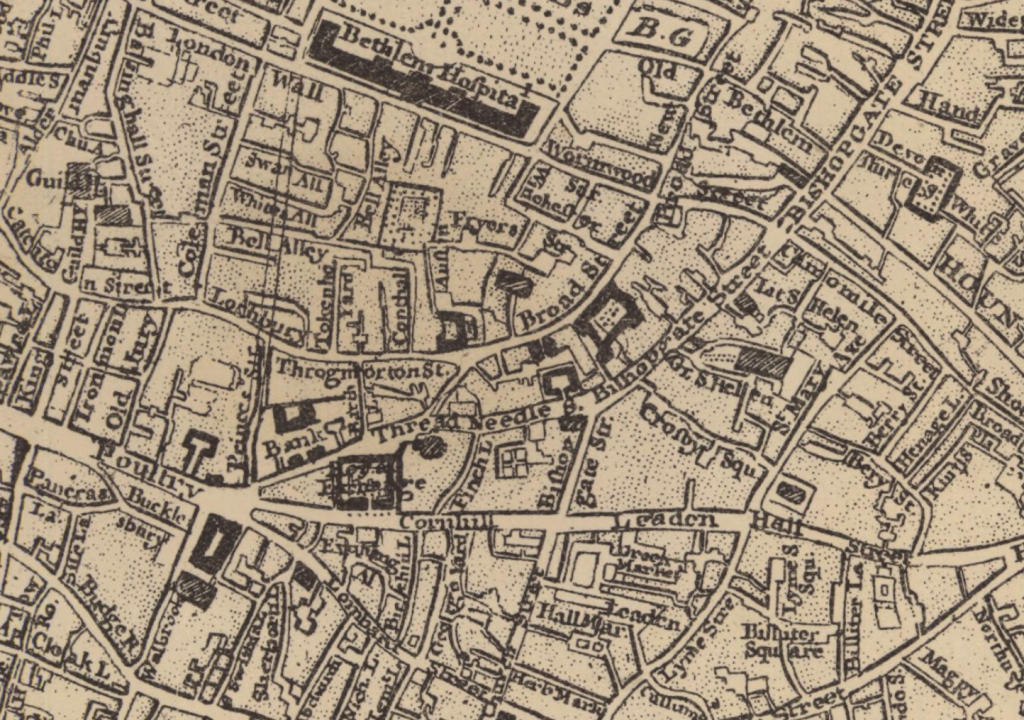
Reproduced with the permission of the National Library of Scotland
John moved from the family home in Broad Street in 1743 to a property in Lewisham High Street. His father then also moved from Broad Street taking a large house at the junction of Lewisham High Street and Ladywell known as Lewisham House.4
On 26 June 1749 we find the marriage (by license) of John Boyd to Mary Bumpsted (a minor, baptised Ratley Parish, Warwickshire, 12 January 1732 ), daughter of William Bumpsted (Merchant of London) of Upton House, Ratley, Warwickshire in St Peters Parish Church, Wormleighton, Warwickshire, England.
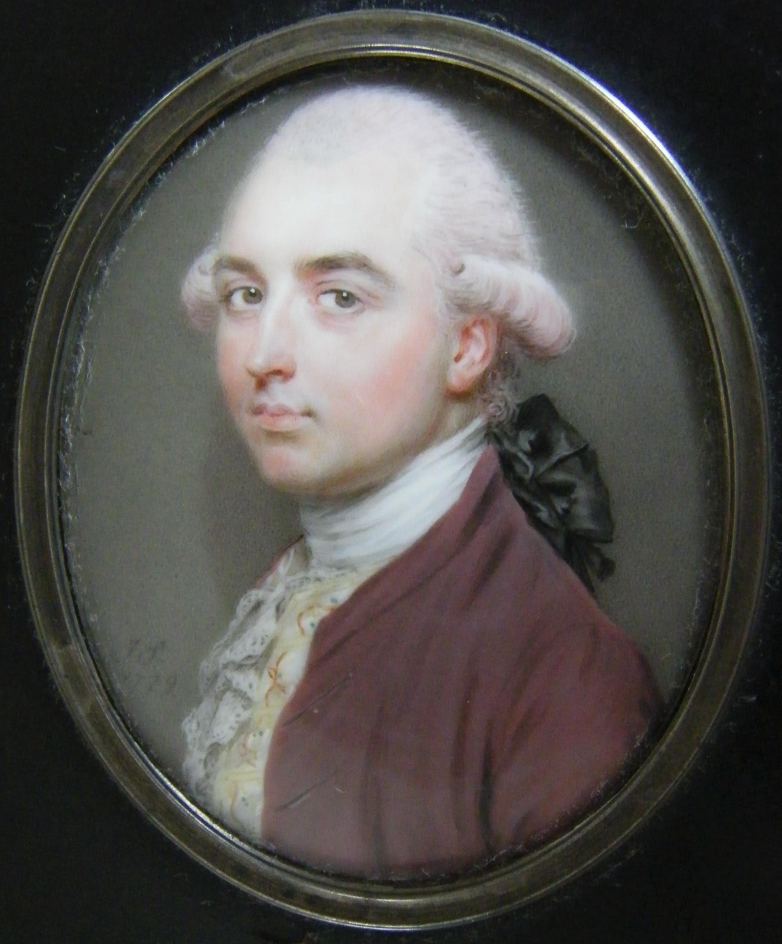
Reproduced with the kind permission of Mr Stephen Goodhart, Ballycastle Boyd Archives
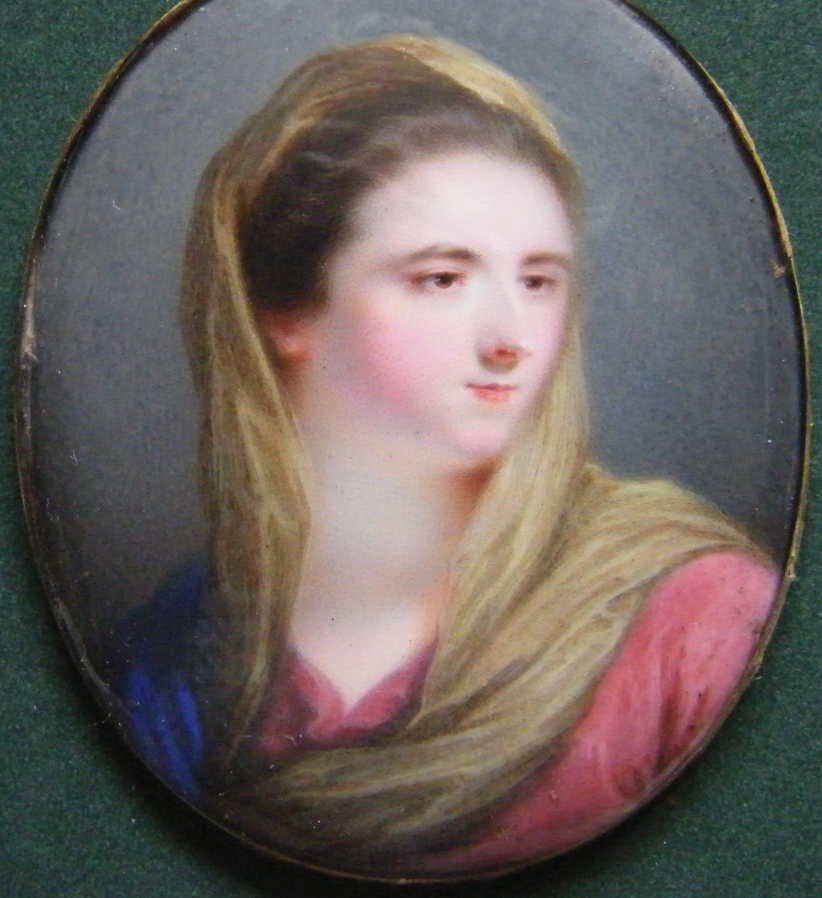
Reproduced with the kind permission of Mr Stephen Goodhart, Ballycastle Boyd Archives

St Peters, Wormleighton, Warwickshire, England © Dave Kelly
John Boyd and Mary Bumpsted had at least five children, ‘John’ [II] Augustus (b.1750), Elizabeth (b.1752), Lucy (b.1753), Mary Jane (b.1754) and Augustus (b. 1758). Lucy, Mary Jane and Augustus all died without any known issue.5

By 1758 John Boyd was partly turning his attentions away from his father’s business ‘Boyd & Co’ and in 1758 he was appointed a Director of the East India Company in which role he remained until 1766,6 including a period as Deputy Chairman 1759-60. He also remained a part-owner in the Bunce Island Slave Factory until 1784.7
With a growing family and no doubt considerable wealth acruing from his business and East India Company roles, John Boyd turned his attention to acquiring an appropriate property reflecting his social position. On 10 July 1753 he took on a lease “for 21 years of the capital messuage or mansion house called Danson House with barns, stables, outhouses, etc., and gardens, orchards, piscaries, canals and fish ponds, and the 40 acres ground around it” from Mary Selwyn of St George’s, Hanover Square, Co. Middlesex, widow. This would mark the beginning of a considerable investment in the extention and development of the property which still exists to this day and is open to the public under the ownership of Bexley Borough Council.
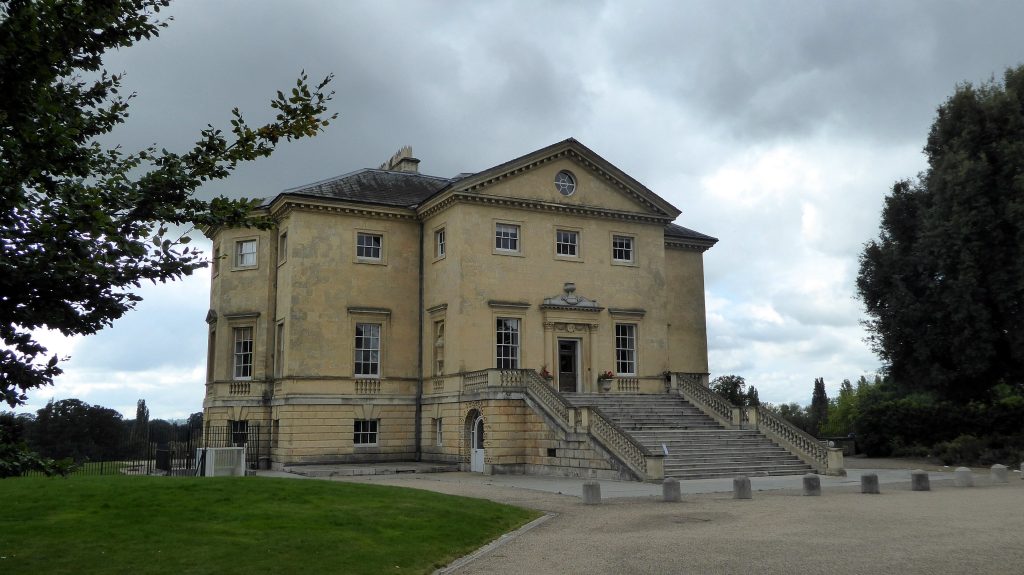
Danson House and its history have been extensivley covered in a publication by English Heritage in 2011 and accordingly we would recommend any of our readers who wish to know more about the property to consult this excellent publication by acquiring a copy or through their local library. We would also like to mention the extensive archive of estate and other papers8 currently held by the Archives Department of Bexley Borough Council.
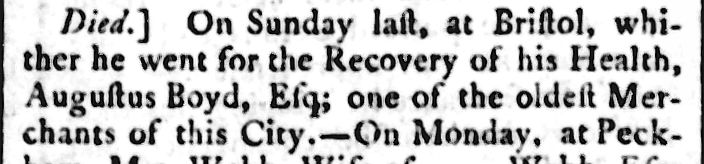
During the development of Danson Estate John Boyd was hit by the tragic death of his wife Mary at Bath, Somerset, England on 5th March 1763. The circumstances of her death in Bath are unknown but it is possible she may have been there to recouperate from an illness. A memorial was erected by John Boyd in Bath Abbey Church in memory of his wife. Mary’s death was followed two years later by the death in Bristol, Gloucestershire, England of John ‘Augustus’ Boyd, John’s father, on 24 August 1765.
By 1766 John Boyd was probably seeking a new marriage with a young family in need of a mother. His father’s death and the associated inheritance of his extensive holdings likely also precipitated new impetous in the works at Danson House and estate. On 14 August 1766 he married, by license, Jane ‘Catherine’ Capon/Chapone (bap. 26 September 1732, Stanton, Goucestershire, England), daughter of Rev John Capon/Chapone9 (1700- 59) and Sarah Kirkham (1699-1764) of Badgeworth, Gloucestershire, England. Catherine’s mother Sarah was the famous 18th century feminist writer credited with authoring ‘The Hardships of the English Laws in Relation to Wives‘.
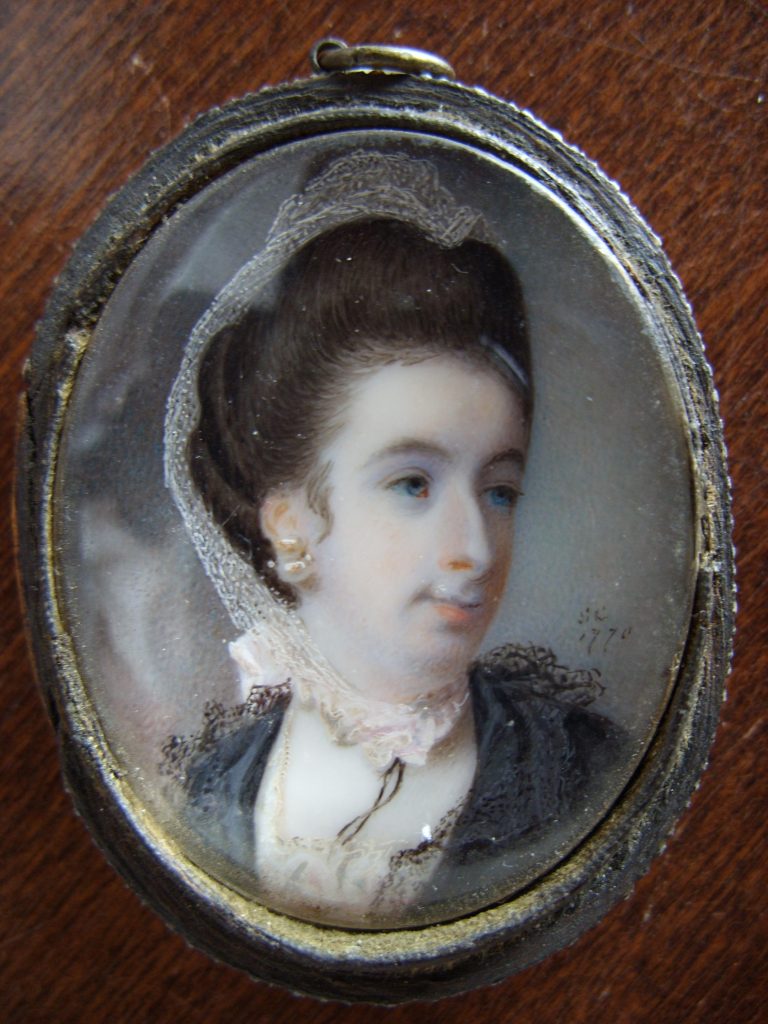
Reproduced with the kind permission of Mr Stephen Goodhart, Ballycastle Boyd Archives
John Boyd and his second wife Catherine Chapone would go on to have at least three children, James (1767-1811), Sarah (b.1768) and Catherine (b.1770).
From 1765 work on completing the interiors to Danson House and the surrounding park continued apace. Meanwhile in regard to John’s business interests he had taken on an associate in John Trevanion. Despite the assistance of others in juggling the development of Danson with his business interests John Boyd could do little to protect himself from the effect of global influences on his business. A fall in sugar prices and the ever presence of conflict throughout the 1760s were beginning to erode his finances. Richard Lea and Chris Miele write10:
“In 1771, a loan of £9,000, which Boyd had made to associates in order to ensure a friend’s election to the East India Company Court of Directors had to be cancelled. Boyd was devastated. In March, he was forced to borrow £5,000 needed to equip seven new plantations on Grenada and Dominica. Soon after another debtor reneged, and then, worst of all, his bank stopped payments on an £18,000 credit.”
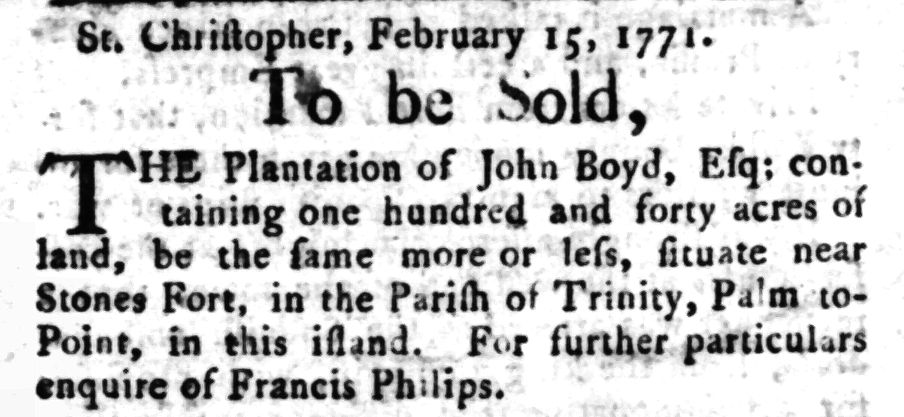
In February 1771 we see an advert placed in the St Christopher Gazette stating John Boyd’s 140 acre plantation in the parish of Trinity, St Christopher is to be sold.
The year 1772 saw the death of John Boyd’s youngest son Augustus and on 5 June 1773 his eldest daughter Elizabeth was married to business partner John Trevanion in St Mary the Virgin parish church, Bexley, Kent, England. On the 20 May 1775 John Boyd was created 1st Baronet of Danson at St James’ Palace by George III. This was a major milestone in John Boyd’s life and perhaps he felt this would be a turning point in his fortunes. The previous year he had placed his son John [II] in the charge of Sir Robert Murray Keith (1730-95), Envoy-extraordinary to Vienna. Unfortunately the events of 1774 and 1775 had little effect on improving the Boyd’s financial fortunes. Richard Lea and Chris Miele write11:
“His son’s budding diplomatic career was brought to an abrupt end.12 Boyd and Co. went bankrupt in 1777. In 1781, almost none of the sugar from the family plantations found its way to London. Boyd was driven to the brink of despair.13 The younger Boyd had to rely on his grandmother in Lewisham to keep him ‘liquid’. He wrote: I cannot foresee anything like ruin, and if, after all his (Boyd senior’s) fortune be reduced by one half of what it is, it will in no measure affect my happiness.’14 Unfortunately, these troubles most certainly did affect the happiness of his father, who seems by this point to have been suffering from severe, recurring depression. The elder Boyd had once more to borrow money. In March 1780, he secured £25,000 from one of his East Indian associates, but in December, months before the note was due, his nabob friend called in the debt. The younger Boyd observed his father could not hope to raise even £15,000, since ‘from gloom, [he has] dissolved all former connections’.15 ‘Nevertheless, that winter Boyd managed to negotiate a larger sum from a more reliable source, Nathaniel Smith, who had started out as a clerk in the office of Boyd and Co. Smith’s £56,000 helped Boyd to ‘regain his composure’, at least for a time and his involvement looks forward to the fate of the house and Park. Smith’s sister was the wife of the architect George Dance the Younger, a connection which, in the early years of the next century, may well have led to the architect’s involvement at Danson. In any case, the respite gained by Smith’s loan was temporary; the unpaid portion had to be renegotiated in 1794. Boyd was not able to discharge the debt in his lifetime, and it passed to his son in the form of a charge upon the estate.”
On 26 February 1784, the now Sir John Boyd Bt’s son ‘John’ [II] Augustus married Margaret Harley, fifth daughter of Right Hon. Thomas Harley MP (1730-1804), brother to the late Earl of Oxford.
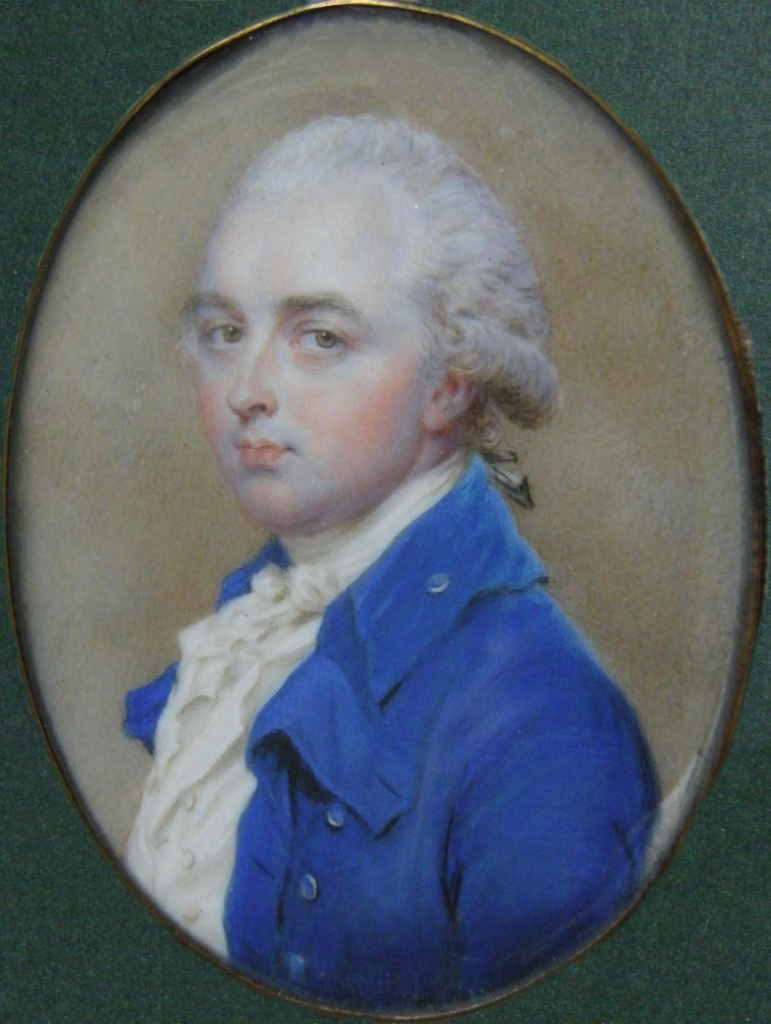
Reproduced with the kind permission of Mr Stephen Goodhart, Ballycastle Boyd Archives
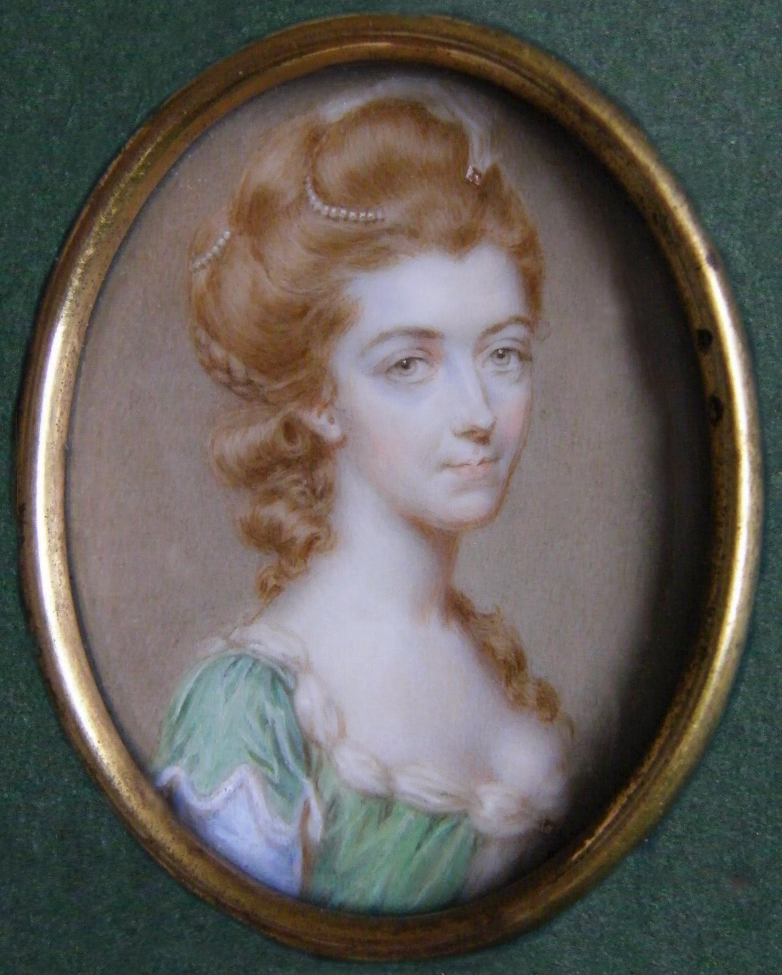
Reproduced with the kind permission of Mr Stephen Goodhart, Ballycastle Boyd Archives
Thomas Harley’s financial successes, initially in the wine trade, and then in lucrative government contracts had probably attracted Sir John Boyd to the marriage. If it was too late for his own fortunes perhaps marriage to Margaret Harley could secure his sons future. Alas a dramatic reversal of his personal fortunes was not to be and Sir John Boyd died at Danson House on 24 January 1800. He was subsequently burried in St Mary the Virgin parish church in Lewisham, Kent, England on 1 February 1800 in whose registers he was recorded as aged 84.
Sir John Boyd Bt had made his will on 8 October 1797 which was subsequently proved in the Prerogative Court of Canterbury on 5 February 1800. A summary of is as follows:
- The payment of all just debts and funerary expenses after his decease.
- Confirmation of a previous marriage settlement (terms not quoted) upon the marriage of his son John Boyd and his present wife (Margaret Harley).
- An Annuity of £1,200 pounds per year to his wife Jane Catherine Boyd (née Capon/Chapone).
- Unto my said wife all her Jewells and all my plate (except my …. Dishes) and such of my pictures, drawings and prints on which I shall cause to be affixed the letters C B and such a number of my books as she shall care to select within three months after my death not exceeding two hundred volumes and all my household …, china and glass ware and my coach and chariot and such pair of horses as she shall claim to be delivered to her as soon as ? may be after my decease.
- The sum of £3,000 pounds to his wife on the proviso that she considers the terms of her dower to be met and releasing his son John Boyd from any libaility thereof.
- To each of his said daughters Lucy Boyd, Sarah Boyd and Catherine Boyd the sum of £10,000 pounds each, except that payment thereof is witheld pending the expiry of five years after the conclusion of any war in which Great Britain now is or may happen to be engaged at the time of my death. In the meantime and until payment of the several principal sums, each of my said three daughters and their respective representatives shall be paid interest half yearly on their respective legacies at the rate of four pounds per hundred per annum.
- A yearly rent charge of £400 for the better maintenance and support of my son James Boyd upon trust by Sir Richard Neave of Dagnam Park in the County of Essex Baronet, John Rawby of Bury St Edmonds in the County of Suffolk Esquire and John Stanley of Shooters Hill in the County of Kent Esquire. Such sum cannot be used for debts, bankruptcy or any other purpose and if his said son James Boyd should attempt to do so the legacy will be voided. I expect my said son (James Boyd) so to conduct himself as to illicit the good opinion and kindness of his brother whom I earnestly request to take him under his protection and to assist him through life as his behaviour shall deserve and circumstance will allow, I having the justest confidence in the liberality and discretion of my said son John Boyd and relying on the affection he bears to every branch of my family that he will be a father to them when I shall be no more.
- Unto my son-in-law John Trevanion Esquire and to the said Sir Richard Neave, John Rawby and John Stanley one hundred pounds apiece for a ring to be paid immediately after my decease.
- Unto my grandsons [John missing] Trevanion and William Trevanion £2,000 apiece and my granddaughter Elizabeth Trevanion £1,000 and I direct that each of the three last legacies shall be paid at the end of seven years after the present war but without any interest in respect of either of them.
- The rest of my estate, real and personal, including the estate of Danson, to my son John Boyd excepting those committments and legacies previously mentioned.
- Executors – my wife, my son John Boyd and Sir Richard Neave, John Rawby and John Stanley
His widow Catherine died some years later on 8 March 1813 in Clifton, Gloucestershire, England. She was likely buried with her husband at St Mary the Virgin parish church in Lewisham, Kent, England on 19 March 1813.
With the death of his father in 1800 John [II] Augustus Boyd became Sir John Boyd 2nd Baronet of Danson. He was by then entering his fifties. He had previously been MP for Wareham (1780-84) but it appears to have been an uneventful and probably unsuccessful political career.16 It is likely that the costs of developing Danson House and estate had finally taken a toal on the families finances for the last time and on April 1805 arrangements were made to sell the estate through auctioneers Peter Coxe, Burrell and Foster.17
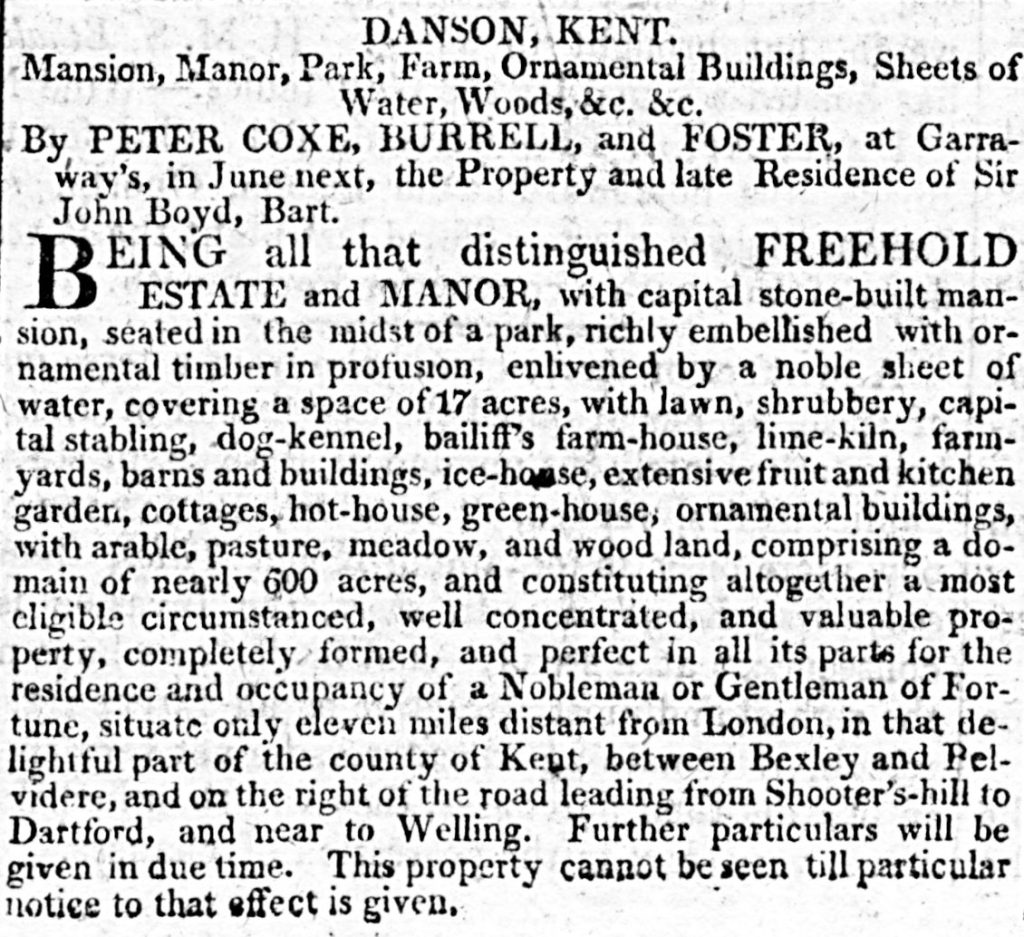
The sale was an apparent success with a new owner found. Richard Lea and Chris Miele write18:
“The highest bidder at the auction was John Johnston, a merchant of Newman Street in the parish of Marylebone. Johnston paid £36,000, of which £1,000 was for books, artworks and furnishings, and as compensation to Boyd for timber on the estate and for a recently constructed lime kiln. Johnston took possession in 1806, while Boyd and his young family moved to a town house in Baker Street.”
We also find an advert for the sale of artworks, mentioning some very famous artists, owned by Sir John Boyd 2nd Baronet Danson.
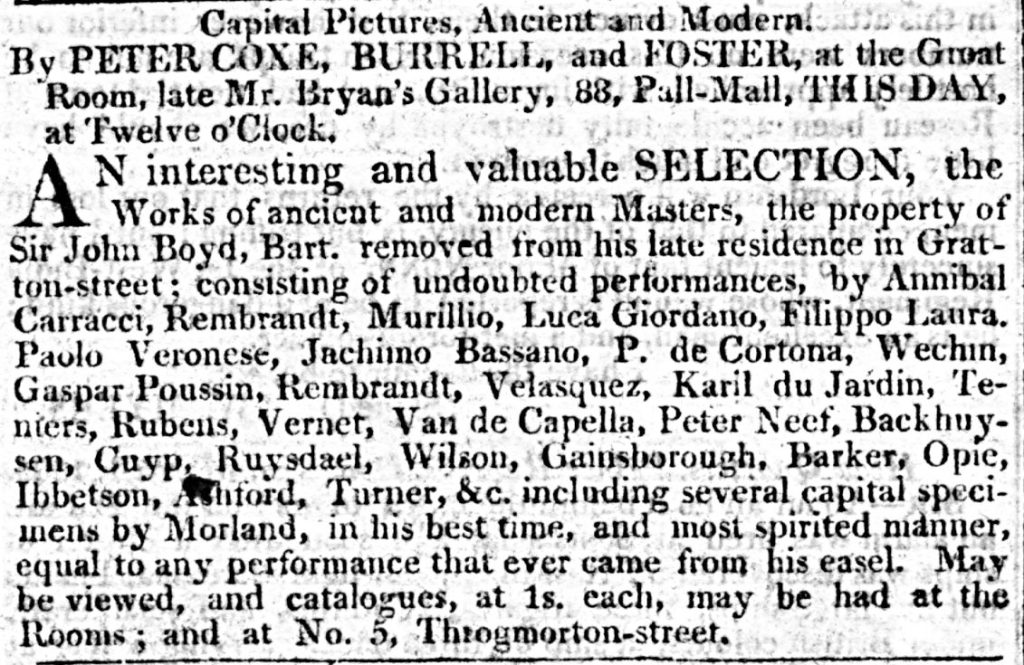
Records regarding the sale of Danson suggest Sir John Boyd 2nd Baronet was residing in Baker Street, London at the time and interestingly a record of Game Licences issued for the County of Middlesex in 1807 states the following:

From the record it would appear that Sir John was likely residing with his son at 56 Baker Street, Marylebone, London. Tax records for 1807-9 confirm Sir John resident at 56 Baker Street. Unfortunately there appears to be little information on the remaining years of the life of Sir John Boyd 2nd Baronet Danson except that we know he died at Ludlow, Shropshire, England on the 30 May 1815. Surprisingly he was buried in the church of St Peter & Paul in the parish of Eye, Herefordshire (which contains a memorial to Thomas Harley, his father-in-law) suggesting he may have lived out his final years in the care of the Harley family. To date no will has been found for Sir John Boyd 2nd Baronet Danson. However his widow Dame Margaret Boyd recorded her will19 on 26 November 1829 and codicil 1 May 1830 while residing in Isleworth, Middlesex, England. She died on 20 November 1830 and was buried in St John the Evangelist parish church, Great Stanmore, Middlesex, England. Her will was accordingly proved 8 December 1830. Interestingly the will of Dame Margaret Boyd records the fact that her primary financial legacy was the settlement of £10,000 from her marriage to Sir John Augustus Boyd 2nd Baronet Danson. This settlement had been invested by way of property and mortgages and was now worth over £17,000 which she directed to be split amongst her three surviving children i.e. Sir John Boyd 3rd Baronet Danson (b. 5 June 1786), Margaret, (b. May 1791) and George (b. 10 March 1793). In the absence of a will for the 2nd Baronet Danson we are left to ponder if the proceeds for the sale of Danson House had been entirely used up to cover the long standing debts of the family during the years of its development.
Prior to her death but after the death of Sir John Boyd 2nd Baronet Danson two of their sons were married. Secondly their son George was married to Mary Elizabeth Blackshaw, daughter of the late George Blackshaw Esq. on 10 February 1829 at Wyvenhoe, Essex, England. George Boyd had a long career in HM Treasury from he was sixteen until he retired as Chief Clerk in 1852.20 The Legacies of British Slavery database states that George Boyd was owner of the Boyd Plantation at Trinity Palmetto Point on the island of St Christopher/St Kitts in 1834 though it would appear he did not receive any compensation monies through the Anti Slavery Legislation as the plantation was subject to a mortgage. Indeed this appears to have been the case with the other Boyd plantation of Fountain on St Christopher/St Kitts and the other family interest on the island of Grenada. George Boyd lived at Rosenberg House, Hitchin, Herts, England with his wife until his death on 6 March 1864 and she followed on 20 December 1881. They had two daughters Mary (b.1830) and Augusta (b.1832). Augusta married the Rev George Digby Newbolt at St James, Paddington, London on 10 June 1856 but sadly died on 5 May 1857 at Souldrop Rectory, Bedfordshire, England, possibly following labour complications on the birth of their only child, Augusta Mary Newbolt (b. Apr 1857). Augusta Mary Newbolt married Capt. Henry Edward Walters RN in June 1881 at St Marys, Hitchin, Hertfordshire. She died on 3 May 1937 at Caer Llan, Cwmcarvan, Monmouthshire, Wales. She and her husband apparently had no issue. A portrait of John [II] Augustus Boyd painted by John Russell R.A. dated 1786 and sold by Christies in 2021 who record in the paintings provenance from 1924 that it was then in the ownership of Commander H E Walter.
The eldest child of Sir John Boyd 2nd Baronet Danson and his wife Dame Margaret Harley was Sir John Boyd 3rd Baronet Danson born 5 June 1786. He married Harriet Boyd (b.1790) daughter of the late Hugh Boyd MP of Ballycastle, Co Antrim (d.1795) in Marylebone Church, London on 22 September 1818. The circumstances of their marriage are not fully known but it is thought that it may have been an arrangement by which the two Boyd families i.e. formerly of Danson House, Kent and Ballycastle, Co Antrim might resolve each others problems. This will be looked at in more detail in our next post.
Sir John Boyd 3rd Baronet Danson and his wife Harriet appear to have lived a fairly transitory life suggesting an either military or diplomatic career for the 3rd Baronet. Their first child, John Augustus Hugh was born at Dingestow Court, Monmouthshire, Wales on 30 July 1819 (the seat of the Huguenot ‘Bosanquet’ family) and baptised in the local parish church the same day. Their second, Frederick, was baptised in the British Embassy Chaplaincy in Brussels, Belgium on 13 August 1820 and finally, Harriett Henrietta, who was curiously born on 10 January 1825 but not baptised until 7 January 1839 which took place in St Georges, Hanover square, London.
Thankfully discovery of Sir John Boyd 3rd Baronet Danson’s military file in the National Archives at Kew has provided the neccessary information. He was enlisted as an Ensign in 1st Regiment of the Garrison Battalion in 1808 (Aged 22), promoted to Cornet 1809 and then Lieutenant in 1811. He was then reduced to half pay following the Treaty of Paris on 30 May 1814. He remained as an half pay officer with the Garrison Battalion until 1820 at which time his regiment was renamed the ‘Royal Garrison Battallions First’. Daughter Harriett henrietta was baptised in the parish of St Georges, Hanover Square in 1825 suggesting a residence in that area at the time. By 1831 he appears to be residing in Charles Street, Knightsbridge, London and by 1836 at Queens Square, Westminster, London. In 1840 we find him residing at 45 Hertford Street, Mayfair, London and then in 1845 a newspaper article21 records his departure for Boulogne-sur mer in France. Sadly the next mention of significance is notice of his death in Boulogne-sur-mer, France on 19 January 1855. Those that reported the death (Messrs Delbarre and Dines) do not appear to be family suggesting that he was alone in Boulogne-sur-mer at the time of his death. Like his father, no record has been found of a will.

We know that his widow Dame Harriett Boyd died at 9 Eaton Terrace, Eaton Square, London on 29 April 1864. A will was proved through the Principal Registry on 13 July 1864 to which effects under £3,000 where awarded to her executors i.e. son, Rev Frederick Boyd and son-in-law Brig Genl Brooke John Taylor. She was buried in Kensall Green Cemetery, London. The story of the 3rd Baronet Danson and Harriet Boyd’s children will be covered in our next post as their story becomes joined to that of the Boyds of Ballycastle, Co Antrim.
- Alumni Oxonienses: The Members of the University of Oxford, 1715-1886, Vol 1, p.146 ↩︎
- See database at Ancestry.co.uk ↩︎
- ‘Danson House, The anatomy of a Georgian villa’, Richard Lea and Chris Miele with Gordon Higgott, English Heritage (2011), p.6 ↩︎
- Ibid ↩︎
- See ‘The Baronetage of England etc.”, Rev William Betham, Vol IV (1804), pp.7-8 ↩︎
- Alphabetical List of Directors of the East India Company from 1758 to 1858 ↩︎
- ‘Danson House, The anatomy of a Georgian villa’, Richard Lea and Chris Miele with Gordon Higgott, English Heritage (2011), p.7 ↩︎
- https://www.bexleyarchives.org.uk/Calmview/Record.aspx?src=CalmView.Catalog&id=PEDAN ↩︎
- Alumni cantabrigienses, a biographical list of all known students, graduates and holders of office at the University of Cambridge – Adm. Fell.-Com. at Trinity, July 1, 1719. S. of John, of St Martin’s-le-Grand, London. Matric. 1724 ; LL.B. 1725. Ord. deacon (Lincoln, Litt. dim. from Gloucester) May 21, 1716; priest. May 24, 1719. V. of Childswyckham, Gloucs., 1719-59. V. of Badgeworth, 1746-59. Died 1759. Brother of David (1716). (F. S. Hockaday.) ↩︎
- The House and Park at Danson London Borough of Bexley – The anatomy of a Georgian suburban estate – English Heritage – Reports and Papers 36 (2000), p.15 ↩︎
- Ibid, pp.15-16 ↩︎
- John Boyd II to Keith, 15 August 1775, British Library, Add. Ms.35, 503, fol.161. The younger
Boyd was deeply saddened by this turn of events and seems, consequently, to have developed a
strong feeling against his father. ↩︎ - Boyd II to Keith, 31 March 1779, British Library Add. Ms. 35,516, fos. 68 and 95, 35,517, fos. 5 and 89. ↩︎
- British Library, Add. Ms. 35,517, fol.5. ↩︎
- Boyd II to Keith, dated 9 December [1780], British Library, Add. Ms. 35,520, fols. 138-9. ↩︎
- The House of Commons, 1754-1790 by Namier, Lewis Bernstein, Sir, 1888-1960 Vol II, p.109
BOYD, John (1750-1815), of Danson Park, Kent. WAREHAM 1780-1784
b. 27 Oct. 1750, Ist s. of Sir John Boyd, Ist Bt., of Danson Park, London merchant and East India Co. director, by Mary, da. of William Bamstead of Upton, Warws. educ. Ch. Ch. Oxf. 1768. m. 26 Feb. 1784, Margaret, da. of Thomas Harley (q.v.), 2s. 1da. suc. fa. 24 Jan. 1800.
Boyd’s seat for Wareham was probably purchased with the approval of the Treasury. Up to March 1782 he supported North. On 18 Feb. 1783 he voted for Shelburne’s peace preliminaries. Next month Robinson set him down as ‘doubtful’, among the ‘country gentlemen and persons unconnected’. On 27 Nov. he voted against Fox’s East India bill; and was classed in Stockdale’s list of 19 Mar. 1784 as a supporter of Pitt, but did not stand at the general election. No speech by him is recorded. He died 20 May 1815.
↩︎ - Bexley LSAC, PEDAN/1/235-6 (Lease and release 22-23 July 1806), PEDAN/1/242-4 (Lease, quitclaim and release 3 July 1807) and PEDAN/1/250 217 (Assignment 14 July 1807) ↩︎
- ‘Danson House, The anatomy of a Georgian villa’, Richard Lea and Chris Miele with Gordon Higgott, English Heritage (2011), p.67 ↩︎
- Nat Archives Ref. PROB 11/1778/360 ↩︎
- https://www.british-history.ac.uk/office-holders/vol1/pp109-135 ↩︎
- London Evening Standard – 24 June 1845 ↩︎