We come now to the family that was synonymous with the beautiful seaside town of Ballycastle for over three hundred years. Its arguably most famous son, Hugh Boyd (1690-1765), will loom large in our next post but for now we must start at the beginning with his parents, for had it not been for their union, history would have likely taken a very different turn. For it is the tale of not one family but two, the McNeales and the Boyds. It is our intention to do a substantive post on the McNeale family in the near future but for now we will take a brief look at them in order to place the Boyds of Ballycastle in context.
Up until around 2015 it had been thought that the McNeales of the Isles (Hebredies) where of Hiberno-Scots origin with a widely held historical belief that they were descendants of Niall but recent DNA testing has suggested they are more likely of an Norse-Gaelic (Hiberno-Norse) origin. We will try to cover this when we look at the family in more detail in a future post.
We know that by the latter part of the 16th century a number of members of the McNeale family or Clan had settled in Co Antrim, Ireland. They had likely come from the Hebridean island of Gigha. In the Fiants of Elizabeth I we find the following references:
On 22 January 1587/881 we find a Hugh McNeele appearing alongside Randulph McNeese McChonell (Randall MacSorley MacDonnell), Sorle mcmicNeese McChonell (Sorley Boy MacDonnell) and Donill McNeele. There are further appearances in the Fiants on 25 June 16012 and 18 May 1602.3
On 27 December 1605 we find a fee farm deed by Sir Randal MacDonnell to Hugh McNeill Gent., of the constableship and keeping of the fort of Dunynie [Dunineny], quarterland of Clare Castle [Clare], 5A Cregmore [likely Carrick-more on the coast to the north west of the townland of Cross], and 5A Portbrittas [or British Port, old name for the area of the Quays adjacent to North Street/Bayview Road, Ballycastle] Co. Antrim. Rent £3. Courts Leet and Baron. Custom of markets, town customs, custom of Portbrittas – when Sir Randal and his Lady, or either of them, dwell in the fort for a season, the whole of the market custom and one moiety of the port custom shall be for their use.4
On 9 November 1611 (recorded as the ninth regnal year of James I on original copy deed) we find a further fee farm deed by Sir Randal MacDonnell of Dunluce to Hugh MacNeill Gent., Constable, of Dunynie [Dunaneeny], of the townland of Ballykenlunte [Ballykenver], the quarterland of Brumarriore [Broom More] and Lucaslieollyne [part of Broom More], the quarterland of Drumnacree [Broom Beg], the quarterland of Ballyeumnyne[Ballydurnian], the quarter land of Dromanas [Drummans] the quarter land of Ballerluge [Ballylig], the 40A of Celaircasler [Clare], the 5A of Creagmore [likely Carrick-more on the coast to the north west of the townland of Cross5], the 5A of Portbrittas [or British Port, old name for the area of the Quays adjacent to North Street/Bayview Road, Ballycastle] and the constableship and keeping of the market towns of Dunynie [Dunaneeny] and Ballycastle. If Sir Randal or Lady Ellis MacDonnell dwell in either Dunynie or Ballycastle the market custom of the towns and a moiety of the custom of Portbrittas is reserved for them. Rent £9, Kings rent 6s.8d.6
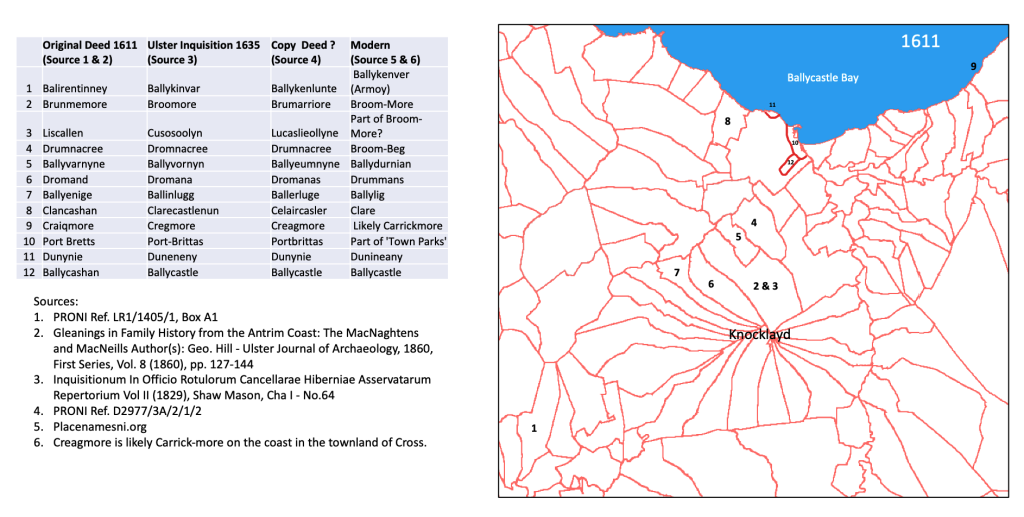
We then find from the Inquisitions of Ulster that Hugh McNeale died nine years later in 1621 and his estate passed to his son and heir Neale oge McHugh McNeale who was then of full age and married. Neale oge McHugh McNeale died on 15 February 1635 and the estate passed to his son and heir, Donell (anglicised to Daniel) McNeale oge Mc Hugh McNeale who was then 14 years of age and unmarried.7
Examination of the Hearth & Poll Money Rolls for Co Antrim records a Lieutenant Daniel McNeale Gent. was resident in the townland of Clare, Ramoan parish in 1660 in a property with two hearths and continued resident there for the years 1666 and 1669.8 Daniel McNeale had at least three children, Hugh (eldest son), Bernard and Rose. It is believed that a woman called Magdalene (surname unknown) was wife to Daniel McNeale and probably mother to his three children.
The late Ballycastle historian Hugh Alexander Boyd related a curious story apparently surrounding Bernard McNeale in his 1929 article9 on the Boyds of Ballycastle, he writes:
“..it has been related (but with what degree of truth the writer is not able to say) that this young man, who was his father’s heir, received a blow on the head with a book from the [words illegible] William Boyd, who acted as [words illegible] tutor. Young McNeile – I have not been able to find his Christian name [words illegible] to have never recovered [words illegible] effects of this blow, and died some time afterwards. It was probably during [words illegible] visits of the Rev. Boyd to Duna[words illegible] tutor to McNiele, that he met the [words illegible] sister, whom he afterwards married. [words illegible] the death of this young man, his sister Rose became heiress, and thus the estate of the McNeile’s which had been [words illegible] to them in 1612 by the First [words illegible] Antrim, passed into the family of Boyd in which it has remained to the present time.”
Unfortunately the source of this story and sequence of events has not been uncovered. However we will attempt to examine any evidence of issues, along with the wider political events of the latter 17th century that may have impacted the McNeale family of Clare.
As suggested by Hugh Alexander Boyd around 1680 Rose McNeale married the young Curate of Layde Parish, Co Antrim, William Boyd10. He was most likely the grandson of William Boyd of Dunluce (d.1628) through his youngest son William. Evidence suggests that Rose was probably in her early teens when she married. This is implied by her continuing to have children into the early 1700s as we shall see. The 1679 Visitation records for the Diocese of Connor record that William later became Vicar and Curate of Ramoan Parish, Co Antrim in 1679 and then also including the Parish of Culfeightrin, Co Antrim from 1682. By then Rose had probably given birth to a son Adam and perhaps daughter Elizabeth. On 20 June 1684 we see a Chancery Hearing in Dublin in which Donnell McNeale Gent., Rose’s father, is plaintiff:
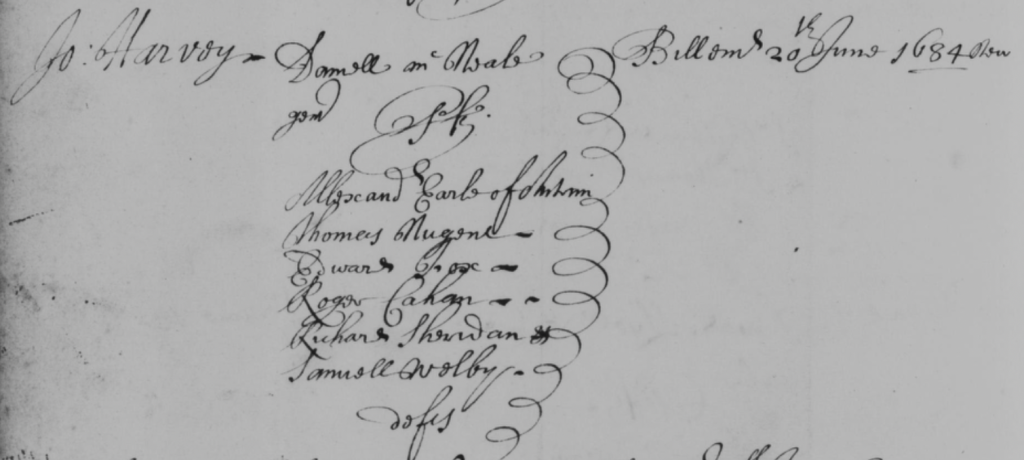
There is no further record of Donnell or Daniel McNeale after this and it is beleived he died the same year passing the McNeale estate to his eldest son Hugh. The reason for the Chancery hearing is unknown but it is interesting to see Alexander Earl of Antrim heading the defendants in the case. By 15 May 1685 we find an Exchequer Bill in which Hugh is now Plaintiff and again Alexander Earl of Antrim heads a long list of defendants.11 The details of these seeming disputes involving the McNeales has not survived. However after the discovery of the McNeale family copy of the 1611 deed in PRONI in 2023 it was interesting to find recorded on the Deed that there appeared to have been some sort of dispute between Hugh McNeale on the one hand and Alexander Earl of Antrim, Daniel McDonnell and Aeneas Black on the other. It seems, possibly as part of the process of the dispute, that Hugh McNeale was asked to produce his copy of the deed of 1611 to an Inquisition held at Bushmills on 28 April 1686 before witnesses Robert Kennedy Esq., Alexander McAulay Esq., Bryce Dunlap, Neale McNeale [a cousin] & Owen O’Mullans Gent. who swore to the validity of the document on his behalf before Charles Steward, Robert Griffith and John McNaughten. We should note that the reknowned historian George Hill had almost certainly seen the McNeale family copy of the 1611 deed as he mentions it in an article12 for the Ulster Journal of Archaeology in 1860. It is remarkable to think that not only had the McNeale family managed to retain their copy through the Rebellion and Civil war period of the mid 1600s but that it has survived over 414 years to the present. To understand what may have been the motivation behind these disputes it may be worth looking at the major political events of the period.
There had been a period of relative calm in Ireland in the years following the restoration of the monarchy in 1660 under Charles II. However in 1679, Titus Oates‘s fabrication of a supposed Popish Plot sparked the Exclusion Crisis when it was revealed that Charles’s brother and heir presumptive, James, Duke of York, had become a Roman Catholic (probably whilst in France) which was revealed after the introduction of the Test Act by Parliament in 1673. To calm the situation Charles II had attempted to place his brother in a form of administrative exile in Scotland under the role of Lord High Commissioner of Scotland. On the death of Charles II on 6 February 1685 his brother ascended the throne as James II of England and VII of Scotland. Whilst James II accession appeared initially to be well received, despite the earlier tensions, religious concerns remained. The new King faced two rebellions, firstly from James Scott, Duke of Monmouth and then Archibald Campbell, 9th Earl of Argyll. Both were quickly and successfully put down by James II. However the Kings later decisions only seemed to increase tensions in his seeking to enlarge the standing army and his desire to repeal the Penal Laws.
Whilst it should be understood that James II appeared to seek religious tolleration amongst all faiths, the appointment of Roman Catholics to high office was seen as a major threat by the Anglican establishment, particularly in Ireland. In 1687 James II undertook moves to ensure the sanction of his wishes by Parliament. Old fears arose and on 30 June 1688 a deputation of seven protestant nobles approached the King’s nephew William, Stadtholder and Prince of Orange seeking that he would invade England to depose James II. William duly landed at Brixham, Devon, England on 5 November 1688 and whilst James II was soon captured, he was allowed to escape to France.
Previously in Ireland moves by James II under a policy of toleration which sought to elevate Roman Catholics into Civil and Military positions was reflected in the office of County Sheriff. For County Antrim Cormac O’Neill of Broughshane was appointed in 1686 and again in 1687. He was followed by Shane O’Neill in 1688 and 1689. Following Alexander MacDonnell’s accession to the Earldom of Antrim in 1683 he was appointed a Privy Councellor and Lord Lieutenant of Antrim by James II. James II also appointed Richard Talbot, 1st Earl of Tyrconnell, Lord Deputy of Ireland in 1687. After William, Prince of Orange’s landing in England in 1688 Tyrconnell was ordered to send loyal troops from Ireland to resist him. To replace these Tyrconnell was to raise four new regiments of 1,200 men each, one for each Province. The Earl of Antrim was to to take charge of the regiment for Antrim.
If we look at the Chancery and Exchequer cases impacting the McNeale family in this period it would not be unresonable to suggest that tensions ran high between those Protestant families holding land in Co. Antrim and Alexander Earl of Antrim. By 1686 Alexander MacDonnell would have felt empowered by a sympathetic King in James II and Roman Catholic allies in positions of authority as Sheriffs of Antrim. He was now around seventy three years of age, an Irish Confederate veteran of the Wars of the Three Kingdoms. He was also dealing with the outworkings of an horendous debt13 (thought to have been over £40,000 by 1643) left by his parents which involved levies on huge swathes of his estates in Co Antrim which was administrated, mainly through English Trustees, for 99 years from 21 November 1637. It is not unreasonable to suppose that he may have felt that with James II and his new Irish policies the fortunes of the MacDonnell family could change for the better.
Remarkably a record has just been found (19 July 2026) amongst our research papers which may explain the reason Hugh McNeale was asked to produce his copy of the 1611 lease to an inquisition at Bushmills and unsurprisingly it involves Alexander Earl of Antrim dating to 1 September 1686. It was found amongst papers of what appears to be the McNeill family of Cushendun, probably photographed by PRONI many years ago and as such held on Microfilm.14 It is a record of considerable importance for it documents the surrender of Hugh McNeale’s claim to the village or castle of Ballycastle unto the Earl of Antrim in return for which the Earl gives him the house of Dunaniny and the land around it and also the custom of the fairs and markets of the castle and the village of Ballycastle forever. A transcription of the deed is below:
“This Indenture made the first day of September Anno Dom, one thousand Six Hundred & Eighty Six in the second year of James the Second King of England Scotland | France and Ireland, Defender of the Faith. Between the Right Honble Alexander Earle of Antrim of the one part & Hugh mc Neale of Clarecastle in the County of | Antrim Esq. of the Other part. Witnesseth that the said Earle of Antrim for and in Consideration of the Release of the Right, or title wch the said Hugh mcNeale | hath or might claim to the village or Castle of Ballycastle in the Barrony of Cary & County of Antrim unto the said Earle of Ant and his heirs, hath given | granted bargained Sold Released and confirmed & by the fsd presents doth give grant bargain Sell Release & Confirm unto the sd? Hugh mc Neale and his heirs all that the house | of Dunaniny & the land thereunto belonging be it more or less with its members & appurtenances as also the custom of the ffaires and markets of the Castle & village of | Ballycastle in the Barrony of Cary & County of Antrim Now in the Actual possession of the said Hugh mc Neale or his bror Bernd. To have and to hold the | afforegranted premises with there appurtenances to the said Hugh mc Neale And his heirs for ever And the said Earle of Antrim for himself his heirs Execrs & adms | doth Covenant grant and agree that the said Earle and his heirs shall and will Warrant and defend all the afforegranted premises with there appurtenances unto the | sd Hugh mc Neale and his heirs from all pson or psons Claiming by from or under the Said Earle & his heirs or any of the said Earle’s? ancestors heirs or possessed of the foregranted | premises And it is further agreed by and between the parties affords that the Said Earle of Antrim shall pfect with himself and Thos Nugent Esq. and of the Justices of the | Kings Bench all such other and further Deed or Deeds assurance or assurances as by the Councell of the said Hugh mc Neale shall be advised or devised for the further | ? of the foregranted premises to the said Hugh mc Neale and his heirs for Ever that the same be required within the space of three years att the cost | nevertheless of the said Hugh mc Neale or his heirs. In Wittness whereof both parties have to the ? ? Sett there hands and Seals the day | and year fortabove written.
Hugh mc Neile {Seal}
Signed & Sealed and Delivered
in the presence of
Hugh mc Collum
Patrick O’Heveran
Antrim“
By 11 April 1689 James II’s rule in Great Britain had ended. However he had previously landed in Ireland on 12 March 1689 with the assistance of French troops and artillery. The Irish Parliament, perhaps concerned at James II’s french military support and also with key allies previously placed in positions of authority, did not oppose him and under his direction an Act of Attainder was passed by them on 25 March 1689. The Act listed the names of over 2,000 Protestants who were considered traitors to James II and therefore subject to the confiscation of all their lands and property along with their lives.
Amongst the list of those attainted in the County of Antrim were:
Pophan Conway alias Seymore Esq.
Clothworthy Skeffington of Antrim in the County of Antrim Efq.
Colonel Robert Adaire of Ballymenagh
Captain Edward Harrison of Killulagh
Captain Archibald Edmonson of Ballygarry
Arthur Upton of Temple-Patrick Efq.
Captain Richard Dobb Junior of Ballynure
Lieutenant Colonel William Shaw of Gemeway
Lieutenant Colonel Charles Stewart of Ballintoy
Captain William Stewart of Grigary
Andrew Rowan of Olstowne Clerk
Captain William Rowan of the same
Captain William Shaw of Bash
Captain Patrick Shaw of Ballygally
Captain James Shavo of Belfast
Henry Shaw ot Ballyvoy Gent
Captain George Macartney of Belfast
Captain Hugh Mac Neale of Clare
Lieutenant Colonel Robert Hueston of Cregg
Francis Hueston of the same Gent.
Captain William Adaire of Ballymenagh
Captain Michael Galland of Vowes
Benjamin Galland, of the same Gent.
Captain John Hamilton of Cloghmills
James Hamilton of the same Gent.
William Hamilton of the same Gent.
Captain William Eaton of Dunfane
Captain John Biggerstaffe of Rossegifte,
Captain John Lyndon Junior of Carrickfergus
Captain John Harper of Ballymenagh
James Mac Clure of Kilmackevet Gent.
Joseph Cunningham of the same Gent.
Forrist Shortrix of Antrim Gent.
John Mac Cay of Mults Gent.
George Buttle of Glenarme Gent.
John Donelson of the fame Gent.
Patrick Agnew of Killanter Gent.
William Cragg of Glenarme Gent.
George Johnston of Glins Gent.
John Crumy of Ballymuny Gent.
James Stewart of Ballyluske Gent.
William Mac Fetrisk of Carneglass Gent.
Robert Clugston of Belfast Gent.
John Mac Neale of Billy Gent. [1st Cousin once removed of Hugh McNeale of Clare]
… Harvyes of Ballymuny Clerk
Alexander Boyde of Carranmore [prob. Cavanmore/Cabragh, Billy Parish] Gent.
John Fullerton of Ballagh Gent.
Captain Ralph Smith Junior
Captain Hercules Davis
John Davys Esq., Son to Hercules Davys and
Clothworthy Upton Esq.
All late of the COUNTY OF ANTRIM.
There is little doubt that the effect of the Act of Attainder was wholesale panic amongst Protestant landholders, clergy and those still in any form of public office. Into this highly volatile and threatening time for the McNeale’s of Clare we turn to the work of the late Danny McGill and his article of 200215. This would be the first of three major crises to hit the McNeale/Boyd family over the next 130 years.
In his article Danny McGill confirms the death of Daniel McNeale in 1684/5 and reproduces the latin text “hugo mc neale ad filius et heres hic danielis” from a renewal license (probably seen by him amongst the Boyd Ballycastle archives) and issued by Lord Antrim to the young heir Hugh but along with the appointment of a Trustee, Alexander McNeale (probably his uncle), suggesting that Hugh had not yet reached his majority of twenty one. Danny McGill further elaborates that young Hugh appears to have died suddenly between 28 April 1686 and 10 June 1690 at which time an indenture was drafted between Bernard McNeale and William Boyd of Drumawillin transferring the McNeale estate to William Boyd. Quoting from the indenture he states:
“Bernard McNeile of Clarecastle in the Barony of Cary and William Boyd of Drumawillen … . clerk .. ‘
which stated that ‘in consideration that the above Hugh McNeile his said deceased brother in his lifetime by his last will and testement did bequeth ….. . and make over to the said William Boyd …… all his estates real and personal. .. which said will and testement is mislaid or casually lost … he the said Bernard McNeile being fully persuaded of the truth thereof .. “
Danny McGill had earlier stated that the original deed of 1611 had stipulated that it was “confirme unto the said Hugh Makneill and the heires male of his bodie lawfully begotten or to be begotten…” so with the death of Daniel 1684/5 and Hugh before 10 June 1690 this would suggest it automatically passing to the surviving male heir Bernard. The sudden death of young Hugh is perhaps not that surprising given the fact that he was included in the Act of Attainder of March 1689. If the Irish parliamentary authorities had caught him he would most likely be executed for treason. Alternatively he may have escaped such a fate only to die in the many engagements of the Williamite War. It is worth remembering the major Battle of the Boyne would take place on 1 July 1690, less than three weeks after the indenture. Whilst the outcome of the battle, a victory for William III, would probably have been the best for the McNeale family, it is fairly certain they could not have felt assured of it at the time. It is easy to see how fear would have gripped the family in a seeming crisis. But as Danny McGill stated in his article surely it was a simple matter of the estate passing to Bernard. A clue for at least part of the reasoning behind the indenture between Bernard and William Boyd lay in the mention of a provision for the payment of alleged debts and mortgages held by Andrew Boyd, Adam Boyd and a James Mashy, witness signatories to the deed, with a cash payment to ” … the said Bernard the sum of Ten pounds ster in hand“, and a further yearly payment of twenty pounds. Again quoting from the deed Danny McGill writes:
“should he the said Bernard McNeile remain with the said William Boyd and be maintained by him in … Meat, Lodging and Cloathes then the annual sum would not be payable.”
Danny McGill firmly believed that these clauses were at the essence of the crisis. He states:
“The fact that Bernard was a party to the deed in his own right suggests to me that he had reached his majority but was incapable of looking after himself or managing the affairs of the estate. The absence of Lord Antrim may have meant there would be a delay in obtaining a renewal licence, perhaps the family felt it unwise to wait for his return. With the Antrim estate held by a grant from a Stuart King, the situation could change rapidly under the new Williamite order. They no doubt felt the need for a strong landlord with a good title to the estate.”
Effectively the family were trying to hold on to their lands in the knowledge that Bernard appeared unfit to manage the estate. In an effort to seek legal backing, submission was made to Thomas Ward, Dean of Down and Connor (1679-94)16to obtain a letter of administration for William and Rose Boyd which was issued on 29 October 1690. An image extract from the administration was included in Danny McGill’s article suggesting that he had also seen it amongst the Boyd Ballycastle archives. Within a few days a further indenture is drawn up on 3 November 1690. Danny McGill states, quoting from the indenture:
“This deed again functions as if Bernard had inherited the estate. This time the parties to the deed are Bernard McNeale brother and heir of Hugh McNeale, of the first part, William Lollie of Moss-side, Charles Stewart of Ballintoy of the second part, with William Boyd and Rose McNeale sister to the said Hugh and Bernard McNeale of the third part. The deed lists alleged debts owed by Hugh McNeale to the sum of ‘five hundred and four pounds four shillings, of which one hundred and ninety six pounds was owed to William Boyd, Collin Campbell was owed fifty pounds, William McPhadrie eighty pounds, William Boyd of Clontefenan Gent. twenty six pounds five shillings, Charles Stewart Esq (?) fifteen pounds, William Hutchinson of Belfast, merchant, thirteen pounds four shillings, Adam Boyd and Andrew Boyd one hundred pounds, James Gillifray(?) twelve pounds, by account to Halbest Hall, London merchant taylor (sic), five pounds, Robert Thomson by bond five pounds fifteen shillings, John Galt, merchant three pounds. To William Boyd signatory to these presents two pounds, of which severall sums noe(sic) past is yett paid nor any interest for the clearance thereof since the death of Hugh McNeale …
This deed also refers to the ‘lost’ will, ‘whereas the said Hugh McNeale by his last will and testement directed the said William Boyd to satisfy and pay the same out of proffits of his estate …
Another line says that the will ‘which by the distractions of the Late tymes is mislade or Lost“.
Danny McGill further states:
“William Lollie and Charles Stewart by a concurrent deed transfer the estate to William and Rose for five shillings. They receive the Quarterlands of ‘Shruannagalmore, Knockans and monanacloigh‘ as payment for their portion of the debts allegedly owed them by Bernard McNeale, thus completing the transfer of the estate into the possession of William and Rose Boyd.
Bernard is well provided for in the detail of the November deed, where he ‘may not be troubled or molested for the said debts … … and that a competent maintainance and provision may be had and made for the said Bernard during his life … ‘. Further in the deed it states that he should be provided with ‘sufficient meat drink and lodging also with ten pounds per annum to buy him cloathes & other necessarys during his life and in case the said Bernard McNeale shall not remain & stay with the said William Boyd and Rose his wife …… then to pay to the said Bernard McNeale the yearly some of twenty pounds … ‘The witnesses to this later deed were Adam Boyd [possibly of Ballylig], John Boyd and Cornelius O’Cahone.”
It appears therefore that by 3 November 1690 matters regarding the McNeale estate had been concluded. The estate had passed to Rev William Boyd and his wife Rose. Debts relating to the late Hugh McNeale were cleared and provision had been made for the maintenance of Bernard McNeale during his lifetime. Certainly Danny McGill recorded his frustration at what appeared to be missing documents and the apparent issues of how the legacy of the McNeale estate had been handled. He stated that apart from a deed involving the townland of Drummans there were no further papers between 1690 and the 1730s other than the Will of Rev William Boyd which we will look at shortly. However we now know this not to be the case as will be demonstrated.
There is no record of the extent of any wealth that Rev William Boyd brought to his marriage to Rose McNeale but it would appear from the November 1690 indenture that it was at least sufficient to cover the debt totalling £504 4s. There is however another clue in a loan made by him to John Kennedy of Mosside for £300 on 30 October 169617 which is suggestive that Rev William had sufficient reserves to finance such a loan although it is likely that this was also a family matter as John Kennedy was probably his cousin i.e. son of Walter Kennedy of Turnarobert, Co Antrim and Janet Boyd daughter of William Boyd of Dunluce. To place these sums in context an amount of £800 in the 1690s would equate to around £200,000 in todays monies based on the effects on pricing since then18.
Since the birth of eldest son Adam (c1680) and eldest daughter Elizabeth (c1682) Rose Boyd had also given birth to daughters Magdalen (c1684) and Penelope (c1686). In 1690 second son Hugh was born. She and Rev William would go on to have at least one other son William (c1697).
By 3 october 1691 the Treaty of Limerick was signed thus ending the Williamite War. The threats to Protestant land owners and those in public life receeded. Despite the terms of the treaty relating to religious freedom for Roman Catholics and others in return for allegience the following years would see the reimposition of Penal Laws with if anything greater vigour. The effects of the late war on the local population and economy would have been horrendous. Shortages of food leading to outbreaks of famine and disease.
Rev William Boyd continued in his role as Vicar & Curate of the parishes of Ramoan & Culfeightrin, Co Antrim. However on 13 May 1696 we find him, whilst resident in Drumawillin, Ramoan parish, Co Antrim, taking a lease19 from John O’Neill Esq. of Edenduffcarrick (Shanes Castle, Co Antrim) and Hugh McCollum, Gentleman, of Dunluce, of a moiety of the salmon fishing of Port bradan [Portbraddon], Lake nashilloge [possibly close to Lackaneena in Carrowreagh Mountain townland] and Port mune [Port Moon in Feigh Mountain townland] and ‘the rocks and creeks therein belonging‘, for 13 years. Rent £5, receivers fees 6d in the pound.
Interestingly on the same day we also find a lease20 from John O’Neill of Edenduffcarrick and Hugh McCollum of Dunluce, to William Boyd of Drumawillin, of the 2 quarter lands of Ballylinny, barony of Cary, for 13 years. Rent £23, 6d per pound receivers fees and 2 unshorn muttons per year. Tenant to build 24 perches of ditch and plant 24 trees per year. its not known why William Boyds title as clerk was omitted from the latter lease but is reasonable to assume the lease was to him. An unusual aspect of these two 1696 deeds is that although they are regarding Rev William Boyd, he signed neither deed. In fact both deeds are signed and sealed by his wife Rose and using what appears to be a McNeale family seal.
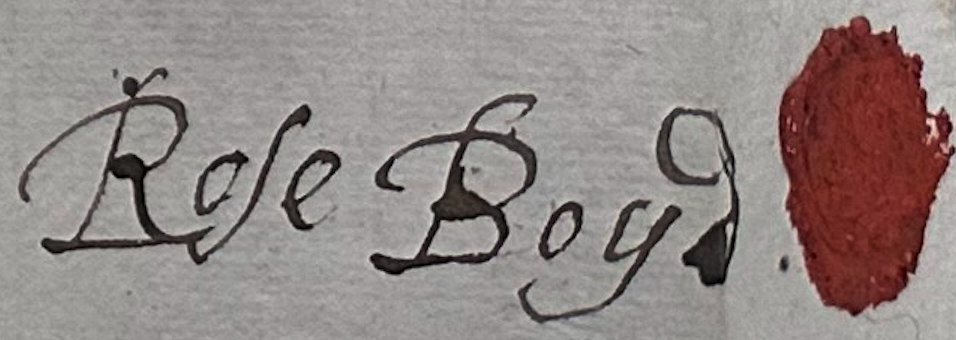
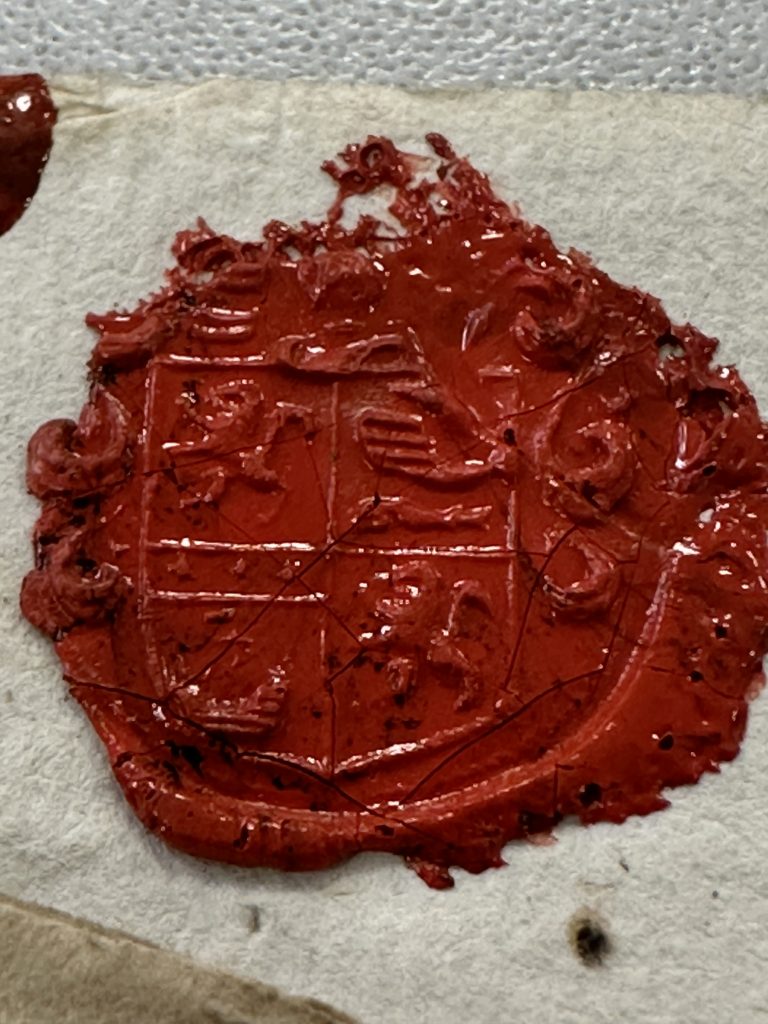
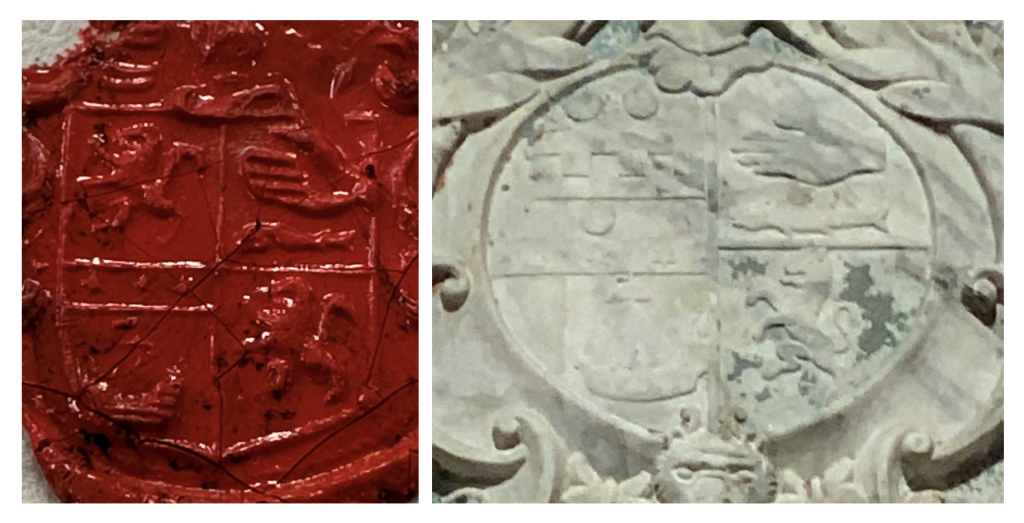
Quarterly, 1st and 4th, az a lion ramp. ar.; 2nd, ar, a sinister hand couped fesseways in chief gu. and in base wavy az. a salmon naiant of the first; 3rd, or, a galley, her oars in saltire gu. on a chief of the last three mullets of the first. Crest – An armed man, from the shhoulder issuing, holding a dagger point upwards all ppr.
The involvement of John O’Neill Esq. (1665-1739) [aka ‘Shane An Frankagh’ or French John] of Edenduffcarrick and Hugh McCollum comes about through the fact that on 4 July 1694 they replaced Thomas Nugent Esq., Lord Riverstowne as trustees for the levies to cover the long standing debts of the Antrim estate.21 This may also explain the unusually short terms of the two leases. Thomas Nugent had previously been appointed a trustee on 18 February 1681 along with Thomas Sherreden of Dublin Esq. and Samuel Welby of Carrickfergus Gent., however messrs Sherreden and Shelby refused to participate in the management of the trust leaving Thomas Nugent sole trustee. Nugent lived in Galway so it was no surprise that he eventually sought to be replaced.
At some time, likely between 1698 and 1701, he and wife Rose arranged the marriage of their eldest daughter Elizabeth to Richard Jackson (b. c1658), son of William Jackson Esq. (1628-88) of Coleraine, Co Londonderry (orginally of Kirkby Lonsdale, Derbyshire, England)22 and his wife Susannah Beresford. Richard Jackson had previously married Ann Dorothy Bate (of Ashby de la Zouch, Leicestershire, England) in St Helens Parish Church, Ashby de la Zouch on 21 February 1694 but sadly she later died on 13 July 1698, possibly in child birth. Elizabeth was almost certainly still in her teens and the match had all the signs of being typical for land-owning families of the period. Richard Jackson would go on to play a vital role within the Boyd family as we shall see.
It is possible that the reason for Rose Boyd signing and sealing the 1696 indentures may have been because Rev William Boyd was absent. However we should consider the possibility that he may have been incapitated by illness for just five years later on 29 May 1701 we find him drafting his will which was found by Danny and Jayne McGill amongst the papers of the Boyd Ballycastle archives.
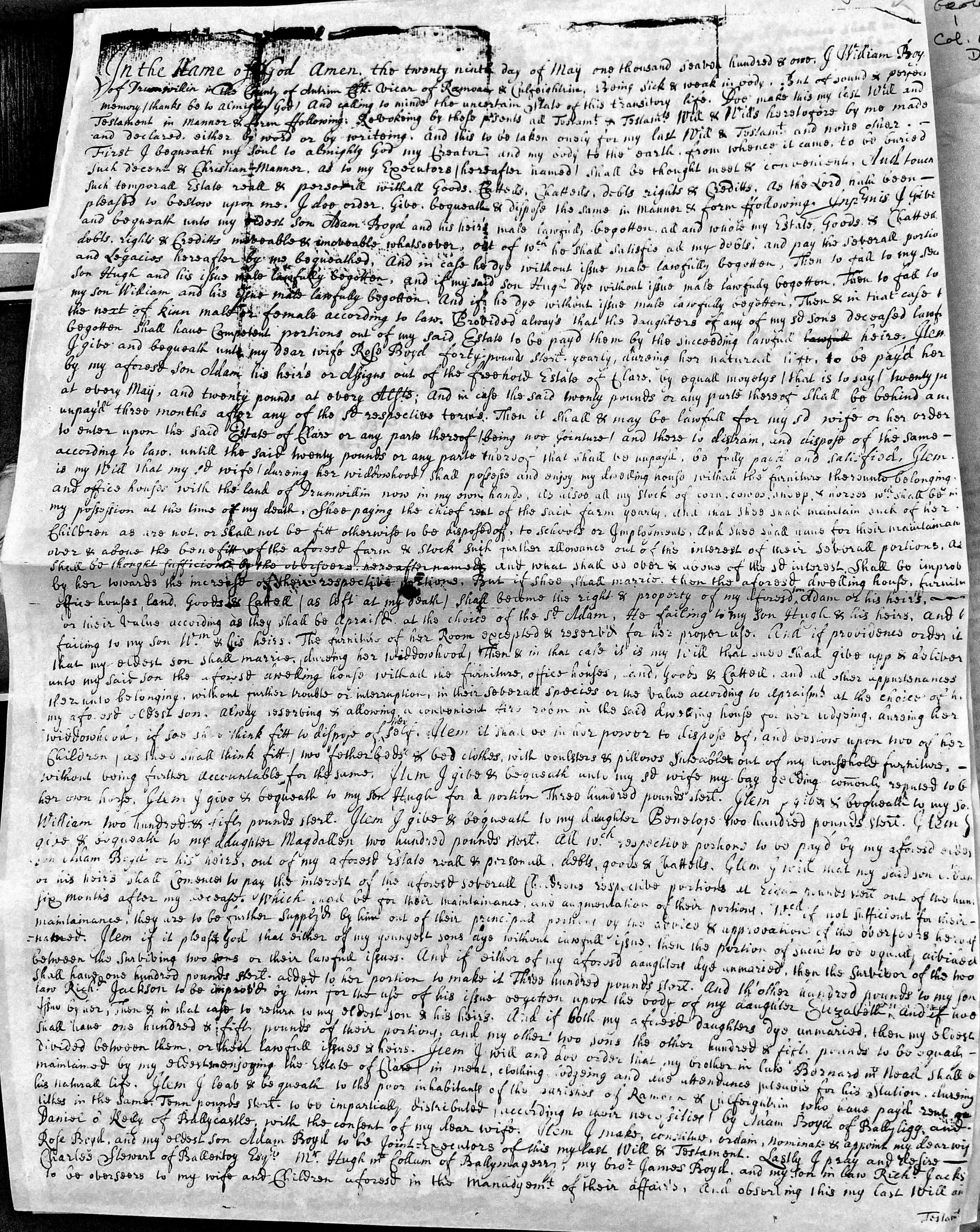
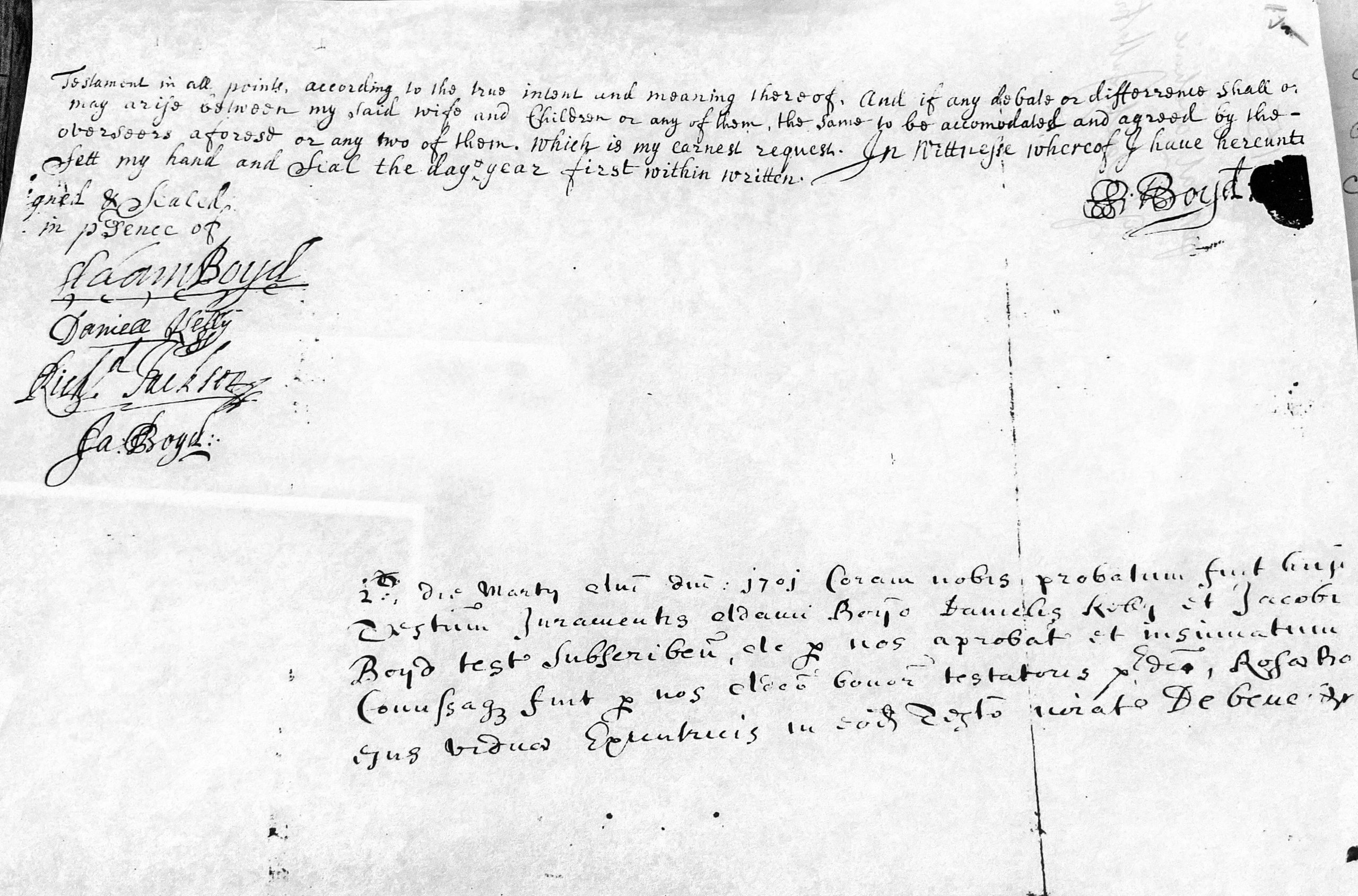
A transcript of the will is as follows:
“In the Name of God Amen, the twenty ninth day of May one thousand seven hundred & one. I William Boyd of Drumawillin in the County of Antrim Clk Vicar of Ramoan & Culfeightrin, Being sick & weak in body, but of sound & perfect memory, thanks be to Almighty God And calling to minde the uncertain state of this transitory life. Doo make this my last Will and Testament in Mannor & form following; Revoking by those presents all Testament & Testaments Will & Wills heretofore by me made and declared either by word or by writing and this to be taken only for my last Will & Testament and none other.
First I bequeath my soul to Almighty God my Creator and my body to the earth from whence it came to be buried such decent & Christian Mannor, as to my Executors | hereafter named | Shall be thought meek & convenient, And touching? such temporal Estate real & personal withal Goods, Cattells, Chattels, debts, rights & Credits, as the Lord hath been pleased to bestow upon me. I doo order, Give bequeath & dispose the same in Mannor & form following,
Imprimis I Give and bequeath unto my eldest son Adam Boyd and his heirs male lawfully begotten all and whole my Estate, Goods & Chattels, debts, rights & Credits moveable & immoveable whatsoever, out of wch he shall satisfie all my debts and pay the several portions and legacies hereafter by me bequeathed, And in case he dye without issue male lawfully begotten, Then to fall to my sec son Hugh and his issue male lawfully begotten, and if my said son Hugh dye without issue male lawfully begotten, Then to fall to my son William and his issue male lawfully begotten, And if he dye without issue male lawfully begotten, Then and in that case the next of kinn male or female according to law. Provided always that the daughters of any of my sd sons deceased lawfully begotten Shall have competent portions out of my said Estate to be payd them by the succeeding lawful heirs.
Item I give and bequeath unto my dear wife Rose Boyd forty-pounds Sterl. Yearly, during her natural life, to be payd her by my aforesd son Adam his heirs or Assigns out of the freehold Estate of Clare, by equal moieties | that is to say | twenty pounds at every May, and twenty pounds at every Alsts; And in case the said twenty pounds or any part thereof Shall be behind or unpayd three months after any of the sd respective terms. Then it shall & may be lawful for my sd wife or her order to enter upon the said Estate of Clare or any part thereof | being her jointure | and there to distrain, and dispose of the same according to law, until the said twenty pounds or any part thereof that shall be unpayd, be fully payd and satisfied.
Item it is my Will that my sd wife | during her widowhood | shall possess and enjoy my dwelling house withal the furniture thereunto belonging and office houses with this land of Drumwillin now in my own hands, As also all my stock of corn, cowes, sheep & horses wch shall be in my possession at the time of my death, shee paying the chief rent of the said farm yearly, and that she shall maintain such of her children as are not, or shall not be fit otherwise to be disposed off, to schools or Imployment, And shee shall have for their maintenance over & above the benefit of the aforesd farm & stock such further allowances out of the interest of their several portions, as shall be thought sufficient by the observers hereafter named and what shall be over & above of the sd interest Shall Go * by her towards the increase of their respective portions. But if she shall marrie then the aforsd dwelling house, furniture, office houses, land, Goods & Chattels | as left at my death | shall become the right & property of my aforesd son Adam or his heirs, as their value according as they shall be apraisd at the choice of the sd Adam, He failing to my son Hugh & his heirs, and he failing to my son Wm & his heirs. The furniture of her room excepted & reserved for her proper use. And if providence orders it that my eldest son shall marrie during her widowhood, then and in that case it is my Will that she shall give up and deliver unto my sd son the aforesd dwelling house withal the furniture, office houses, land, Goods & Chattels, and all other appurtenances thereunto belonging, without further trouble or interruption, in their several species or the value according to appraisal at the choice of my asd eldest son, always reserving & allowing a convenient *** room in the said dwelling house for her lodging during her widowhood, if son shall think fit to dispose of herself.
Item it shall be in her power to dispose of and **** upon *** of her children |as she shall think fit | *** featherbeds & bed clothes, with bolsters & pillows out of my household furniture without being further accountable for same.
Item I give & bequeath unto my sd wife my bay gelding commonly reputed to be her own horse.
Item I give & bequeath to my son Hugh for a portion Three hundred pounds sterl.
Item I give & bequeath to my son William Two hundred & fifty pounds sterl.
Item I give & bequeath to my daughter Penelope Two hundred pounds sterl.
Item I give & bequeath to my daughter Magdallen Two hundred pounds sterl.
All which respective portions to be payd by my aforsd eldest son Adam Boyd or his heirs, out of my aforesd Estate real & personal, debts goods & Chattels.
Item I Will that my sd son Adam or his heirs shall to pay the interest of the aforesd several Children’s respective portions at Eight pounds nett out of *** *** six months after my decease. Which should be for their maintenance and augmentation of their portions. Wch if not sufficient for their maintenance, they are to be further supply’d by him out of their principal portion by the advice & approbation of the observers *.
Item if it pleases God that either of my youngest sons dye without lawful issue, then the portion of such to be equally divided between the surviving two sons or their lawful issue. And if either of my aforesd daughters dye unmaried, then the survivor of the too shall have one hundred pounds sterl. Added to her portion to make it three hundred pounds sterl. And the other hundred pounds to my son law Richd Jackson to be **** by him for the use of his issue begotten upon the body of my daughter Elizabeth and if no issue by her, then & in that case to return to my eldest son & his heirs. And if both my aforesd daughters dye unmaried, then my eldest shall have one hundred & fifty pounds of their portions, and my other two sons the other hundred & fifty pounds to be equally divided between them, or their lawful issues & heirs.
Item I Will and doo order that my brother in law Bernard McNeal shall be maintained by my eldest son enjoying the Estate of Clare | in meat, clothing, lodging and due attendance suitable for his station during his natural life.
Item I leave & bequeath to the poor inhabitants of the Parishes of Ramoan & Culfeightrin who have payd rent & tithes in the same Tenn pounds sterl. To be impartially distributed | according to their neccessitie | by Adam Boyd of Ballyligg, and Daniel O’Kelly of Ballycastle, with the consent of my dear wife.
Item I make, constitute, ordain, nominate & appoint my dear wife Rose Boyd, and my eldest son Adam Boyd to be joint Executors of this my last Will & Testament.
Lastly I pray and desire Charles Stewart of Ballintoy Esq., Hugh McCollum of Ballymagerry, my bror James Boyd, and my son in law Richd Jackson to be observers to my wife and children aforesd in the management of their affairs, and observing this my last Will and Testament.
Testament in all points, according to the true intent and meaning thereof, And if any debate or differences shall or may arise between my said wife and children or any of them, the same to be accommodated and agreed by the observers aforesd or any two of them, which is my earnest request. In Witness whereof I have hereunto Sett my hand and Seal the day & year first within written.
Signed & Sealed
in presence of
Adam Boyd [of Ballyligg]
Daniel Kelly [of Ballycastle]
Richd Jackson [son-in-law]
Ja Boyd [brother]“
Unfortunately a date for Rev William Boyd’s death is unknown but Probate for his will was granted on 2 March 1701/2 to Rose Boyd his executrix and widow before the oaths of Adam Boyd, Daniel Kelly and James Boyd the subscribing witnesses. The key points from the will are as follows:
- It would appear that Rev William Boyd may have lived somewhere other than Drumawillin for a period or in Drumawillin as a sub tenant. His statement of in my own hands suggests he now holds it directly from the Earl of Antrim. He also mentions his wish that his wife maintain the chief rent whilst enjoying residency at Drumawillin during her widowhood. Traditional provisions are made in the will should Rose remarry.
- Mention is made of the estate at Clare being part of Rose’s jointure meaning it came as part of their marriage settlement the documenting of which has not apparently survived. She was to receive the income from the estate but her brother Bernard was to reside there and be supported by the Boyd family during his natural life.
- The former McNeale lands, excluding Clare, were to pass to his eldest son Adam and then through the other sons, Hugh and William if they should predecease their siblings.
- Significant cash legacies are left to all his children, excluding Adam, totalling £950
With Rev William Boyd deceased the expectation was that the former McNeale lands pass to Adam under the terms of the will however events recorded in the year 1704 suggests that something has arisen which has prompted recourse to the Court of Exchequer in Dublin.
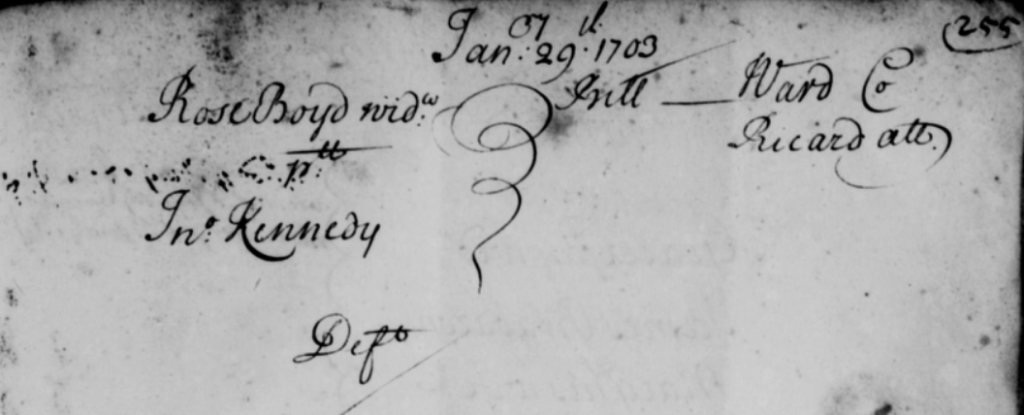
29 January 1703/4 – Rose Boyd Widow Plaintiff & John Kennedy Defendant.
Details for the bill are not given but the name John Kennedy could be the cousin to whom Rose’s husband had lent £300 in 1696. Then on 3 February 1707/8 we see administration granted to Rose Boyd widow, the daughter, in the case of Magdalen McNeill of Dublin widow who died intestate. Then we find a further bill entered in the Court of Exchequer on 14 March 1708/9, this time by John Kennedy as Plaintiff and Rose Boyd, Hugh Boyd and Richard Jackson, defendants.
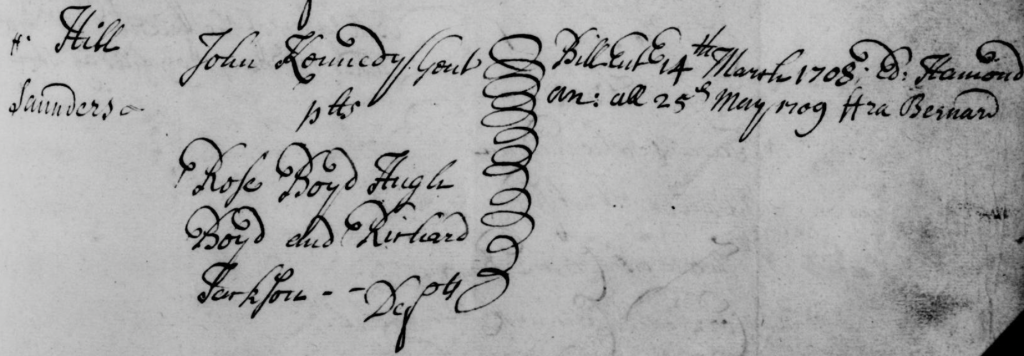
In summary it would appear that a protracted lawsuit had arisen between Rose Boyd and John Kennedy, most likely over the 1696 loan. In the midst of this Rose’s mother Magdalen died in Dublin. This would certainly have been a very difficult time for Rose Boyd. However closer examination of the counter suit by John Kennedy to the Court of Exchequer reveals something odd. One would have expected Adam to inherit the outstanding loan from his father. Also Rose is not referred to as widow and why had her son Hugh and son-in-law Richard Jackson been joined in the suit. The answer to some of these questions comes in a later deed registered in the Irish Deed Registry in 1723 and indeed it is the same deed we referenced earlier in confirming the 1696 loan.
In essence a solution was proposed and accepted between the parties that Rose, Hugh Boyd and Richard Jackson, Hugh’s Guardian, would receive a payment of £741 4s 4p (as had been decreed by the Courts in July 1709 as due by John Kennedy) from Roth Jones (a dublin financier) being the original loan by Rev William Boyd plus interest and other costs. In return Roth Jones was free to dispose of the property tied to the original loan as he saw fit. This was, by all intents and purposes, a bailout and one can only imagine the relief felt in the Boyd household that a defaulted loan had been avoided and the money not only recovered but with interest etc.
However this still leaves the question of Rose Boyd’s missing widowhood and why was there no mention of son Adam. Regarding the latter, the mention of Richard Jackson’s role as Guardian to Hugh in 1709 would seem to suggest that Adam Boyd was likely deceased. Hugh became heir but in 1709 he had not yet reached his majority and therefore required the representation of a guardian i.e. his brother-in-law Richard Jackson. Regarding the former there are two possible explanations, either the term widow had been dropped in error on the 1708/9 Exchequer Bill and the Deed of 1723 or remarkably, but more credibly, Rose had remarried to a gentleman called Boyd some time between 3 February 1708 and 14 March 1709.
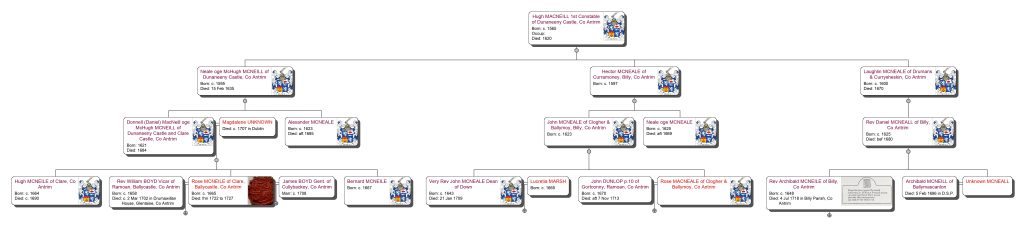
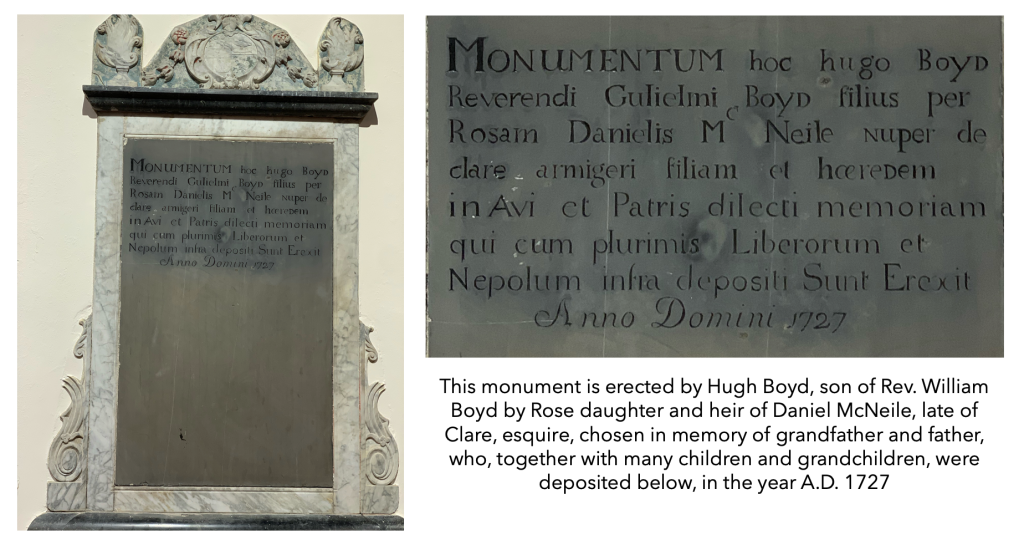
Previously historians had referred to the death of Rose and that Rev William Boyd had remarried. This theory came about for a number of reasons. Firstly a memorial tablet was placed in the old church in Ramoan in 1727 by Hugh Boyd in honour of his parents and grandparents (we shall see this later) and from this the conclusion was reached that 1727 was the year Rev William Boyd died which we now know is incorrect. Further a Rev William Boyd was in place in Ramoan parish from 1719 and this was taken as a renewed placement by Rose’s husband instead of it being their son William who was installed as Vicar of Ramoan between 1719 and 1730. Finally records show that Hugh Boyd, son of Rev William and Rose Boyd had two half-brothers, Rev Charles Boyd of Rathlin and Killowen and Alexander Boyd of Clare Park. Previously these had been seen as the children of Rev William Boyd of Ramoan by a second marriage after the death of Rose which we now know to be incorrect. We will now look at the evidence supporting a second marriage by Rose but first it is worth recording the family tree of Rev William Boyd which we believe to be confirmed by the evidence previously given.
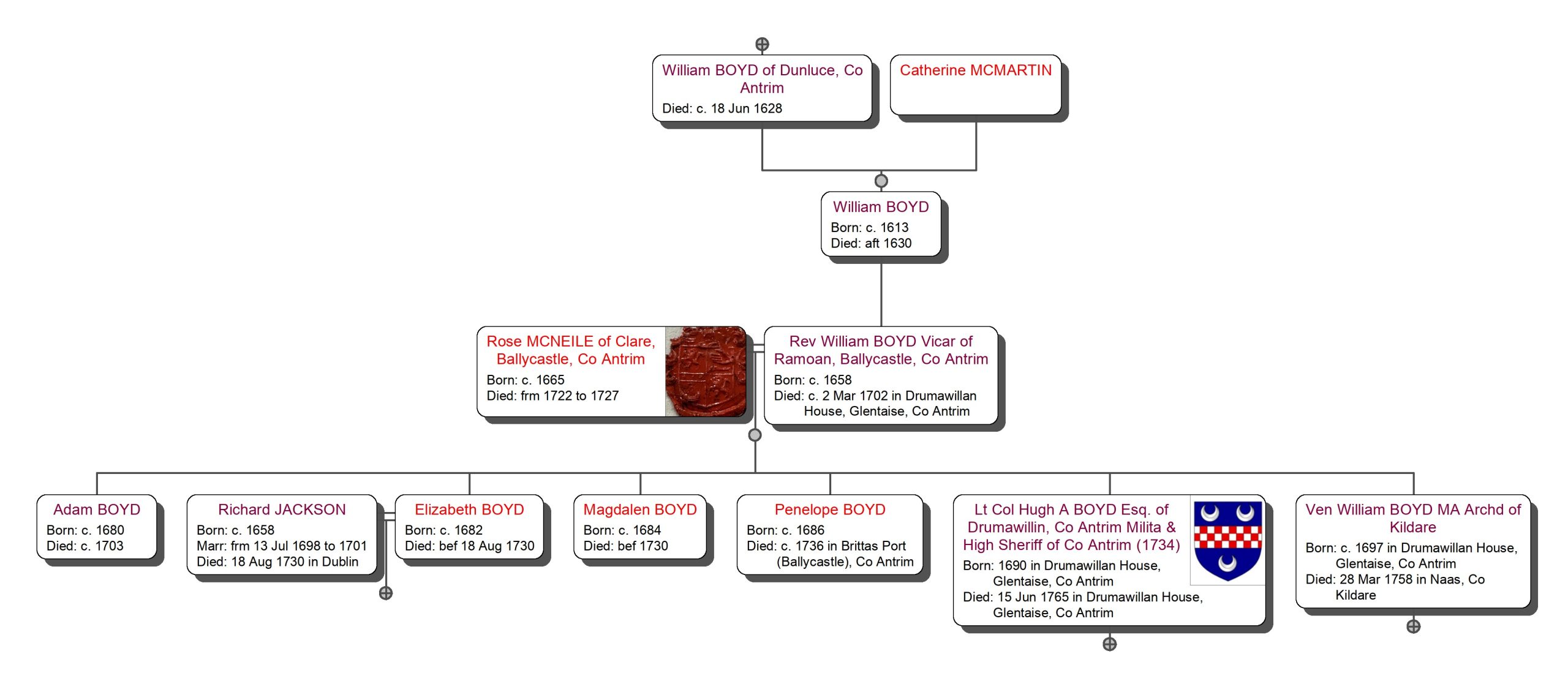
The main evidence for Rose’s second marriage lies in the information surrounding two key individuals, Rev Charles Boyd, Rector of Rathlin and Killowen and Alexander Boyd of Clare Park.
Canon Leslie’s ‘Clergy of Connor’ records the following for Rev Charles Boyd23:
b c1722 Co Antrim; ed by Rev Samuel Clark of Lisburn; ent TCD 13 Nov 1727 aged 19 BA 1731
C Agherton (Conn) 1739-47; Rathlin 1747-66; Chap Ballycastle 1768-72; R Killowen (Derry) 1772-81
m and had issue; 1. Mary Jane Haschett m John Boyd Postmaster Coleraine;
half brother of Col Hugh Boyd.
Died 9 July 1781 and was buried at Coleraine (MS Diary John (or James) Orr Coleraine)
This entry by Canon Leslie provides us with some excellent research but further examination reveals two important errors and omissions. Firstly when we look at the actual matriculation for Charles Boyd in the Albums of Trinity College Dublin we can confirm he was 19 when he entered the college, but on 13 November 1726 (not 1727) so likely born in Co Antrim 1708/9 (not 1722). The matriculation also records the vital information that his father was James Boyd Gent.

If we turn now to look briefly at Alexander Boyd of Clare Park the first thing we must address is his residence. This Alexander Boyd of Clare Park resided for most of his life in the McNeale estate of Clare, held by Rose Boyd as her jointure in marriage to Rev William Boyd of Ramoan, as confirmed by his will. Had he purchased or leased the property or did he hold it as an inheritance from his mother Rose Boyd?
Thankfully a rare family heirloom, a baptismal book relating to Alexander Boyd of Clare Park, was in the keeping of Robert Given of Coleraine in 1865 when transcribed by Rev George Hill and included in his work on the Stewarts of Ballintoy and published the same year. Two particular entries in the book are of interest:
“Hugh was born ye 21st of November, 1746; sister Charlotte Orr was godmother, brother Hugh Boyd and brother William Wilson, godfathers.
William was born ye 29th of March, 1748; his uncles, Wm. Boyd, of Cullybackey, and Wm. Boyd, of Drumawillen, Esqrs., godfathers and Mrs. Stewart, of Ballintoy, godmother.”
These entries relating to the baptism of two of the children of Alexander Boyd of Clare Park, Hugh and William, record his acknowledgment of three brothers, firstly Hugh Boyd, almost certainly of Drumawillin, William Boyd of Drumawillin (Hugh’s brother) and finally a William Boyd of Cullybackey. The mention of William Boyd of Cullybackey provides the basis by which we confirm the name of Rose Boyd’s second husband.
In a deed24 dated 2 November 1724 we find William Boyd of Cullybackey son of the deceased James Boyd of Cullybackey in regard to over 600 acres of land in and around Cullybackey, Co Antrim, previously held by them from a Captain Houston. It is surely more than coincidence that William Boyd of Cullybackey’s father was called James. Furthermore a search amongst the archives in PRONI revealed that a James Boyd had also taken a lease25 on property in Leymore, Co Antrim from Sir Robert Adair in 1688 for 126 years and this then passed to messrs Robert Aiton (1657-1742)26 and George Aiton on 6 October 1699. Unfortunately we do not find a record of James Boyd’s death or a will. The existence of William Boyd of Cullybackey suggests that James Boyd of Cullybackey was married prior to marrying Rose Boyd and William was the issue of that prior marriage. Despite this wrather complicated family structure we find the Cullybackey lands pass through James’ son William to his half-brother Alexander Boyd of Clare Park. This is confirmed by an advert in the Belfast Newsletter in March 1794 in which Ezekiel Davys Wilson, brother-in-law and trustee of the will of Alexander Boyd of Clare Park places the Cullbackey lands for sale.
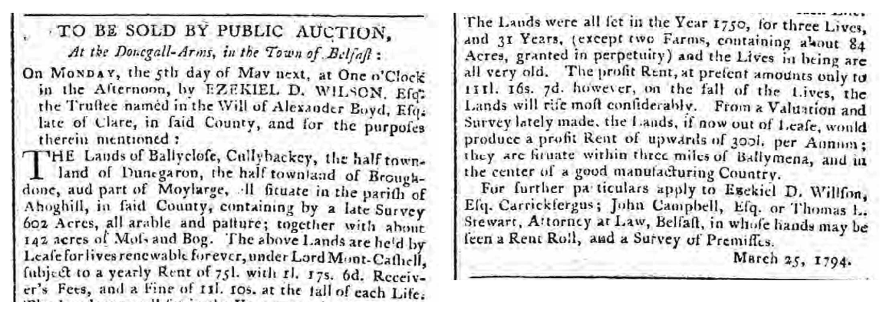
Unfortunately it is hard to confirm who James Boyd was or more specifically who his father was. If we assume him to be of roughly the same generation as Rose and the Rev William Boyd i.e. born c1650s then there is a possibility his father was born in the opening decade of the 1600s or shortly after. Interestingly in a transcription of an inquisition held in Carrickfergus on 19 March 1637 we find amongst the jurors a John Boyde of Drien (possibly Dreen, Craigs parish, Co Antrim) gent. and a Thomas Boyd of Levallyn (possibly Lisnafillon, Ahoghill parish, Co Antrim) gent. we assume both of Co Antrim. If we place the information regarding these two men along with what we know of James Boyd of Cullybackey etc. we find an interesting correlation of evidence linking a fairly tight area around Cullybackey with the Boyds of Clare Park. (See the notes and associated map below.)
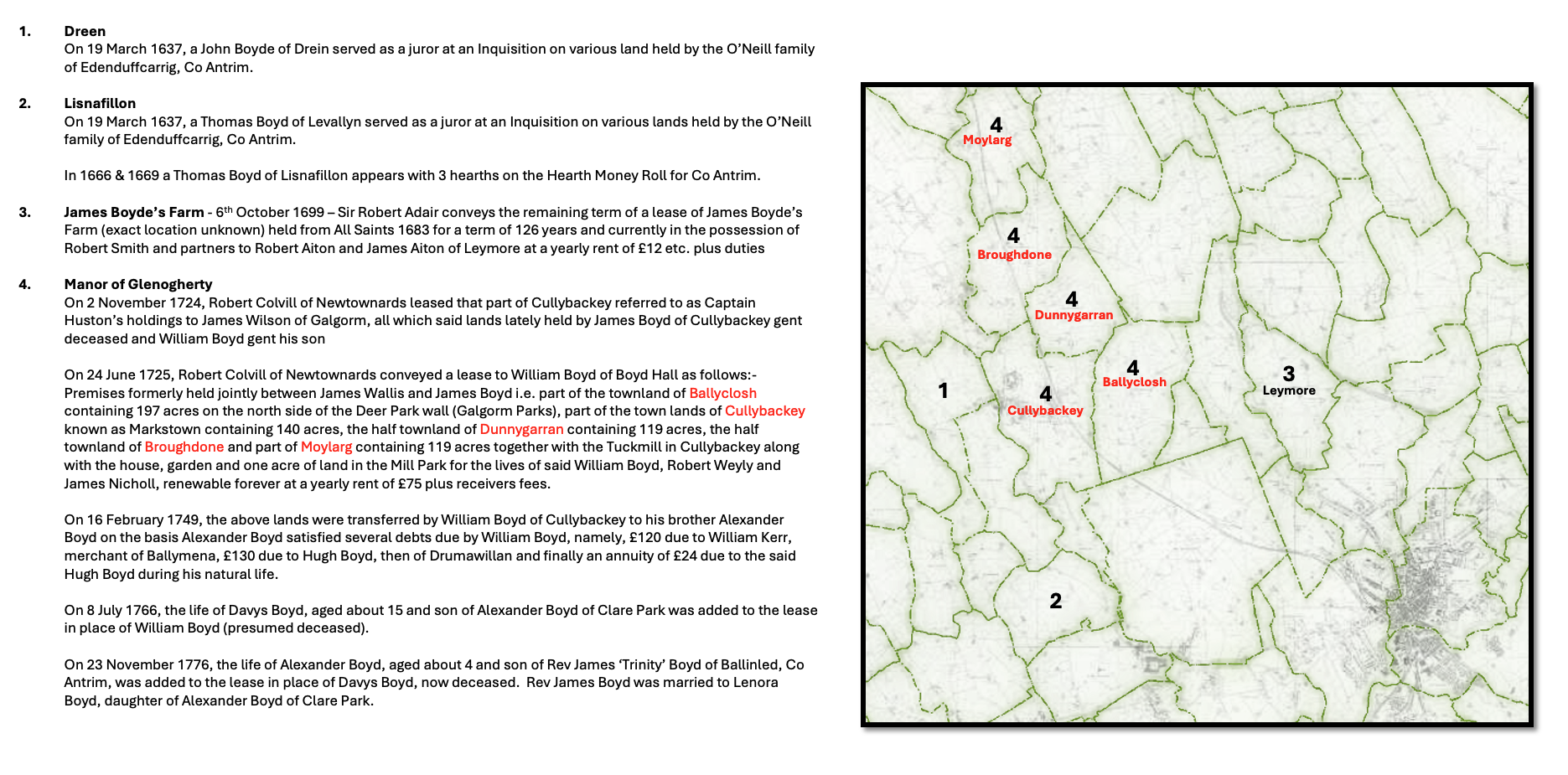
One very real possibility is that John Boyd of Dreen is non other than John, second son of William of Dunluce. Certainly the time period fits and then perhaps James Boyd of Cullybackey was his son. If this was the case then Rose, widow of Rev William Boyd of Ramoan, had married her deceased husbands cousin which might have been acceptable under the canon law of the time (although perhaps requring dispensation from the appropriate Bishop) and ensured a degree of continuity with the connection to the Boyds of Dunluce. Perhaps further information will be found in the future to test this theory.
We can now propse a family tree detailing the descendants of Rose McNeale of Clare, Co Antrim which documents both of the marriages suggested by the evidence previously discussed:

Before we look further into the lives of Rose’s children it is perhaps worth considering the character of Rose herself. In her lifetime she bore at least nine children to two different men. The first of those, Rev William Boyd of Ramoan, she likely married as young as fifteen as we must consider the fact her last child Alexander was probably born c1712 when she was probably around forty seven years of age. All indications are that she was a woman of considerable determination. We feel there is little doubt that the young Hugh Boyd grew up with a great love and respect for his mother and whilst no record survives of her death or will it is very poignant that Hugh had a memorial created and placed (originally in the old Parish Church of Ramoan) in 1727, most probably a short while after her death. When we consider this memorial it shouts loudest of Hugh’s McNeale family legacy and in all likelihood that which was protected and passed on by his mother.
If we look closely at the armorial atop the tablet we see that the Boyd arms are merely quartered 1st and not more typically 1st and 4th with those of McNeale. Was this Hugh Boyd’s way of acknowledging his gratitude to his mother and McNeale ancestors? (see below)
With Rose Boyd née McNeale deceased before 1727 we must look at what became of her brother Bernard. Unfortunatley no record of his death or a will has survived. The most likely outcome is that whatever condition prevented him from fully realising his heirship had resulted in his death probably before 1709.
Of the daughters of Rev William Boyd of Ramoan and Rose McNeale i.e. Magdalen and Penelope, we presume Magdalen died unmarried before 1730 and Penelope around 1736 at Brittas Port,28 also unmarried. The main source for these findings is the will29 of Richard Jackson dated 18 August 1730 in which he names brothers-in-law Hugh Boyd and William Boyd along with sister Penelope Boyd. It would seem also from the will that Richard Jackson’s wife Elizabeth, daughter of Rev William of Ramoan and Rose McNeale had predeceased him. We would encourage our readers who wish to know more about the family of Richard Jackson and Elizabeth Boyd to consult Sharon Odie Brown’s excellent website and Blog.30
Before turning to look at the life and legacy of Hugh Boyd it remains to examine arguably one of the most pivotal moments in his early life. We do not know what the circumstances leading up to this moment were but it would appear that his intent was to place any doubts about his McNeale inheritance beyond question (such as those discussed in Danny McGill’s article of 2002) and place his future on a secure footing. To do this he appears to have connected in 1715 with an important relation. Hugh’s third cousin Mary McNeale (c1667-1739) was married to the Rev Jasper Brett (1665-1736), Chancellor of Connor who was 1st cousin once removed of Michael Ward (1683-1759) a rising star of the law and politics in Ireland who had previously been called to the Irish Bar in 1705 and was now MP for Bangor Co Down. It was more than likely Michael Ward who suggested the presentation of an important legal document before justices of the Kings Bench in Dublin which would confirm Hugh Boyd’s right to the McNeale estate and put any doubt to his inheritance beyond question. The mechanism for this was a Final Concorde.
Many years ago whilst examining papers of the Boyd Ballycastle archive Danny and Jayne McGill had copied a seemingly very old document which was, though apparently in latin, of such a style of writing as to render it effectively indecipherable to all but a select group in the legal professions, probably a form of court hand that was forbidden by legislation in 1730. (see below).
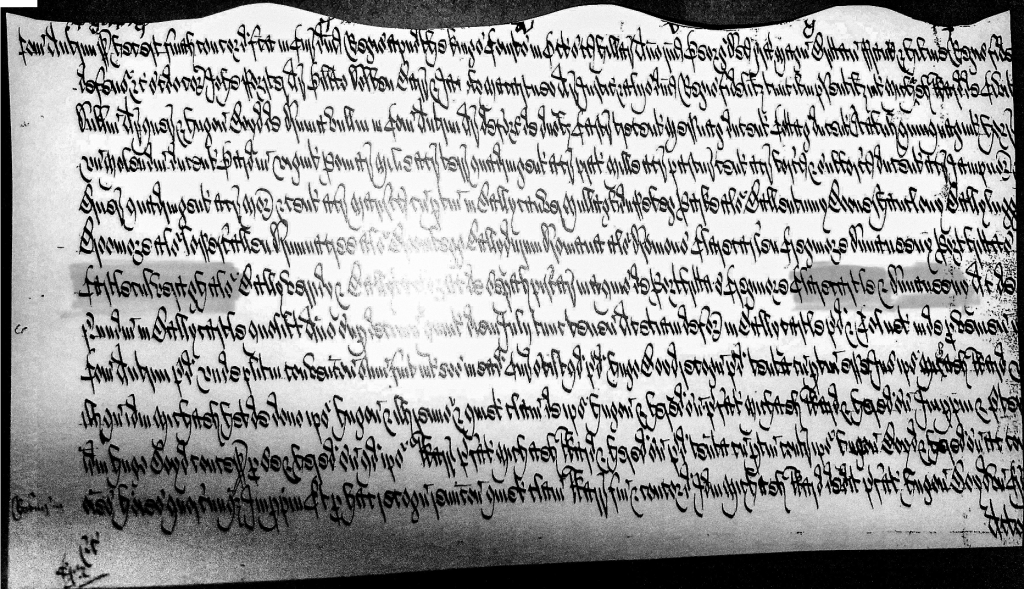
When examining a digital copy of this document a few years ago we decided to refer it to an expert in medieval and other texts, Dr Claire Jarvis PhD(Cantab) MSc(Econ) PgDip(ARM) who quickly confirmed the nature of the document as a final concorde and provided us with a translation as follows:
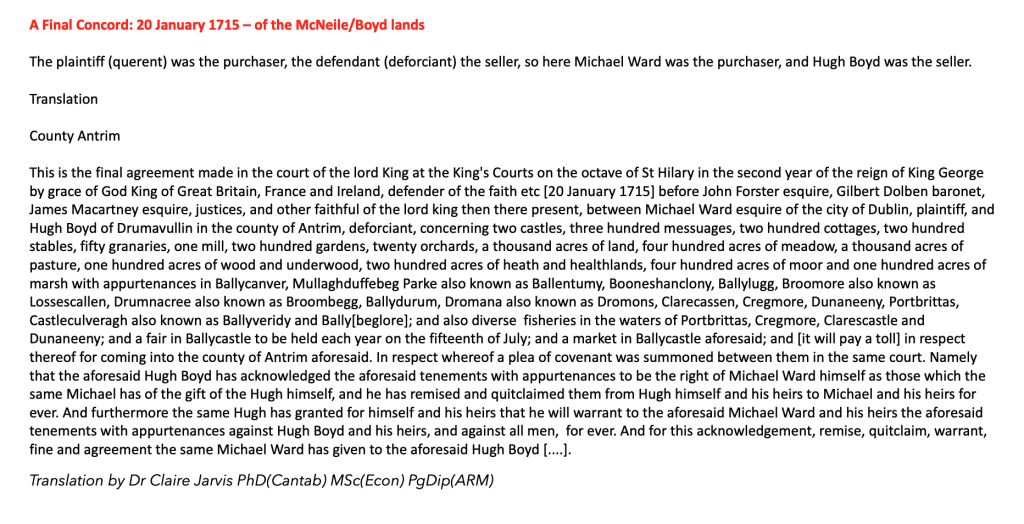
Once translated it was easy to understand why this remarkable but frustrating three hundred year old document had been kept. In just one action, Hugh Boyd, with the assistance of Michael Ward and the sanction of three judges (John Forster, Gilbert Dolben and James Macartney) of the Kings Bench in Dublin, had secured his future.
- Fiants of Elizabeth I – No. 5136 ↩︎
- Ibid No. 6556 ↩︎
- Ibid No. 6633 ↩︎
- PRONI Ref. D2977/3A/2/1/1A&1B ↩︎
- We are grateful to local Ballycastle Historian Caoimhin Mac Gabhann (Kevin McGowan) for his assistance in locating the reference to Craigmore. ↩︎
- PRONI. LR1/1405/1, Box A1 (Original Copy) & D2977/3A/2/1/2 & ↩︎
- Inquisitionum In Officio Rotulorum Cancellarae Hiberniae Asservatarum Repertorium Vol II (1829), Shaw Mason (Inquisitions of Ulster) – Antrim, No. 64, Cha I ↩︎
- Heads and Hearths; The Hearth Money Rolls and Poll Tax Returns for Co Antrim 1660-69, S T Carleton (1991) – ISBN 10: 090569127X / ISBN 13: 9780905691275, p.70. ↩︎
- Ballymoney Free Press and Northern Counties Advertiser – 7 March 1929, p.3 ↩︎
- Clergy of Connor, Canon J B Leslie (1993 Ed.), p.229. Hugh Alexander Boyd recorded that William Boyd was ordained a Deacon by the Right Reverend Roger Boyle D.D., Bishop of Clogher (1672-87) at St Tigernach’s Parish Church, Clones, Co. Monaghan on 18 October 1679 – see his article the Boyds of Ballycastle in the Ballymoney Free Press, 7 March 1929 ↩︎
- Findmypast.co.uk – Crossle genealogical abstracts (Parcel 1A-32-26 v. S cont.) Smith notebooks, v. 13-31 (cont.) ↩︎
- Gleanings in Family History from the Antrim Coast: The MacNaghtens and MacNeills, Author(s): Geo. Hill, Source: Ulster Journal of Archaeology , 1860, First Series, Vol. 8 (1860), pp. 143-144 ↩︎
- See the Dictionary of Irish Biography (DIB) for Randall MacDonnell 2nd Earl of Antrim by Jane Ohlmeyer also the DIB for Alexander MacDonnell 3rd Earl of Antrim by Micheál Ó Siochrú and The Stewarts of Ballintoy: With Notices of Other Families of the District in the Seventeenth Century. The Stewarts of Ballintoy (Continued) Author(s): George Hill – Source: Ulster Journal of Archaeology , Jul., 1900, Second Series, Vol. 6, No. 3 (Jul., 1900), pp. 149-159. ↩︎
- PRONI Ref. MIC63/1 ↩︎
- 1690 and the McNeills of Clare Castle, The Glynns Vol.30 (2002), p.133-137 ↩︎
- Clergy of Connor, Canon J B Leslie (1993 Ed.), p.643 ↩︎
- Irish Deed Memorial No. 23760 – 13 June 1723 ↩︎
- See Measuring Worth ↩︎
- PRONI Refs. D2977/3A/7/3A ↩︎
- Ibid D2977/3A/2/1/13 ↩︎
- National Archives Ireland (NAI) Ref. NAI RC 6/3 ↩︎
- We are grateful for the many years of research into the Jackson family as undertaken by Sharon Odie Brown which has proved so valuable in our research – see The Silver Bowl and associated Blog ↩︎
- Clergy of Connor, Canon J B Leslie (1993 Ed.), p.229 ↩︎
- Irish Deed Memorial No. 27806 – 2 November 1724 ↩︎
- PRONI Ref. HA12/F2/1/7 also possibly held in Suffolk County Archives under same reference – Adair family of Ireland Tasburgh family of Flixton, Suffolk ↩︎
- See Memorials of the Dead in Ireland, Vol VI Pt 1 (1904), p.190 ↩︎
- https://antrimhistory.net/the-ordnance-survey-memoir-for-the-parish-of-ramoan/ ↩︎
- See FindMyPast – Connor Admon Bonds ↩︎
- See FindMyPast – Bethams Will Abstracts for details. ↩︎
- See Note 20. ↩︎