In our previous post we looked at the beginnings of the Boyds of Ballycastle and the significance of the marriage of Rev William Boyd to Rose McNeale c1680. We also seen how the McNeale lands in the parish of Ramoan came under the ownership of the couple and passed to their second son Hugh. Finally we covered the pivotal moment in the life of Hugh Boyd when he secured his succession to the family estates in 1715.
There have been many excellent articles and histories of Hugh Boyd over the years which have done so much to inform us of his business ventures, his development of the town of Ballycastle and in particular its harbour and we will refer and indeed recommend our readers to access and read them in association with this article and in the whole come to understand more about this remarkable son of Co Antrim and indeed Ballycastle. We will of course cover all these things to some degree but through the article we will focus, where possible, more on the man, his family and the lands and estate which lay at the heart of his legacy.
Hugh Boyd’s Early life and education
First we must address Hugh Boyd’s birth date. There are no relevant parish registers available from the time period in question i.e. late 1600s so conventional means are not possible. We therefore resort to methods typically used in genealogical and historical research, particularly in ireland. The main Boyd family memorial in Holy Trinity Parish Church erected in 1856 records his death in 1765 aged 75 so therefore c1690. This is also confirmed by a notice of his death in the Belfast News Letter.1 So with a contemporary source and also one likely commissioned by his family we shall assume c1690.
Being born the second son it is possible that Hugh would be prepared for an appropriate role for a land owning family of the time, typically the church or apprenticed for a mercantile career or even the army. However the crisis of his elder brother Adam’s likely death by around 1703 would of course change everything. We also know from sources in our previous post that Richard Jackson, his much older brother-in-law had been made his guardian.
It was thought that Hugh was educated at the ‘Whitepark School for Young Gentlemen‘2. However this would have been impossible as his early life predates the school by over thirty years, which was said to have been held in the property built by John Stewart of Ballintoy c1740 and the children supposedly educated by Rev William Sturrock, Vicar of Culfeightrin (1770-77).3 So for now his education remains a mystery and no evidence of a university education has been found to date. One possibility is that he was educated in Dublin as his guardian Richard Jackson most likely had connections within the city. The error in linking Col. Hugh Boyd to Rev Sturrock has likely come about by the fact that Hugh Boyd MP4 (1765-95), his great grandson and son of Ezekiel Davys Boyd (I) was educated by Sturrock/Sterick before attending Trinity College Dublin in 1782.5
Apart from Hugh’s inclusion in the Chancery hearing of 1708, mentioned in the last post, the next evidence we find for him is in a lease6 of 29 December 1709, which raises an interesting question. The lease is for land i.e. the quarter of Drumnacross and the parcel called Altnanum (Drumnacross now part of Town Parks and Altnanum part of Drumawillin parish of Ramoan, Co Antrim) from Randall Earl of Antrim for 31 years. The lease appears to be signed and sealed by Hugh Boyd, although the seal would appear to be his mothers as it bears the arms of McNeale.
We know from his memorial and obituary that his birth year was likely 1690, so if this was the case he signed the lease under age i.e. under 21. Whilst this was probably possible it may have left a potential risk for the lessor as the lease could be voided by the lessee for being under age under Common Law. Interestingly the same year he had witnessed a deed by which his mother let the townland of Drummans to a John Boyd.7
The Causeway Museum Service in its 2007 publication ‘Col. Hugh Boyd’s Ballycastle’8 states that Hugh moved to Dublin in 1711 to learn business upon inheriting the Ballycastle Estate i.e. reaching his majority. However it would appear he was back in Ballycastle by 1714 when they further state he “Supervised building of a bridge of stone and lime over the Margy River, cost £80, to replace the old wooden bridge which was ‘totally down’” and then in 1719 “Finishing two bridges over the river at the water foot of Port Brittas.“
Marriage
At some time c1711/2 it is believed Hugh Boyd married Anne McAlister, supposed daughter of Randle McAlister of Kinbane. The marriage is mentioned in Burkes Landed Gentry9 but no year given. The year of marriage is calculated from the date of the marriage articles10 of their eldest son William, which were dated 11 October 1733 in his marriage to Mary Wilson, daughter of Ezekiel Davys Wilson11 (1685-1735) former Mayor of Carrickfergus, suggesting that William was likely around twenty one at the time. Interestingly the discovery of a deed12 and associated Bond13 in PRONI dating to 1695 would appear to support Randle or Randal as Anne’s father for in the 1695 documents Randal is referred to as Yeoman of Altnanum (now part of Drumawillin, Ramoan parish, Co Antrim) where the Boyd family also resided.
On 9 October 1720 Hugh Boyd took a lease14 for 31 years from the Earl of Antrim on the townlands of Ballyveely, Drumeeny, Drumahitt and Drumahaman. Curiously on signing the lease he appears to have used a generic seal with no armorial bearings of either Boyd or McNeale. The lands were formerly held by the late Robert McCarroll who was buried in the family plot in Old Ramoan Churchyard, Ballycastle, said to be the oldest grave yet visible.
Ballycastle Collieries and Saltworks
The publication, ‘Col. Hugh Boyd’s Ballycastle’ states that Hugh Boyd was “Appointed manager of Ballycastle Colliery Salt Works and Co.” in 1721. In his 2007 article15 Danny McGill gives a short history of the Ballycastle Collieries and Salt Works from 1720-35 and begins with a deed16 of 10 August 1720 from the Earl of Antrim to Richard and William McGwire for:
“All and every the said Randal Earl of Antrim’s Colliery’s and Coal Pits and all the mines of coal and culm which there were discovered and found on which thereafter might be discovered or found in or at or under all and every the lands of the said Earl of Antrim lying and being in the Barony of Cary and the County of Antrim extending from the church of Bonemargy to the hill called Fair Head, together with the houses buildings and works thereon the premises so in as large and ample a manner as Captain James Butler formerly held or might have held and enjoyed the same and also all those two townlands called or known by the name of Ballyreaghs … together with all the saltpans and other works thereon belonging for the term of thirtyone years to continue from the first day of November next at and under the yearly rent of five pounds fifteen shillings….”
It had been previously thought that Richard and William McGuire were brothers, however we now know them to have been father and son, Dublin bankers. Confirmation comes by way of the will of Richard McGwire dated 27 May 1727. We presume he may have died on the Isle of Man whilst developing an estate he had purchased previously. He was said to have left considerable debts but an advert17 in the Dublin Journal suggests that his son William was left to carry on the family business.
Danny McGill further states:
“The next year (1721/2) on the 31st of January they sold shares in the Lease to Richard Nutley [(1670–1729)], Richard Stewart18 [(1677-1728) MP for Co. Tyrone], Thomas Burgh [(1670-1730) MP for Naas], Richard Stone19 [(1674-1727) MP for Newtown Limavady 1695-99], John Hall [of Dublin Esq.(d. <2 April 1731)] and Hannibal Hall [Surgeon of Dublin]. Selling shares in the enterprise raised five thousand pounds, which the partners used to pay for the lease and provide funds for future investment to improve the output of both the collieries and the salt works. The partnership was known as the Irish Coalyard Company…”
In an undated document held on microfilm20 at PRONI we find details of an intended share issue raising £13,500 to be invested in the company. The current allotment of 36 shares was to be issued as follows:-
Peter Hartop Esq. & his friends – 6 shares at £500 each totalling £3,000
Alexander Barham Esq. & his friends – 6 shares at £500 each totalling £3,000
Mr Cave Wiseman & his friends – 6 shares at £500 each totalling £3,000
Old proprietors and others to be admitted – 9 shares at £500 each totalling £4,500
Phillip Peck – 9 shares free from payment
& two hundred pounds per annum
Totalling – 36 shares – £13,500
when the said fund is expended the Interest will be increased to 360 shares viz
Mr Hartop & his frds – 60 shares at £50 each
Mr Barham & his frds – 60 shares at £50 each
Mr Wiseman & his frds – 60 shares at £50 each
Totalling – 180 shares at £50 each
Old proprietors or others – 90 shares at £50 each
Totalling 270 shares at £50 each – £13,500
Phillip Peck – 90 shares free from paymt
Totalling 360 shares
We note two points from this share issue. Firstly, it likely post dates the 1721/2 share issue and we must presume that messrs Nutley, Stewart, Burgh, Stone, John Hall and Hannibal Hall are the old proprietors referred to in the new issue. Secondly we see that Phillip Peck is given 9 shares at no cost and also a £200 annual payment suggesting his managerial role was to be funded through this mechanism. From the same document we can now look at the ways in which it was intended to expend the £13,500:
Methods proposed for expending £13,500 on Bally Castle Works
1st – To make the sevrl paymts to the Old partners as the same shall fall due – But if any of them or their Friends (Capable to promote the Interest of the Undertaking) desire to be Concerned they may be Admitted in proportion to the Sum to be paid them.
2ndly – To Build Ten boats or more of the burthen of Ten Tun each according to a new Modell wch may easily be hawled on shore on rollers to be loaded and remain there till Shipping Arrives; By which Method many Ships of large burthen may be loaded in a days time, and then the sd Ships Observing the Printed Directions may avoid any danger of a Storm in the Bay.
3rdly – That if any Ship desires to be loaded at Rathlin Island the sd boats will Carry the Coals there at only 6d per Tun Additional Expense, the sd Boats being easily hawled on shore and Managed with Two Men & a boy as the boats of 4 Tun burthen formerly Used; And the Carpenters from England who build them will undertake same.
4thly – That as soon as the Boats are built the price of Coals will be reduced at the Works so as to be Shipt on board at 2 Shillings per Tun less than is now paid elsewhere And a Number of Ships Engaged from the North part of Great Britain to purchase and Export the same to Dublin and other parts on their own accounts – or as freight.
5thly – That if any Inhabitant have a Mind to Purchase their Yearly Quantity of Coals, they may be Supplyed with the saame at twelve Shillings per Tun Weight in Summer all large Coal and 14 Shillings per Tun in Winter.
6thly – That the Managmt of the Works be Continued under the Direction of Hugh Boyd Esq. and Mr Peck.
7thly – That after the Coal Works are Established as aforsd (Which may be Effected) in a few Months, more Salt pans to be Erected to boyl Sea Water after the Method now practiced with success in Northumberland and Cumberland, the Number of wch may be so far Enlarged as to Supply the whole Kingdom with better Salt than that wich is imported and made from Rock Salt.
H: B: [likely Hugh Boyd]
Three sevl Societys of the Iron Trades in England desire to Seyle at Ballycastle And it is proposed to give them Incouragemt by Allowing Coal at a reasonable price Reserving a Rent for the Water Courses, which Nature afords such plenty of there, so as to Exceed any Situation in England; It being a great Difficulty to Obtain Coals, Water Courses, Land for Building on and an Open Navigation for the Importation & Exportation of Mettalls & the Manufactory thereof, all Contiguous & in a Cheap Country.
We should mention that the Ballycastle collieries had significant backing from the Irish Parliament following a petition from Richard Stewart and Thomas Burgh on 5 October 1721. Just eight days later the petitioners received an offer of £1,000 with a further offer of a £1,000 if they can ensure that 5,000 tons of coal can be delivered to Dublin before the 1 November 1722. A further petition was made on 10 October 1723 by Richard Stewart seeking financial assistance and a further grant of £2,000 was offerred a few days later. Shortly after there appeared a dispute regarding parliamentary priviledges involving messrs Richard Stewart and Thomas Burgh. However it does not appear to have had a negative affect on the petition for funds for the collieries as £2,000 was paid by parliament on 31 July 1724. A third petition is made by Richard Stewart on 10 January 1727/8 and a further £2,000 received by 5 March 1727/8. Finally on 13 April 1730 a parliamentary commission investigation and report into the colliery and the use of public monies it was agreed that the investments were justified and indeed Ballycastle should be made a discharging port to enable the colliery to increase exports etc.
On an engineering note, the 2007 pamphlet21 argues the case for the first railway line built in Ireland in 1721 being at Gobb Colliery, probably a primitive, horse-drawn wooden tramway designed specifically to transport coal from the mines down to the sea. Regarding the Mr Peck who was a co-manager of the works with Hugh Boyd it was most likely Phillip Peck, son of Cheshire Merchant Daniel Peck. The father and son were also involved in a mining venture in Stevenston Ayrshire, Scotland22 at the same time as the Ballycastle venture and previously Daniel Peck had speculated in lead mining in Wales and was said to have been the purchasing agent for the notorious ‘Company of Mine Adventurers in England‘.
We must presume that Hugh Boyd’s confidence and finances were good as on 24 March 1726 he purchased a share in a glasshouse on bachelors Walk, Dublin. The other partners were Dr Richard Helsham (c.1682–1738), Richard Stewart23 and Joseph Nuttall24 (Banker & Mayor of Dublin 1731-32). Then on 5 June 1730, as stated by Danny McGill in his 2007 article in the Glynns;
“Hugh Boyd sold his share in the glasshouse in Dublin to John Hall and by the same deed he bought John Hall’s share in the Irish Coal yard Company… On 25th December 1735 by a Deed of Trust, (an agreement with remaining partners), Hugh Boyd secured complete control of the Coal yard Company whose main asset was the Ballycastle Salt and Colliery Works, with 16 years left of the original lease (up to 1751). Other assets in Dublin included the glasshouse on Bachelors Walk, house in Poolbeg Street, the coal yard and offices. Within two years Hugh Boyd had ‘part exchanged’ the remaining sixteen years of the 1720 ‘McGwire Lease’ for a ‘Fee Farm Grant’ of the collieries from the Earl of Antrim.“.
Recently we discovered a remarkable piece in an english newspaper from 1733 recording the significance of Ballycastle coal:

Public office, disputes and family
Hugh Boyd was said to have been Mayor of Coleraine on three occasions.25 However we have examined the research notes of Maxwell Given (1865–1934, architect, local historian, and antiquarian of Coleraine) whose extensive research is held in PRONI. In a listing of Mayors of Coleraine26 (1613-1840) Hugh Boyd’s name is absent. However, Hugh Boyd was made High Sheriff of County Antrim in 1734 and the same year Alexander (1713–1775) 5th Earl of Antrim commissioned a survey of his land holdings in north Antrim.27 The trigger for the survey appears to have been the young Earl attaining his majority. However it also seems to have triggered a dispute between himself, his Agent Alexander Stewart of Acton, Co Armagh and Hugh Boyd. It appears the young Earl thought himself duped into agreeing to an undervalued lease of various lands in the Barony of Dunluce to Hugh Boyd at the instigation of Stewart his Agent and that the two men had colluded to bring about the said lease. The Earl subsequently wrote28 to Robert Jocelyn, High Chancellor of Ireland (after 7 September 1739) but we have been unable to find a record of any adjudication in the matter.
Regarding the 1734 survey, of particular interest is the section covering those lands leased to Hugh Boyd in and around Ballycastle which we have overlayed on current mapping to compare the old place names and their locations along with a few well known landmarks.

Before looking at the latter part of Hugh Boyd’s life we will turn for a while to consider his children. We previously mentioned his eldest son and heir William (b. c1712). However we know that he and his wife Anne McAlister had at another three surviving children, Daniel, Margaret and Leonora.
We know very little about Hugh Boyd’s second son Daniel except that he was left an annuity of £100 per year in the hands of the trustees to his father’s will.29 He was also the first name recorded in a list of those buried in the vaults of Holy Trinity Church, Ballycastle, Co Antrim. The list was said to have been in an album originally held by Miss Katherine Gage (1854-1918, four times great grandaughter of Hugh Boyd who married Col Alexander Sinclair Grove) who then passed it to her daughter Mrs Mary Grace Montgomery Campbell née Grove and transcribed by Charlotte Trench and included in her book on the Wrays of Donegal.30 It is possible that Daniel had some form of disability that left him unable to manage his affairs. Margaret the eldest daughter married Alexander McAuley KC MP31 (1702-66 of Drumnagessan & Glenville, Co Antrim and Dublin) and Leonora (c1721-99), the second daughter, married c1738 Jackson Wray (c1715-94) of Ballycastle & Bentfield, Co. Antrim and Bath, Somerset.32

The securing of the Ballycastle lands and collieries
Returning to the life of Hugh Boyd, on the 26 November 1735 we see another pivotal moment in his life as he purchased33 the townlands in and around Ballycastle i.e. the village and demesne of Ballycastle, Drumawillin, Altnanum, Drumnacross, Lelan, Stroanshesk, Drumargy and Kilcregg, under a fee farm grant from the Earl of Antrim for £1,150 with a ground rent of £50 per annum. In our last post we saw how the final concorde was used to establish Hugh Boyd as heir to the McNeale lands and now by this deed he had secured part of those lands under fee farm forever.
With the lands of Ballycastle secured Hugh Boyd turned his attention to the local collieries. Danny McGill in his 200734 article in the Glynns states:
“On 25th December 1735 by a Deed of Trust, (an agreement with remaining partners), Hugh Boyd secured complete control of the Coal yard Company whose main asset was the Ballycastle Salt and Colliery Works, with 16 years left of the original lease (up to 1751). Other assets in Dublin included the glasshouse on Bachelors Walk, house in Poolbeg Street, the coal yard and offices. Within two years Hugh Boyd had ‘part exchanged’ the remaining sixteen years of the 1720 ‘McGwire Lease’ for a ‘Fee Farm Grant’ of the collieries from the Earl of Antrim.”
Drumawillin House & the Charter School
On 19/20 March 1735/6 Hugh Boyd leased35 20 acres (plantation measure) part of the lands of Altnanum to the ‘Incorporated Society in Dublin for Promoting English Protestant Schools in Ireland‘ for ever. The deed was subsequently registered on 5 December 1739. The deed was witnessed by John Hansard, Secretary to the Society. It is presumed the rental income from the 20 acres at Altnanum was used to fund the school but the school itself was said to have been located at the original Boyd homestead at Drumawillin and certainly early Ordnance Survey maps would appear to confirm this.

On 25 March 1737 the Society reported:
“At Ballycastle in the County of Antrim, the Building is in great Forwardness, so that before the End of the Summer the Society expect it will be opened. This Foundation is owing to the Beneficence of Hugh Boyd, Esq; who has conveyed twenty Acres of Land in perpetuity towards the Support of it.”
We believe that the Charter School was built behind the old Boyd residence (which possibly dated to the 17th century) at Drumawillin, shown as an L-shaped 1 1/2 storey property on a sketch in the 1734 survey shown earlier. We know that the school was built by 1737 and that Hugh Boyd moved with his family into the town in the spring of 1739. It would appear that the old Boyd residence was still in existence by the time of the first Ordnance Survey c1834-37 but has since, along with the Charter School building been replaced. The current Drumawillin House is a much more recent property built to the north of the old site.
Returning to the Charter school we see from the same report of 1737 that Hugh Boyd was a member of the Society and from a further report in 1744 we see that the school formed by the Society in Ballycastle in 1737 had 25 children attending. Sadly, what had appeared initially to be a benevolent act directed at educating children from poor homes was in reality a tool for proselytising vulnerable children. Unfortunatley it took over fifty years for parliament to be sufficiently concerned and organise inspections and by 1825 a Royal Commission put the organisation beyond saving and a withdrawl of public funding. The Commission’s report mentioned the school at Ballycastle twice, first on an inspection by a Mr Howard in 1784 who said that he found a number of children at Santry who had previously been six years at Ballycastle who could not read. He further added:
“the dreadful Situation of the Schools, prevented their being filled. The Children, in general, were sickly, pale, and such miserable Objects, that they were a Disgrace to all Society ; and their Reading had been neglected for the Purpose of making them work for their Masters.”
In 1818 following a visit to Ballycastle school by a Mr Thackeray, where he found ten girls:
“so ill taught and so ill qualified, that not even the Offer of a Bounty would tempt the commonest Farmer to receive them.”
It is remarkable that a project that was setup by and administered by people within the established church, that it was the establishment, through Parliament, that decided that its continued existence was intolerable.
Need for major development in Ballycastle and its industries
On 9/10 March 1736 Hugh Boyd took a fee farm lease36 of the collieries, coal pits and land extending from Bonamargy church to Fair Head in the townland of Ballyreagh at a yearly rent £5.15s.0d.
In the following years we see Hugh Boyd concentrate on the need for a substantive harbour at Ballycastle with one of his greatest achievements in securing a grant of £10,000 from parliament towards the cost of constructing a suitable harbour at Ballycastle to contain thirty ships of 30 tons burthen in 1737. This was a remarkable achievement from a man who had limited engineering or construction experience and unsurprisingly the project came at great personal and financial cost.
Thanks to an account written by Hugh Boyd and published in 1743 (see below) we have a diary, of a type, of the works on the harbour from 1737 to around 1741. But perhaps a lesser known aspect relates, not to matters of construction, but a reference to supplying bread to his workforce in 1740 and the summer of 1741. He writes:
“In the Year 1740 and Summer 1741, when the Price of Bread was excessivley high, I bought Quantities of Wheat, and caused good Houshold Bread to be baked for my Labourers, which I sold them at the Rate of twelve Pounds for an English Shilling, when the Assize of Bread in the neighbouring Towns was from six to seven Pounds for twelve Pence. I also bought Barley and Oat-meal, which I sold them about a Third cheaper than the common Prices. This Trouble I chose to undergo, rather than to raise the Price of Labour, which I knew by Experience could not easily be reduced in a plentiful Season. Besides, the great Cheapness of Bread here, invited Labourers to the Place, and had no small Influence in checking the Exorbitance of the neighbouring Markets.”
At first glance this appears to be the thinking of a clever and shrewd businessman endeavouring to maintain his project but what we must understand is the time at which this cost cutting measure is occuring, for it concides with one of the most calamitous events of Irish history, the Irish Famine of 1740–1741 (Bliain an Áir, the Year of Slaughter). Unfortunatley Hugh Boyd does not elude to the reasons for high food prices in the local economy but surely it is the result of shortages brought about by the failure of recent harvests. This then begs the question, had Hugh Boyd, by his project on the harbour and decision to directly intervene in the supply of cheaper food to his workers, protected some in the local population from the worst effects of the famine, even death? This may be an aspect of Hugh Boyd’s legacy in Ballycastle that has been lesser known until now.

Alongside his business interests, Hugh Boyd’s other passion was the development of Ballycastle as a substantive town. On 10 December 1736 we see a deed37 from him to the Earl of Antrim for what appears to be a new courthouse i.e. a newly built house in the village of Ballycastle, which is used to hold the manor courts. Yearly fee farm rent £50. This is of course the current Ballycastle Museum which will now undergo a wonderful project of restoration and development funded through the National Lottery and other funding.

Castle Street would become the hub of mercantile development in the growing town, housing many of its merchants, apothecarys, surgeons etc. A wonderful resource was placed online in 2024 by Ballycastle Museum which documents some of the history of the buildings and residents over the years. We will return to Castle Street later in the post when examining the will of Hugh Boyd.
The beginnings of a growing town were evident by 1734. From the 2007 pamphlet38 ‘Col. Hugh Boyd’s Ballycastle we read:
“In 1734 there were 62 householders in the town. Most of these were situated along Castle Street, which ended at a bridge over the river flowing past the ruins of the old MacDonnell castle, and there were four small cabins at the quay. As Boyd’s ‘Colliery Salt Works’, harbour, glassworks and bleach works developed, more merchants and skilled craftsmen were attracted to the town. Soon there were soapworks, a chandlery, a brewery, a distillery, limeworks, sandstone quarries, brickworks and a tannery. There were as many as 600 people employed at one time in these industries and building the harbour and roads, with more building houses for the workers.”
In his publication of 1743 Hugh Boyd stated:
“In Spring 1738-9 I removed my Family to a small House situate at the Harbour, in order to give the more close Attendance upon the Works, and left a comfortable and agreeable Place of Residence about a mile and a half distant, where I and my Family had been settled for many Years.”
In the 2007 pamphlet this is identified as ‘Hybla’ (originally on ‘Up Street’ then named ‘Ann Street’ and eventually ‘Quay Road’, Ballycastle) which was mentioned in research by Canon Isaac Purcell Barnes, B.A., & Hugh Alexander Boyd. The property is rated as ‘B1’ in the Historic Environment Record of Northern Ireland and certainly the official record would seem to concur with the age as suggested in the pamphlet. Additional reading may be found in the Ulster Architecural Heritage Society’s publication on the ‘Glens of Antrim‘ (c1972) by C. E. B. Brett (later Sir Charles). Interestingly Sir Charles Brett’s 5 x great uncle Rev Jasper Brett (1665-c1736) married Mary McNeale, second cousin once removed of Hugh Boyd’s mother Rose.
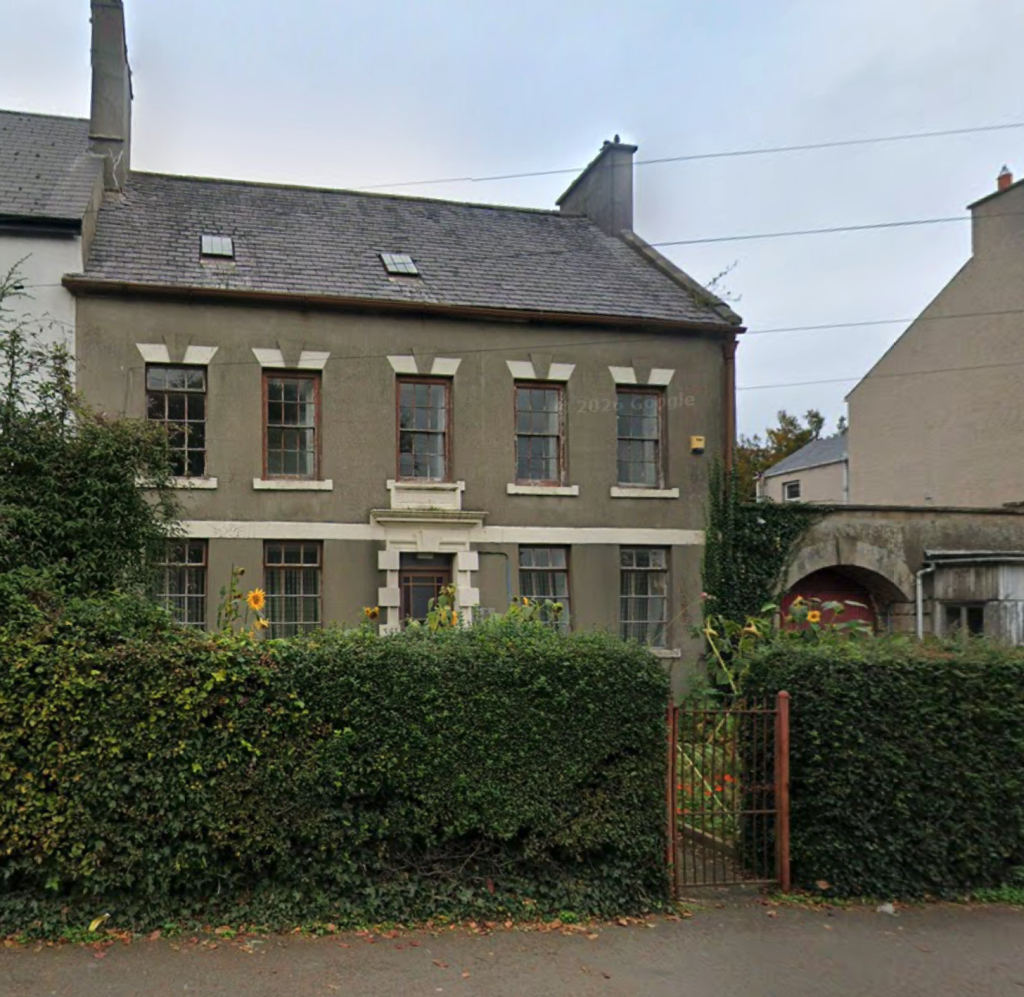
A possiblity as to why the move from Drumawillin to Anne Street in the town did not occur until Spring 1739, despite work on the harbour beginning earlier, may have been because by that date all of Hugh Boyd’s children had been married, except Daniel, who as touched upon previously was probably cared for by his parents. Firstly was William’s marriage to Mary Wilson c1733, then Margaret to Alexander McAuley c1735 and finally Leonora to Jackson Wray in 1738. All of these marriages and their associated settlements were very much typical of landed families of the time. Hugh’s daughter’s marriages would bring him much needed assistance from his sons-in-law and as we shall see they would prove vital as his trustees after his death.
On 31 January 1743/4 the Irish House of Commons received a detailed report from a committee setup by them for the purpose of examining the works of Hugh Boyd on the harbour and how he had used the monies granted him by parliament. It ran to over thirty one pages along with a report by Hugh Boyd himself. In conclusion:
“Upon the whole your Committee came to the following resolutions . Resolved, that it appears to this Committee, that Hugh Boyd, Esq; hath made an harbour in the bay of Ballycastle, sufficient to contain thirty ships, each of thirty tuns burden and upwards, and hath supplied all ships, which came to that port for coals, and delivered the same on ship – board at the rate of four shillings and six – pence a tun in pursuance of his contract .
Resolved, that it appears to this Committee, that the said Hugh Boyd hath expended in making the said harbour the sum of ten thousand pounds grant-ed him by Parliament , and also the further fum of two thousand five hun-dred and twenty-fix pounds out of his own private fortune .
Reſolved, that it is the opinion of this Committee, that the completing the harbour of Ballycastle, according to the plan laid before this Committee and annexed to this report, referred to therein, will render the said harbour more useful to the publick than it is at present, by encouraging the building of ships of large burden, by reducing the price of the freight of Ballycastle coals, and by promoting several other branches of trade in this kingdom”.
Some time, likely 1743-1750, Hugh Boyd built another residence for his family, closer still to the continuing works on the Harbour and convenient to his other businesses. It is still known to this day as the Boyd Manor House39 and was occupied, on and off, by his descendants until 1944.

A focus on legacy & a call to arms
By the 1750s Hugh Boyd was well into his middle age and we can only imagine the likely toll the energies he had deployed in his lifetimes endeavours thus far were taking on his health. In his 1743 publication and submission to the Irish House of Commons he wrote:
“My Fatigue during the first Summer of the Work [1737], added to the Cold and Wet, I could not well avoid exposing myself to, in turning the Rivers, were the Causes assigned for a violent Fever I fell into, in October 1738, which confined me to my Bed, for some Months; and to my House, for the most part, until the following Summer; and gave such a Shock to my Constitution, that I cannot say I have since enjoyed a Month’s Health, at any one time. A Dissorder in my Head and Stomach, to which I was a Stranger before, has confined me for the greatest Part of every Winter since my Fever: and even in my best Health, since that time, I feel such a general Weakness, as renders me incapable of my former Assiduity in Business of any kind.”
In the writings40 of Richard Pococke, who visited and apparently stayed with Hugh Boyd and his daughter Margaret McAuley at the Manor House in 1752, we get a glimpse of Ballycastle from an outsiders point of view. Allthough, as an english clergyman and member of the established church, his views came from a well-defined viewpoint for the time.
In 1752 Hugh Boyd began building what we know today as Holy Trinity Church in the diamond of Ballycastle. It would take another four years to complete and at a huge personal cost of £2,769 4s 71/2d.41 We can only wonder at his motivations for building the church. Some may feel it was nothing more than the fancy of a self-made man leaving a suitable physical epitaph to his life and works. Others that he was simply providing a possible replacement for the old parish church. But perhaps the main reason was his family’s history was closely associated with the established church, his father a Rector, his likely great grandfather a Registrant for the Diocese of Connor.
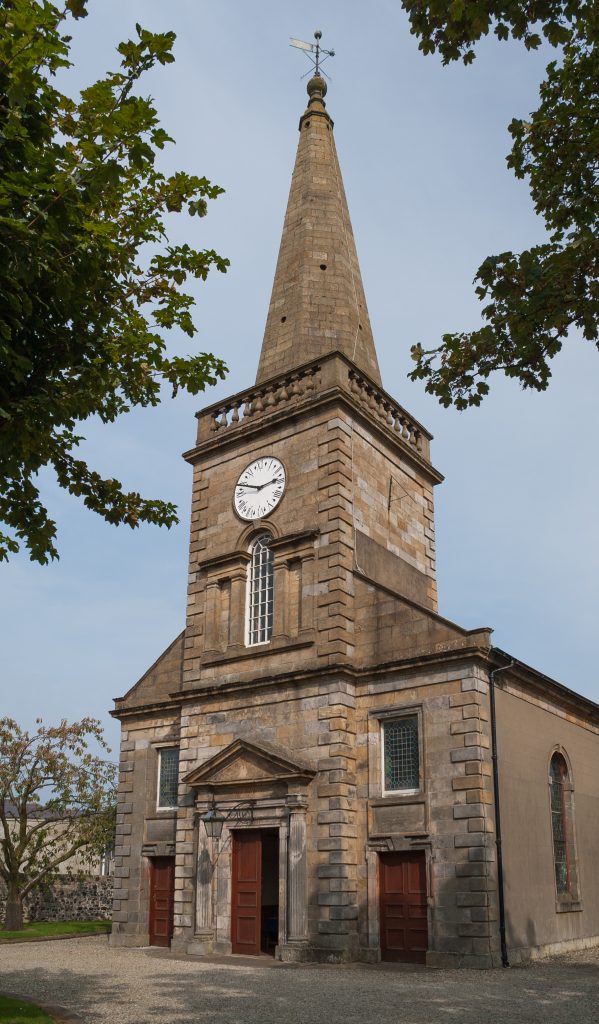
Many of the histories and articles written of Hugh Boyd include what appears to be his military rank i.e. that of Colonel, but little as to what his military connections, if any, were. The only reference we have found which seems to connect him to a military or more likely militia role dates to a piece in the Belfast News-Letter from 1760 (see below). It relates to the landing of french troops at Carrickfergus on 21 February 1760 under Captain François Thurot, during the Seven Years War. They soon captured the castle after a brief skirmish and having taken prisoners harassed the inhabitants of the town for supplies and bounty. The call soon went out for military aid for the town and many corps of Militia from counties Antrim and Down began to arrive in the town. Amongst these corps was 200 men from Ballycastle under Col. Hugh Boyd, the largest single corp from Co. Antrim who arrived on Monday 25 February. The incursion soon collapsed in a matter of days and the remaining french troops boarded their ships with the intention of further incursions or returning to France. However they were engaged by ships of the Royal Navy in the Irish Sea in what has been referred to as the Battle of Bishops Court resulting in the capture of the french fleet and the death of their Commander Thurot.

The final years
By the late 1750s Hugh Boyd’s health was almost certainly declining. However there was always the neccessity of planning prudent marriages for his grandchildren. On 8 October 1757 we find the marriage settlement42 of Hugh Boyd, second son of William Boyd, eldest son of Hugh Boyd to Mary Hill, youngest daughter of Rowley Hill formerly of Culmore, Co Londonderry, deceased. However the settlement also raises the issue that William Boyd, eldest son of Hugh Boyd is not party to his son’s marriage settlement. Unfortunately there is no explanantion for his absence given in the settlement. Then on 3 March 1758 we see an indenture43 relating to the marriage settlement of Alexander Boyd, “grandson and heir apparent to Hugh Boyd” and Anna Maria Acheson, eldest daughter of the Hon Sir Archibald Acheson, 6th Bt of Gosford44, Markethill, Co Armagh. The use of the term ‘heir apparent’ in the agreement would seem to be confirmation that William Boyd, eldest son of Hugh Boyd has previously died. When William Boyd died remains a mystery, indeed it appeared to have remained a mystery to his descendants also as when the family memorial was placed in Holy Tinity church in 1856 there are no dates against his name. Also in a record of those supposedly buried in the vaults of Holy Trinity and seen by Charlotte Violet Trench, his name is also absent. We must conclude therefore that William Boyd, eldest son of Hugh Boyd, died some time between 175545-57 and given the absence of exact dates it is possible he died at sea or abroad.
In 175546 Hugh Boyd built a Glass House on what is now known as Glass Island, which made wine bottles from 1760. The enterprise was relatively short-lived and likely lacked the energy of its creator following his death. Its giant conical structure rising to around ninety feet in height was instantly a landmark for anyone approaching the town and also no doubt for local shipping.

In 1757 Hugh Boyd published “An Account of the Collieries and Harbour at Bally-Castle, humbly addressed to the Hon. House of Commons of Ireland“47. He begins:
“As my Age, and a Constitution pretty much worn out, make it neccessary for me to retire from the great Hurry and Fatigue in which I have been engaged for 37 Years past to perfect the Works of the Collieries and Harbour at Bally-Castle, I think it my Duty to the Publick, who contributed to the Support and carrying on of same, to give an Account how far I have discharged the Trust they reposed in me, the good Ends that have been already answered by those Works, and the present State they are now in.”
On 16 April 176248 in the Irish House of Commons “Mr. Robert French reported from the Committee, appointed to inquire into the fate of the harbour and collieries of Ballycafle, the matter as it appeared to them, and the refolutions of the Committee thereupon..” The Committee heard submissions from Christopher Myers employed by Hugh Boyd on the harbour works since April 1760 and John Crawford of Ballycastle, Clerk of the Collieries following which a number of resolutions were made concluding with:
“10. Resolved, that it is the opinion of this Committee, that when the said harbour shall be effectually compleated, the said Hugh Boyd should be reimbursed his expences in repairing the same, provided they thall not exceed his estimate, and the sum resolved on in pursuance thereof, for the repairs of the said harbour, the last sessions of Parliament.”
Hugh Boyd’s Will and burial
According to Charlotte Violet Trench, Hugh Boyd made his last will and testament on 16 June 1762 with two codicils following on 7 December 1762 and then 8 June 1765. Unfortunately we have been unable to find a copy of the will to date and instead must rely on extracts as recorded by others, such as Charlotte Violet Trench and the late Danny McGill.
Hugh Boyd’s eldest son William had predeceased him and as such provision was made for his sons which we will come to shortly. In respect of his second son Daniel, provision was made by way of a maintenance bequest through the trustees and executors. As we mentioned earlier it is likely that Daniel had been born with some form of disability which left him unable to manage his affairs. Hugh Boyd’s sons-in-law, Alexander McAulay and Jackson Wray were appointed trustees and executors along with his eldest grandson Alexander Boyd.
Charlotte Trench says of the will:
“It was a very long and involved document, and provided for contingencies which might arise in generation after generation. A copy of a large part of this will is preserved in an Album, originally the property of Miss Kate Gage of Rathlin Island, now in the possession of Mrs. Campbell of Lisvarna, Ballycastle, who inherited the book and who kindly allowed me to make some extracts from it.”
Charlotte Trench also recorded the following extracts etc:
“In his will Colonel Boyd bequeathed to his son-in-law Jackson Wray two yearly sums, one of £40 and one of a third share of £100. Reference is also made to ‘my daughter Wray’; evidently settlements had been made for her on her marriage. A sum of £1,000 was bequeathed to ‘my grandson Hugh Wray’ when he is 21, with interest at 5 per cent. From the time of Hugh Boyd’s death ‘for his education’. By the second codicil of the will Jackson Wray Junior was left a tenth share in the Bottle House and Bonamargay lands.
It appears from Colonel Boyd’s will that he took a special interest in this grandson who bore his name. In his will Colonel Boyd says :
I give and bequeath to my grandson Hugh Wray the sum of £1,000, of the debt due to me by my son-in-law Alex McAulay, the same to be paid at his age of twenty-one years, with the interest thereof at £ 5 by the hundred towards his education from my death until the same shall become payable and if he dies before that age the interest thereof shall, from his death, go to the sole and separate use of his mother.“
Thanks to the late Danny McGill we have details of the provisions for Hugh Boyd’s grandsons, Alexander, Hugh and Ezekiel:
“Col’ Hugh Boyd willed:
to Alexander Boyd his grandson, the lands as follows, Clare, Dunameeny, Broombeg, Ballydurninand, Broomore the Great Park on Knocklead commonly called the Hill Park, Ballylig, Drumawillan, Tuckmiln, Ballycastle and also the Constableship and customs of all the fairs, Ballycastle, British Port, Altenanum. Drumnecross, Leland, Stroneshesk, Drumargy, Killcreg, Dunemallaght, and Drumnagonly, Druminney, Ballyveely, Carnsampsons, Carnduff, Carnemonn, Cregganboy, Machremore, Capecastle, Moyargits, Terylonskan, Cloghdunmurray, Toberbilly, Carnetlys Glestaghysin Parish of Ballintoy Ballykanvir Park Bunhancloney, Mullanghduff in Armoy, Drummons and all the fisheries from the western side of Glenstaghys to Fair Head excepted and to make leases of said lands of Ballycastle. British Port, Altenanum, Drumnecross, Leland, Stroneshesk, Drumargy, Killcreg, Dunemallaght and Drumnagonly,…and to make leases of plots to be built on in said town and lands of Ballycastle and British Port etc. …with or without covenants of renewal for ever…and every plot to be demised to be adjacent to a public street or Road in front and to extend in equal breadth from such street or road not more than 210 feet in depth end a yearly rent of not less than 1/- for every foot in front.. with clauses restrictions as were contained in the leases of tenements in the said town of Ballycastle theretofore execute by me..”
The remarkable clause above regarding future building in Hugh Boyd’s will is suggestive of his desire to influence the layout and development of the town of Ballycastle. An early form of town planning.
“to Hugh Boyd his grandson, ‘I give and devise all my woods in the parish of Culfeightrin… the lands of Doonard (containing the sub-denomination of Dooncross, Coolenlogh, Dirveelin, Gregfadd end twenty acres and also the south half quarter of Ballyverridy and the lands of Ferrinmacarther and Egloe thereunto adjoining and also the lands of Broughanlea situate in the parish of Culfeightrin and County of Antrim… is by the said Joseph Bovd’s marriage settlement limited to me and my heirs and whereas a dry stone wall is lately begun on the lands of Bonamargy… the same is intended to extend in a straight line from the sea coast or strand to the Bonamargy river. Now I do give and devise all the lands hereinbefore mentioned… to the said Hugh Boyd…all my coolieries and salt-works subject to the rights and interest of thomas Bourgh (decsd).
Moss-side mill etc to E D Boyd (after refusing glasshouse etc).
Glass-works shared into ten shares, four to maintain the harbour, remainder shared out in ones to grandchildren. (26th July Col Hugh Boyd agreed to maintain the harbour for twenty-one years on receiving payment from the public purse for repairs carried out. Boyd died June 1765.)
‘rents issues and profits of the glasshouse to be split into tenshares. four towards maintenance through the trustees:- Alexander McAulay, Jackson Wray, and his grandson Alexander Boyd, one to grandson Hugh, one to grandson Ezekiel Boyd’s son Hugh, one to grandson Daniel Boyd, one to grandson Hugh McAulay, one to grandson Jackson Wray, and one to grand-daughter Charlotte.”
The codicil of 7 December 1762 made provision for the future of Holy Trinity Church and charitable housing as follows49:
“Codicil to the Will of Hugh Boyd Esquire made 7th day Decr 1762 (under which Ballycastle Church is endowed. I Hugh Boyd of Ballycastle in the County of Antrim do make this codicil to ‘my last will & testament bearing date the day next before the date hereof. I give & devise the lands of Carnside & Ballylinney with the appurtenances situate in the parish of Billy & County of Antrim aforesaid unto the Most Reverend the Lord Bishop of Armagh, the Right Rev. the Lord Bishop of Down & Connor & the Chancellor of the Cathedral of Connor & their successors for ever upon trust that the yearly Rents & profits thereof shall be applied in manner following that is to say a yearly sum of £40 to be applied in maintaining constant divine service in the new church or chapple of Ballycastle in the parish of Ramoan & county aforesaid, & £10 yearly for repairs thereof & for salaries for a clerk & sexton for the same until it be made a Parish Church, & from thenceforth a yearly sum of £50 to be applied in maintaining constant Divine service therein for ever. Provided always that the said yearly sum of £40 or £50 shall not be paid by the said Trustees to any person other than an officiating minister nominated by me in my lifetime) or by my grandson Alexander Boyd after my death (or by the person who for the time being shall be seized of the imediate estate of Freehold of & in the lands of Ballycastle aforesaid.
And whereas I am seized in fee of an acre of ground around the site of the said new church or chapple the same being reserved to me & my heirs by my grandson Alexander Boyd’s marriage settlement. Now my will is that the surplus profits of the lands & premises hereinbefore devised shall be disposed of in building twenty houses within said acre of ground as near the said new church or chapple as conveniently may be for reception of 20 superannuated or disabled men employed for seven years next before their reception in the business of the Ballycastle Collieries or Glass House or widows of men who for seven years next before their respective deaths were so employed or superannuated or disabled seamen employed as mariners tor seven years next before their respective reception by merchants resident in the town of Ballycastle aforesaid or widows of men who for seven years next before their respective deaths were so employed so as no more than one person falling under same or one of the description aforesaid be received into one house. The residue of the said acre to be laid out in gardens for the said houses respectively & when the said houses are built the surplus profits of the premises shall be equally divided among the persons who for the time being shall respectively inhabit the said Houses & shall have been received therein as proper objects of this charity such persons to be chosen & received by the said Trustees with the consent & approbation of my said grandson Alexander Boyd during his life & afterwards with the consent & approbation of the person who for the time being shall be seized of the imediate estate of freehold of & in the lands of Ballycastle aforesaid. In witness wherereof I have hereunto subscribed my name & affixed my seal confirming my said will this 7th day of December in the year 1762.
Hugh Boyd. Seal.
Witnesses
George Dunlope
John Boyd
John Ray.”
The houses referred to in the codicil above were subsequently built probably c1763 and became known as ‘Poor Row’. They are now long gone and part of the car park at the Co-op in the town. However a sketch made in 1850 was included in an article50 by Francis Joseph Bigger in the Ulster Journal of Archaeology. The sketch, said to by Joseph Huband Smith (1801–1886), shows the ruins of the McDonnell castle as viewed from the railway station along Poor Row.

Sadly the houses in Poor Row appear to have been badly maintained over the years and frequently appeared in reports by public health officials regarding the level of delapidation and sanitary issues. Hugh Boyd had left through his will a legacy and trustees to administer a charity regarding the properties and it would seem on the face of it that any problems lay with the trustees. However in 1908 an issue arose which suggested a much more confusing state of affairs:

With three of his grandsons successfully married and a large and detailed will prepared with codicils it would seem Hugh Boyd felt his work was done and he could do no more. He died on 15 June 1765 aged 75 probably at the Manor House, now on Quay Road, Ballycastle, Co Antrim. A fitting obituary was published in the Belfast News-Letter on its front page:

It would be some days before arrangements were completed for his burial which would be in the church he had recently built in the diamond of Ballycastle. On Sunday 23 June 1765 in an extraordinary day which saw not only his burial but consecration of his church, the events were recorded and published a few days later in the Belfast News-Letter:

Hugh Boyd’s widow Anne would live on many more years before her own death on 21 March 1776, said to be in her 91st year. Notice of her death was also published in the Belfast News-Letter:

Hugh Boyd, his wife Anne and son Daniel are buried in the First or East Vault of Holy Trinity Church. Alongside them is their grandson Ezekiel Davys Boyd (I) (d.1801) and great Grandsons Hugh Boyd (d.1795) and John Cuppage (d.1798).

- Belfast News-Letter – 25 June 1765, p.1 ↩︎
- Ordnance Survey memoirs of Ireland – Parishes of County Antrim IX 1830-2, 1835, 1838-9, p.30 – see also QUB Report ↩︎
- Clergy of Connor, Canon J B Leslie, (1993 Ed.), p.615 ↩︎
- History of the Irish Parliament 1692-1800, (2002) Vol III, p.232 ↩︎
- Alumni Dublinenses – 1924, p.87 ↩︎
- PRONI Ref. D2977/3A/2/1/22 ↩︎
- The Glynns Vo.30 (2002) – 1690 and the McNeills of Clare Castle by D J McGill B.Sc., p.136 ↩︎
- Col. Hugh Boyd’s Ballycastle (2007) – Causeway Museum Service – ISBN 0-9552286-3-8, ISBN 978-0-9552286-3-6 ↩︎
- A Genealogical and Heraldic Dictionary of the Landed Gentry of Great Britain and Ireland by Sir Bernard Burke, Ulster King of Arms, Part I (1862), p.140 ↩︎
- Irish Deed Memorial No. 69652 – 18 October 1733 ↩︎
- https://artuk.org/discover/artworks/ezekiel-davys-wilson-168253 ↩︎
- PRONI Ref. D2977/3A/2/1/11A ↩︎
- PRONI Ref. D2977/3A/2/1/11B ↩︎
- PRONI Ref. D2977/3A/2/1/27A ↩︎
- The Glynns Vol. 35 (2007) – Ballycastle Collieries and Salt Works Lease 1720-1735 ↩︎
- PRONI Ref. D2977/3A/2/36/2A ↩︎
- See ‘Personal financial management in early eighteenth-century Ireland: practices, participants
and outcomes’, Brendan Twomey (TCD 2018), pp.59-60 ↩︎ - History of the Irish Parliament 1692-1800, (2002) Vol VI, p.344 ↩︎
- Ibid, p.355 ↩︎
- PRONI Ref. MIC500/8 sub ref D562/1191 ↩︎
- Col. Hugh Boyd’s Ballycastle (2007) – Causeway Museum Service – ISBN 0-9552286-3-8, ISBN 978-0-9552286-3-6 ↩︎
- See Ayrshire Archaeological and Natural History Society – ‘The finest Place for a Lasting Colliery, Coal Mining Enterprise in Ayrshire c1600-1840, C. A. Whatley p.68 ↩︎
- See note 15 ↩︎
- Partner with William McGwire in the Bank of ‘Nuttall & McGuire’ – see Journal of the Cork Historical and Archaeological Society 1894 Vol.3, pp.55-56. ↩︎
- Three Hundred Years in Inishowen etc…, Amy Isobel Young (2018 Ed.), p.293 ↩︎
- PRONI Ref. D4164/A/22, pp.5484-5487 ↩︎
- Ibid. T1703/1 ↩︎
- Ibid. D2977/5/1/5/31 ↩︎
- The Wrays of Donegal Londonderry and Antrim by Charlotte Violet Trench, (Oxford. 1945), pp.249-250 ↩︎
- Ibid, p.262 ↩︎
- History of the Irish Parliament 1692-1800, (2002) Vol V, p.162 – See also record in Find a Grave ↩︎
- Find a Grave ↩︎
- PRONI Ref. D2977/3A/2/1/32 see also Irish Deed Memorial No. 57271 ↩︎
- The Glynns Vol. 35 (2007) – Ballycastle Collieries and Salt Works Lease 1720-1735 ↩︎
- Irish Deed Memorial No. 67705 ↩︎
- PRONI Ref. D2977/3A/2/36/3A ↩︎
- Ibid D2977/3A/2/29/1 ↩︎
- Col. Hugh Boyd’s Ballycastle (2007) – Causeway Museum Service – ISBN 0-9552286-3-8, ISBN 978-0-9552286-3-6 ↩︎
- https://apps.communities-ni.gov.uk/Buildings/buildview.aspx?id=7083&js=false ↩︎
- Pococke’s tour in Ireland in 1752 by Richard Pococke and edited by George T Stokes DD MRIA (1891) ↩︎
- Col. Hugh Boyd’s Ballycastle (2007) – Causeway Museum Service – ISBN 0-9552286-3-8, ISBN 978-0-9552286-3-6 ↩︎
- PRONI Ref. D642/E/16 ↩︎
- Irish Deed Memorial No. 127502 ↩︎
- History of the Irish Parliament 1692-1800, (2002) Vol III, p.49 ↩︎
- See Irish Deed Memorial Nos. 118008 & 118009 ↩︎
- Col. Hugh Boyd’s Ballycastle (2007) – Causeway Museum Service – ISBN 0-9552286-3-8, ISBN 978-0-9552286-3-6 ↩︎
- PRONI Ref. MIC500/8 sub ref. D562/1185 ↩︎
- Journals of the House of Commons of the Kingdom of Ireland v.12 1761-62 ↩︎
- Ibid Ref. T1049/1 ↩︎
- Bigger, Francis Joseph. “The Bally Castle, Country Antrim.” Ulster Journal of Archaeology, vol. 8, no. 1, 1902, pp. 7–9. JSTOR, http://www.jstor.org/stable/80000274. Accessed 30 July 2026. ↩︎