In Derrykeighan Old graveyard near Dervock, Co Antrim lies the family burial ground of James Camack of Dervock, Surgeon and a number of his descendants, the last of whom recorded on the associated headstone is the subject of our post.
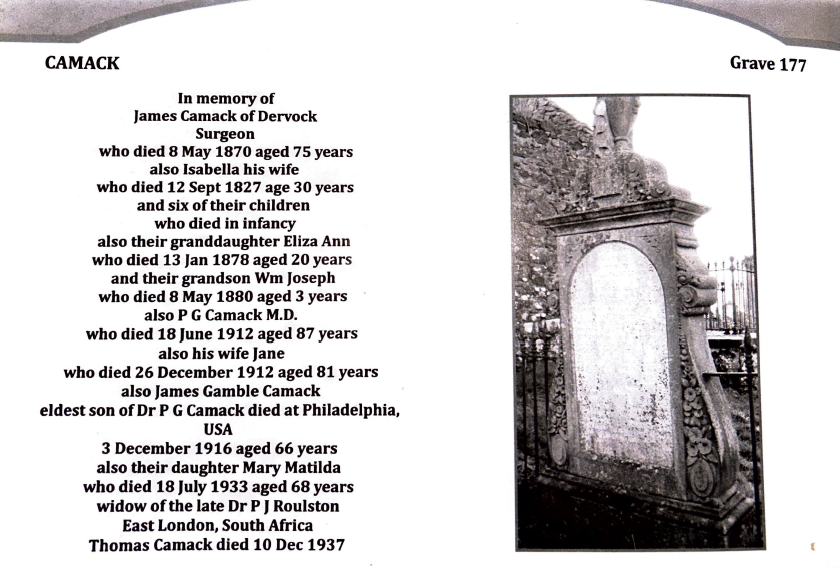
For many with a lengthy family history in Ireland much is usually drawn from the family name. Clues abound in it’s spelling, how its pronounced and of course where the family lived/live. The name Camack/Camac/Camock/Camoke/Cammock/Cammocke is one of those names that force us to work a little harder. Perhaps it sounds a little scottish. Does it have a meaning in Irish/Gaelic? Could it even be Huguenot? The answer we will find is wrather more surprising.
The basis for this investigation are two wonderful publications, firstly ‘Memoirs of the Camacs of Co Down etc.’ edited by Frank Owen Fisher (1897) and ‘Memoirs of the Camacs of Co Down etc’ by William Masters Camac, privately printed in Philadelphia, USA in 1913. However we have undertaken our own research to coroborate or add to those contained in the books as well as seeking additional sources. Our journey begins with the likely oldest known ancestor of Thomas Camac and it is to England that we look.
John Camoke (I) (c1425-81) of Essex, England
The earliest identifiable ancestor of the family is John Camoke, known by his Will1, which was proved in 1481. Unfortunately the evidence survives as an index entry recorded by the distinguished F G Emmison (County Archivist for Essex 1938-69), for the British Record Society.
John Camoke (II) (c1450-1513) of Fayre Elmes, St. Giles, Colchester, Essex, England
It is likely he was a son of the John Camoke above. We know him by his Will dated 24 January 1514/5, a registered copy of which is kept in the Essex Record Office.2 From this John there were three surviving children, Nicholas, William and a daughter Alice (who married an unknown Damyon). A transcript of his Will is detailed below:
“Testmt John gannok Camoke
et pachia Sancti Gylii [of the parish of St Giles]
In dei nomine Amen the xxiiij day of January in the yer of our lorde god ye mccccc xiij. I John Camoke Dwellyng at fayrelmes in the parish of Saynt Gylis in Colchestr beyng in hole mynde make this my testament and laste will. ffirst I bequeth my sowle to almyghti god & to all the holy company of hevyn & my body to be buried in the parish church yard of Saynt Gylis a forsaid. Also I bequeth to the hie Altr for my tithes forgot a weder [castrated] shepe [sheep]. Item I bequeth to the church of Saynt Gylis for to kype an obet [A religious service or endowment established to pray for the soul of the departed on the anniversary of their death] yerly Duryng the worlde in the weke [period of prayer] a forsd at the Purificacion of our lady [Feast of the Purification of Our Lady (Candlemas, February 2)] for my sowle, my wiffes sowle & all ****** ******* & for to be prayed for in the bedrolle [list of names of people to be remembered and prayed for, especially by a religious community or chantry priest] ij kyne [cows] pc xxs viij Twe shepe prc xs to be at the lettyng or kypyng of the church warden in the parish of Saynt Gylis and myn obet to be kept undre this maner & forme. The Curate to have for bedrole [prayers] xijd dirige [solemn service and chant of lamentation for a deceased person] & light xijd the Clarke for the knell ryngyng & dirige vjd the sextyn for the herse [decorative framework, canopy, or temporary wooden/metal monument erected over a coffin or tomb during funeral service] ijd the church wardens for my mase peny & for ther labur to see this myn obet kept ixd the residue of the profits of myn obet left to go to the Reparacion of the church. I bequeth to the wedowe brokshawe ij shepe. Item to Mawde my servaunt ij shepe. Item I will by licens of the lorde my ij tenementes lying at Fayr Elmes be solde by myn executors & the mony thereof comyng to be spendid bytwixt my iij Childern that is William Cammok, Nicholas Camoke and Alis Damyon This many befor rehershed with all other my goodes meveabilles & imeveabilles I bequeth to myn executors whome y orden & make Nicholas Camoke & Kathryn buktan wedowe and this maner of forme thei to buryng my body in ye erth to kype my monyth day to pay my dettes & to prove my will & all other charges thereto belongyng. The Residue of my goodys be left I will thei shal be Devided equally bytwyxt my iij childern a fore rehershed by the handes of myn executors and dane John Colgest Curate of Saynt Gylis whome y make supervisor to see this my will to be fulfylled berys witness of this said will John bukton John leche & John Shepherd
Johannes Cammock
pochie sancti E gidij
ccxxij”
Nicholas Camock (c1475-c1529) of St Giles, Colchester, Essex, England
Frank Owen Fisher says of Nicholas Camock, “eldest son of John Camoke” (II), above:
“Nicholas Camock is thought to have left a widow, named Elizabeth (Const. Linc. 1530, f. 316b) , and three sons, viz .: John of Layer Marney, Robert of Billinghay, and Roland of Tattershall. The last occurs in the will of his mother, and his son and grandson are known to have been related to the Billinghay and Layer Marney Camocks.”
John Camock (III) (c1497-c1546) of Layer Marney, Essex, England
Son of Nicholas Camock, he is recorded in the visitation of Essex in 1612 by John Raven, Richmond Herald (1597-1615) who records the Camocke Arms as “Quarterly or and gules, a cross ermine” and he identifies the son and heir of John Camock (III) as Robert Camock of Layer Marney, Essex, England.
Robert Cammocke (c1518-85) of Layer Marney, Essex, England
Robert Camock, son of John Camock (III) above, he is the first of the family were we have substantive evidence. We first find him mentioned in the Deeds of the manor of Baynard and other properties in Messing on 4 November 1545.3
“Sale by Charles Tuke of Laer Marney, esquire, to Robert Cammock of the same, yeoman, of messuage, lands, etc., called Vin’s in Messing, Wigborough, or Laer Marney, in occupation of Robert March, and also lands called Dawbes and Patts, sometime called Widdowe Lands, parcel of Dewbes and Pratts, in the occupation of the said Cammock.”
Then on 12 September 1569 we find him the victim of theft in the following4:
“Indictment: John Grene of Colchester, butcher, and John Castell of London, butcher, for breaking into the close called Howghefeld of Robert Cammocke of Layre Marlye [Layer Marney], gentleman, at the same, and for taking away 21 ewes worth £4 belonging to William Reynoldes alias Smythe of Maldon, butcher.
A true bill. By copy.”
Philip Morant recorded5 the family’s property in the Winstree Hundred, Essex:
“Camocks, is another capital messuage and large brick house, in this parish, so named from its ancient owners the Camock family.”
We know he was married at least twice, firstly to Elizabeth Badbye and secondly to Mary Everton. A set of brass memorials is located in St Mary the Virgin Church, Layer Marney, Essex, England which record Robert Camock and his two wives:
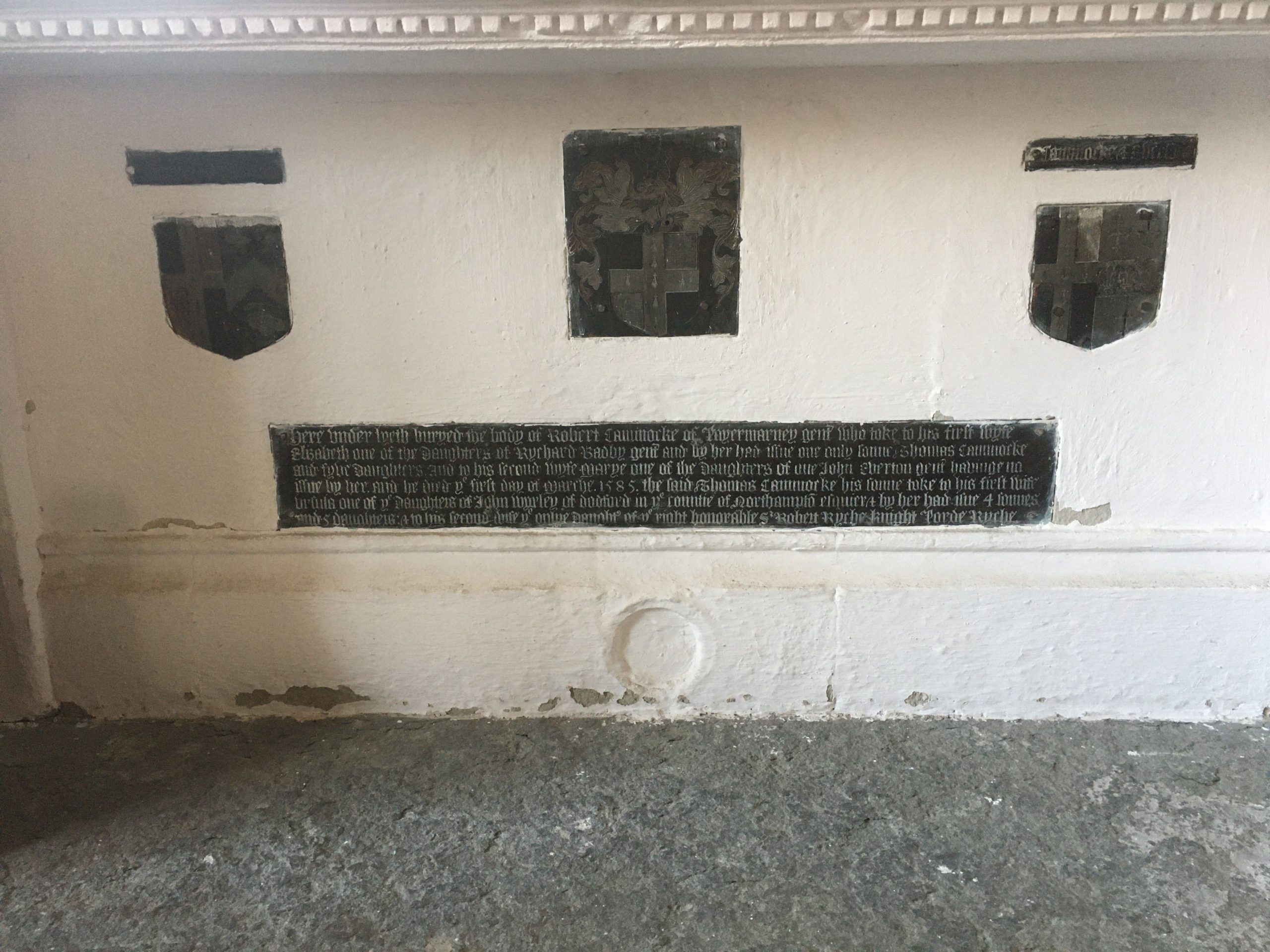
The memorial brasses above are typical of the time period and record the arms of the persons involved as well as an epitaph. Centre are the arms of Camock, to the left the impaled arms of Camock and Badby topped Cammocke & Badby and to the right the impaled arms of Camock and Everton topped Cammocke & Everton. The inscription is as follows:
“Here under lyeth buryed the body of Robert Cammocke of Layermarney gent who tuke to his first wife | Elizabeth one of the daughters of Richard Badby gent and by her had the one only sonne Thomas Cammocke | and fyve daughters and to his second wyfe Marye one of the daughters of one John Everton gent having no | issue by her and he died ye first day of Marche 1585 the said Thomas Cammocke his sonne tuke to his first wife | Ursula one of ye daughters of John Wyrley of dodford in ye countie of Northampton esquire & by her had issue 4 sonnes | and 5 daughters & to his second wife ye onlye daughter of ye Right Honorable Robert Ryche Knight Lorde Ryche”
Robert Cammocke had previously made a Will on 29 January 1582/3 which was lodged and proved in the Prerogative Court of Canterbury on 5 March 1585/6.6 A transcript of the Will was made by Mary Gregg and placed online here along with other genealogical information on the Camock family.
Capt. Thomas Cammocke (c1540-1602) of Maldon, Essex, England
As mentioned previously, Thomas Cammocke is identified as the son of Robert Cammocke on the memorial brass to his father in St Mary the Virgin Church, Layer Marney, Essex. However he is more directly commemorated on a much larger and more ornate memorial in All Saints Parish Church, Maldon, Essex, England.
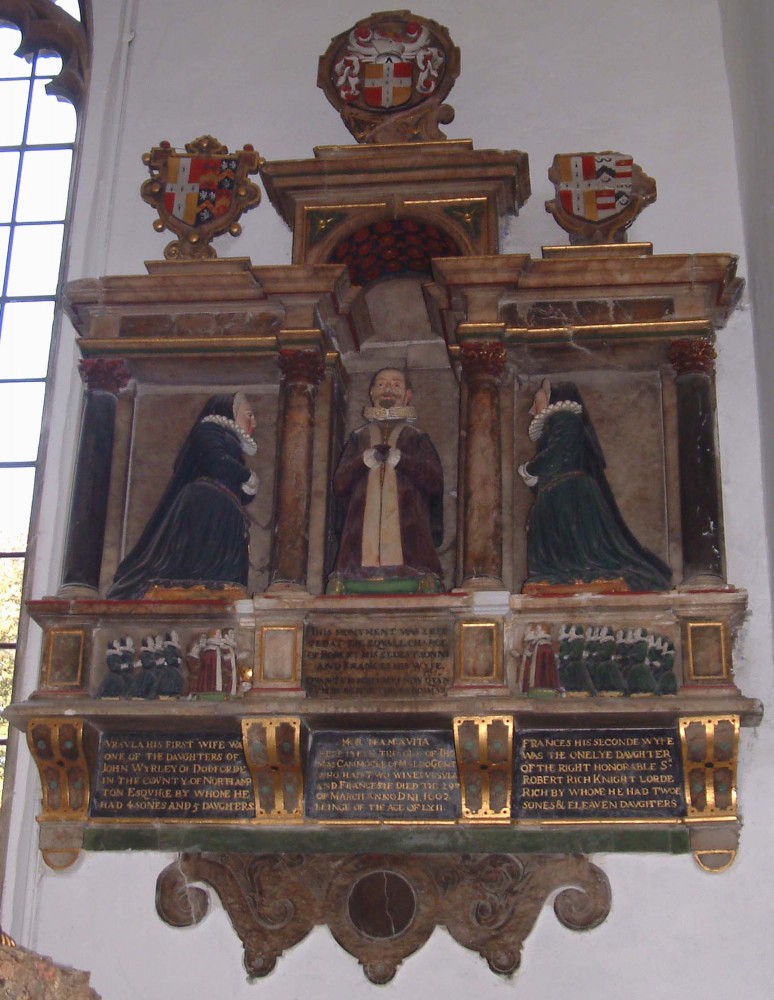
in All Saints Parish Church, Maldon, Essex, England
The above memorial is again typical of the period but for a person of greater social standing than Robert Cammocke which we shall see is explained by his second marriage. The memorial shows Thomas Cammocke center with his first wife, Ursula Wyrley, on the left and second wife, Frances Rich, on the right. Beneath the images of his wives are panels depicting the children of each of the marriages. A transcription of the panels containing text is as follows:
THIS MONVMENT WAS EREC
TED AT THE EQVAL CHARGE
OF ROBERT HIS ELDEST SONNE
AND FRANCES HIS WYFE
QVANTUM POSSVMVS NON QVAN
TVM DEBEMVS TIBI REDDIMVS
| VRSVLA HIS FIRST WIFE WAS ONE OF THE DAVGHTERS OF JOHN WYRLEY OF DODFORDE IN THE COVNTY OF NORTHAMP TON ESQVIRE BY WHOME HE HAD 4 SONES AND 5 DAVGHTERS | MORS MEA MEA VITA HERE LYETH THE BODY OF THO MAS CAMMOCKE OF MALDON GENT WHO HAD TWO WYVES VRSVLA AND FRANCES HE DIED THE 29TH OF MARCH ANNO DNI. 1602 BEINGE OF THE AGE OF LXII | FRANCES HIS SECONDE WYFE WAS THE ONELYE DAVGHTER OF THE RIGHT HONORABLE SR ROBERT RICH KNIGHT LORDE RICH BY WHOME HE HAD TWOE SONES & ELEAVEN DAVGHTERS |
There are a number sources relating to Thomas Cammocke but we will record perhaps two of the more interesting ones. Firstly in relation to him providing a piped water supply to the town of Maldon, Essex in October 1587.7 We are indebted to local Maldon historian and author Stephen P Nunn for his article on Thomas Cammocke which states regarding the water supply:
“he paid for Maldon’s very first convenient water supply – piped in a 600 yards lead conduit from his well in Beeleigh Road (the ‘Crom’ or ‘St. Helen’s Well’) to a pump on St. Helen’s Lane (now Cromwell
Hill).”
But secondly perhaps the most remarkable story surrounding Thomas Cammocke is how he and second wife Frances Rich came to be together. It is the stuff of local legend. After the death of Thomas’ first wife Ursula c1584 he went to work amongst the retinue of Lord Rich, 3rd Baron Rich (later 1st Earl of Warwick) at Rocheford Hall. Whilst in Lord Rich’s employ he became involved with his sister Frances and one night it is said they eloped and in a night of appalling weather they crossed a raging local river on horseback to evade detection and capture. The story continues that Frances’ brother was so moved by the obvious love the couple had for each other that he agreed to their marriage. Regardless of the validity of the romantic back story the couple did marry and go on to have thirteen children together.
A later connection to Ireland may have come through the Rich family as Frances’ father, Lord Robert Rich 2nd Baron Rich, had accompanied Walter Devereux 1st Earl of Essex to Ireland on his ill-fated mission to north east Ulster. This was effectively a private mission, though royally sanctioned and supported by William Cecil Lord Burleigh. It was an attempt to control and colonise north east Ulster and prevent incursion by scottish interests in Ireland.
On 17 July 1573 we find mention8 of Lord Riche’s armour being laden for sending to Ireland along with his kinsman Barnaby. A Devereux descendant Walter Bourchier Devereux (1810-1868) recorded9 the near disastrous start to the mission:
“Lords Rich and Darcy, and many knights and gentlemen, with a large number of followers, accompanied the Earl of Essex as volunteers. They embarked at Liverpool on the 16th August, 1573, with a fair wind and promise of a favourable passage, which soon changed; heavy gales followed, the fleet was dispersed and shattered ; and, after undergoing considerable danger, the vessel which bore the Earl of Essex fetched Copeman’s Island, near the mouth of Belfast Lough, whence he reached Knockfergus in safety. Lord Rich landed at Castle Kilcliffe [Kilclief], whence he was conducted by Captain Malbie with a guard to Inch Abbey, and thence to Knockfergus. The rest of the company were scattered along the coast, some, as Essex was informed, being driven to Cork.”
Richard Bagwell records10 the intended allocation of lands in Ulster to the Crown and participants as follows:
“Some of the land between Belfast Lough and Lough Neagh may have been destined as a reserve for the O’Neills. An extant paper shows how it was proposed to quarter the gentlemen adventurers, and what was kept for the Queen and the Earl: —
Glenarm, Will. Morgan of Pencoed; Red Bay, Lord Rich; Bunneygal (?), H. Knollys; Market-town (Ballycastle), several; Kenbane Castle, not appointed; Dunseverick, Mr. Champernowne; Dunluce, Mr. Kelway; Portrush, Mr. Fitton; Coleraine, the Queen; James MacHenry’s cranogue at Innisloughan, reserved to keep the ford of the Bann; Ballymoney, Mr. Bourchier; Brian Carragh’s cranogue on the Bann, reserved for the ford; Castle Toome, Geo. Carleton; Massereene, not assigned; Belfast, the Queen; the bottom beneath the cave having two little piles, Messrs. Barkley and Brunker; Carrickfergus, the Queen; Magee’s Island and the mouth across, the Queen; Olderfleet (Larne), the Queen.
NB – In the R.O., calendared under Dec. 1574 (No. 81), is the paper above quoted, which shows how complete a division of Antrim among the colonists was really intended .”
It would seem Lord Rich had decided at an early point that either the mission was doomed to failure or not worth risking his life over as he soon found an opportunity to carry dispatches from the Earl of Essex to England and never returned. However another of Essex’s company, Ralphe Bourchier (4th cousin once removed) was determined to see the campaign through and for a brief period may have actually stood on the land at Ballymoney, Co Antrim that had been allotted to him. However long term occupation was not to be and the mission, which was remarkable for its savagery and violence, ended in failure. Walter Devereux, 1st Earl of Essex died in Dublin on 22 September 1576. Some say he was poisoned.
With the death of Walter Devereux, 1st Earl of Essex he left a widow, Lettice Knollys and children Dorothy (later Lady Perrot), Robert, 2nd Earl of Essex and Penelope. In 1580 Penelope married Robert, 3rd Lord Rich, brother of Frances later wife (1584) to Capt. Thomas Cammocke. According to Frank Owen Fisher, Thomas Cammocke went to work for the household of Penelope, Lady Rich, around this time and following the death of his first wife Ursula Wyrley. Penelope would later become involved in a famous love triangle (1590) with her husband and Charles Blount, later Lord Mountjoy. Mountjoy of course would be known for his later success in the ‘Nine Years War in Ireland‘ against Hugh O’Neill, Earl of Tyrone.
Its not known if Capt. Thomas Cammocke actually served in Ireland but his service to the Rich family and by marriage the Devereuxs certainly presented opportunities and Ireland was likely a regular subject of interest among these families for many years.
George Cammocke (c1574-1610) of Layer Bretton, Essex, England & Ballymoney, Co Antrim, Ireland
With the death of Capt. Thomas Cammocke in 1602 his widow Francis née Rich would assume responsibility for the younger children still living from Thomas’ first marriage. However by 1602 George Cammocke was then around 18 and probably being introduced to the responsibilities of his fathers’ estates etc. With the death of his mother Ursula Wyrley c1583 his step mother Frances would have assumed a greater role in his life so there is little surprise that he and his half brother Sussex Cammocke would become involved in Irish affairs later. However he appears to have had time to setup his domestic affairs in the village of Layer Bretton with a farm held under lease from his elder brother Robert (1573-1631) of Layer Marney. It is thought he married11 a woman called Marie/Mary but her surname has remained elusive. Subsidy records would seem to indicate George Cammocke paid subsidy on his lands 1596/7.12 Again we find from the Close Roll of James I (10th) that George Cammocke had died by 1612/13.13
Sadly we have no specific information regarding George Cammocke’s time in Ireland. However in the boundary wall of the old parish burying ground of Ballymoney, Co Antrim we find a badly eroded gravestone. The writers of the two Memoirs of the Camacs of Co Down state that the inscription on the gravestone was as follows:
(Coat of Arms)
Here lies
body of
…..Cammocke
who
departed ……
1610
Although the stone is still visible in the same location today it appears nothing remains of the above inscription and if anything someone has carved, in a more modern font, “CAMAC 1610” which interestingly is a common spelling of the name locally since the eighteenth century.
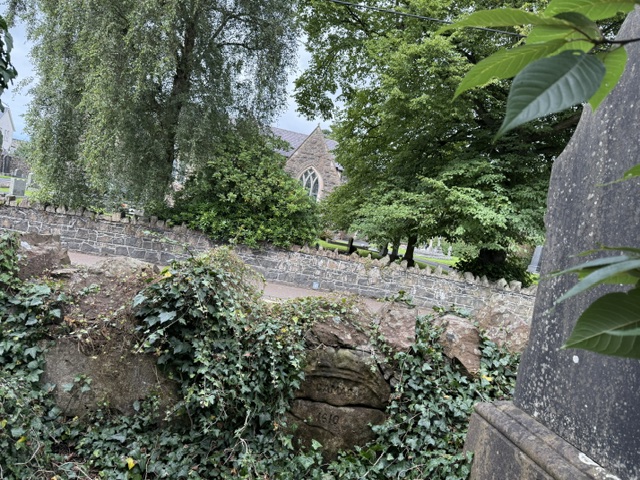 | 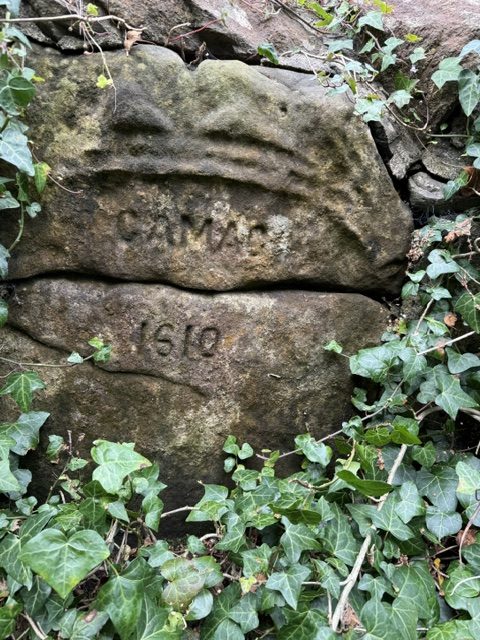 |
| Images courtesy of Kate Connolly, Ballymoney |
James Camock (b.c1600->1641) of Holywood parish, Co Down and Killagan parish, Co Antrim
The authors of the memoirs stated he is one of three sons born to George Cammocke (d.1610) but they were unable to name him. Unfortunately the time period of this member of the family concided with the 1641 rebellion. However the discovery of a James Gamock in a partial rental of the Earl of Antrim’s estate dating to May 164114 is intruiging. Closer examination of the rental entry reveals more information:
“Stroan Millis – James Gamock yeoman holds this parcel of land, being a 1/4 of a great Towne from Gowen Kellsay. The same containinge of Arable ? and pasture – 180 acres. Moss 6 acres in all – 286 acres etc.”
The name of the location for the lease ‘Stroan Millis’ is problematic but adjoining entries suggest it was most likely in Killagan parish, Co Antrim, perhaps where the village of Cloughmills is located today. Gowen Kellsay was also a chief tenant of the Earl of Antrim in the neighbouring townlands of Ballyligg and Culcrum, Killagan parish. Killagan is a small parish lying to the south east of Ballymoney and adjacent to the village of Cloughmills.
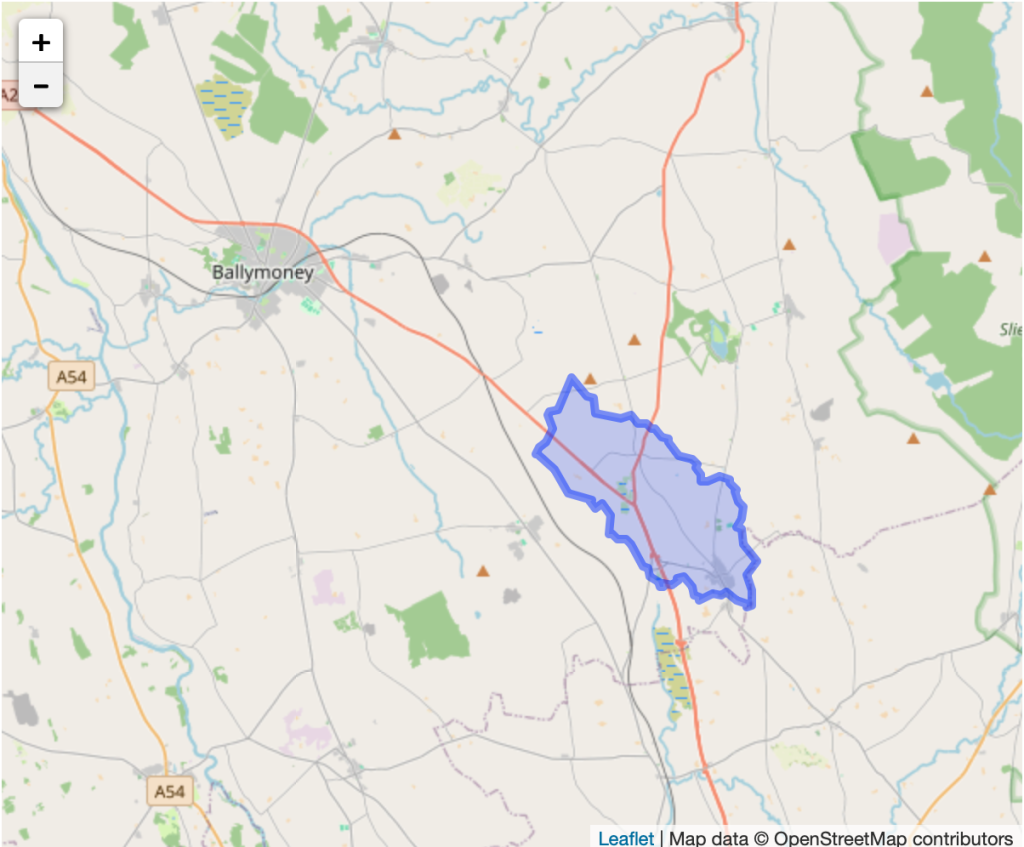
The chief tenant in the Gamock lease, Gowen Kellsay, is most likely the person identified in taking a lease in the Haberdashers lands, Co Londonderry from Sir Robert MacClelland of Bombie, Kircudbrightshire, Scotland in 1617.15 In that transaction he is referred to as “Gawin Kelso in Holywood in Irland“. In an old Rootsweb article which details the history of the Kellsay family we find a reference to this same lease. In the same year on 28 November 1617 we find a grant of denization to a Thomas Kelsoe of Ballihacamer (Ballyhackamore, Holywood Parish, Co Down). It is not unreasonable to suggest these two men are related. A look amongst the indexes of the National Records for Scotland reveals the following entry16 dating to 12 April 1576:
“Charter by John Kelso of (Nether) Kelsoland to (his cousin) Donald Kelso Captain of the Isle of Rachry [Rathlin] in Ireland ?(Rattry) of an annualrent of 12 merks, payable from the 5 merkland of Nether Kelsoland, lying in the Lordship of Largs. Witnesses John Boyle of Baledwin [prob. Ballykewan, Great Cumbrae Island], George Montgomerie brother german of Robert Montgomerie of Skelmorlie and (“germanus meus”) Thomas Kelso. At Kelsoland.”
Interestingly two of the families mentioned in this charter i.e. the Montgomeries of Skelmorlie, Ayrshire and the Boyles of Ballykewan, Great Cumbrae Island, Ayrshire both married into the Boyds of Portencross and on the same denization list for 1617 mentioned above was Archibald Boyd of Carncullagh, Co Antrim, son of Archibald, 5th Laird of Portencross. One possibility is that Thomas Kelso was the senior of the two men and Gavin possibly his son both being of the Kelso family of Kelsoland in Largs, Ayrshire, Scotland.
A look in the Ulster Muster Roll of 1630 finds Gawen Kelsa17 the first entry of the muster on the estate of Sir Robert Macclelan, chief tenant to the company of Haberdashers with a sword and pike. Also in the Muster of 1630 is a James Cammock18 who mustered on the estate of the the Lord Viscount Ards in Co. Down with no arms. One possible explanation from this information is that James Cammock originally resided on the Viscount Ards estate in 1630. Between 1617-41, Gawen Kelso/Kelsa/Kellsay leased property in Killagan Parish, Co Antrim from the Earl of Antrim. James Cammock then came to reside on one of these properties (Stroan Mills) as a sub tenant of Gawen Kelso/Kelsa/Kellsay. Wonderfully amongst a volume of document transcripts relating to the MacClellan holdings from the Haberdashers is reference19 to “Depositiounes of wittnesses taken at Newtoune [probably Newtownards] the 26th day of August 1656 befoir (blank)“. Amongst the witnesses is one “Gavine Kellsoe aged 60 years“.
Whilst there is a discrepancy in the surnames i.e. Gamock/Cammock this is not unusual for the time period and the particular document in which we find James Gamock i.e. rent roll of May 1641 is awash with unusual spellings of tenants names and places. The source or reason for the document has never been fully identified but we suspect it to be english which may account for some of the confusing names given to the townlands.
In summary therefore we believe that one of the sons i.e. James Cammock of George Camock (c1574-1610) settled in north Down in Holywood parish before 1630 but then moved to the area around Cloughmills, Killagan parish, Co Antrim before May 1641. Unfortunately there are no records of anyone named Gamock of Cammock on either the Pender Survey (1654-9), Poll Tax (1666) and Hearth Money (1669) records for Co Antrim.
Unknown Camock (c1630-?) of Ballymoney, Co Antrim
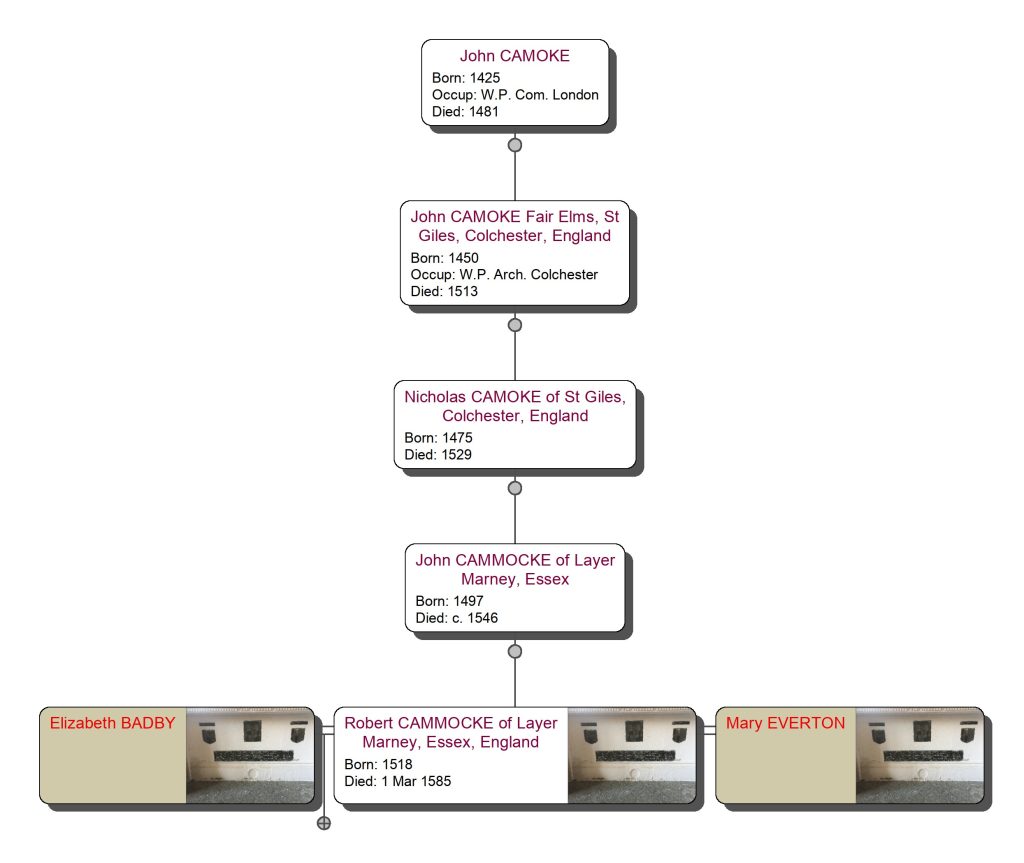
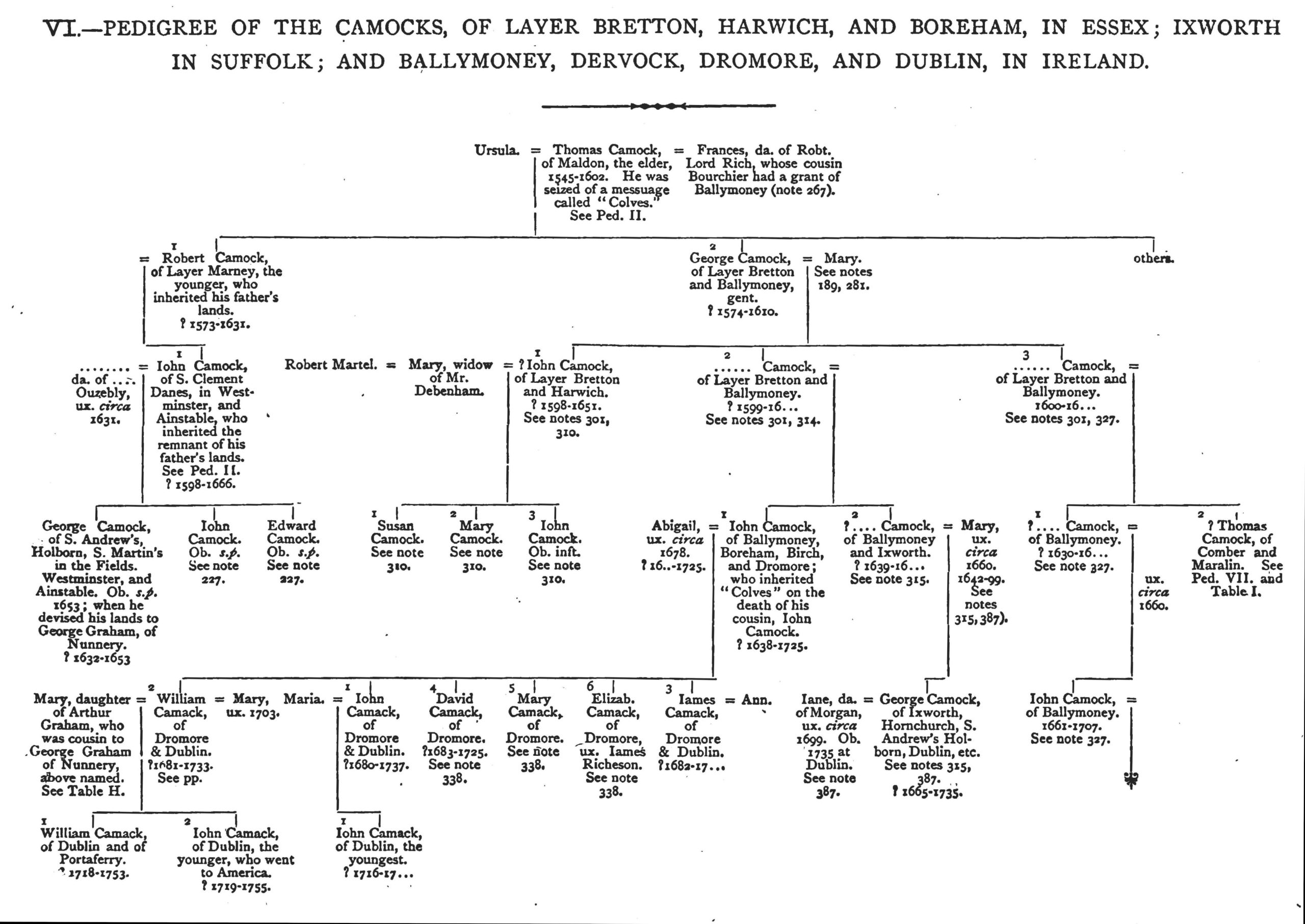
Despite having some fortune in identifying a likely candidate for the previous generation this descendant remains ellusive for both the authors of the Camock family memoirs and our own research. For now he must remain unidentified. Below is shown a tree of the descendants of Thomas Cammock of Maldon, Essex by Frank Owen Fisher. At the bottom right is the subject of our next descendant.
John Comock (1661-1707) of Ballymoney parish, Co Antrim
Thankfully we have significant evidence for the next member of the family, namely John Comock as he is identified on a slab burial in the old graveyard of Ballymoney parish. The inscription, taken from ‘Memorials of the Dead in Ireland Vol. 1’ (p.282), is in raised letters and reads as follows:
“HERE LYETH THE | BODY OF JOHN COMOCK WHO | DEPARTED JANR. | 26TH 1707 AGED | 46 ALSO JEAN | HACKET HIS WIFE | WHO DEPARTED DECEMBER THE | 16TH 1726 AGED | 70 ALSO JOHN | COMOCK THERE | GRANDSON WHO | DIED JAN. THE | 16TH 1738 AGED | 14 YEARS.”
[This is on a flat stone, near the north wall, in raised letters. Above the epitaph is something like a man’s head, and a coat-of-arms underneath.]
Unfortunately the gravestone makes no mention of where John Comock and wife Jean Hacket lived, however it is reasonable to suggest it was likely within the bounds of Ballymoney Parish, Co Antrim. A major clue comes in the form of a Deed Memorial20 dating to 16 September 1741, a transcript of which is as follows:
“A Meml of a Deed of assignt bearing Date the Sixteenth day of September in the year of our Lord One Thous Seven hund & Forty One. Whereby Jno Hackett of Garry in the Parish of Ballymoney in the Bo of Dunluce & County of Antrim Wheelwright in Consdn of the sum of Seventy two pounds fifteen Shills Ster being the sum remaining due on the Judgment herein after mentd to him pd by Wm Camock & John Camock both of Garry afsd Farmers, Did Assign & make over unto the Sd Wm Carrock & Jno Camock their Exrs Admns & Ass One Judgmt obtained by the sd Jno Hackett agt Jno Smart of Ballynagor in the parish of Billey in the barony of Dunluce & County of Antrim aforesd Gent in his Maties Court of Excheqr in Michas Term in the second year of the Reign of our Sovn Lord George the second by the grace of God King of Great Britain France & Ireland King Defender of the Faith & so forth for the sum of One Hundred & forty five pounds ten shill ster. Debt besides Cost to have take & receive the same unto the sd Wm Camock & Jno Camock their Exrs Adms & Ass unto their own proper use & behoof for Ever which sd Deed of Assigmnt & meml is witnessed by Quintin Dick of Ballymoney Mercht & Jno McGaw of Greenshields Farmer of the County of Antrim afsd.”
This would appear to be strong evidence that these individuals are direct relations of those mentioned in the earlier grave. A further piece of evidence appears to firmly locate the Camock and Hackett families in an advert in the Belfast News-Letter of 13 August 1756 for letting lands belonging to John Rowan Esq. of Lisburn.
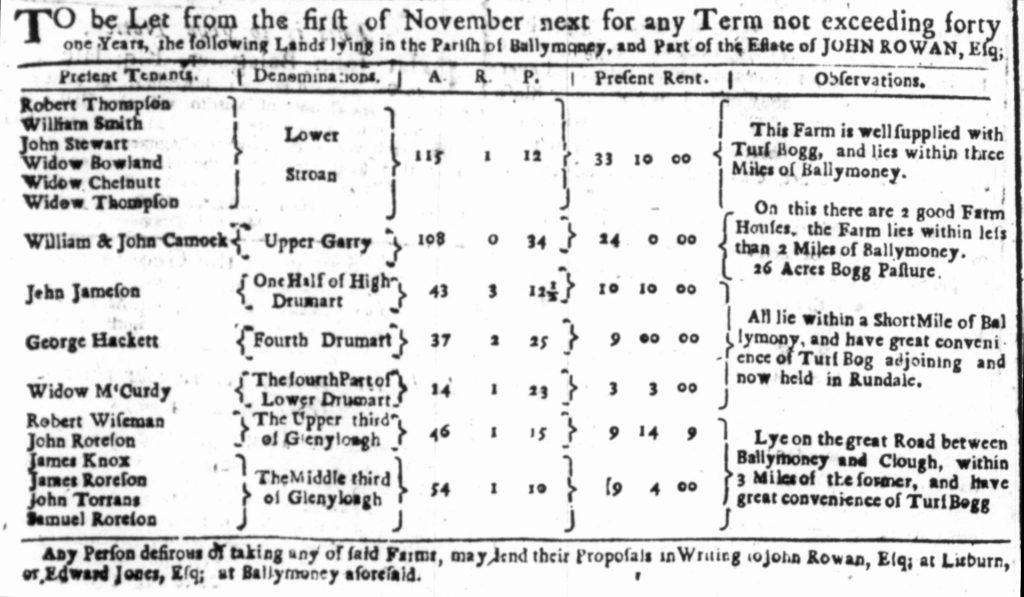
We can clearly see William and John Camock on a substantial holding of 108 acres 34 perches in the townland of Upper Garry, Ballymoney Parish, Co Antrim and George Hackett in a 37 acre 2 rood and 25 perch holding in the Fourth of Drumart (Drumard) also in Ballymoney Parish, Co Antrim. Interestingly John Rowan was the son of Rev Robert Rowan (c1702-42)21 Curate of Finvoy Parish, Co Antrim. His great aunt Margaret Rowan (c1688-1747) married Capt Hugh Boyd (c1687-1731) of Clontyfinnan & Mount Edwards, Co Antrim and his daughter Helena Rowan married her 3rd cousin Samuel Boyd (c1777-1858) of Ballymoney, Co Antrim & Arran Quay, Dublin.
If we factor in this new information we can suggest an extension of the earlier Cammocke family tree as follows:
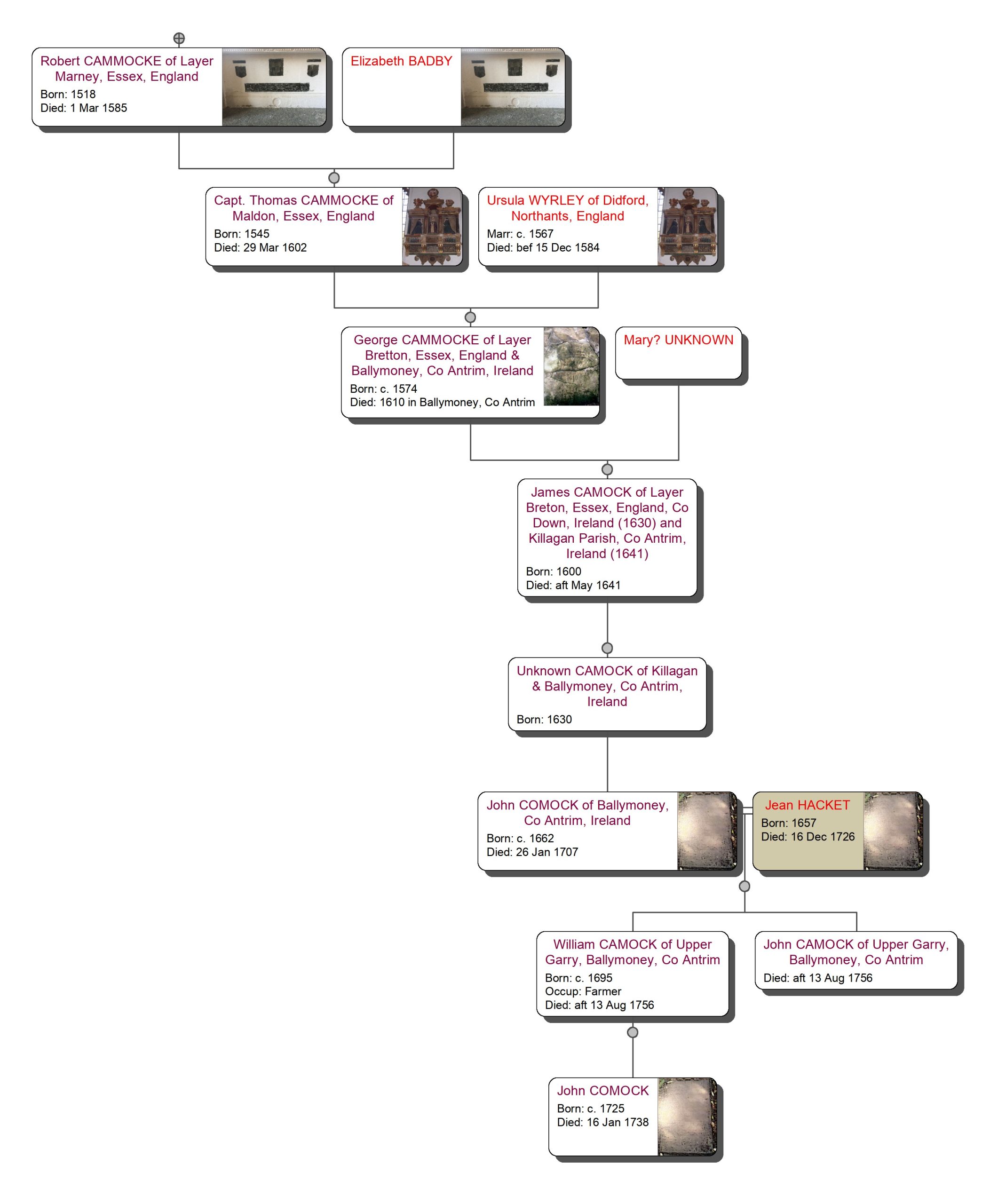
We now have a new problem in that the Ballymoney grave leaves us with the death of grandson John Comock in 1738 aged just thirteen. However we know that his father, likely William and uncle John Camock were still alive in 1756 leaving the possibility of a surviving male heir to either brother. In the Irish Deed Memorials22 we find Rose Camock widow connected with a lease of the lands of Upper Garry, Co Antrim from Adam Hunter of Ballymagarry, Co Antrim on 11 March 1790. Unfortunately no other Camocks are mentioned.
Examination of the ‘Name search‘ facility on the PRONI website affords us some possibilities for identifying Rose’s deceased husband and other members of the Camock family from in and around Ballymoney. The following names were found:
Connor Diocesan Wills before 1858
William Camock of Ballymoney – 1757
William Camock of Ballymoney – 1770
John Cammock of Ballymoney – 1777
In a notice by many local subscribers in support of Civil Order in the Ballymoney area of Co Antrim published in the Belfast News-Letter on 7 April 1772 we find one David Camock. Also examination of the Agricultural Census of 1803 via Bill MacAfee’s excellent website provides another avenue with which to identify possible family members. Accordingly the names of John and William Camock are found recorded against the townland of Garry, Ballymoney parish, Co Antrim.
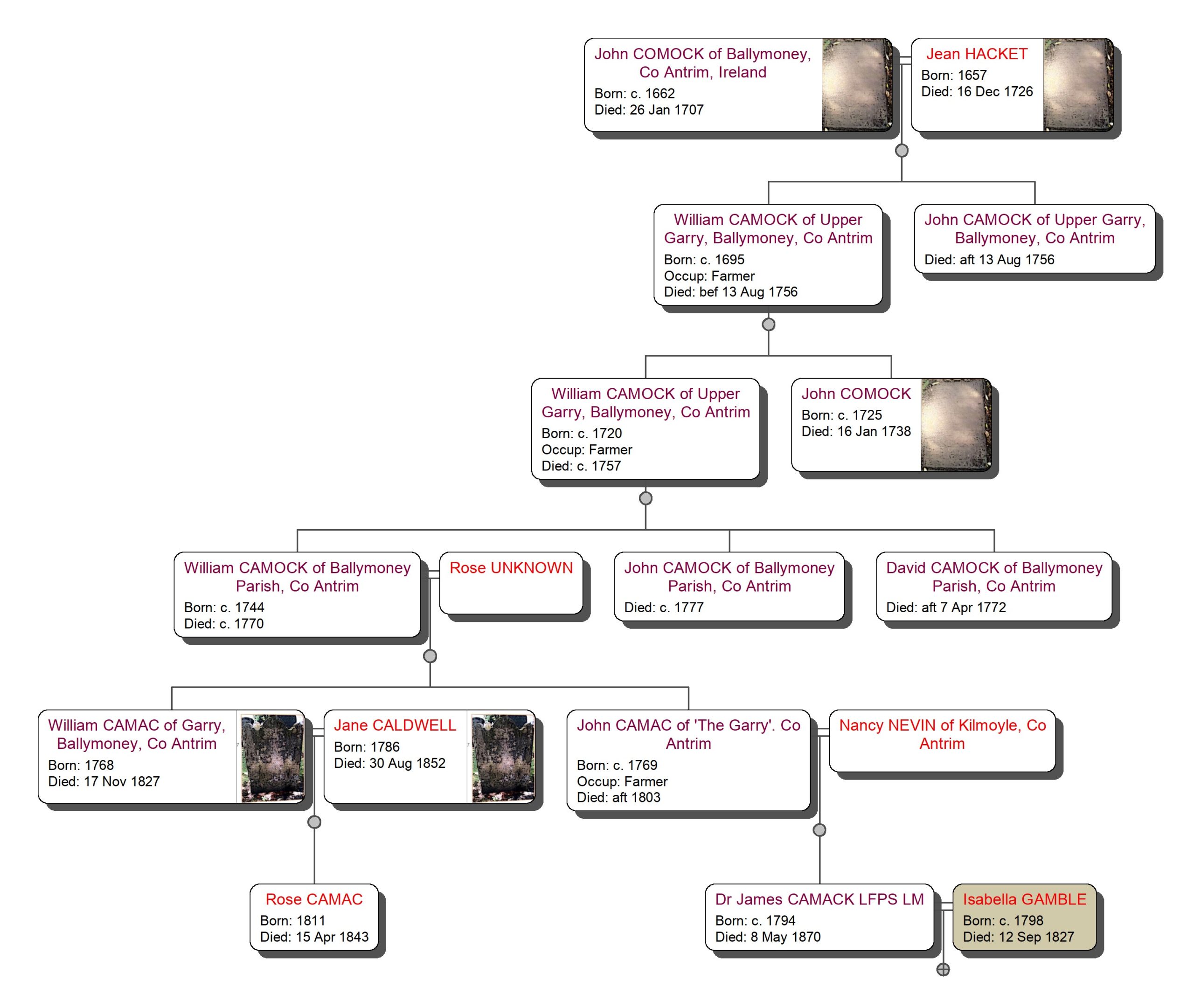
With these additional likely family members from the Ballymoney area we may begin to suggest connections. In Dorothy Arthur’s book on Ballymony graveyard we find the grave23 of William Camac, late of Garry (c1768-1827). In the associated transcript of the grave and notes Dorothy states William to be the son of a William. She further records that William Camac (c1768-1827) and wife Jane Caldwell (1786-1852) had a daughter Rose (1811-43). If we apply traditional naming patterns used in Ulster as well as elsewhere it may be that daughter Rose was named after her paternal grandmother i.e. the Rose Camock widow mentioned above who was alive in 1792. In looking at our previous findings amongst the pre 1858 wills for the Diocese of Connor there is only one William Camock who died before 1792 but was alive after 1768 i.e. the supposed birth year of William Camac of Garry, husband of Jane Caldwell.
Before we proceed with the descendant line of the Camock family we must return to the grave at the beginning of our post. In the notes associated with the grave in Dorothy Arthur’s book she states that James Camack of Dervock was the son of John Camac or Camack of Garry and his wife Nancy Nevin. If we place all the additional information into the Camock family descendant tree from John Comock and his wife Jean Hacket we find the following:
It remains now to mention the remaining members of the Camock family down to the subject of our post.
Dr James Camack (c1794-1870) LFPS LM
James Camack would begin a long link with the Camock family and the medical professions not just lineally but through marriage. In the excellent two volume reference series ‘A Directory of Ulster Doctors’ (who qualified before 1901), Compiled by R S J Clarke (2013) we find the following entry for James Camac:
CAMAC, JAMES (1794/5-1870), Dervock, county Antrim
born 1794/5, son of John Camac of The Garry, county Antrim and Nancy Nevin of Kilmoyles; LFPS24 and LM25 Glas 1814; accoucheur of Glasgow Lying-in Hospital; medical officer to Dervock Dispensary District, constabulary and Liscolman Spinning Factory; married Isabella Rowan (who was born 1796/7 and died 12 September 1827); father of Dr Peter Gamble Camac (q.v.); died 8 May 1870 at Dervock. [BNL 28 September 1827 (d); Bennett (1974); Croly (1843-6); Dub GRO (d); gravestone inscription; Med Dir, Mullin (1969)]
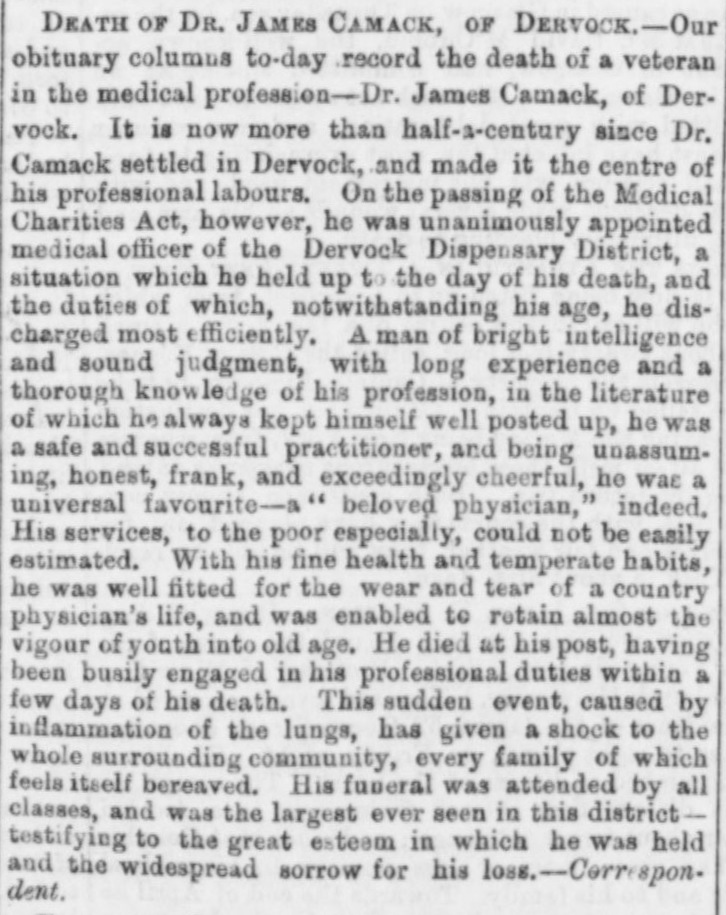
James Camac’s wife Isabella was Isabella Gamble daughter of Joseph Gamble (d.1799) of Dervock and Jane Rowan (d.1828) and not as stated in the above directory. Hi obituary was carried in the Northern Whig on 14 may 1870:
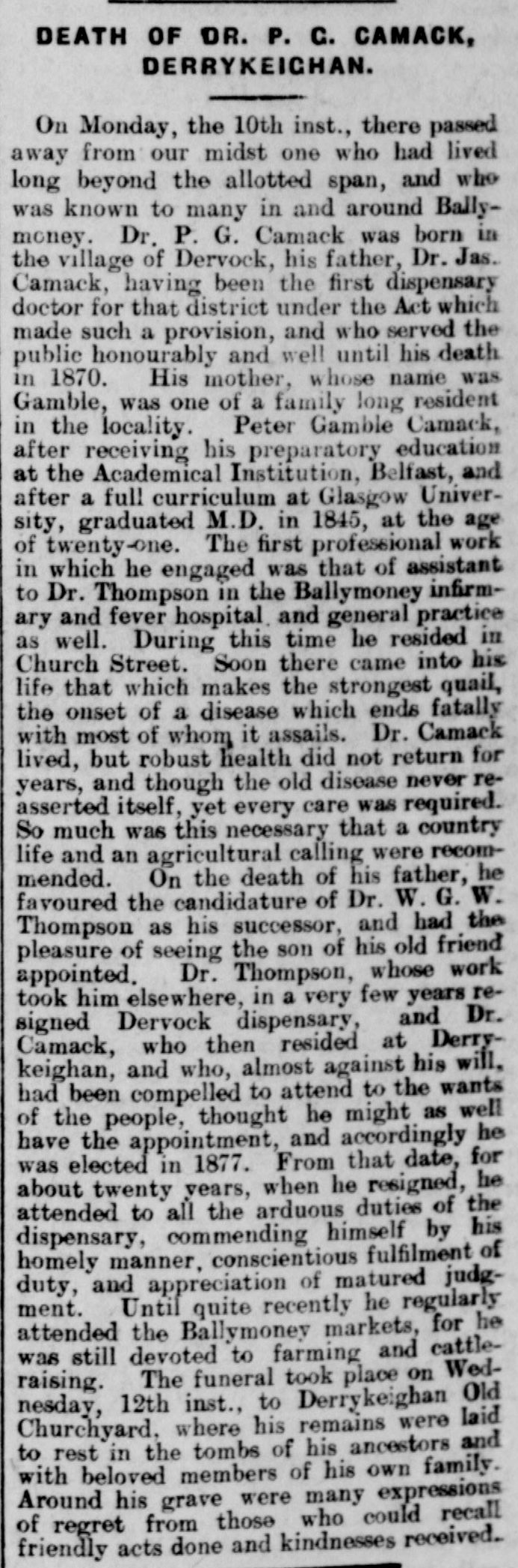
Dr Peter Gamble Camac(k) (c1824-1912) MD CM
As with his father we can get much information on his career from the Directory of Ulster Doctors etc.
CAMAC(K), PETER GAMBLE (1824/5-1912), Derrykeighan, Dervock, county antrim;
born 1824/5, son of Dr James Camac (q.v.); studied medicine at Glasgow University; MD (Glasgow) 1845; CM 1877; general practitioner in Derrykeighan, Dervock; assistant medical officer to Ballymoney Fever Hospital from 1847; married 4 August 1849 in Roseyards Presbyterian Church, Ballymoney, Jane Camac (a first cousin, who was born 1830/1 and died 26 December 1912), second daughter of Thomas Camac, farmer, of The Garry; father of mary Matilda Camac who married Dr Robert John Roulston of East London, South Africa (q.v.), of Agnes nevin Camac who married Dr Robert Craig Miller (q.v.) of Dervock, and isabella camac who married Dr James Laughlin Nevin (q.v.) of Ballymoney; died 10 June 1912 at Derrykeighan; probate Dublin 19 October 1912. [Addison (1898); Belfast PRO, will cal; Bennett (1974); Burns (1988); Coleraine Chronicle 11 August 1849 (m); Dub GRO (d); gravestone inscription; Londonderry Sentinel 11 August 1849 (m); Med Dir; Mullin (1969); UHF database (m)].
His obituary was published in the Coleraine Chronicle on 15 June 1912:
Thomas Camack (1863-1937)
Finally we reach the life of the subject of our post, Thomas Camack. Thomas was born one of at least twelve children to Dr Peter Gamble Camack and his wife Jane. We must assume that he had likely adopted farming as his primary concern and if we examine the Irish Census returns for 1901 we find him at home with his elderly parents and stating he was a farmer.
There is no clue as to what sparked an interest in local history but he began contributing articles to the Ulster Journal of Archeology (UJA) as far back as 1896 with an article entitled ‘A 98 Gravestone’26 and the grave of William Dunlap in Old Derrykeighan graveyard. This was followed the following year by his article on the McKinleys of Conagher27 and later the same year an article on Ballyrashane Churchyard, Co Antrim.28 However the beginnings of his most significant work on the Parish of Derrykeighan were published in two parts in the UJA in May29 and September30 of 1899. His apparent final contribution to the UJA was in 1900 with an article on the Ballymoney Volunteers31. His book ‘History of the Parish of Derrykeighan for Three Centuries’ was printed by the Northern Constitution in 1908. The work was serialised in part by the Coleraine Chronicle on the 22nd and 29th August the same year and then a second edition published in 1930. Interestingly the photograph of old Derrykeighan church after the foreword in the 1930 edition was taken by Dr Robert Craig Miller, Thomas Camac’s brother-in-law.
Thomas Camac died on 10 December 1937 at Derrykeighan, Co Antrim with probate of his estate granted to Thomas Taggart Solicitor and his brother-in-law Dr Robert Craig Miller. Whilst Thomas had no known issue there are members of the Camock family still living in north Antrim.
Other Camack/ Camac/Camock/Camoke/Cammock/Cammocke lines
Of particular interest in Ireland was Admiral George Camock who died in Rouen, Seine-Maritime, France on 3 June 1722 and his widow Jane Morgan who died in Dublin in 1735. Also the descendants of Thomas Camock (1642-1708) of Comber & Magheralin, Co Down32 which included Col Jacob Camac (1734-1802) of the HEIC and Turner Camac of Green Mount, Co Louth, Ireland and Philadelphia, USA.
- British Record Society – Wills at Chelmsford (Essex and east Hertfordshire) / [Edited by F. G. Emmison, county archivist of Essex v.78, p.79 ↩︎
- Essex Record Office Ref. D/ACR 1/222/1 ↩︎
- Ibid Ref. D/DH VF128 ↩︎
- Ibid Ref. Q/SR 30/24 ↩︎
- NA Ref. PROB 11/69/139 ↩︎
- Essex Record Office Ref. D/DQs 143 ↩︎
- Calendar of Sate Papers Ireland 1509-73, p.518 ↩︎
- Lives and letters of the Devereux, earls of Essex, in the reigns of Elizabeth, James I., and Charles I., 1540-1646, Vol I, p.33 ↩︎
- Ireland under the Tudors; with a succinct account of the earlier history, Vol 2, p.243 ↩︎
- See Note 281 – Memoirs of the Camacs of Co Down, Frank Owen Fisher, p.72 – “Close Roll , 11 Jac. I. , pt. 32. Conveyance from Robert Camock to Samuel Tryon of lands in Layer Bretton , etc. (note 189) , saving one lease dated the Feast of S. Michael the Archangel, 38 QE. , from Robert Camock and Mawe his wife unto George Camock, gent. , and Marie his wife, for the term of 21 years at an annual rental of 5li.” ↩︎
- See Note 282 – Memoirs of the Camacs of Co Down, Frank Owen Fisher, p.72 – “In 39 QE George Camock paid subsidy upon lands in Layer Bretton cum Virley, value 20s.” ↩︎
- See Note 298 – Memoirs of the Camacs of Co Down, Frank Owen Fisher, p.75 – “Close Roll, 10 Jac. I. , 19. Mortgage from Robert Camock to James Darrel of lands in Layer Bretton , etc. ( note 187 ) ; saving one lease, having thirteen years to run from the feast of S. Michael the Archangel next ensuing, made by Robert Camock to George Camock , gent . , since deceased, at a rental of 5li.” ↩︎
- PRONI Ref. T694/1, see also ‘Names of tenants on part of the Earl of Antrim’s estate
in May 1641′ Compiled by Ian Montgomery, Directory of Irish Family History Research, No.43 (2020) ↩︎ - PRONI Ref. T640/14 ↩︎
- National Records of Scotland (NRS) Ref. GD39/1/88 ↩︎
- ‘Men and Arms’, The Ulster Settlers c.1630, Ed. by R J Hunter (2012), prepared for publication by John Johnston, p.88 ↩︎
- Ibid, p.154, No. 995 ↩︎
- PRONI Ref. T640/83 ↩︎
- Irish Deed memorial No. 74153 – 16 September 1741 ↩︎
- ROWAN, ROBERT c1702-1742
b c1702; ed Mr Clark, Lisburn; ent TCD 14 May 1720 aged 18 BA 1724, C Finvoy (Conn) 1739 (VB), 7th s of Rev John Rowan, V Drumballyroney (Drom) c1694-1728 (s of Rev Andrew Rowan by Margaret (nee Stewart) and brother of Rev John Rowan V Drumballyroney (Drom) 1728, Rev Alexander Rowan V Kilbroney (Drom) 1727-28, and Rev William (his twin) V seapatrick (Drom) 1734-35); m Latitia (or Letitia) dau of John Stewart of Garry (branch of the Stewart family of Ballintoy), Issue 1. John of Mullans and garry b 18 Def 1733 High Sheriff Co Antrim 1755 m 3 Feb 1753 Rose dau of Capt Charles Stewart Lisburn and of Clunie N B, by Rose daughter of Roger hall Narrow Water Co Down. Clergy of Connor, Canon J B Leslie (1993), p.573 ↩︎ - Irish Deed Memorial No. 290467 – 19 April 1792 ↩︎
- Ballymoney Old Church Graveyard, Dorothy Arthur, 2008, Grave No. 351, p.387 ↩︎
- Licentiate of the [Royal] Faculty of Physicians and Surgeons ↩︎
- Licentiate in Midwifery ↩︎
- Swanzy, H. B., et al. “Miscellanea.” Ulster Journal of Archaeology, vol. 2, no. 3, 1896, pp. 205–12. JSTOR, http://www.jstor.org/stable/20563657. Accessed 22 Aug. 2026. ↩︎
- Camac, Thomas. “The M’Kinleys of Conagher, Co. Antrim, and Their Descendants. With Notes about the President of the United States.” Ulster Journal of Archaeology, vol. 3, no. 3, 1897, pp. 167–70. JSTOR, http://www.jstor.org/stable/20563699. Accessed 22 Aug. 2026. ↩︎
- Camac, Thomas. “Ballyrashane Churchyard, Co. Antrim.” Ulster Journal of Archaeology, vol. 4, no. 1, 1897, pp. 66–67. JSTOR, http://www.jstor.org/stable/20563766. Accessed 22 Aug. 2026. ↩︎
- Camac, Thomas. “The Parish of Derrykeighan (County Antrim) for Three Centuries.” Ulster Journal of Archaeology, vol. 5, no. 3, 1899, pp. 147–61. JSTOR, http://www.jstor.org/stable/20563878. Accessed 22 Aug. 2026. ↩︎
- Camac, Thomas. “The Parish of Derrykeighan (County Antrim) for Three Centuries (Continued).” Ulster Journal of Archaeology, vol. 5, no. 4, 1899, pp. 214–17. JSTOR, http://www.jstor.org/stable/20609049. Accessed 22 Aug. 2026. ↩︎
- Camac, Thomas, et al. “The Ulster Volunteers of 1782: Their Medals, Badges, Flags, &c. (Continued).” Ulster Journal of Archaeology, vol. 6, no. 1, 1900, pp. 34–38. JSTOR, http://www.jstor.org/stable/20609074. Accessed 22 Aug. 2026. ↩︎
- See Pedigree IV of the ‘Memoirs of the Camacs of Co Down etc’ by William Masters Camac, privately printed in Philadelphia, USA in 1913 ↩︎