This branch of the Boyd family in Co Antrim descended from Robert, son of Archibald Boyd of Underhill, West Kilbride Ayrshire and Carncullagh, Derrykeighan Parish, Co Antrim.
Robert Boyd (c1612-69) son of Archibald Boyd of Underhill, West Kilbride Ayrshire and Carncullagh, Derrykeighan Parish, Co Antrim
In ‘Men and arms’ by R J Hunter1 which documents the Muster Roll of Ulster in 1630 we have eleven Robert Boyds listed. Of these, five are recorded as mustering on estates in Co. Antrim:-
p.111 – On the estate of the Earl of Antrim in the Barony of Dunluce – f.150 No.171 – sword only
p.115 – On the estate of the Earl of Antrim (servitor lands) in the Barony of Dunluce – f.157 No.26 – sword only
p.117 – On the estate of the Earl of Antrim in the Barony of Glenarme – f.161 Nos. 60 & 73 – swords only
p.118 – On the estate of the Earl of Antrim in the Barony of Glenarme – f.163v No. 214 – No arms
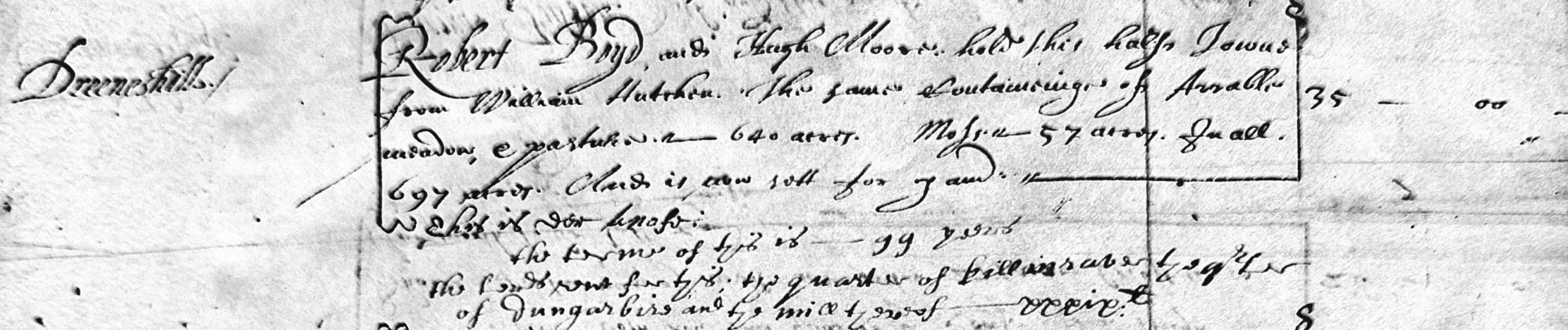
In an effort to narrow this evidence in relation to the likely Robert Boyd of the Dobbs Report we can probably discount the entries relating to the Barony of Glenarm. This leaves just two possibilities on pages 111 and 115. Thanks to the survival of a partial rent roll2 from May 1641 within the MSS of the Harleian Collection in the British Library we have reference to a Robert Boyd having a lease on the townland of Greenshields, Co Antrim.
| Townland | Tenancy | Rent |
| Dreeneshill {Greenshields Upper & Lower, Barony of Upper Dunluce, Ballymoney Parish, Co Antrim}. | Robert Boyd and Hugh Moore hold this halfe Towne from William Hutchen. The same containing of Arable meadow, & pasture – 640 acres. Moss – 57 acres. In all 697 acres. Land is now sett [?] [?] [?] [?] [?] [?] the terme of this is – 99 years The lands [?] [?] the quarter of killinraver the qter of dungarbire and the mill thereof – XXXiXl {£39} | 35 – 00 |
The William Hutchen named as landlord to Robert Boyd in the above tenancy is the only one mentioned in ‘Men and arms’ by R J Hunter. He is found as William Hutchon on p.111 – On the estate of the Earl of Antrim in the Barony of Dunluce – f.149v No. 151 – sword only, which would be an excellent match for the first of the entries for Robert Boyd above i.e. p.111 – On the estate of the Earl of Antrim in the Barony of Dunluce – f.150 No.171 – sword only.
Given this information it is likely that Robert was born around c1612 to be on the Muster of 1630 with a sword and old enough to be party to the lease on Greenshields with Hugh Moore in 1641.
As to when he likely died there are no known graves, nor has a will been found. However an entry has been found in the Hearth Money Rolls for 1666 & 1669 for a Robert Boyd in the townland of Ballyratahan, Derrykeighan Parish, Co Antrim which may be him.
William Boyd of Clontyfinnan, Loughguile Parish, Co Antrim (d. c1707)
From the lineage recorded in the first report by Francis Dobbs Esq. regarding ‘Hutchinson’s Charity’ we find the following on page (6)3 of the report:-
“Robert Boyd, above mentioned, had three sons, Hugh, William and Archibald, and one daughter Jane.“
William the likely second of the three sons to Robert Boyd is found first in reference to an indenture of 1675 whereby he leases in fee farm various lands from Tristram Beresford Jnr of Coleraine as follows:-
“Tristrim Berisford Jnr late of Coleraine in the County of Derry by his Indenture bearing Date the first day of Septr one Thous Six hundred Seventy five for the Considerations therein mentioned did Give Grant & Demise unto William Boyd of Clintifenan in the County of Antrim, All that and those the full and Just fourth Part of the Two Quarter Lands of Clintifenan and the two Quarter Lands of Ballyvelly and the Quarter Land of Tully McCamly the Fourth Part of the Three Quarter Land of Ballycraigagh the one Quarter Land of Drumnafevy all in the Parish of Loghgill in the County of Antrim and the one Quarter Land Knockanfrim the one Quarter Land of Magherebuy in the Parish of Killraghs in the said County of Antrim. To hold the same to the said William Boyd and his heirs forever in fee farm and under the yearly Rents & Covenants in the said Inden’re contained.”4
It is not known for certain where William Boyd lived prior to 1675 but we can say that no Boyds were recorded in Clontyfinnan in the 1666 or 1669 Hearth Money Rolls.
Returning to the Dobbs Report, page (8), it further states:-
“William the son of said Robert (who was brother of Mary Ann Boyd) had a son Captain Hugh Boyd, whose daughter Letitia, married Samuel Boyd..“
The reference to a Captain Hugh Boyd is significant in linking this lineage to an important source found in the old graveyard at Clough, Co Antrim.
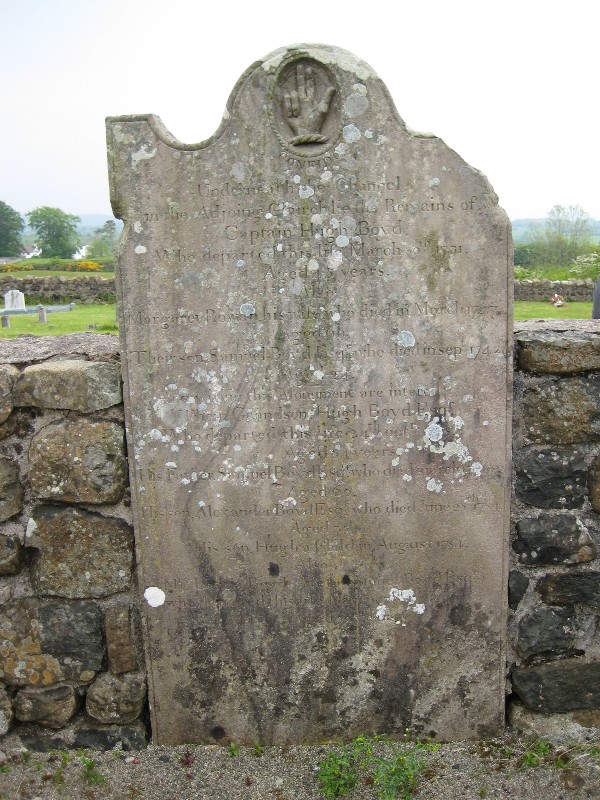
Underneath the Chancel
in the Adjoining Church lie the Remains of
Captain Hugh Boyd
Who departed this life March 30th 1731
Aged 45 years
Also
Margaret Rowan his wife who died in March 1747
Aged 60
Their son Samuel Boyd Esqr who died in sept 1742
Aged 24
And within this Monument are interred
Their Grandson Hugh Boyd Esqr
Who departed this life 24th Octr 1778
Aged 34 years
His father Samuel Boyd Esqr who died march 17th 1780
Aged 60
His son Alexander Boyd Esqr who died June 25th 1784
Aged 35
His son Hugh a Child in August 1784
Also
Mrs Letitia Boyd wife to Samuel Boyd Esqr
who departed this life March 17th 1797
Aged 82 years
We are fortunate for the survival of this memorial and the extensive information it provides covering the lives of three generations. The graves importance was not missed by Amy Isabel Young in her book ‘Three Hundred Years in Inishowen’ (1929)5, although she wrongly identified the individuals with the Boyds of Ballycastle, probably due to the lineage published by Burke. However she relates an intriguing piece of information:-
“It appears probable that there was another son, William of Clontifinan, who was father of Capt. Hugh Boyd, of Mount Edwards, Cushendall (b. 1685/6, and d. March 30, 1731), who married Margaret Rowan (who was b. 1687 and d. 1747), both of whom are buried in the chancel of the church at Clough, Co. Antrim. A portrait of this Capt. Hugh Boyd, similarly inscribed, stating that he was the eldest son of William Boyd, of Clontifenan, Ballycastle, was in the possession of a family named Boyd, residing at 9, Victoria St., Dublin. The portrait was of a gentlenian in a wig and armour. The inscription in Clough church gives several sons and daus., the name Hugh occurring more than once, so that it is very probable that this family were closely related to the Ballycastle branch, though the exact connection is not known.”
This address in Dublin will feature later in this article but it would appear that Amy Isobel Young may have visited the address and seen the portrait for herself.
Perhaps the most remarkable source for William Boyd of Clontyfinnan was a transcript of his will of 1707 in PRONI6 which is reproduced below:-
“In the name of God Amen I William Boyd of Clontisennan in the County of Antrim gentt. being sick and weake of Body, but of sound and perfect memory Doe make and Proclaime this my last Will and Testament in Manner and form following, And I Doe hereby Revoke & make null & void all former Will and Wills heretofore by me made and Declared. Firstly? I Bequeath my soul to God my Creator in assured hope to Obtaine full pardon and Remission of all my sins in and through the merritts and suffering of my Blessed Saviour Jesus Christ, and my Body to be Buried in a Decent Manner without perfuse expense as my Executors hereafter named shall think fit.
Item it is my will that my Executors hereafter Named and Appointed shall out of the first and readiest of my Estate pay and discharge my funeral expenses and all the just debts that I Owe, and in particular that they pay and satisfie unto my sonn David Ker the some of fifty pounds, sterl, due to him by me which became payable att May last, And that they pay unto my Sonn Alexander Boyd the sume of fifty pounds sterl that I owe him with Interest for the same from the first of February one thousand seven hundred and seven until the time of payment thereof.
Item it is my will and I Doe give and Bequeath unto my wife Mary Boyd the freehold purchased from Mr Cahall Oge o Hara, to witt, the Equall fourth pte of the halfe Townland of Clontfinian, the half townland of Ballyveely & Quarterland of Tully, alias TullymcCavill, for and During her Natural life and not longer, And it is my Will and my Will is, that aft the Death of my said Wife, the said fourth pte of all and singular the lands aforesaid shall come and Descend to my sonn Hugh Boyd and the Heirs Male of his Body lawfully begotten or to be begotten for ever provided allwise that the said Hugh Boyd shall have noe power to sell or mortgage the said freehold or any pte thereof to any person or persons whatsoever except to one of my Executors hereafter named And if it shall please God that the said Hugh Boyd shall Dye without Heirs Male lawfully begotten, then it is my will that the said freehold shall goe and Descend to the Heirs Male of my Sonn Alexander Boyd Begotten or the Body of his now wife Margaret Boyd my Daughter, and for want of such Heirs Male It is my will that the said freehold goe and Descend to the Heirs Generale of my two Daughters Jane and Margarett And if it shall happen that my said sonn Hugh Boyd shall Dye without issue Male as aforesaid, My will is that the person or persons to whom the said freehold shall Descend by nature of these presents shall pay to the Daughter or Daughters of the said Hugh lawfully begotten the some of Eightie pounds sterl. On the day of her or their marriage respectively and if the said Hugh shall Dye without any issue lawfully begotten I doe order and Appoint that all that the said Hugh shall become Intitled to By virtue of this my will shall returne to my Executors and to their Administrators or Assigns.
Item I give and Bequeath to my said wife Mary Boyd All my household furniture to be ***
Item I give and Bequeath to the poor of the Parish of Lougheel the some of Three pounds sterl – and as to all the rest and residue of my goods and Chattles rights and Creditts whatsoever, it is my will and my will is that Immediately after my Death a perfect Inventory thereof made and that the said Mary Boyd my wife shall Have and enjoy the same During her Natural life, without power to Lessen or Diminish the said goods and Chattles in value And at the death of my said wife it is my will that all and singular the said goods and Chattles rights and Creditts shall be equally Divided in three ptes Amongst my sons in law David Kerr, Alexander Boyd, and my sonn the said Hugh Boyd their Executors Administrators or assigns And it is my intent and meaning that the said Hugh my sonn shall so in and above his Equal share of the said goods and Chattles Have and enjoy the Benefitt of a Bond of Sixty pounds sterl. Principall Money due by Mr Neale McNeale wch I have already assigned to the said Hugh And lastly I Doe nominate and Appoint the said Mary Boyd my wife, my Brother Hugh Boyd of Ballynagorr and my said two sons in law David Kerr and Alexander Boyd Executors of this my last Will and Testament And I hereby Intreat Lieut Coll John Hamilton of Mount Hamilton7, Francis Andrew of Carnkein Esqr8and Mr Thomas Sterling9to oversee that this my will and Testament be served and performed according to the time interest and meaning thereof In Wittnesse whereof I have herewith sett my hand & fixd my seal this twenty eighth day of March in the year of our Lord God one thousand seven hundred & seven 1707 Memorandum that before signing or publishing hereof the words freehold & pts was first **** ****
Will Boyd (seal)
Signed sealed & published in presence of us
Joh Dunlop William Luk Andrew McPheatris
Thomas Luk William Foulton
Roger McCormicke“
Before recording an initial family tree for the Boyds of Clontyfinnan it is important to consider two other valuable sources. In PRONI there are various documents held under the ‘Ker Papers’10 to which the following background is given:-
“The family is descended from David Ker, a merchant of Ballymena, Co. Antrim, who had taken a lease of the first fall on Sir Robert Adair’s mill-race at Ballymena, c.1710. He married Jean Boyd of Clontfinnan near Clough, Co. Antrim, and had a family of eleven children of whom three were prominent merchants: William in Ballymena, Hugh in Dublin, and David in London. David Ker settled in London and traded at Cateaton Street, first as Ker & Elmes, then after 1755 as Ker, Elmes & Priest, and later after 1758 as David Ker & Co. In 1765 he purchased the Portavoe estate near Groomsport, in the Ards. He died in 1770 and was succeeded by his son, David, during whose lifetime the firm traded as Ker, Pope & Dyson and later as Ker, Brookland & Priest. In 1785 he purchased the Clough and Magheraknock estates in Co. Down from Arthur Annesley and in 1800 that of Montalto at Ballynahinch, Co. Down, from the 2nd Earl of Moira. His brother, Richard Gervais Ker, High Sheriff of Co. Antrim in 1791, bought the Red Hall estate at Ballycarry, Co. Antrim, in 1780 from Sir Archibald Edmonstone. David Ker died in 1811, and was succeeded by his son David, who married, in 1814, the daughter of the 1st Marquess of Londonderry and in 1834 bought the Southwell estate at Downpatrick, Co. Down, from the representatives of Lord de Clifford. The Kers are especially important in the late 18th century for their enterprises in the land market in Ulster. Besides purchasing at least four estates between 1785 and 1834, they showed interest in the purchase of several others. In this way the descendants of a Ballymena merchant entered county society and in 1796 the Irish House of Commons (David Ker was returned in that year for Blessington, Co. Wicklow, then controlled by Lord Downshire).“
More detail of the marriage of David Ker and Jean Boyd is found within the Ker Papers11 viz:-
“David Ker was married to Jean Boyd the 11th day of Jullie 1699. Robert Ker was born the first Wedensday of May 1701 about 5 o’clock. Marie Ker was born upon Sunday the 23rd day of 8 br. 1702 about 7 o’clock. William Ker was born upon Sunday the 7th day of May 1704 about 8 o’clock. Hugh Ker was born upon Munday 25th day of Jun. 1705 about 8 o’clock. John Ker was born upon Tuesday the 5th day of 9 br. 1706 betwixt six and 7 o’clock. An Ker was born the first day of Januar at 4 o’clock 1707. The were all born in the morning. David Ker was born upn Tuesday the 8th day of Januar betwen three and four o’clock in the morning 1709. Samuall Ker was born upon Tuesday the 9th day of Xbr. betwen 8 and nine o’clock at night 1712. Joan Ker was born upon Wedensday the 4th day of March 1713/14 betwen 7 and 8 o’clock at night. Margratt Ker was on Sunday about ¾ an hour after 4 in afternoon the 4th of Agust 1715.”
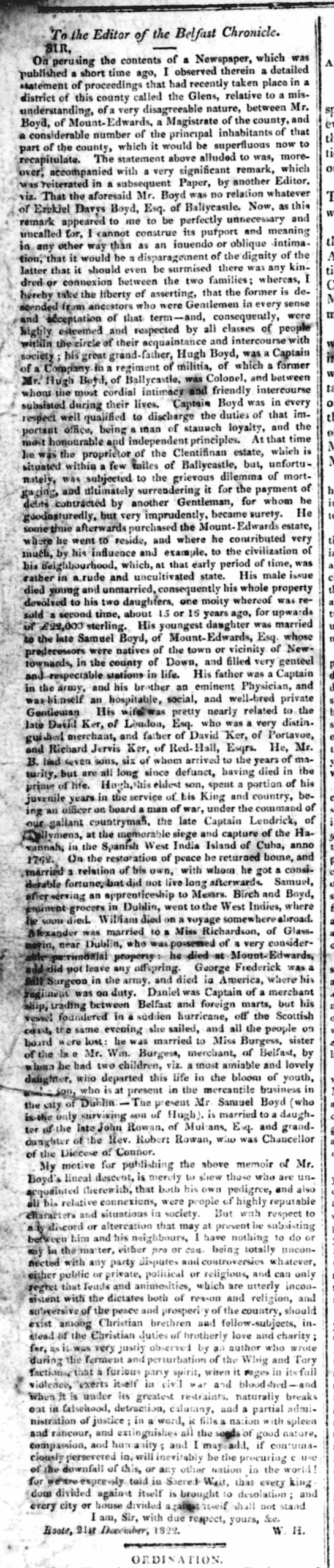
Finally in the Belfast Commercial Chronicle for 28 December 1822 we find a remarkable letter to the editor from W.H. of the Roote dated 21 December 1822.
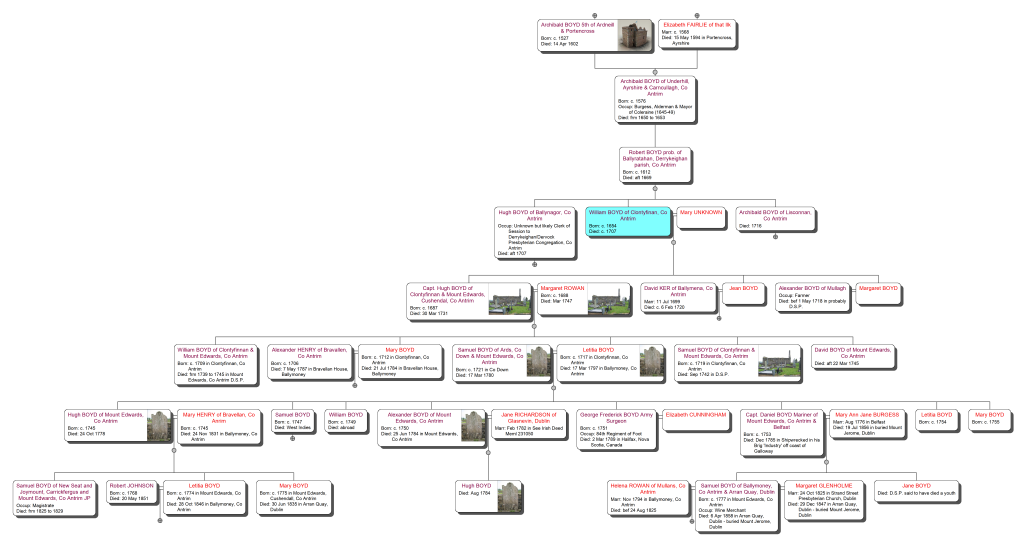
From the above sources and information we can produce the summary tree below for the Boyds of Clontyfinnan & Mount Edwards, Co Antrim.
Capt. Hugh Boyd of Clontyfinnan & Mount Edwards, Co Antrim (c1687-1731)
As mentioned previously Capt. Hugh Boyd was son and heir of William Boyd of Clontyfinnan. He married Margaret Rowan (c1688-1747), daughter of Rev Andrew Rowan12 of Greenhead, Govan, Lanarkshire, Scotland and later of Clough, Co Antrim.
Returning to the aforementioned Deed Memorial 13974 we see that the lands originally acquired by William Boyd of Clontyfinnan were mortgaged to David Kerr of Ballymena, Co Antrim, brother-in-law of Capt. Hugh Boyd on 1 May 1718 for £112. The letter to the Belfast Commercial Chronicle of 1822 eludes to financial difficulties faced by William Boyd of Clontyfinnan for standing surety for another. It would seem that these difficulties still remained after his death c1707 and perhaps as a result Capt. Hugh Boyd had mortgaged his inheritance to mitigate those difficulties. However the funds were obtained within the wider family i.e. David Ker of Ballymena with a likely effort to keep some control over the destiny of the lands.
Capt. Hugh Boyd had obviously sufficient funds to lease alternative property for we find on 5 July 1721 he acquires a lease13, jointly with Rev Samuel Dunlop14 of Athlone, of various lands in the parish of Layde, Co Antrim. It is worth noting, that as with many indentures involving the Boyd family of Co Antrim, there is a preference for involving family where possible and this venture between Capt. Hugh Boyd and Rev Samuel Dunlop is no exception as the two men were first cousins twice removed with Archibald Boyd of Underhill & Carncullagh being their common ancestor. Rev Samuel Boyd descended from Anaple Boyd, daughter of Archibald, who married Hugh Campbell and their daughter Catherine married Thomas Dunlop. Their son James Dunlop was the father of Rev Samuel Dunlop.15
Before looking further at the life of Capt. Hugh Boyd of Clontyfinnan & Mount Edwards it is perhaps worth recording the background to the lands that he leased along with Rev Samuel Dunlop. Through a timeline of events from 1687 to 1721 involving these lands in the parish of layde, Co Antrim we have a snapshot of some significant moments in Irish history.
Timeline of lands in the Parish of Layde leased by Capt. Hugh Boyd & Rev Samuel Dunlop in 1721
- May 1687 – Various lands in the Parish of Layde (almost certainly including that which would became Mount Edwards) leased for a term of 500 years at an annual rent of £5 by Alexander MacDonnell, 3rd Earl of Antrim to Daniel MacDonnell, illegitimate son.16
- 1688/89 – Daniel MacDonnell enlists in the army of James II, initially as a Captain.17
- November 1694 – Col Daniel MacDonnell taken prisoner and sentenced to death for high treason, committed to Newgate prison.18
- 8 August 1699 – At an Inquisition held at Carrickfergus Daniel MacDonnell was the subject of forfeiture of his lands and holdings, probably due to his sentence for high treason.19
- 1700 – Under the Act of Resumption it would appear the title and remainder term of Daniel MacDonnells lease was vested in trustees of the Crown.20
- 3 June 1703 – Daniel MacDonnell’s estate in the Parish of Layde sold to the Hollow Sword Blade Company, for £2,596.21
- c1713 – Francis Edwards22, a wealthy London Merchant purchases various holdings of the Hollow Sword Blade Company including Daniel MacDonnells former estate in Layde.
- 13 April 1721 – Francis Edwards, now of Dublin, leases Daniel McDonnell’s former estate in the parish of Layde to Captain George Gregory of Cragg, Co Tipperary for 71 years at £260 per annum.23
- 5 July 1721 – Captain George Gregory surrenders his lease to Francis Edwards, who then leases the former estate of Daniel MacDonnell to Hugh Boyd of Clontyfinnan and Rev Samuel Dunlop of Athlone for the remainder term of the original lease of 1687 i.e. 466 years at the initial yearly rent of £200 per annum for the first three years and then £240 per year, over and a above the £5 per annum payable to the Earl of Antrim, for the remaining term.24
On 6 April 1722 there is a revision25 of the 1721 Deed between Capt. Hugh Boyd now of Glenacree (probably Gortaclee, Cushendall) and Samuel Dunlop of Straid, Co Antrim. Lands of the 1721 deed are split between Capt. Hugh Boyd and Samuel Dunlop of Straid. It would seem that Rev Samuel Boyd had resigned from his position as Minister to the presbyterian congregation of Athlone by this time and moved to Straid. His resignation was formerly accepted by the Synod of Ulster at their meeting of 22 June 1722. The portion due to Capt. Hugh Boyd his heirs and assigns was as follows:-
“Cashandale, ****fad, Carnanie, Tully, Munevert, Drimore, Ballynalocker, Gortaclee, **** Cloughglass, Leany, Tavenaghgillanamuck, Agolah, Carnamaddie, Drumfesky, Clellashane, Unshanagh, Claghagh, Crunknacro, Brockaghs, Beaghs“
The portion due to Samuel Dunlop was as follows:-
“Milne of Coshandiell with house & garden, Glasmullin, Tavenaghdressagh, Tavenaghcony, Carnasherine, Rannanagh, Straid, Drimnaca*, Callishnagh, Gortacregan, Dunaragan, Kenewn, Brughnadrum, tragh?“
It is likely that the upper part of the townland of Gortaclee was separated off to form Mount Edwards which may have taken its name from Francis Edwards the former landlord.
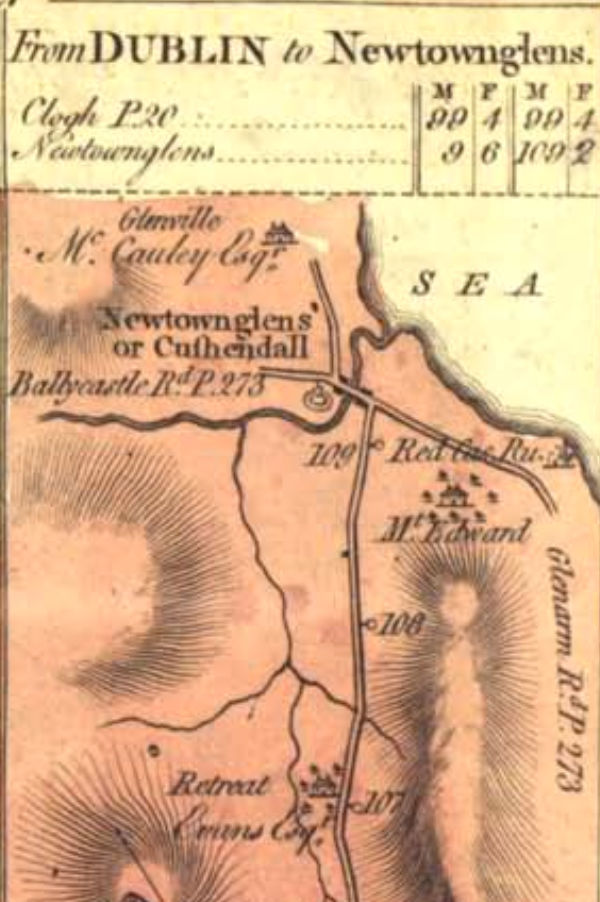
showing Mt Edward i.e. Mount Edwards
On 30 March 1731 Capt. Hugh Boyd died leaving his widow Margaret and children, William, Mary, Letitia, Samuel and David. Interestingly the Indexes for the Wills of the Diocese of Connor list a Hugh Boyd of Mt Edwards with a Probate year of 1730 but to date no will has been found. No record of a will has been found for Hugh’s wife Margaret either who died in March 1747. Margaret was predeceased by her son Samuel in 1742. All three are said to buried under the chancel of the old Parish Church at Clough which was replaced by Dunaghy St James.
William Boyd of Mount Edwards, Layde Parish, Co Antrim (c1709-c1741)
With the death of Capt Hugh Boyd of Mount Edwards in 1731 his eldest son and heir William took over the estate at Mount Edwards. The first mention we see of William is a deed of mortgage26 between him and Rev John Grace of Dublin (later Vicar of Layde Parish, Co Antrim (1738-65)) involving lands in Tullynewy and Tuftarney in the barony of Kilconway. The mortgage was discharged on 6 March 1739. We then see him as witness in an indenture27 between Francis Stewart of Red Bay, Co Antrim, Jane Stewart, widow of Robert Stewart, Hugh Boyd of Drumawillen, Co Antrim (later Col Hugh Boyd of Ballycastle, Co Antrim), Alexander McAuley of Dublin dated 17 September 1737. Then on 6 April 173928 we see him convey the previously mortgaged townlands of Tullynewy and Tuftarney to his cousin William Kerr of Ballymena, Co Antrim forever for the sum of £221 sterl. Finally in what appears to be a decision by the Court of Exchequer in Dublin we see the following deed29:-
“Memorial of Indented Deeds of Lease and Release bearing Date Respectively the Twenty first and Twenty Second day of March One thousand Seven hundred and Forty five the Release being of four parts and made Between
the Right Honble Henry Lord Visct Palmerston Chief Remembrancer of His Majesties Court of Exchequer in Ireland of the first part
William Ker of Ballymena in the County of Antrim Merchant of the Second part
David Boyd of Mount Edwards and County of Antrim aforesaid Gent. onely Brother and heir at Law of Samuell Boyd late of Mount Edwards aforesaid Gent. Deceased and also heir at Law of William Boyd late of the same Gent Deceased of the third part and
Hugh Kerr of the City of Dublin Merchant of the fourth part
whereby the said Henry Lord Viscount Palmerston in Consideration of the sum of Two hundred pounds Ster to him in hand paid by the said Hugh Kerr and the said David Boyd Wm Ker. in consideration of the sum of five shillings Ster a piece to Each of them in hand by the said Hugh Kerr they the said David Boyd and William Kerr did Grant Bargain Sell alien release and Confirm unto the said Hugh Kerr, in his actual possession then being by Virtue of the said Indenture of Lease all that and those the two Quarters of Land of Tullynewy and parcell of Land Called Tivetarnagh situate Lying and being in the Barony of Kilconway and County of Antrim aforesaid with the appur thereunto belonging To hold to the said Hugh Kerr his heirs assigns forever which said Deed of Lease is witnessed by Charles Boyd of the City of Dublin Gent and David McKedy of Ballymena in the County of Antrim Merchant…”
This deed is therefore confirmation that by 2 March 1745 William Boyd of Mount Edwards is deceased. The deed also confirms that Samuel Boyd son of Capt. Hugh Boyd and brother of William Boyd of Mount Edwards is also deceased leaving the estate to their surviving brother David.
David Boyd of Mount Edwards, Layde Parish, Co Antrim (d. >2 March 1745)
Sadly we know nothing of David Boyd after 2 March 1745 and no further information has been found. Interestingly he is not mentioned on the family memorial/grave at Clough suggesting that he may have died somewhere other than Mount Edwards.
The situation regarding the likely death of David Boyd, last remaining son of Capt. Hugh Boyd of Mount Edwards would appear to be confirmed by a deed dated 3 August 1750.30 In the deed the lands in the parish of Layde previously held by Capt Hugh Boyd are confirmed to his surviving children:-
“Men of a Deed Poll or Instrument in writing bearing date the third day of August in the year one thousand seven hundred & fifty Reciting that Francis Edwards Esq. did by Lease dated the fifth day of July one Thousand Seven hundred & Twenty one Demise Several Denom, of land in the County of Antrim to Captain Hugh Boyd & Mr Samuel Dunlap for a Division of the said Lands then by the said Deed Poll Alexander Henry in Right of his Wife and Samuel Boyd in Right of his Wife as being the only surviving children of the said Captain Hugh Boyd agreed that the Lands of Tully & Dromore Brokas Clitaghan Cushendall & Mr Edwards together with forty shillings Ster yearly to be paid out of the Land assigned to the said Samuel Boyd should from the first of November then last belong to the said Alexander Henry his Heirs admn or assigns during the Remainder of the said Lease from the said Mr Edwards and that the Lands of Ballyad Cloghlass Leany Tamnaghgillenamuck Agolagh , Claghagh Beaghs Drumfusty Carnumady Coknacra , Iragh , Alnsenoch & Moneyvoit should from the first of November then Last belong to the said Samuel Boyd his heirs adm and assigns during the Remainder of the said Lease from the said Edwards he paying yearly out of said Lands to said Alex. Henry two poundsduring the said Lease & that Each of them their heirs Exr Admr & assigns Shall during said Lease pay their Equal half of the reserved yearly Rent due out of the same and which said Deed Poll Contains Several other Covents and is witnessed by John Henry of Cloverhill in the Co of Antrim Merchant and William M Laughlin of Bally money in the said County Gent & this Memorial is witnessed by the said John Henry & Edmd Wilson of the City of Dublin Gent”
The two surviving children of Capt. Hugh Boyd were Mary who married Alexander Henry of Bravallen, Co Antrim and Letitia who married a Samuel Boyd of Newtownards, Co Down.
Mary Boyd (c1712-84), wife of Alexander Henry of Bravallen, Ballymoney, Co Antrim
Much of what we know about Mary Boyd and Alexander Henry is from their respective gravestones in the railed surround of the Henry family plot in old Ballymoney Parish Graveyard. Thankfully the inscriptions carved on the three gravestones within the plot were transcribed by Dorothy Arthur in 2008.31 Of Mary’s grave the transcript reads:-
“Here lyeth the remains of | Mary Henry alias Boyd | who departed this life on | the 21st day of July Anno | Domini 1784 aged about 72 | years during warm long | cries of time she marvelled? | Fulfilled all the respective | duties incumbent on her in | every state and condition | of her progress through life | with the most exemplary | rectitude? and propriety of | deportment“
of her husband Alexander Henry his grave. states:-
“In this sepulchre lyeth | the remains of Alexander Henry | Late of Bravellan who departed this life on | the morning of the 7th day of | May in the year of our Lord | 1787 aged 81 years.”
Dorothy Arthur states “Alexander and Mary (Boyd) Henry had two children. Their eldest son William didn’t marry, although he was said to have three illegitimate children. When he died his sister Mary inherited Bravellan. Some of the lands were seized due to debts incurred by William.” It would appear William Henry died 10 April 1826 with probate granted to his sister Mary on 24 June 1826. Of Mary the remaining child of Mary Boyd and Alexander Henry, she would marry her cousin Hugh Boyd who we will turn to shortly.
Letitia Boyd (c1717-97) wife of Samuel Boyd of Newtown, Co Down (c1721-80)
Referring to the letter to the editor of the Belfast Commercial Chronicle from ‘W.H.’ in 1822 it states “His youngest daughter (i.e. Letitia)was married to the late Samuel Boyd, of Mount Edwards Esq. whose predecessors were natives of the town or vicinity of Newtownards, in the county of Down, and filled very genteel and respectable stations in life. His father was a Captain in the army, and his brother an eminent Physician, and was himself an hospitable, social, and well-bred private Gentleman“.
The existence of Capt. Samuel Boyd is confirmed by a Deed Memorial32 dated 4 July 1738 in which Capt. Samuel Boyd was in receipt of a yearly rent charge of £14 issuing out of the Mansion House & Demesne of Castletown, Ballynure, Co. Antrim conveyed to him by Samuel Smith Jnr of Belfast as Executor for Margaret Boyd of Belfast (d.1718). Capt. Samuel Boyd then assigned this to Rev Richard Dobbs33 in trust for Arthur Dobbs of Castle Dobbs, Co. Antrim. Two further sources would also appear to confirm Capt. Samuel Boyd. Firstly in a will abstract34 for George Boyd of Dublin proved 7 May 1717 in which we see mention of a Capt. Samuel Boyd of Creighton’s Regiment. Interestingly this same abstract records that George Boyd had a son Samuel and finally we see a Capt. Samuel Boyd listed as a half pay officer in Brigadier Phineas Bowles Reg. of Foot in 171835. These sources raise some interesting possibilities as to the origins of Capt. Samuel Boyd with seeming connections to Co Antrim in the Dobbs family, to Margaret Boyd, widow of Hugh Boyd of Belfast (d.1713) and finally to George Boyd of Dublin who is believed to have been a Victualler of Lazar Hill, Dublin. We turn now to his son Samuel as mentioned in the letter of 1822.
Samuel Boyd of Newtown (Newtownards), Co Down and of course his father were most likely a close family connection to Capt. Hugh Boyd of Mount Edwards, Co Antrim. He and his wife Letitia were likely cousins, possibly even first cousins. With the last of the male heirs of Capt. Hugh Boyd of Mount Edwards deceased by 1745, a cousinal marriage to an appropriate Boyd would be the best means of retaining the Mount Edwards property within the wider family. The date of Letitia’s marriage to Samuel Boyd is unknown but likely c1743 and from the memorial in Clough, Samuel would have been around 22 years old at the time with Letitia being perhaps 26. The children born to Samuel and Letitia Boyd were Hugh, Samuel, William, Alexander, George Frederick, Daniel, Letitia and Mary.
Hugh Boyd of Mount Edwards, Co Antrim (c1745-1778), eldest son of Samuel and Letitia Boyd
Hugh, eldest son of Samuel and Letitia Boyd of Mount Edwards was born c1745 as deduced from the entry on the Clough memorial. The letter of 1822 to the editor of the Belfast Commercial Chronicle says of Hugh “spent a portion of his juvenile years in the service of his King and country, being an officer on board a man of war, under the command of our gallant countryman, the late Captain Lendrick36, of Ballymena, at the memorable siege and capture of Havannah, in the Spanish West India Island of Cuba, anno 1762. On the restoration of peace he returned home, and married a relation of his own, with whom he got a considerable fortune, but did not live long afterwards.” Hugh married his first cousin Mary Henry of Bravallen, Co Antrim c1771 and in their brief time together they had at least four children, Samuel, William, Letitia, Mary and Hugh Jnr. Hugh predeceased his father on 24 October 1778 and sadly little or no record is found of him. His wife Mary lived on as his widow for another 53 years before her death in Ballymoney on 24 November 183137 and she was buried in the Henry family plot in old Ballymoney graveyard.38
Samuel Boyd (b. c1747), son of Samuel and Letitia Boyd
The letter of 1822 to the editor of the Belfast Commercial Chronicle says of Samuel “after serving an apprenticeship to Messrs Birch and Boyd, eminent grocers in Dublin, went to the West Indies, where he soon died.” The firm of ‘Birch & Boyd’ on Ormond Quay, Dublin appears to have consisted of Patrick Boyd and Robert Birch, two Dublin merchants. Of particular note is a marriage settlement between the two men and Robert Birch’s sister Elizabeth in 1750, as evidenced by a Deed Memorial39 registered on 3 July 1752. There is also a Marriage Abstract by William Betham which confirms the marriage of Patrick Boyd and Elizabeth Birch in St Johns Parish, Dublin on 15 April 1752. It is very likely that there is a family connection between Patrick Boyd and the Boyds of Clontyfinnan and Mount Edwards. However the details have remained elusive this far and we will look at the family of Patrick Boyd in a future article.
Unfortunately no record has been found of Samuel’s death in the West Indies and for now what evidence we have appears confined to the 1822 letter. It is probable that he predeceased his father.
William Boyd (b. c1749), son of Samuel and Letitia Boyd
Similar to Samuel his brother above, information is scant on William’s life. The 1822 letter simply states “died on a voyage somewhere abroad“. Like samuel it is probable he predeceased his father.
Alexander Boyd (c1750-84) Mount Edwards, Co Antrim son of Samuel and letitia Boyd
With the death of his eldest brother Hugh in 1778 and likely also his brothers Samuel and William he became heir to the Mount Edwards property on his father’s death in 1780. The 1822 letter says of him “married to a Miss Richardson, of Glassnevin, near Dublin, who was possessed of a considerable patrimonial property: he died at Mount Edwards, and did notleave any offspring.” The marriage, probably February 1782, was indeed to a Jane Richardson, daughter of Rev Galbraith Richardson (c1712-80) of Richmount, Errigle Keerogue, Co Tyrone as confirmed by a Deed Memorial.40 The Memorial mentions a dowry of £1,500 held in trust for Jane following her father’s death in 1780. The Clough memorial states Alexander had a son Hugh who died a child in August 1784.
Before leaving Alexander it is worth recording a disturbing agrarian incident of cattle mutilation i.e. houghing or hocking on the Mount Edwards property in Feb/March 1772 following which a substantial reward was offered in an effort to catch the perpetrators. The list of subscribers to the reward money reads as a veritable ‘whos who’ of north Antrim landlords who are clearly determined to catch the offenders.
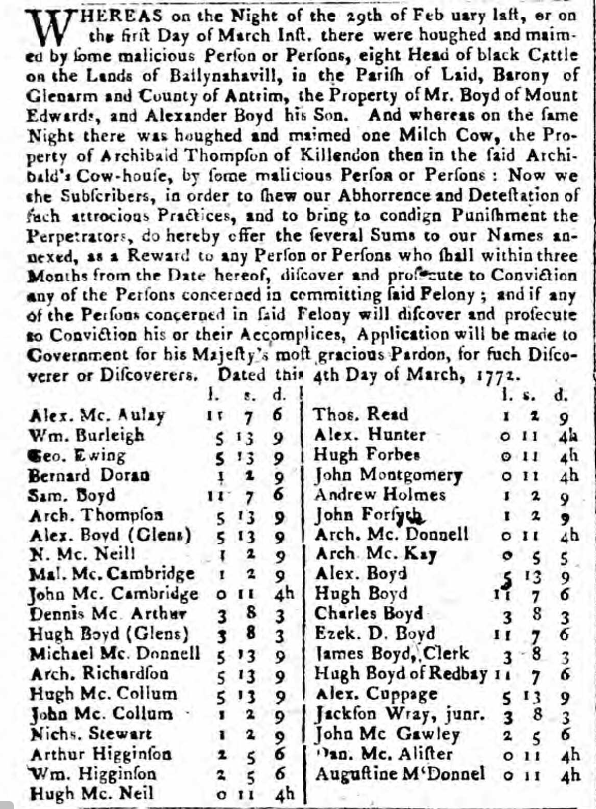
George Frederick Boyd (c1751-89) son of Samuel and Letitia Boyd
The 1822 letter says of him “was a full Surgeon in the army and died in America, where his regiment was on duty.” Unlike his older brothers, Samuel William and Alexander we are more fortunate in the survival of records of his life and career, most probably due to his career being in the army. We see that George Frederick Boyd was recorded to be Surgeon in the 84th Regiment of Foot in 1779.41 This was mid way through the American War of Independence and George’s regiment was drawn from loyalist settlers and former soldiers of the Seven Years War who had settled in what is present day Ontario & Quebec in Canada. George Frederick Boyd registered his will with the authorties in Halifax on 27 January 178942 and administration was granted to his widow Elizabeth on 25 June 1790. A transcript of the will is below.
“The Last Will and Testament of George Frederick Boyd of Halifax Esquire formerly Surgeon of his Majesty’s late 84th Regiment of ffoot being now very sick and weak of Body but of sound Mind do make this my last Will and Testament in manner and form following hereby declaring all other Wills made or said to be made by me to be null and void. First I give, devise and bequeath unto my dearly beloved Wife Elizabeth Boyd her heirs and assigns for ever my two lots of land number twelve and thirteen on the north east side Windsor Road with all the buildings, Improvements, Stock of Cattle, ffarming utensils and all other priviledges thereunto belonging in as full and ample a manner as I enjoy the same subject to all my Just Debts herein. I give devise and bequeath unto my dearly beloved Wife Elizabeth Boyd her heirs and assigns for ever my Grant of Land at the head of Milford Haven in the County of Manchester with all the Buildings, Improvements and all oyher priviledges thereunto belonging in as full and ample manner as I enjoy the same subject to the following Legacy. Item I give and bequeath unto my dear Aunt Mrs Mary Boyd now of Church Street, Ballymoney, Ireland Thirty pounds sterling. This Legacy not to be paid until a sale of the above Lands can be effected. Item I give and bequeath unto my much respected ffriend Brigadier General Archibald McArthur ffive Guineas a piece to purchase a Mourning ring. Lastly I nominate and appoint my dearly beloved Wife Elizabeth Boyd Sole Executrix of this my last Will and Testament. In witness whereof I the said George Ffrederick Boyd have hereunto put my hand and affixed my Seal at Halifax this twenty seventh day of January One thousand seven hundred and eighty nine.“
It is thought that George Frederick’s wife was Elizabeth Cunningham and it appears she remarried following his death on 2 March 1789. In a Deed Memorial43 dated 18 September 1806 we find the following:-
“Memorial of an Indented deed of assignment bearing date the 10th day of September 1806 and made between
– Benjamin Gerrish Gray of Winsor in the County of Hants and province of Nova Scotia, Clerk and Elizabeth Gray wife of the said Benjamin Gray formerly Elizabeth Boyd of Sauls Brook near Halifax in Nova Scotia America, widow and Relict of George Frederick Boyd Esquire one of the sons of Samuel Boyd late of Mount Edward in the County of Antrim and Kingdom of Ireland in Europe Esquire of the one part and
– Samuel Boyd of Carrickfergus in the County of the Town of Carrickfergus in Ireland aforesaid Esq. the nephew of the said George Frederick and son and son of the said George’s Brother Hugh Boyd of the other part
Whereby after Reciting as is therein recited said Benjamin Gerrish Gray and Eliza Gray for the Condons in said deed mentd granted sold assigned transferred and made over unto the said Samuel Boyd all their the said Benjamin Gerrish Gray and Elizabeth Gray’s right title and Interest of in and to All that and those the two Quarter lands of Cloghglass and Gortaclee and also all that and those the Janes of Beaghmore and Beaghbeg, Clettegan, Sheagh, unshenagh, Crockanacro, Claughagh, Agolaugh, Ballyfad, Tamnagilinamock, Leny, Cloghglase, Ballynalockes, Carnamady and Gortaclee orwise now called Mount Edwards with their Respective Subdenominations situate lying and being in the Barony of Glenarm in the County of Antrim To hold to said Samuel his Exors admons and assigns for the respective terms for years of said Lands then to come and unexpired and all other the Estates of said Benjamin and Elizabeth therein and which deed contains other Covenants and as to the Exon thereof by said Benjamin Gerrish Gray and Elizabeth his wife is witnessed by Robert Stannas and Lewis de Maliton both of Hallifax aforesaid Gent and said Deed and this memorial as to the Exon of each resply by said Samuel Boyd party thereto is witnessed by said Samuel Boyd party thereto is witnessed by Joseph Wright and James Anderson both of the City of Dublin attornies at Law
Samuel Bay (seal) signed and sealed in presence of Joseph Wright, James Anderson“
This deed appears to conclude the formal process by which the property and lands of Mount Edwards passed to Samuel Boyd of Carrickfergus, Co Antrim, eldest son of Hugh Boyd of Mount Edwards (c1745-78) and Mary Henry of Bravallen. It is possible that George Frederick Boyd and Elizabeth Cunningham had children but it would appear that none lived beyond 1806 as inheritance in the above deed passed to his nephew.
Captain Daniel Boyd (c1753-85), Master Mariner & Ship owner son of Samuel and Letitia Boyd
The 1822 letter says of him “was Captain of a merchant ship, trading between Belfast and foreign marts, but his vessel foundered in a sudden hurricane, off the Scottish coast, the same evening she sailed, and all the people on board were lost: he was married to Miss Burgess, sister of the late Mr. Wm Burgess, merchant of Belfast, by whom he had two children, viz. a most amiable and lovely daughter, who departed this life in the bloom of youth, and a son, who is at present in the mercantile business in the city of Dublin.“
On further research a number of pieces of evidence have been uncovered which corroborate the above writer. The first piece of evidence dates to the 17 August 1776 and a notice of marriage published in the Freemans Journal whereby Mr Daniel Boyd, mariner weds Miss Mary Anne Jane Burgess, both of Belfast. Its possible that Daniel had become a master Mariner by the late 1700s as we find his name linked to the vessels ‘Rebecca & Anne’ and ‘Prince of Wales’ in 1778/79. By 1785 his name appears linked to the brig ‘Industry’. Regarding the ‘Rebecca & Anne’, it is perhaps worthwhile recording an incident in March 1778 which attracted the attention of the local Irish press.
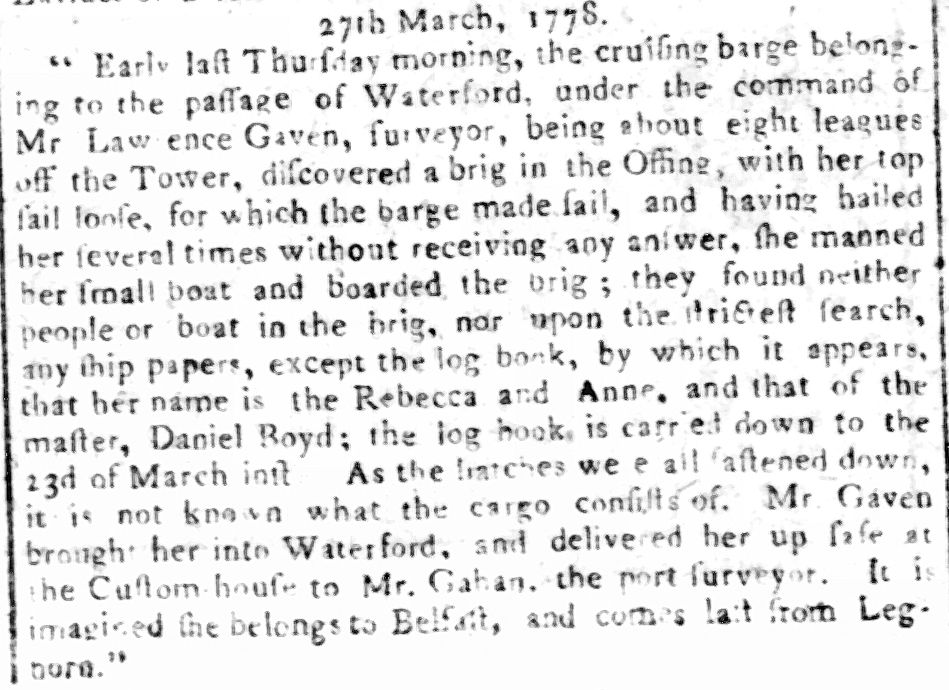
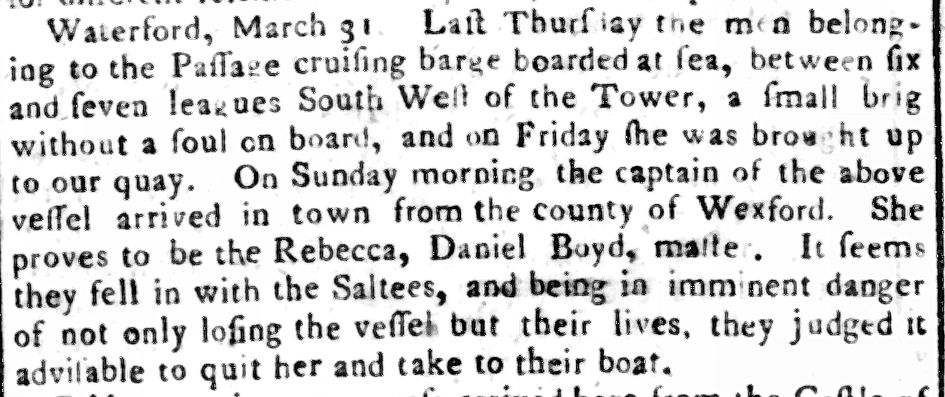
This story is indicatve of the perils facing mariners and seamen in the 18th century and sadly it would be an even more severe incident that Daniel or indeed any of his shipmates would not survive. It is likely that by 1782 Daniel and his wife Mary Anne Jane had seen the birth of their two children Samuel and Jane. Daniel was now in possession of a twenty one year lease of Mount Edwards and 40 acres of surrounding land from his brother Alexander.44 With the death of Alexander in June 1784, Daniel advertised the property of Mount Edwards and 40 acres for a new lease of 21 years on 1 December 1784.45 We then find a notice of Daniel Boyd, Master of the vessel ‘Industry’ landing a cargo of Brandy, Rum etc. from Bordeaux at Belfast.46 Sadly, Daniel Boyd did not live long with his inheritance of Mount Edwards as we find from a notice placed in the Freemans Journal on 22 December 1785 as follows:-
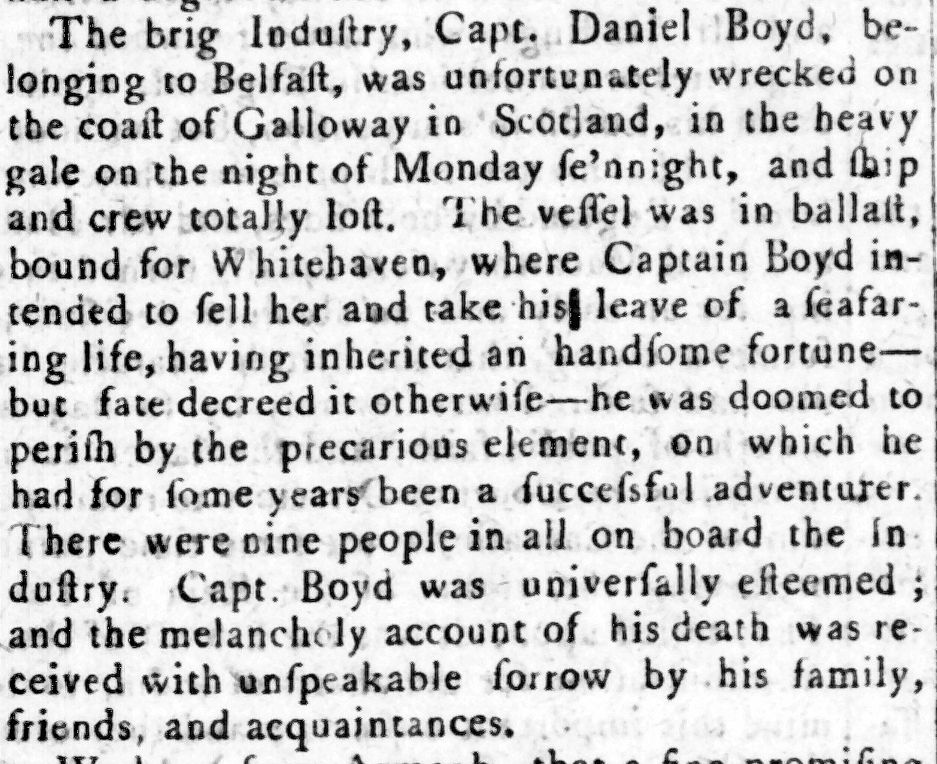
As yet we have been unable to find a grave or memorial for Daniel Boyd or indeed his wife Mary Ann Jane. Despite Daniel’s early and tragic death it would appear that his widow was secure enough to raise her two children, Samuel and Jane.
Samuel Boyd of Carrickfergus, Co Antrim Esq. JP (d aft 1825) eldest son of Hugh Boyd & Mary Henry
By 1797 and the death of Letitia Boyd in Ballymoney, Co Antrim the Boyds of Mount Edwards had limited options for male heirs as to whom the estate could pass. By seniority it would appear Samuel Boyd of Carrickfergus was the primary candidate as evidenced by the deed of September 1806 above. However a financial problem arose within the wider family concerning loans taken by Samuel Boyd of Carrickfergus, Co Antrim from his sister Lettia and her husband Robert Johnson and also his other sister Mary. This protracted legal affair can be seen through a series of Irish Deed memorials as follows:-
10 September 1806 – No. 398063
26 November 1806 – No. 396886
9 December 1806 – No. 397139
31 December 1806 – No. 398156
12 January 1807 – No. 398000
30 January 1807 – No. 398062
For the sake of brevity we have not detailed the transactions except to say that in the end the Mount Edwards estate passed to Samuel Boyd of Carrickfergus by 30 January 1807. In July 1817 we find it recorded that the Rt Honorable the Lord Chancellor appoints Samuel Boyd of Mount Edwards a Magistrate for Co Antrim.47
On 5 September 1820 Samuel Boyd appears to have been instrumental in the opening of a school for local children not far from Mount Edwards. The property, complete with dedication stone above the front door, is still in existence today as a domestic property at 63 Middlepark Road, Cushendall, Co Antrim and we are grateful to Mr Donnell O’Loan for the following images. Samuel Boyd was evidently satisfied with his patronage of the school and later referred to it in a farewell address printed in the Belfast Newsletter.
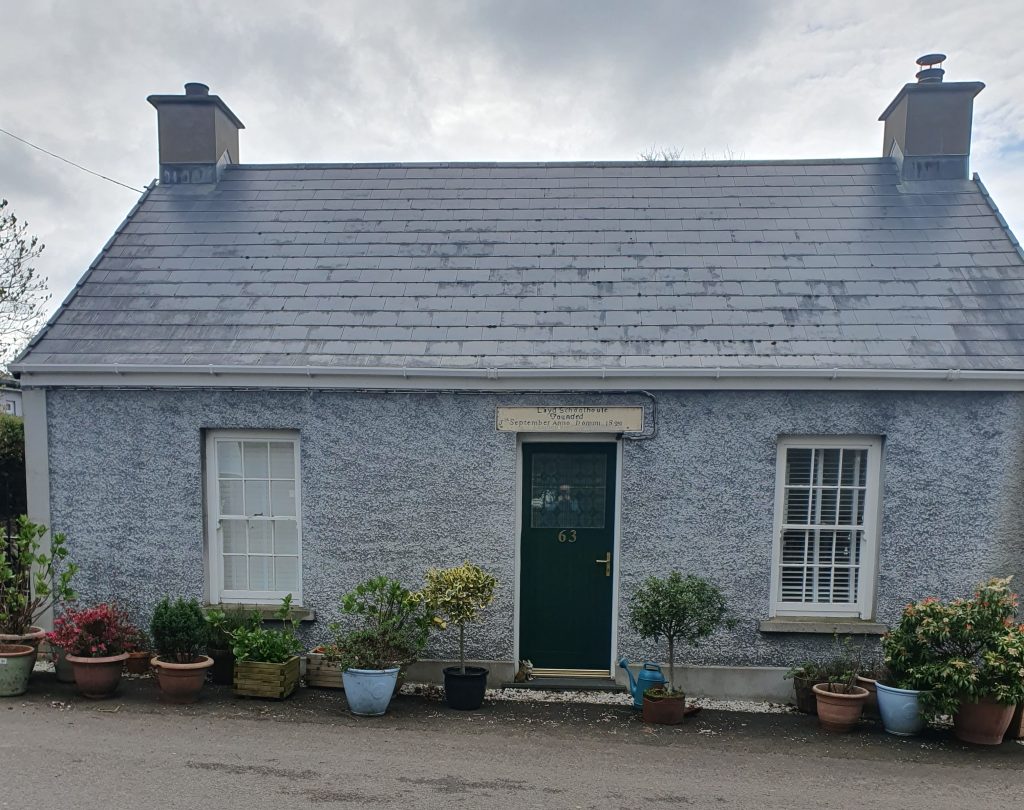
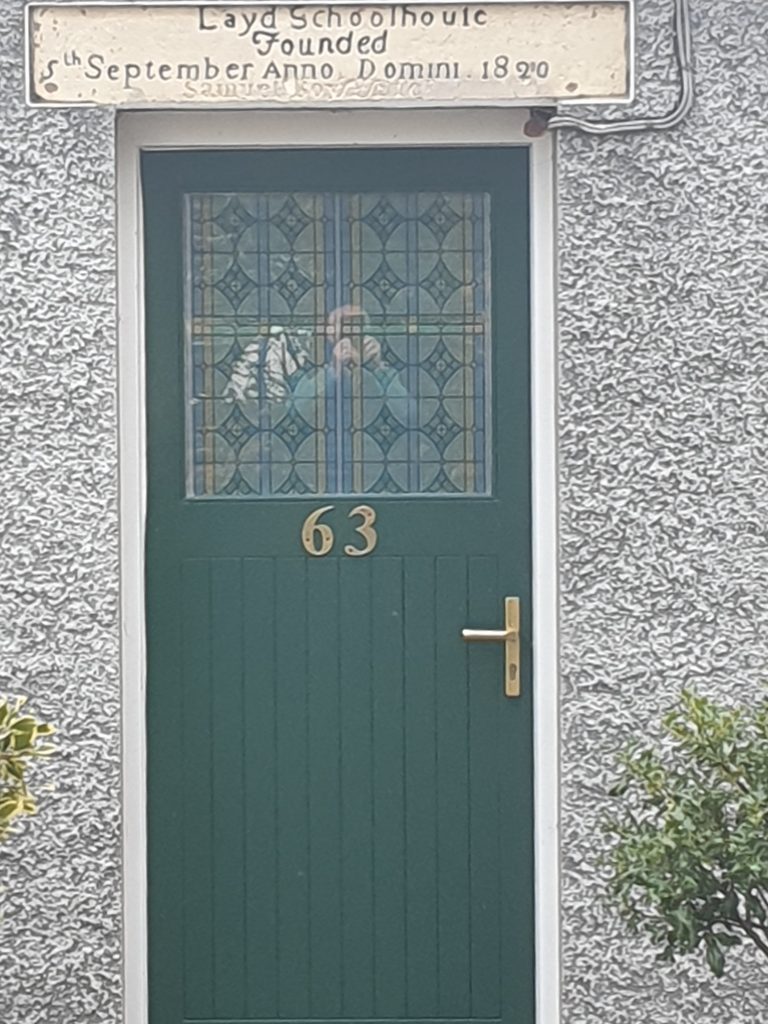
By the beginning of 1822 Samuel Boyd was preparing to sell the Mount Edwards estate48 although no specific reason is known. However the same year it appears that Samuel Boyd of Mount Edwards JP became involved in an acrimonius affair with the local Postmaster of Cushendal, a Mr McDonnell. Various charges were aimed at Mr McDonnell and it appears that these involved testimony from two former employes, Mr Young and Mr Kennedy. However Samuel Boyd’s actions provoked the ire of some in the local community and the battle lines where struck. Over most of the year accusations and investigations arose from the affair and resulted in open letters published in the local press. In the end Mr McDonnell only faced a rebuke from senior officers of the Post Ofice for being absent for a period without permission. Also despite protestations from individuals in the local community to have Samuel Boyd stripped of his office as a Justice of the Peace for Co Antrim he remained in office until at least 1825. The estate remained with Samuel Boyd JP until 21 May 1823 when it was conveyed to Maj Genl Alexander Cuppage of Claregrove, Dublin of the Honorable the East India Company for a total sum of £5,600.49
Before leaving Mount Edwards Samuel Boyd conveyed his thanks to friends and neighbours in the parish of Layde in an open letter published in the Belfast Newsletter on 15 April 1823:
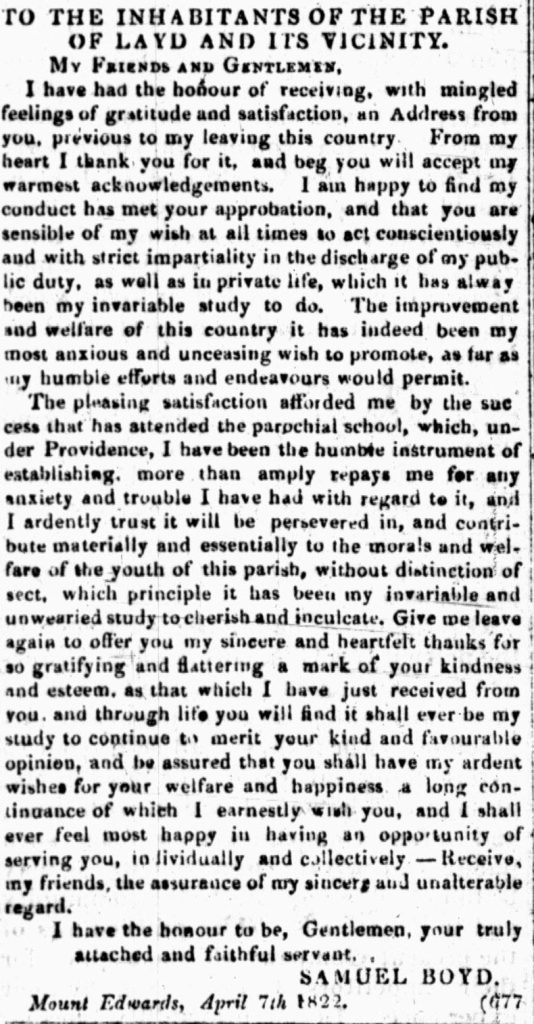
Samuel Boyd removed Mount Edwards to reside at Joymount Court, Carrickfergus, Co Antrim. He is then referred to as Esq.50 On 21 December 1824 Samuel Boyd Esq. is recorded51 as one of up to forty magistrates of Co Antrim at the proclamation of a new constabulary and a year later he is recorded52 passing £3 to the poor of the parish of Carrickfergus following its receipt as a fine by someone for breaching the terms of their liquor license. Nothing more is known of Samuel Boyd Esq. JP after this date. From a deed53 dated 12 March 1829 reference is made to “Samuel Boyd then late of Mount Edwards in the County of Antrim aforesaid Esquire deceased” confirming his death sometime 1825-29.
Mount Edwards remained in the Cuppage family for many years. In the Valuation of Mount Edwards (1923-29) we find Alexander Delargy, a farmer, resident on the property under the Representitives of Alexander Cuppage.
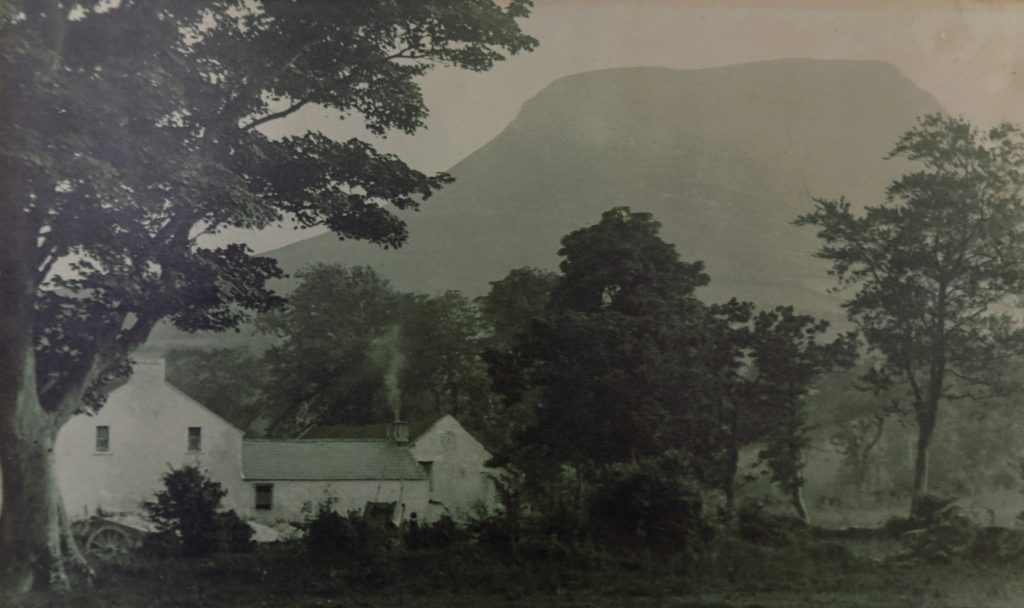
Reproduced courtesy of the McLaughlin family of Mount Edwards, current owners
Samuel Boyd (c1777-1858) son of Daniel Boyd and Mary Anne Jane Burgess
The only son of the late Captain Daniel Boyd he was likely the last surviving male heir of the Boyds of Clontyfinnan and Mount Edwards after the probable death of his cousin Samuel of Carrickfergus c1825. The year of his birth is difficult to ascertain as sources appear to differ on a likely birth year.
We can say that he married Helena Rowan of Mullans, Co Antrim in November 1794 in Ballymoney, Co Antrim.54 It is possible that when his father tragically died in 1785 he was sent into the care of his Aunt Mary in Ballymoney. His Aunt was likely of significant financial means and she continued living in her widowhood in Ballymoney until her dath in 1831.
We know that Samuel and his wife had moved to Dublin by 1801 for the birth of their children are recorded in the registers of Eustace Street Presbyterian Congregation.
| Name | Birth date | Baptism date |
| Daniel | 23 October 1801 | 8 November 1801 |
| William Burgess | 27 March 1803 | 25 April 1803 |
| Jane | 1 October 1804 | 21 October 1804 |
| Alexander | 25 April 1806 | 18 May 1806 |
| Letitia | 5 August 1807 | 30 August 1807 |
| Hugh | 25 June 1809 | 7 August 1809 |
| Helena | 26 March 1811 | 26 May 1811 |
| George Frederick | 1 January 1813 | 9 February 1813 |
| Ann Jane | 16 May 1815 | 23 July 1815 |
| James | 14 June 1817 | 19 August 1817 |
The number of children born to Samuel and Helena certainly poses the question of Helena’s age at the time of her marriage which may have been only seventeen giving her a birth year c 1777. Unfortunately neither Established church or Presbyterian records are available for Ballymoney for this period.
There is little or no record of Samuel in the papers before 1820 and it is likely that he had spent those years in employment, possibly learning business and making contacts. From an 1822 deed55 we see “that William Burgess of Belfast in the County of Antrim Esq did by his last will and testament in writing bearing date the tenth day of Novr one thousand eight hundred and seventeen after bequesting and disposing of diverse parts of his Estate and effects leave and bequeath to the said Samuel Boyd the sum of one Thousand pounds stg to be paid to him after the death of his the said William Burgess ‘s wife Rebecca Burgess“. William Burges was Samuel’s uncle and although this legacy from his uncle’s will became security against a debt it is likely that his uncle’s death may have been the catalyst to him moving into business for himself.
By 1820 we find Samuel Boyd running a Delf and Glass Warehouse business at East Arran Street, Dublin56 and by 1822 he has a substantial grocery business called the ‘Bellview Distillery Stores’ located at 3 Queen Street, Dublin.
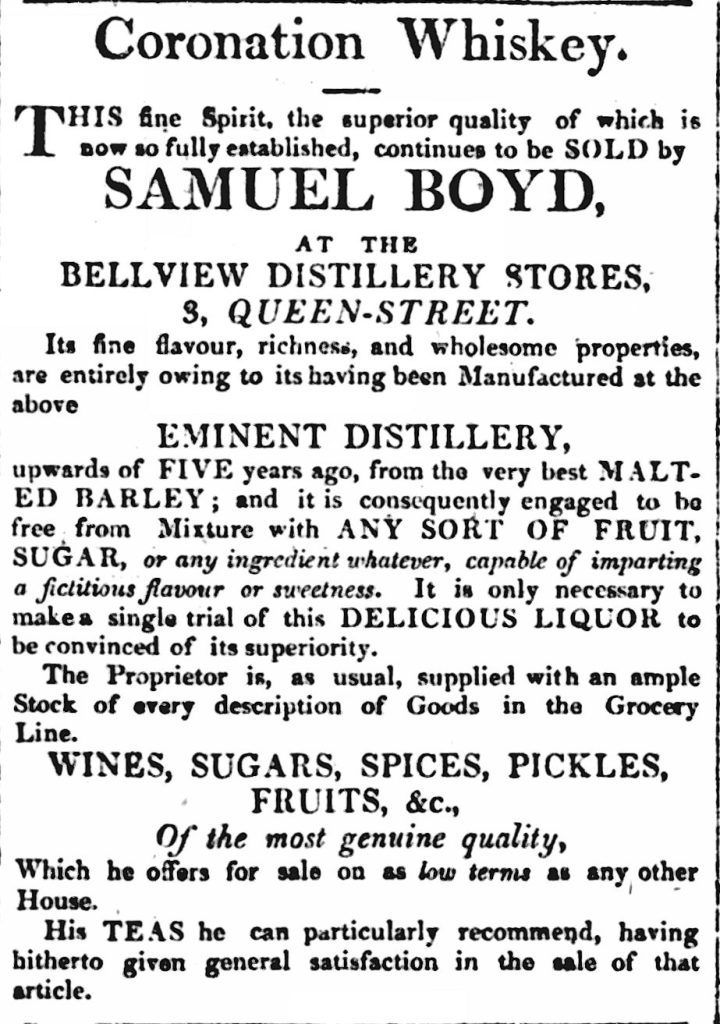
Incredibly a trade card survives from this period and is held in the collections of the National Library of Ireland.57 The associated remarks with the NLI entry state that Samuel was in business at 3 Queen Street, Dublin 1820-24 according to the Dublin directories.
At some time prior to October 1825 we presume Samuel’s wife Helena died. No record has been found amongst the local papers or the usual sources. On 24 October 182558 we find the marriage of Samuel Boyd to Margaret Glenholme in Strand Street Prersbyterian Church. Margaret was the daughter of the late Hugh Glenholme of Co Londonderry and resided in Blessington Street, Dublin at the time. By March 1826 Samuel is now residing at 42 Arran Quay, Dublin and intent on moving his business to his residence. An advert correspondingly appeared in the Dublin Morning Register (see below).59
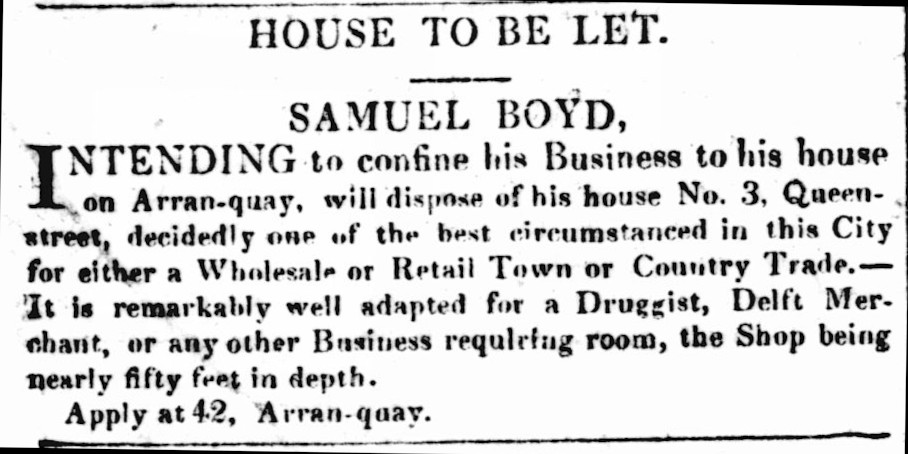
On New Years day 1828 Samuel’s daughter Jane is married in Eustace Street presbyterian Church, Dublin to Leonard Johnson of Ballymoney, Co Antrim.60 Leonard was the son of Robert Johnson and letita Boyd, Samuel’s cousin. Sadly Leonard Johnson died a few years later on 26 October 1830 leaving his widow Jane and most likely unborn son Leonard along with a daughter Jane Boyd.
It is thought Samuel’s son William Burgess Boyd became a shopkeeper in Mullingar, Co Westmeath where he married Catherine Keena on 7 December 1830.
After just a few years in August 1831 we find a notice that Samuel is retiring from business and selling his premises and fittings etc. at 42 Arran Quay, Dublin.
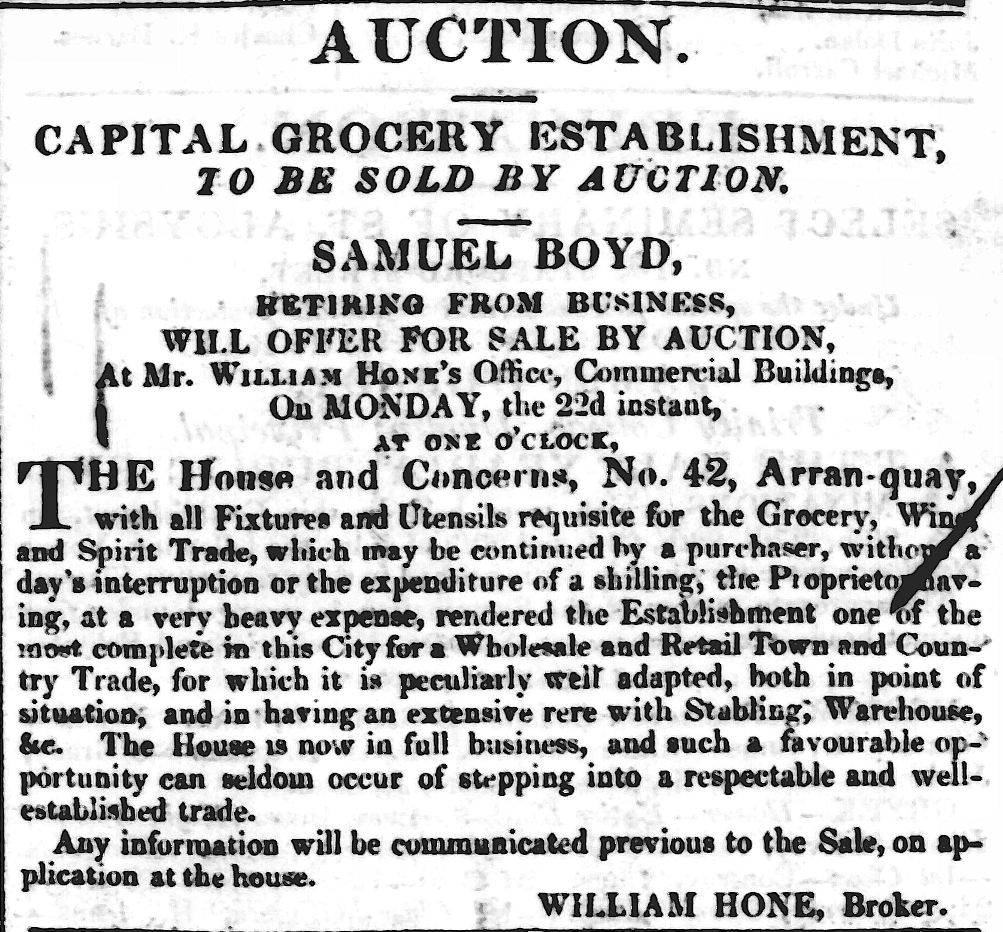
Dublin Morning Register – 13 August 1831
Then the following year we see that the sale of his business may have been an attempt to head of his creditors. In May 1832 he is declared insolvent61 and listed for the 26 May62 to hear his petition.
It appears Samuel may also have attempted to resolve his indebtedness by borrowing money by way of a mortgage63 from his son William Burgess Boyd. William may have received a legacy from his uncle William Burgess from whom he undoubtedly took his name. Unfortunately the outcome of Samuel Boyd’s petition regarding his insolvency is unknown and no further reports or advertising are found in the press for many years. On 13 October 1839 Samuel’s grandaughter Jane Boyd Johnson dies aged 11 and is buried in Mount Jerome and tragically just 2 years later on 24 October 1841 his grandson Leonard Johnson also 11.
We believe by 1846 Samuel had started up again in business, this time with his son George Frederick. The new business ‘Samuel Boyd & Son’ was based at 13 Arran Quay, Dublin not far from his previous premises and remarkably from the above advert the mainstay of the business was the sale of bottled porter from the famous Messrs. Guinness, today arguably one of the most internationally famous brands in the world.
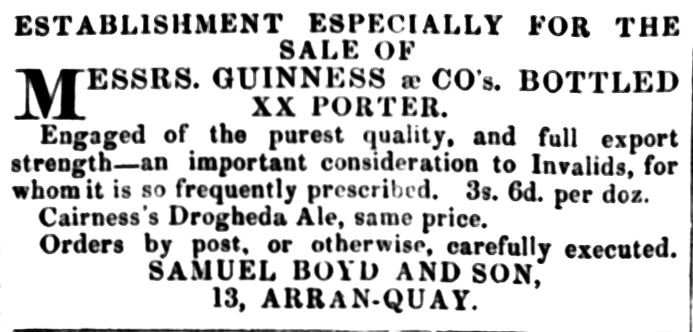
Sadly on 29 December 1847 Samuel’s second wife Margaret died and was buried in Mount Jerome Cemetery near Harold’s Cross, Dublin. Earlier the same year on 26 June his daughter Ann Jane had died and was also buried in Mount Jerome.
On 21 July 1848 Samuel’s son Hugh, who previously had resided in Galena, Illinois, USA married Mary Boyd Johnson, his second cousin at Ballymoney Presbyterian Church, Co Antrim. Sadly Hugh would later commit suicide on 8 April 186964 at his residence in Kerr Street, Portrush, Co Londonderry and his wife Mary Boyd would die the following year on 18 August 1870. We do not believe there was any issue to their marriage.
Returning to Samuel Boyd we can record that he died65 at his residence in Arran Quay on 6 April 1858 and was buried in Mount Jerome Cemetery, Dublin (Plot B026-00165). Of Samuel’s remaining children it is thought that sons Daniel, Alexander, James and daughter Letitia possibly died young as no evidence has been found of them after their births/baptisms. William Burgess Boyd was still living in Mullingar, Co Westemeath on 18 July 1832 but nothing further has been found on him after that date. Helena remained a spinster and appears to have resided with her brother George Frederick at 9 Victoria Street, Dublin where she died on 15 March 1879. She was also buried in Mount Jerome. Regarding James the youngest son, nothing further has been found to date. No will has been found for Samuel Boyd to date but we presume that the business in Arran Quay had passed to his son George Frederick Boyd.
George Frederick Boyd (1813-80), Wine Merchant of 9 Victoria Street, Dublin
As mentioned above we believe that George Frederick Boyd had followed his father into the business of a Wine Merchant living and operating in business at 13 Arran Quay, Dublin. On 26 November 186266 he marries his apparent near neighbour Georgina Ellis Kinder at St Michan’s Parish Church, Dublin. About 2 years later George and Georgina had a daughter Helena Georgina. No other records have been found to date of any other children so we presume that Helena Georgina was an only child. It is thought that George Frederick Boyd carried on in business as a tea and wine merchant at 13 Arran Quay, Dublin until around 1873 before likely retiring. In Thoms Almanac for 1875 he is listed as G F Boyd Esq. of 9 Kingsland Park, Dublin and by 1876 residing at 9 Victoria street, Dublin.
Earlier in this post we referred to remarks by Amy Isabel Young in her publication ‘Three Hundred Years in Inishowen’. You will recall that she referred to a painting of Capt. Hugh Boyd (c1687-1731) in a house at 9 Victoria street, Dublin. We now know that this was the home of George Frederick Boyd. However Amy isabel Young nee Stuart was born in 1885 and if she saw the painting first hand it must have been as a young child or perhaps this information came to her from someone else. George Frederick Boyd died on 8 August 1880 at 9 Victoria Street, Dublin. On 8 October 1884 George Frederick and Georgina’s only child Helena Georgina Boyd married Sergeant George Roberts (Royal Artillery) in Holy Trinity Parish Church, Rathmines, Co Dublin.
With the death of death of George Frederick Boyd in 1880 we believe that he may have been the last of the male Boyd descendants of Clontyfinnan and Mount Edwards, Co Antrim. Of course new information may still arise to reveal other possibilities.
- ‘Men and Arms’ – The Ulster Settlers c1630, R J Hunter (2015 Ed.) ↩︎
- PRONI Ref. T694/1 ↩︎
- Dobbs’ Report, viii + 103 pp., ISBN 9 781906 689872 (softback) and 9 781906 689889 (hardback), [2018], p.6 ↩︎
- Irish Deed Memorial 13974 – Boyd to Ker – 1 May 1718 refers in text to indenture of 1675. ↩︎
- ‘Three Hundred Years in Inishowen’, Amy Isobel Young, (2018 Ed.), p.292 ↩︎
- PRONI Ref T828/20 ↩︎
- Lt Col JOHN HAMILTON of Mount Hamilton, Co Armagh died 28 January 1714 Intestate – see PRONI Ref. D556/8. He took leases of various lands in Co Antrim from the Earl of Antrim. ↩︎
- FRANCIS ANDREWS of Carnkirn, Grange of Drumtullagh Parish, Co Antrim, d. c10 Dec 1708 probably d.s.p, great uncle of the Hon. Francis Andrews 1718-74 ↩︎
- STIRLING, THOMAS; s. of Rev. Robt. Stirling, Dervock (1635-99); educ. Glas. 1692; lic. Route Pres. 13 May 1702; ord. Dervock, 22 June 1703; retused to take Abjuration Oath & was prosecuted; mar. Mary Wallace, Faughanvale, 1709; d. 20 Nov. 1718. from ‘Fasti of the Irish Presbyterian Church 1613-1840, McConnell’, p.122 ↩︎
- PRONI Ref. D2651 ↩︎
- PRONI Ref. D2651/1/2 ↩︎
- ROWAN, ANDREW : eldest s. of John Rowan, Greenhead, Govan; bro. of Rev. Robt. Rowan, Maghera (1658-61). Ord. Clough, Co. Anttim, 1659; conformed to Episcopacy, 1661; adm.
rector of Dunaghy (Clough), 13 Sept.. 1661. He mar. (1) dau. of Capt. Wm. M’Phedris, Camglass, Co. Antrim ; (2) Alice Dunlop. Died 1717. Rev. John Rowan, Rector of Ballynagappog, Rathfriland, was a SON. [Reff. : Adair’s Narrative, 626 : Reid, ii, 205 : Burke’s Landed Gentry, 525.] from ‘Fasti of the Irish Presbyterian Church 1613-1840, McConnell’, p.47 ↩︎ - Irish Deed Memorial 18741, Vol.31, p.193 – 5 July 1721 ↩︎
- DUNLOP, SAMUEL. b. near Dervock; educ. Glas. and Edin., M.A. (Edin.) 1701; lic. Route Pres. 13 Feb. 1705/6; extreme subscriber; ord. Athlone, 29 April 1706; res. 1722; ins. Ramoan before 14 May 1723; res. Jan. 1733/4; officiated at Minola and Branagh, Co. Mayo; received R.D. 1737. Died 1738. [Reff.: Mins. Derry Sub-Syn. 363 ; Mins. Route Pres. 302 : Hist. & Lit. Memls. 1, 226.] – see also Glens of Antrim Historical Society – THE GLYNNS Vol. 26 (1998) – ‘The Reverend Samuel Dunlop, Minister of Ramoan, 1724-1733’ by V. Rev. Dr. A.W.G. Brown ↩︎
- Dobbs’ Report, viii + 103 pp., ISBN 9 781906 689872 (softback) and 9 781906 689889 (hardback), [2018], p.20 ↩︎
- An Historical Account of the MacDonnell’s of Antrim, Rev G Hill (hereafter Hill’s MacDonnells of Antrim), p.361 ↩︎
- Ibid, p.362 ↩︎
- State Papers William III, Dec 14th 1700 Whitehall, SP44 101 p.155 ↩︎
- Hill’s MacDonnells of Antrim, p.362 ↩︎
- See note 10. ↩︎
- Hill’s MacDonnells of Antrim, p.362, p.362, Footnote 17 ↩︎
- https://en.wikipedia.org/wiki/Mary_Edwards_(1705–1743) ↩︎
- Irish Deed Memorial 18707, Vol.30, p.314 – 13 April 1721 ↩︎
- See note 10. ↩︎
- Irish Deed Memorial 29980 ↩︎
- Ibid 62781 ↩︎
- Ibid 62577 ↩︎
- Ibid 66179 ↩︎
- Ibid 83854 ↩︎
- Ibid 108353 ↩︎
- Ballymoney Old Church Graveyard, Dorothy Arthur (2008), pp.406-9 ↩︎
- Irish Deed Memorial 65916 ↩︎
- Richard Dobbs, inst. May 13 (D.R.); was descended from the Castle Dobbs family ; in early years was an officer in the Navy, subsequently ent. T.C.D. where he became B.A. 1723 ; Fellow 1724, M.A. 1726 ; B.D. and D.D. 1750. He was R. Desertcreat from 1731, but exchanged it for this (Clogherny). He held also the R. Lisburn from 1749 with Clogherny till his death in 1775. He m. Mary, dau. of William Young, widow of Cornet McManus. His P. Will, dated 16 May, 1775 (codicil 18 May), proved 10 Nov., 1775, mentions his wife Mary, eldest son Richard, who became Dean of Connor in 1775, and d. Feb. 4, 1802 (see C.F. Ill, 255, 267), dau. Maria, sons William and Francis ; left £20 to poor householders of Lisburn – Armagh Clergy & Parishes, Leslie p.178 ↩︎
- Betham’s Will Abstracts ↩︎
- Treasury Warrants: June 1718, 21-25 ↩︎
- https://threedecks.org/index.php?display_type=show_crewman&id=9520 ↩︎
- Belfast Comercial Chronicle – 5 December 1831 ↩︎
- See note 29. ↩︎
- Irish Deed Memorial 103933 ↩︎
- Ibid 231050 ↩︎
- The Edinburgh Advertiser – 22 January 1779 ↩︎
- The National Archives (UK) – Ref. PROB 11/1307/318 ↩︎
- Irish Deed Memorial 398063 ↩︎
- Belfast News Letter – 26 December 1794 ↩︎
- Ibid – 1 December 1784 ↩︎
- Ibid – 8 April 1785 ↩︎
- Ibid – 22 July 1817 ↩︎
- Belfast Commercial Chronicle – 8 May 1822 ↩︎
- Irish Deed Memorial 529007 ↩︎
- Pigot & Co., City Of Dublin And Hibernian Provincial Directory (1824), Carrickfergus ↩︎
- Belfast Commercial Chronicle – 25 December 1824 ↩︎
- Ibid 21 September 1825 ↩︎
- Irish Deed Memorial 566853 ↩︎
- Belfast News letter – 21/24 November 1794 ↩︎
- Irish Deed Memorial 524299 ↩︎
- https://www.from-ireland.net/wilsons-1820-dublin-directory/?record=522 ↩︎
- National Library of Ireland Ref. PD 2175 TX 36 ↩︎
- Weekly Freeman’s Journal – 5 November 1825 ↩︎
- Dublin Morning Register – 9 March 1826 ↩︎
- https://www.familysearch.org/en/search/record/results?count=75&q.filmNumber=100238&q.givenName=leonard&q.surname=johnson ↩︎
- Belfast Commercial Chronicle – 9 May 1832 ↩︎
- Dublin Mercantile Advertiser – 21 May 1832 ↩︎
- Irish deed Memorials 545685 (20 May 1825) and 580327 (18 July 1831) ↩︎
- Northern Whig – 30 April 1869 ↩︎
- Dublin Evening Post – 10 April 1858 ↩︎
- Belfast News Letter – 2 December 1862 ↩︎