The subject of this relatively short article is Major George Boyd who is evidenced primarily from a memorial tablet on the interior walls of old Derrykeighan church which also mentions his wife Jean Gordon who predeceased him in 1679.
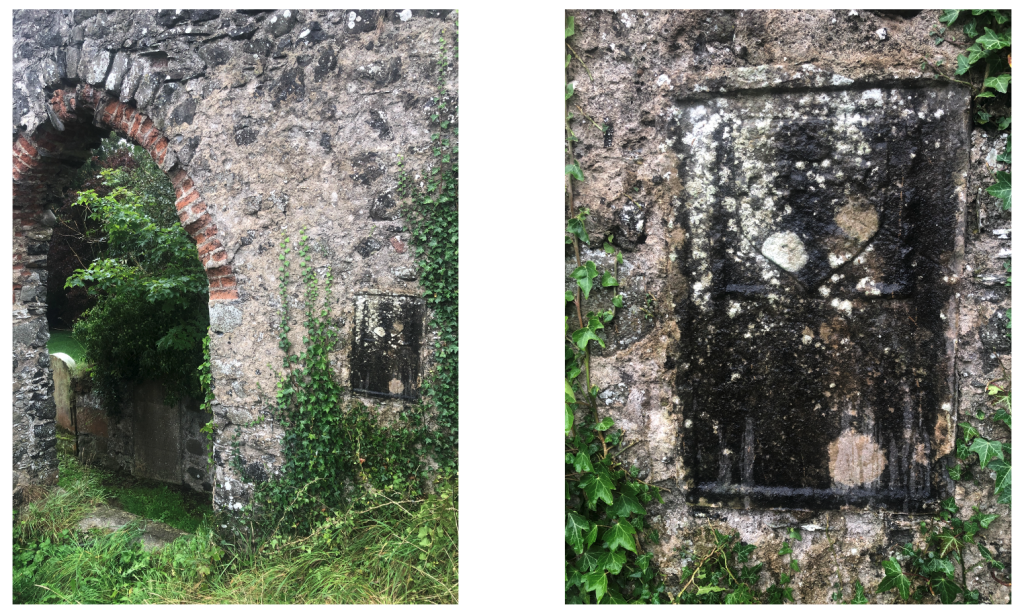
east gable of old Derrykeighan Parish Church.
The tablet has been referenced in a number of publications including the Memorials of the Dead in Ireland in 18901 which reproduces the inscription from the memorial as follows:
[Coat-of-arms, with initials G.B., J.G ]
“HEIR • LYETH • THE • BODY OF | MAYOR •
GEO • BOYD | WHO • DIED • THE • 14 • OF | JAN • THE
79 • YEAR • OF • HIS | AGE • ANO • 1688 |
WITH • HIS • WIFE • JEAN | GORDON • WHO •
DIED • OCTOBER • THE • 8 • 1679.”
An apparent rubbing or sketch of the heraldry on the tablet was included in Thomas Camac’s publication2 on the history of Derrykeighan which allows us to make a reasonable attempt to reproduce how it might have originally looked:
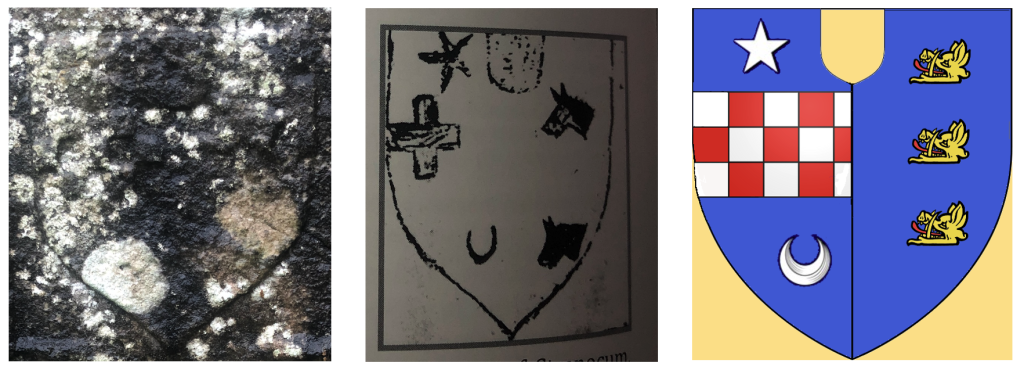
The arms on the tablet would appear to produce those of Boyd impaled with those of Gordon which would relate well to the wording below the arms as recorded in 1890. It is obvious that the wear to the tablet was substantial by 1890 and unsurprisingly it is very difficult today to discern any detail without the knowledge of these earlier recordings.
Curiously this tablet appears to have gone unnoticed by Rev George Hill in his publications on north Antrim in the mid 19th century. However it was included in the report of J Stokes as one of the early ordnance surveyors in the 1830s during their visits to Derrykeighan. He writes3:
“Fourthly, a freestone inside in the east gable of the church: “Here lyeth the body of Major George Boyd, who died the 12th of January the 79th year of his age, with his wife Jean Gordon, who died October the 8th 1679”“
The transcript by the surveyors appears to state that our subject was ‘Major’ George Boyd whereas the transcript in the Memorials of the Dead states ‘Mayor’. Thomas Camac provides his own insight by stating “Mayor is probably a mistake for major. Nothing certain is known of the deceased, who were no doubt some of the Lisconnan, Carncoggy or Carncullagh family.”
If our subject was indeed a mayor it is likely that his burial location would suggest a proximity to the two most likely mayoral positions in his adult lifetime i.e. Derry and Coleraine4. However examination of mayoral lists available online and elsewhere would seem to rule out his being a mayor of either place. So our subject was more likely a Major and this would be unsurprising given the time period in which he lived.
Wonderfully a contemporary document has been found dating to 1661 which relates to a Major George Boyd in Ireland but included amongst the archives of the National Records of Scotland.5 The document dated 12 July 1661 is referred to in its description as an “Obligation by Major George Boyd, County Antrim, to Sir George Montgomery of Skelmorlie for 100 merks.” Thankfully we were able to obtain a digital image of the document and a transcript is given below thanks to the help of Diane Baptie:
“{Note: This bond is damaged towards the end. This part covered the conclusion and so would have taken a specific form. I have suggested what the missing word(s) or letters might have been in italics}
I Major George Boyd in Bellyhill in the parish of Reiled w[i]thin the county of Antrim w[i]thin the kingdome of Ireland Grants me to hav borrowed & receaved from Sir Robert Muntgomerie of Skelmurlie all & haill the sowm of ane hundreth merks money in Scotland wherewith I grant me satisfied discharging him therof and q[uhi]lk sowm of ane hundreth merks Scots with the ordinar a[nnua]lrent therof from the dait of thir p[resen]te unto the terme of pay[men]t underwryttin I oblis me my aires exe[cuto]rs successors & intromettors w[i]th my guids & geir q[uha]tsomever to pay and deliver to the s[aid Sir Robert Muntgomerie his aires exe[cut]ors & assignais at the terme of Whitsonday nixtocome in the year of god Javjct Sixtie twa years with the sowm of twintie pounds money of expenses & penaltie by and attour the s[ai]d prin[cipa]ll sowm & a[nnua]lrent in case of not thankfull pay[men]t therof at the terme forsa[i]d & togither also with the ordinary a[nnua]lrent of the s[ai]d prin[cipa]ll sowme ay & sua long as the s[ai]d prin[cipa]ll sowme shall remain unpayed efter the s[ai]d terme of Whitsonday nixtocome & for the more security I am content & consents thir {presents be} reg[ist[rat in the court books of …yrice or any uth[e]r {to have the strength of ane decreit} authoritie …. Interponed that {lette}res of horning and poinding & warding & uth[er]rs may pas {heirupon as} affeirs & th[a]t upon a simple chairge of six dayes allenerlie & for th[a]t effect constitutis {name(s) not filled in} my proc[ura]tors conjunctly & severally in most ample forme of proc[ura]tory In witness q[uhe]rof wryttin be Mr Ro[ber]t Pattown schoolm[aste]r in Largo I hav sub[scrivi]t thir p[rese]nts at Largo the twelfth day of Julij this year of god Jajvjct Sixtie on years befor thir witnesses James Boyd broth[e]r to the s[ai]d George Boyd merchand in Largo & the s[ai]d Mr Robert Pattown
Their signatures“
Examination of the document allows us to make a number of observations. Firstly Major George Boyd was residing or billeted in the townlands of Ballyhill Upper & Lower in the parish of Killead, Co Antrim at the time the document was recorded. Secondly he refers to Sir Robert Montgomerie of Skelmorlie i.e. 3rd Baronet in Ayrshire, Scotland and thirdly he mentions his brother James Boyd, a merchant residing in Largo, Fife, Scotland who witnessed the document.
Whilst the document may be relating to our subject its reference to Ballyhill problematically places him some 40 miles south of Derrykeighan at the time of writing. However we should consider his military occupation may be a factor. More important may be the link to Sir Robert Montgomerie of Skelmorlie.
From our earlier article on the Boyds of Portencross readers may remember that Robert Boyd, 6th Laird of Portencross had married Jean Montgomery of Skelmorlie c15956 as evidenced by a marriage contract.7 Interestingly the marriage contract is contained in the same archive as the bond with the National Records of Scotland i.e. papers of the Montgomerie Family, Earls of Eglinton.
Examination of the testament of Jean Montgomery dated 19 December 1621 reveals the names of her children with Robert Boyd 6th Laird of Portencross:
“Legacie.
At Portincors, the xix day of December, the zeir of God jaivic. and twentie ane zeiris, the uhilk day Jeane Montgomerie nominat Robert oyd of Portincors, hir husband, executour. em, my will, and I ordane my husband, to help ur bairnes, Nans, Elupetk, and Barbara Boyds, ;ir this manor, viz. to Nans viii c. merks, to peth vii c. merkis, and to Barbara fyve hun- rith merks. And to our eldest sone Robert, ane undrith merks, and ane brounc naig, to George, ie hundrith merkis, to Archibald tlirie hun- rith merkis, to Gavin thrie hundrith merks, and James thrie hundrith merks. And farder, I quiest my husband, for the love that has been betwixt my husband and me, and for the favour he beiris to our bairnes abonewritin..”

We can clearly see evidence for sons George and James which may be the same persons as mentioned in the bond as brothers. We also know that George Boyd, son of Robert Boyd 6th Laird of Portencross was a witness to his fathers marriage settlement with Jeanne Ezat in 1623.8
If we add the information on our subject along with an abbreviated tree of the families of Boyd of Portencross and the Montgomeries of Skelmorlie and their known connections it provides strong evidence that our subject is likely a son of Robert Boyd 6th laird of Portencross and Jean Montgomery of Skelmorlie. If that is indeed the case then the bond referred to in 1661 was between Major George Boyd and his 1st cousin once removed Sir Robert Montgomerie, 3rd Bt Skelmorlie.
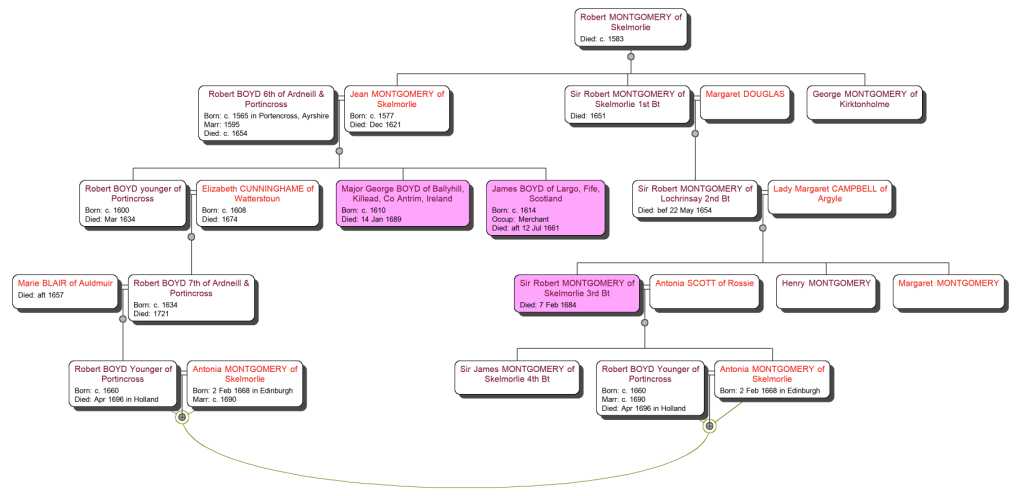
Whilst the evidence is fairly good a search was made for further information.
In his excellent work on the Covenanter Army9 of the 1640s David Stevenson lists the officers of the Earl of Eglinton’s regiment at Carrickfergus, Co Antrim on 13 September 1642 in which we find a Captain George Boyd in command of just under 200 men. Then on 15 April 1645 we see amongst a list of soldiers granted honorary burgesses of Glasgow, “Boyd, Major George“.10
Based on the evidence provided we believe that the Major George Boyd buried in old Derrykeighan parish church, Co Antrim is a son of Robert Boyd 6th Laird of Portencross and Jean Montgomery of Skelmorlie. Further he served initially from at least 1642 under the Earl of Eglinton in the Covenanter Army of Major General Robert Munro until at least 1645 but more likely until c1660 and the restoration of the Monarchy under Charles II.
Unfortunately no further records have been found specifically mentioning a Major George Boyd and more particularly a marriage to a Jean Gordon. However we note that the reknowned genealogist and historian Philip Crossle mentioned the memorial tablet in old Derrykeighan church in a serialised work entitled ‘The Gordon Clan in County Antrim‘ which was published over several weeks in the Ballymena Observer11 in 1911. Although he does not provide a specific identity for Jean Gordon he appears to suggest by inclusion of the tablet transcription that she was a relation of the Gordon family that settled in the parish of Armoy, Co Antrim in the townland of Balleny.
Returning to the remarks of Thomas Camac in his history of Derrykeighan he had suggested that Major George Boyd was connected to the local Boyd families of Lisconan, Carncoggy and Carncullagh. This research would seem to prove that he was indeed correct in that statement. Our belief is that Major George Boyd was a nephew of Thomas of Carncoggy and Archibald of Carncullagh.
- Memorials of the Dead in Ireland, Vol 1 (1890), p.129 ↩︎
- History of Derrykeighan Parish for Three Centuries, Thomas Camac (1908), p.77 ↩︎
- Ordnance Survey Memoirs of Ireland – Parishes of County Antrim V 1830-5, 1837-8 Vol 16 (1992), p.87 ↩︎
- ACTS OF THE CORPORATION OF COLERAINE, 1623–1669, IMC (2017), Brid McGrath ↩︎
- National Records of Scotland (NRS) Ref. GD3/2/51/24/1 ↩︎
- Memorials of the Montgomeries, Earls of Eglinton, (1859) William Fraser, p.158 ↩︎
- NRS Ref. GD3/2/10/26 ↩︎
- Register of the Great Seal of Scotland, Vol 9, p.211, No.587 ↩︎
- Scottish Covenanters & Irish Confederates, (2004 Ed.), David Stevenson, p.333 ↩︎
- Burgesses and Guild Brethren of Glasgow (1573-1750), p.116 ↩︎
- Ballymena Observer, 3 February 1911 ↩︎