The Hutchinson Charity, whilst far from being culturally unique in the annals of British and Irish history, is nonetheless a remarkable incident in Irish history but more particularly in the history of the people of County Antrim. Not least for its genealogical importance it stands out, covering as it does, a span of over one hundred years. It concerned a charitable bequest made by Archibald Hutcheson of the Inner Temple, London, great grandson of George Hutcheon of Stranocum, Co Antrim mentioned in previous posts. In his will of 1740 he left the amount of £15,000 to be distributed amongst his poor relations resulting in a dilemma for the executors to his will. The resolution would require an Act of Parliament.
Thanks to the republication of the first Dobbs Report by Peter Hutchinson in 20181 , a descendant of the Hutcheson’s of Stranocum, many people will have had the opportunity to study its contents and excellent work by Charles Clark in 20002 and Stephen N Stuart in 20183, has helped elaborate on and test the work undertaken by the Trustees and Francis Dobbs in the late 1790s.
It is hoped that this effort to create a chronology of the events surrounding the Charity will add to
previous work and develop the understanding of its remarkable place in the local history of County Antrim and beyond.
- 22 July 1740 – Will of Archibald Hutcheson of the Middle Temple4
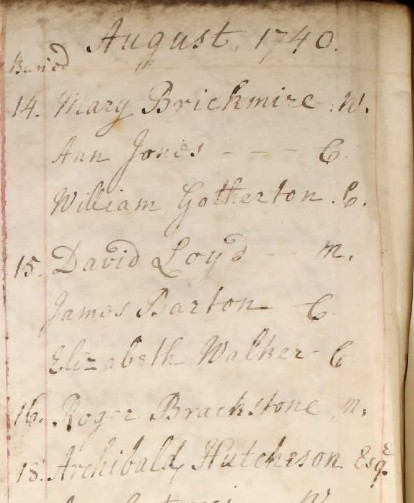
- 12 August 1740 – death of Archibald Hutcheson of the Middle Temple, MP for Hastings (1713-27), said to be near 805 and buried St James, Piccadilly, Middlesex 18 August 1740 (see below).
- 15 August 1740 – Will proved in London at the Prerogative Court of Canterbury – Elizabeth Hutcheson, widow, relict and sole executrix named in the Will and to whom administration was granted. The Will contained the following text with regard to the distribution of two elements of Archibald Hutcheson’s estate totalling £15,0006 “or such other of my poor relations in Ireland, and in such shares and proportions as my said wife shall, by writing under her hand, direct…… The nature of the Will was such that the element relating to a legacy to “my poor relations” was in abeyance until such times as the death of wife Elizabeth Hutcheson i.e. she had a life interest.7
- 1 August 1761 – Will of Elizabeth Hutcheson of Kings Cliffe, widow, relict, executrix and residuary legatee of Archibald Hutcheson, late of the Middle Temple, London Esq. deceased.8
- 14 September 1768 – codicil to the Will of Elizabeth Hutcheson of Kings Cliffe.9
- 22 September 1777 – second codicil to the Will of Elizabeth Hutcheson of Kings Cliffe.10
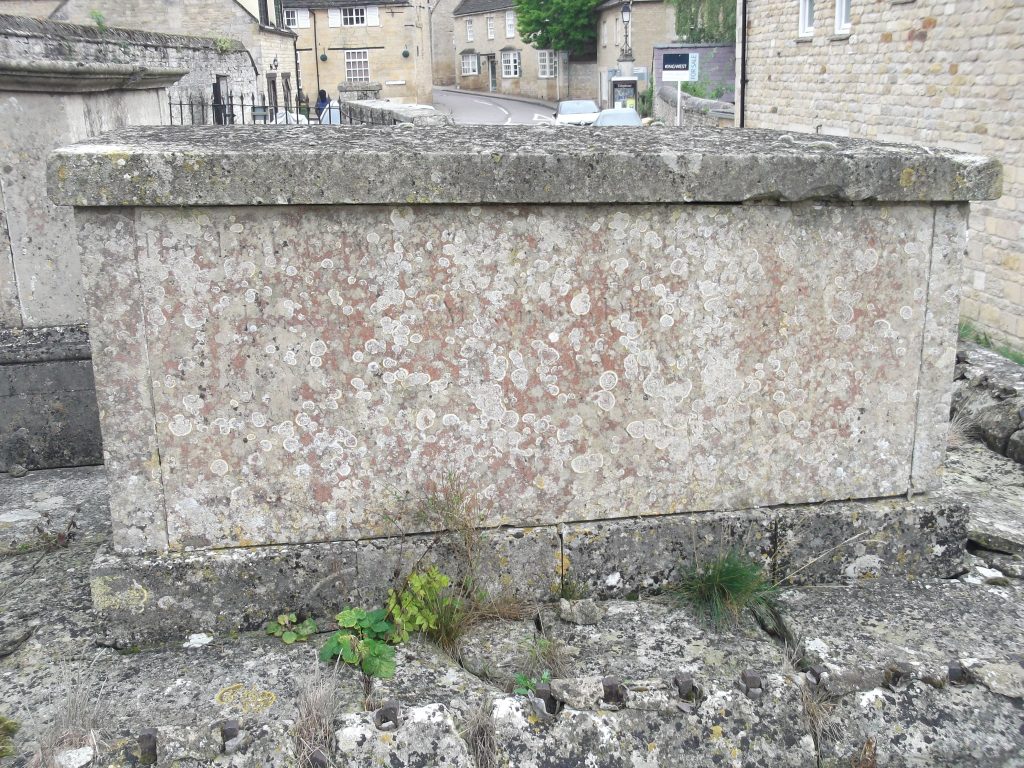
- 31 January 1781 – Death of Elizabeth Hutcheson of Kings Cliffe, Northamptonshire, aged 91 (buried All Saints Churchyard)11
- 14 February 1781 – Will of Elizabeth Hutcheson of Kings Cliffe, proved in London with two codicils at the Prerogative Court of Canterbury, Elizabeth & Catherine Campbell, spinsters and executors named in the second codicil to whom administration was granted. Amongst the text of Elizabeth’s Will is more detail regarding her husband’s legacy totalling £15,000 to his poor relations i.e. “upon trust to lay out the same in the purchase of lands, tenements or hereditaments of [inheritance?] in the said Kingdom (i.e. Ireland) and until the same should be so invested to lay out the same on some good sufficient security or securities of lands or tenements in the said Kingdom and upon further trust that the said trustees do and should once in every year for ever by and with the consent and approbation of the Most Reverend the Lord Primate of All Ireland and the Right Reverend the Lord Bishop of Down and Connor in the said Kingdom for the time being pay and distribute the net Income or clear money which should at the time of such meeting have been received for or by means of the said seven thousand pounds by any one of the ways and means aforesd to and amongst such and so many poor and necessitous persons in the said Kingdom of Ireland as shall appear to be in any ways related or of kindred to my said husband either on the side of his father or on the side of his mother through their kindredship be ever so remote and in such shares and proportions as his said trustees by and with such approbation and consent as aforesaid shall think proper but so as that none of his said poor relations shall in any one year have more than ten pounds or less than five pounds Irish money from his said Charity who shall appear to be of kindred to my said husband then the said trustees are directed to pay, divide and distribute all such net money to and amongst such poor and necessitous persons within the said County of Antrim in such shares and proportions as the said Trustees by and with such consent and approbation as aforesaid shall think proper but so as no such poor object not of kindred to my said husband shall receive more in any one year than the sum of five pounds Irish money”12
- 18 July 1790 – Mr Harris (likely from Messrs Harris & Bryan Sols of Dublin) places a notice in the Dublin Evening Post and Belfast Newsletter headed ‘Hutchinson’s Charity’. He states he is “the Agent for the Trustees of Hutchinson’s Charity and having now returned from England with the several Title Deeds relative to the purchase of Lands in this Kingdom made out of the Charity Fund which Deeds had been hitherto detained by Mr Leigh, an English attorney, and Counsel having advised an application to be made to the Parliament of this Kingdom, for an act to settle the distribution of said Charity Fund – it is requested, that all the Poor and necessitous persons in the Kingdom of Ireland, who shall claim to be in any wise related or of kindred to Arch. Hutchinson, late of the Middle Temple, London, Esq; dec. either on the side of his father, or on the side of his mother, though their kindership be ever so remote, will send up to Mess. Harris and Bryan, the agents for the aforesaid Trustees, at their office, No.40, Golden Lane, Dublin, within six calendar months from the day of the date hereof, a Certificate, signed by the Rector, Vicar, or Curate and Church-wardens of the respective Parishes in which such claimants live and reside – setting forth, that they believe such claimants are relations of the said late Mr. Archibald Hutchinson, and that such claimants are poor and necessitous persons – and also that they believe such claimants are related to the said Mr. Hutchinson, in a certain degree of kindred, specifying the said degree particularly, and whether on the father’s or the mother’s side – and also the number, names, and ages of their respective children now in being; and where there are any orphans, it is requested that the next of kin will send in a like Certificate on their behalf. The Certificate need not state any pedigree of the claimants, as it is intended, that the fact of kindred shall afterwards undergo a more solemn investigation. If any person or persons shall omit to claim as aforesaid, and before the expiration of the said six months, this danger is apprehended – that such persons, even though they should fall within the rule of distribution, which may be adopted by the Parliament of this Kingdom, may probably be excluded from any benefit of said Charity, on account of such non-claim, within such time of limitation as aforesaid.”13
- 29 September 1792 – Under the heading ‘Hutchinson’s Charity’, Messrs Harris & Bryan, Agents for the Trustees of said Charity placed the following notice in the Belfast Newsletter viz. “The Persons claiming any benefit therein are hereby informed, that the Trustees having failed in procuring an Act of Parliament, are now taking all necessary steps to obtain the Lord Chancellor’s directions for the conduct they ought to pursue; all that can be done for the benefit of Mr. Hutchinson’s poor relations, will be done without expense to them. If however they choose to involve themselves in a suit, as appears likely from late advertisements, the Trustees can have no possible objection.”14
- 10 October 1792 – An interesting notice under the heading Hutchinson’s Charity was placed in the Belfast Newsletter by a John McClean, Agent in which he states “This is to give Notice to the Claimants of said Charity, that this day I received from Dublin the advice and opinion of an able and respectable Counsel on their Case, and will prepare a Bill by his direction and under his inspection, and have it filed in November next; And lest any person who has a right to said Charity would be deprived of it by not having their claims inserted in said Bill, I will attend to receive Subscriptions and Claims, at Mr. Boyd’s in Cushendall, on Monday the 22nd instant; at Mr. Hull’s, in Ballycastle, the 24th; at Mr. Dixon’s, Ballymena, the 26th; and at my own house, in Belfast, till the 20th instant. Case and Counsel’s opinion will be laid before all the Subscribers – Such as do not attend or send in their claims as above directed, need not afterwards apply, as the Bill will be filed as soon as possible after the 26th instant.“15 It is not known in what capacity Mr McClean was acting.
- 3 May 1793 – A notice is place in the Belfast Newsletter by a John McClean as follows – “HUTCHINSON’S CHARITY – The claimants to said Charity are requested to meet at the house of Mrs. Townley, in Bow Lane, Lisburn, on Saturday the 11th of May inst. At ten o’clock in the forenoon, where the full state of the proceedings in their business will be laid before them; and they are likewise requested to come prepared to mind their former Subscriptions, as there is a certain sum wanted to compleat a business that they will be fully acquainted with on that day. Those that do not attend or appoint some person to act for them at said Meeting, will not be included in the farther proceedings in the case – And those that attend will have the opportunity of hearing the Bill read, that was filed for their relief. – Belfast 4th may 1793.”16 The notices placed in the Belfast Newsletter by John McClean would seem to suggest that an unofficial collective had formed outside the direction of the Trustees to the will of Archibald Hutcheson and in a capacity as their Agent McClean was hoping to place a Bill before Parliament in which they might assume control over the will.
An article was published by George Hill in the Coleraine Chronicle17 in which he summarised the events surrounding the Hutchinson Charity. He states that the original attempt by the Trustees to distribute the charity produced “no fewer than 15,000 claimants!” and that this had led to the Trustees seeking direction from Parliament through an appropriate Bill i.e. that tabled on 8 February 1796. It is worth noting at this stage that when examining the text of the two wills, i.e. that of Archibald Hutcheson in 1740 and Elizabeth Hutcheson in 1761, it demonstrates that Archibald’s will had left the Trustees with a very vague description with which to work i.e. “poor relations”. This was tightened to a degree by the will of his widow Elizabeth which used the phrase “poor and necessitous” but neither stated to what degree of connection qualification was required. It was therefore the legislation passed on 24 March 1796 that defined the qualification as in and within the sixth degree of relation to Archibald Hutcheson as defined under canon law. - 1 February 1796 – Thanks to the publication of the Proceedings of the Irish House of Lords 1771-1800 by the Irish Manuscripts Commission we have some detail as to what transpired in the Irish Parliament in the early part of 1796 regarding the Hutchinson Charity viz. “The Lord Chancellor said that a Mr Hutchinson had bequeathed £15,000 to purchase an estate, from the issues of which his relations of every[sic], the remotest degree, were to have annuities, the lowest five and the highest ten pounds. The testator died in England, and the Court of Chancery in England transferred the appropriation of the bequest to the Court of Chancery in Ireland. A master in chancery was authorized to call upon the claimants by a public advertisement to produce their claims, which he did; and a northern attorney published, at the same time, an advertisement in a Belfast newspaper offering a shilling each to establish the right of inheritance. The consequence was that there were 16,000 claimants of £5 and £10 a year upon an estate of £600 annual produce; and the master in chancery applied to him (the Lord Chancellor) to make such a partition, which not being possible, he had recommended an application to the legislature. The present petition in his mind, however, ought to be so formed as to obtain an opinion from the judges in the first instance if it were possible for the trustees to fulfil their trust, and if the bill, which his lordship presumed the noble viscount means to offer to the House, was in the next place sufficient for its purpose. The principal object of the bill was to limit the right of inheritance to the sixth degree of affinity, which was the limitation of the canon law. His lordship concluded by moving such references as he had pointed put to Mr Justice Crookshank and Baron Smith, and the monies being agreed to, Lord O’Neill presented the bill which was referred to the judges above mentioned, and the House adjourned to Thursday.”18
- 8 February 1796 – Bill placed before House of Commons in Irish Parliament, Dublin – ‘To enable certain trustees to execute the charitable intentions expressed in the will of Archibald Hutchinson, of the Middle Temple, London, esquire, deceased’.19
- 24 March 1796 – Royal Assent of Bill in Irish Parliament.20
- 10 May 1796 – Public Notice21 by Trustees of ‘Hutchinson’s Charity’ as follows:-
“HUTCHINSON’S CHARITY – We the undernamed Trustees of said Charity do give this public notice that by an act passed in the last session of Parliament, all persons whose kindred to ARCHIBALD HUTCHINSON, of the Middle Temple, London, Esq. deceased, is more remote than the sixth degree by the canon law, are precluded from all benefit under the will of the said Archibald. And also, that all persons not in E**e before the 1st day of July next, and all persons, whether infants or of full age, now in E**e, who shalt not apply, by themselves or others in writing, to Messrs Harris and Bryan, Golden Lane, Dublin, the Law Agents of said Charity, on or before the 1st day of August next, as claimants for a share in said Charity, are by said act in like manner precluded from any benefit under said Charity.
And whereas, by said act, Francis Dobbs, Esq. barrister at law22, is appointed to hear and decide on the affinity, and poor and necessitous situation of such claimants, and to hold public courts for that purpose, in such places in the counties of Antrim, Down, Armagh, Tyrone and Derry, as to the Trustees shall seem proper – Now we, the undernamed Trustees do hereby give this public notice that we have authorized the said Francis Dobbs to hold such public courts in the following place in the said five counties, viz
| Ballimoney | Glenavy | Newry | Strabane |
| Ballycastle | Belfast | Newtown-Hamilton | Derry |
| Cushendall | Newtownards | Milton | Newtown-Limavady |
| Glenarm | Downpatrick | Armagh | Magherafelt |
| Carrickfergus | Rathfryland | Dungannon | |
| Ballymena | Dromore | Omagh |
He the said Francis Dobbs giving one lunar month’s notice of the day and hour he will open such public courts in each respective place; such notices to be thrice advertised in all papers that shall at the time be published in Belfast, Derry, and Newry.
Dublin, 10th May 1796
O’NEILL23
PAT. DUIGENAN24
WM. HAMILTON
EDW. HILL
N. B. Such persons as have already sent in written claims by themselves or others to Messrs Harris and Bryan, are not required to send in new ones; and those claimants to whom Dublin will be more convenient are to observe, that the said Francis Dobbs will hold a final Court here to hear all claims not decided by him at the places above-mentioned; one lunar month’s notice will be given of such final court in the Dublin Gazette and some others of the Dublin papers.”
- 30 May 1796 – A notice was placed in the Belfast Newsletter25 by George Hutchinson, attorney of Ballymoney in which he states – “HUTCHINSON’s CHARITY – The several relations within and in the sixth Degree of Relationship to the late Counsellor Hutchinson, are desired to apply forthwith to Mr George Hutchinson of Ballymoney, Attorney, in order that the Proofs of their Relationship necessary to be made in the several Courts to be holden by Francis Dobbs, Esq. may be properly arranged, he being determined to detect any imposition which may be attempted by any who are not really related in manner above-mentioned; the doing of which will tend much to the advantage of those who are real Relations. Personal applications only attended to, Ballymoney 30 May, 1796.” Whilst the notice of George Hutchinson appears to recognise the process of Francis Dobbs it appears to be an attempt to offer preferential treatment prior to the commencement of the official process by Dobbs.
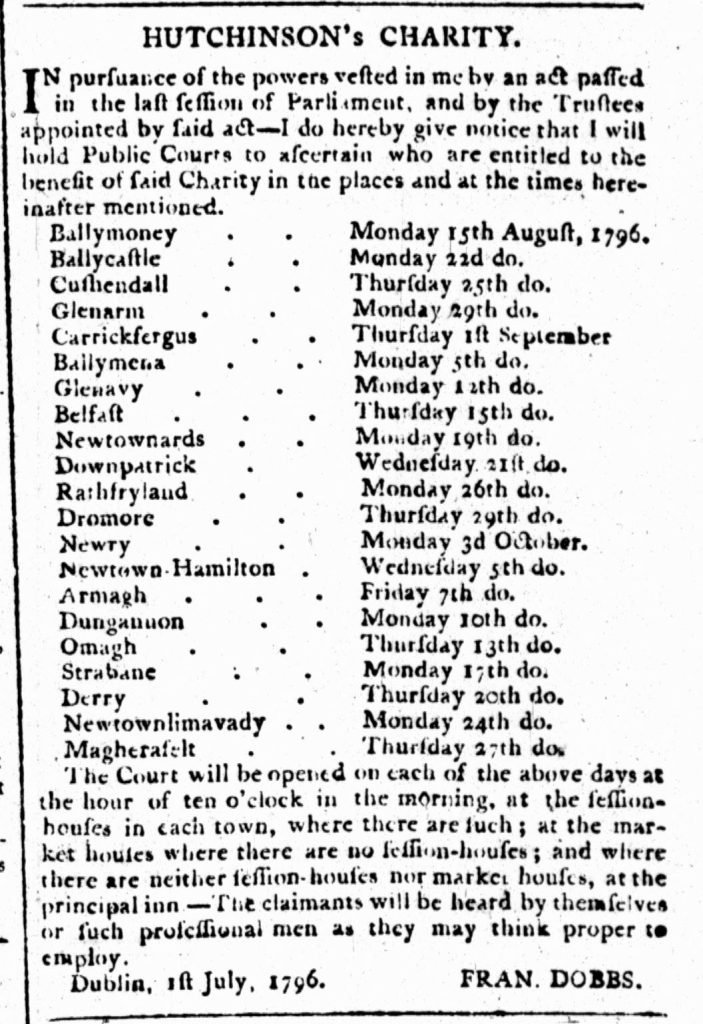
- 1 July 1796 – As per the notice of the Trustees to Hutchinson’s Charity dated 10 May a further notice is issued giving details of the dates and locations by which Francis Dobbs would preside over public courts “to ascertain who are entitled to the benefit of said Charity”. The courts where to be held between 15 August and 27 October 1796.
- 10 November 1796 – In a notice placed in the Dublin Evening Post by Francis Dobbs he states that “I will open my final court to hear and decide on the claims to the charitable fund bequeathed by Arch. Hutchinson, of the Middle Temple, Esq. deceased, on Monday the 12th day of December next, at the hour of ten o’clock in the forenoon, at the Tholsel26of the city of Dublin.“27
- 13 February 1797 – A notice appears to have been placed in the Belfast Newsletter by Messrs Harris and Bryan, solicitors in which they state “HUTCHINSON’S CHARITY – Printed lists of the names of those who have established their claims to the satisfaction of Mr. Dobbs, are now to be seen in the hands of the officiating Clergyman of the Established Church, the Church Wardens, and two principal Innkeepers of each Town in the Province of Ulster where Courts were held, and also in the hands of Messrs. Harris and Bryan, Golden Lane, Dublin.”28 This appears to suggest that the work by Dobbs begun in late May 1796 had concluded by February 1797 and the Trustees would shortly be in a position to distribute the Charity. However this was all occurring during a period of heightened political tensions culminating in the United Irish Rebellion the following summer.
- 18 June 1798 – death of John 1st Viscount O’Neill, one of the Trustees to Hutchinson’s Charity.29
- 12 April 1799 – A notice is placed in the Belfast Newsletter by Messrs Harris & Bryan as follows – “HUTCHINSON’S CHARITY – The sale of the Estate belonging to the said Charity, is obliged to be postponed, on account of the state of the Kingdom. Whenever there is a probability of obtaining the value, a day will be appointed for the Sale, due notice of which will be given.”
- 1 November 1800 – It appears it was not until the latter part of 1800 before substantive progress was made on the sale of the Charity estate as is witnessed in a notice placed on behalf of the Trustees in the Belfast Newsletter in which 1,765 acres and 22 perches of land are to be auctioned.30
- 31 December 1800 – 1 January 1801 – The Act of Union of Great Britain and Ireland creating the United Kingdom. The statutory powers of the Irish Parliament cease and are transferred to Westminster. This momentous period in British and Irish history likely had a further delaying effect on implementing the distribution of the Hutchinson Charity.
- 9 July 1802 – By July 1802 the sale of the Charity lands had not been completed, and a notice is placed in the Belfast Newsletter indicating the degree of frustration likely felt by waiting claimants. In the notice, Alex. Magee and Wm Stewart state as follows – “HUTCHINSON’S CHARITY – The Claimant’s of said Charity, in the County of Antrim and its neighbouring Counties, are requested to meet in Cushendall, on the 15th Cay of August next, to adopt Measures, in order to enter a Suit against the Trustees of said Charity, for delaying the Payment thereof. The Opinion of an eminent Lawyer, and his Terms, will be produced to the Claimants, who will give Security for the Recovery of the same.”31
- 1 November 1802 – The sale advertised in November 1800 appears to have been realised in late 1802 when we find a Memorial32 registered in Dublin as follows:-
“Memorial of an Indented Deed of Release bearing date the first day of Novr in the year of our Lord 1802 made Between
– Patrick Duighan Doctor of Laws and Judge of his Majesty’s Court of Prerogative in Ireland, Conway Richard Dobbs Esq., Alexr. McAwley Esqr, the Honble Wm John Skiffington Esq., Wm Hamilton Esqr., surviving Trustees named and Appointed in and by an act of Parliament made in Ireland in the 36th year of the Reign of his present Majesty entitled an act to Enable certain Trustees to execute the Charitable intentions Expressed in the Will of Archd Hutchinson of the Middle Temple London Esqr deced and Edwd Hill Esqr and Chas Henry St John Earl O’Neill, Trustees also for the purposes aforesd Chosen & appointed pursuant to the sd act of the one part and Luke White of Woodlands in the Coy of Dublin Esqr of the other part (in which sd Deed of Release an Indented Deed of bargain and Sale for one whole year made of the same prems contd in the sd deed of release & by the same Granting parties to the sd Luke White in Conson of five Shillings is recited and also Reciting as therein is Recited the sd Patk Deignan, Conway Richd Dobbs, Alex Mac Awley, Wm John Skiffington, Wm Hamilton, Edwd Hill and Chas Henry St John Earl O’Neill therefore by sd Deed of Release of which this is a Memorial for the consons therein mentd did grant, bargain, Sell, demise, release and confirm unto the sd Luke White (in his actual posson by Virtue of a deed of bargain and sale in sd deed of Release of which this is a Memorial mentd – all that and those the Town and Lands of Killokee orwise Kicklokee orwise Killakyee and Slogony? Except only that part of sd Town and lands contg 36 acres and 2 roods or thereabts in the possn of the Rt Honble Thos Conolly his undertenants or assigns and which are part of a Deer park enclosed in a stone wall ) and all that and those the Town and Lands of Cruagh orwise rough orwise Creaugh orwise Crewagh orwise Crew formerly in Lease to Thos Taylor the Elder but then as to part thereof to Ralph Smith the Town and Land of James Land orwise James’s Land formerly in lease to John Ranch and all that part of the Town and Lands of Woodlown formerly in lease to Thos Wilkinson but then in lease to Chas O’Brien of the City of Dublin Mercht all which sd Land and premes are situate lying and being in the Manor or Lordship or reputed Manor or Lordship of Rathfarnham in the Coy of Dublin and Contg in the whole 1763 acres and 22 perches plantation measure be the same More or less and are more particularly mentd and described on and by a Map or Survey in said afore mend togr with all Timber, Trees and other trees, woods, underwoods, ways, paths, passages, Waters, Water Courses, Bogs, Mountains, Commons, Common of Pasture, waste grounds, Turbary, rights of Turbary, rents, services, privileges, profits, rights, [?], Commodities, Advantages, Emoluments, Appendes and Appurtes whatsr to the Towns, Land, Tenements, Hereds and premes herein before and thereon granted and released or intended so to be every or any of them belonging or in any wise Appertg or with them a with any of them or at any time theretofore used occupied passed or enjoyed or accepted reputed taken and known as part parcell or member of them or any of them and also all other the Tenements and Hereddts whatsr whereof Charles Hamilton in sd and named or herein he or any person in Trust for him were seized of or entitled to any Estate of Freehold or [?] or other Estate in posson or expectancy Situate lying and being in the Lordship of Rathfarnham in the sd Coy of Dublin in as full and ample manner as the same were by the sd Charles Hamilton Conveyed by the deed of the 28th July 1787 in sd deed of Release mentd to the sd John O’Neill, Conway Richd Dobbs, James Leslie, Stephen Ratcliffe and Alex MacAwley and the reversion and reversions, remainder and remainders yearly and other rents, issues and profits thereof and of every part and parcel thereof and all the Estate, right, Title, Interest, Trust, property, claim and demand whatsr Either at Law or in equity of them the sd Patk Duignan, Conway Richd Dobbs, Alexr MacAwley, Wm John Skiffington, Wm Hamilton, Edwd Hill and Chas Henry St John Earl O’Neill in to or out of the sd thereby granted and released Towns, lands, Tenements, Heredts and premis of them in part or parcel thereof
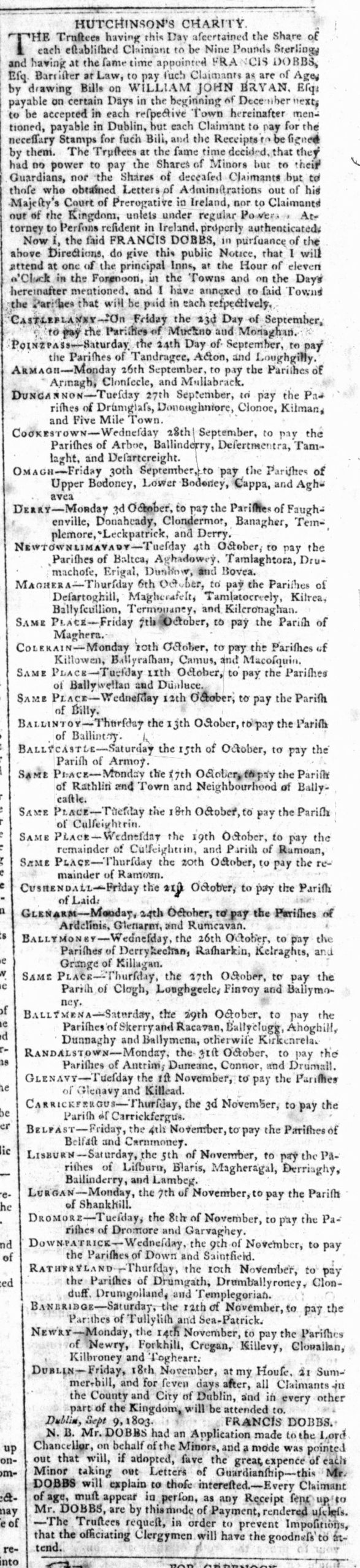
To Hold all & sing the Towns lands, Tenements, Heredts, and prems (Except the part before and therein Excepted ) with that and Every of their rights members and appurtes unto the sd Luke White his heirs and assigns for ever which sd deed and this Memorial were duly Executed by the sd Patk Duignan, Wm John Skiffington, Wm Hamilton and Edwd Hill in presence of Wm John Bryan and Wm McDermott both of the City of Dublin Gent Attys at law….etc. etc.“ - 9 September 1803 – After over seven years of investigations and sales of land dogged by political unrest and constitutional change the Hutchinson Charity was now ready for distribution. In a notice published in the Belfast Newsletter by Francis Dobbs the following statement is given – “HUTCHINSON’S CHARITY – The Trustees having this day ascertained the Share of each established Claimant to be Nine Pounds Sterling and having at the same time appointed FRANCIS DOBBS, Esq. Barrister at Law, to pay such Claimants as are of Age by drawing Bills on WILLIAM JOHN BRYAN, Esq. payable on certain Days in the beginning of December next, to be accepted in each respective Town hereinafter mentioned, payable in Dublin, but each Claimant to pay for the necessary Stamps for such Bill, and the Receipts to be signed by them. The Trustees at the same time decided, that they had no power to pay the Shares of Minors but to their Guardians, nor the shares of deceased Claimants but to those who obtained Letters of Administrations out of his Majesty’s Court of Prerogative in Ireland, nor to Claimants out of the Kingdom, unless under regular Powers of Attorney to Persons resident in Ireland, properly authenticated. Now I, the said FRANCIS DOBBS, in pursuance of the above Directions, do give this public Notice, that I will attend at one of the principal Inns, at the Hour of eleven o’Clock in the Forenoon, in the Towns and on the Days hereinafter mentioned, and I have annexed to said Towns the Parishes that will be paid in each respectively.” After listing the various places and dates for disbursement the notice further sates “N. B. Mr. DOBBS had an Application made to the Lord Chancellor, on behalf of the Minors, and a mode was pointed out that will, if adopted, save the great expence of each Minor taking out Letters of Guardianship – this Mr. DOBBS will explain to those interested. – Every Claimant of age must appear in person, as any Receipt sent up to Mr. DOBBS, are by this mode of Payment, rendered useless. – The Trustees request, in order to prevent Impositions, that the officiating Clergymen will have the goodness to attend.”33
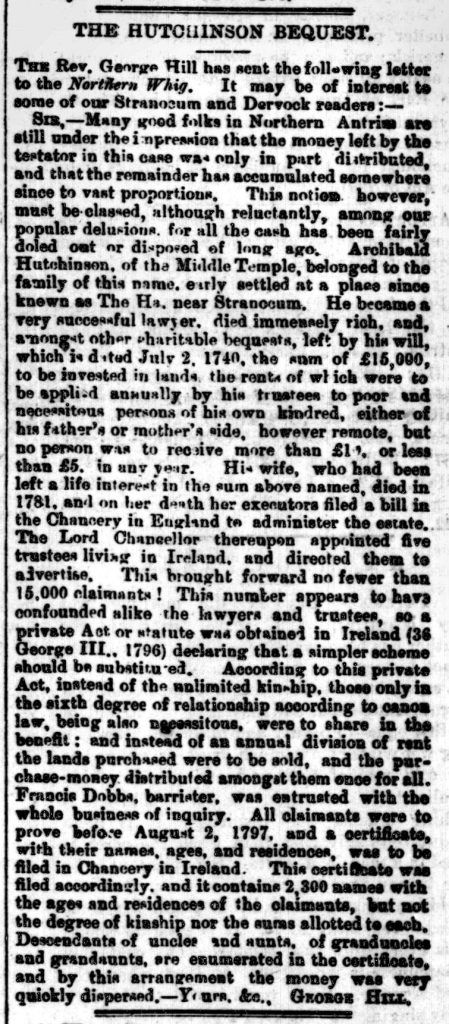
- The wording of the above notice appears to suggest that at that time only persons of age (probably 21 and over) were paid, also others not meeting the requirements similarly did not get paid. George Hill stated in his article published in 1894 that there were 2,300 claimants included on a certificate lodged with the High Court of Chancery in Ireland, although he gives no date for when this occurred. He also appeared to infer that this was the finish of the Charity as he states, “by this arrangement the money was very quickly dispersed.” However this statement appears to be contradicted by an earlier article published by the Coleraine Chronicle in 1855 as we shall see.
- 11 April 1811 – the death of Francis Dobbs.34
- 1 March 1813 – The distribution of Charity funds to claimants in 1803 appears to have not been without some controversy. In a notice published in the Belfast Newsletter in 1813 the following statement was made viz. “HUTCHINSON’S CHARITY – SUCH of the Claimants, under the Will of ARCHIBALD HUTCHINSON, Esq. late of the Middle Temple, London, deceased, as reside in the LOW-GLENS, request a Meeting of all those concerned, within the County of Antrim, on THURSDAY the 18th day of March inst. At the House of Mr. JOHN BLACK, in Cushendall, by ONE of the Clock in the afternoon, in order that such measures may be adopted as then and there shall be deemed necessary, for enforcing a distribution of the accumulated Funds, still in the hands of the Trustees to the Charity, contrary to the Will and desire of the Testator. Dated at CUSHENDALL.” The result of this meeting is unknown, and it would appear over twenty years would pass before any further significant announcements are made regarding the Charity.
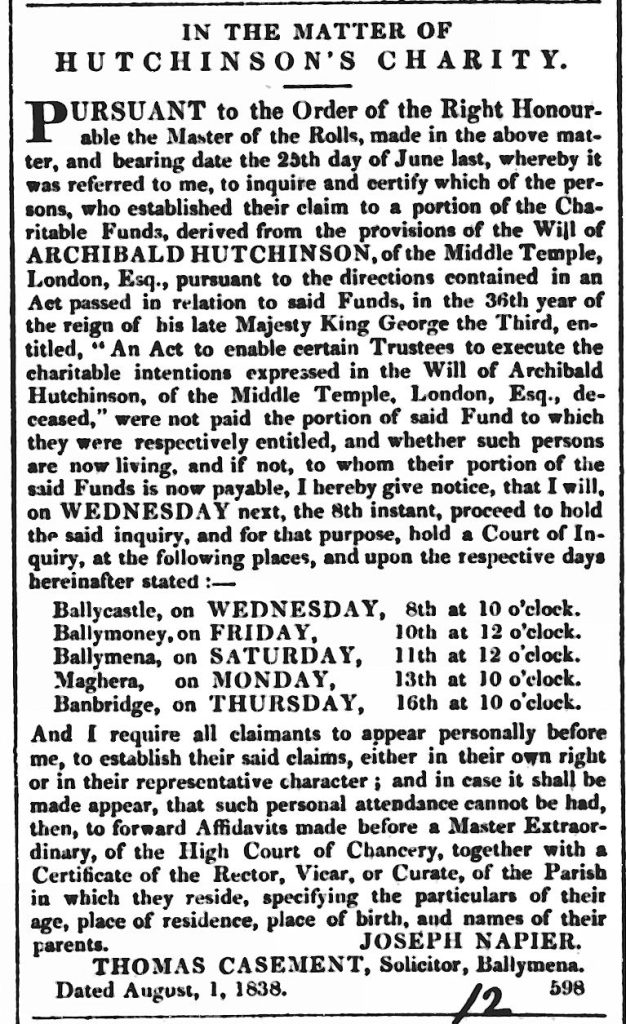
- 1 August 1838 – An article published in the Northern Whig in 183835 any remaining undistributed funds were dealt with by the remaining Trustees to the Charity. It is recalled that in the notice published in 1803 it seems Minors and other persons not meeting requirements were not included in the disbursement of funds. The article infers that the remaining Trustees to the Charity had been subject to an Order of the Right Honourable the Master of the Rolls dated 25 June 1838 in which Joseph Napier, it is presumed now acting for the remaining Trustees in place of Franncis Dobbs, deceased, was required to enquire which Claimants remained unpaid. Accordingly the notice advises that a Court of Inquiry was to be held at various venues from 8-16 August 1838 to ascertain same.
- 10 March 1855 – The above process seems to be referred to in an article published in the Coleraine Chronicle called ‘The Hutcheson Legacy’. The article appears to have been prompted by the submission to the paper of a copy of Archibald Hutcheson’s will held by John Boyd (1789-1862).36 The article includes a transcript of Archibald Hutchinson’s will and further states “About twelve years ago a final payment was made to those who had proved their claims in the year 1800, and were not of age in 1803, and under that arrangement Mr. Boyd himself received his share of the legacy in consequence of his relationship to the deceased, whose mother’s name was Boyd.” Whilst there is a discrepancy in the dates mentioned i.e. c1843 and 1838 there seems little doubt the processes mentioned appear to be the same. When examined against the specific case of John Boyd (1789-1862) we can observe that at the time of the initial disbursement in 1803 he was only around fourteen years of age and therefore, as a Minor, not entitled to funds from the Charity at that time.
- 31 March 1894 – In a letter to the Northern Whig and reproduced in the Coleraine Chronicle. Rev George Hill provides a brief history of ‘The Hutchinson Bequest’.
Conclusion
It is hoped that this chronology will help provide a greater understanding of the events leading up to and during the lifespan of the Hutchinson Charity. The survival of documents from the period of the Irish Parliament is problematic, however following the Act of Union and the involvement of the Master of the Rolls in 1838 it is hoped that some documentation may have survived relating to the Charity amongst the Westminster Archives.
- Dobbs’ Report, viii + 103 pp., ISBN 9 781906 689872 (softback) and 9 781906 689889 (hardback), [2018]. ↩︎
- The Ballyhivistock Manuscript Revisited 2000, chap. 14 ↩︎
- North Irish Roots – Vol. 30, No. 1 (2019), pp. 26-28 ↩︎
- National Archives UK – Ref. PROB 11/704/286 ↩︎
- https://archive.org/details/sim_gentlemans-magazine_1740-08_10_8/page/412/mode/2up?q=archibald ↩︎
- It is worth knowing that this figure when inflated using the Retail Price Index would be valued at just under £3 million today. ↩︎
- National Archives UK – Ref. PROB 11/704/286 ↩︎
- National Archives UK – Ref. PROB 11/1074/224 ↩︎
- Ibid ↩︎
- Ibid ↩︎
- https://www.findagrave.com/memorial/214609596/elizabeth-hutcheson ↩︎
- The Will of Elizabeth Hutcheson, p.3 ↩︎
- Dublin Evening Post – 20 July 1790 & Belfast Newsletter – 27 July 1790 ↩︎
- Belfast Newsletter (BNL) – 2 October 1792 ↩︎
- BNL – 12 October 1792 ↩︎
- BNL – 3 May 1793 ↩︎
- Coleraine Chronicle – 31 March 1894 ↩︎
- Proceedings of the Irish House of Lords, 1771–1800,Vol. III, IMC, pp. 5-6 also https://virtualtreasury.ie/item/IMC-2008-Lords-3-1-1-4 ↩︎
- https://www.qub.ac.uk/ild/?func=display_bill&id=2543 ↩︎
- https://www.qub.ac.uk/ild/?func=display_bill&id=2543 ↩︎
- BNL – 23-27 May 1796 ↩︎
- https://www.dib.ie/biography/dobbs-francis-a2643 ↩︎
- Possibly John 1st Viscount O’Neill (1740-98) – https://www.dib.ie/biography/oneill-john-a6928 ↩︎
- https://en.wikisource.org/wiki/Dictionary_of_National_Biography,_1885-1900/Duigenan,_Patrick ↩︎
- BNL – 3 June 1796, p.1 ↩︎
- https://en.wikipedia.org/wiki/The_Tholsel,_Dublin ↩︎
- Dublin Evening Post – 12 November 1796 ↩︎
- BNL – 24 February 1797 ↩︎
- https://www.dib.ie/biography/oneill-john-a6928 ↩︎
- BNL – 18 November 1800 ↩︎
- BNL- 9 July 1802 ↩︎
- Deed Memorial No. 364726 – https://www.familysearch.org/ark:/61903/3:1:3Q9M-CSJW-C8J9?view=fullText&keywords=Killokee&lang=en ↩︎
- BNL – 13 September 1803 ↩︎
- https://en.wikisource.org/wiki/Dictionary_of_National_Biography,_1885-1900/Dobbs,_Francis ↩︎
- Northern Whig – 2 August 1838 ↩︎
- https://www.dib.ie/biography/boyd-john-a0832 ↩︎
This is a very satisfying and thorough bit of work on the bequest and all the ins and outs. I was startled to realise that the lands which were sold to pay the bequests are in Rathfarnham, as I am at this moment! I know the townlands in question very well . I wonder if the Massy estate bought Kilakee at that time? it was in Massy ownership into the 20th century I think. I must look at the stone wall round the deer park mentioned, it may explain some of the otherwise mysterious boundaries in the woodlands. I suppose all the unpublished material and certificates involved in the preparation involved in Dobbs ‘s Report was just chucked out.
I see now that the lands went to Luke White. His house is still extant in or near Cruagh. The Massys must have bought later