We learned in the previous post on the Boyds of Ardneil & Portencross that Archibald was a son of Archibald Boyd, 5th Laird of Portencross and his wife Elizabeth Fairlie of that Ilk. We know that he had lived in Underhill, West Kilbride for a period before coming to Co Antrim and settling at Carncullagh. We also know that he had a daughter Margaret who is buried in the old graveyard at Derrykeighan. However until recently the identity of his wife was unknown. Thanks to the research of Jeff Homes we were delighted to discover an extremely important document in the Testament of Alexander Cunynghame1 (1612) a Merchant and Burgess of Irvine. Listed amongst the persons to whom a debt is outstanding to the estate of Alexander Cunynghame are “Catherine Peblis spouse to Thomas Boyd late Provost of Irvine, Jot [probably Jonet/Janet] Peblis spouse to Arch Boyd of Underhill and Margaret Peblis Lady Smithstone..”
These three woman were sisters and therefore daughters to Patrick Peblis of Broomlands, Ayrshire and Burgess of Irvine who died in 1585 and their mother Marion Montgomery of Hessilhead. The are all named on a contract dated 10 November 1592 as follows2:-
“Contract between Daniel Montgomery of Mekill Lugdorug and Margaret Nasmyth, his spouse, with consent of Robert, Master of Eglinton at whose instance Daniel Montgomery was interdicted on the one part and Marion Montgomery, relict of unquhile Patrick Peiblis, burgess in Irvine and Margaret Peiblis (Peebles) daughter lawful begotten between unquhile Patrick and Marion taking burden on her for Margaret Peiblis her daughter on the other part, whereby in consideration of 400 merks Daniel Montgomery and his spouse bound themselves to infeft Marion Montgomery in liferent for all the days of her lifetime and Margaret Peiblis her daughter heritably and the heirs lawfully to be gotten of her body which failing Katherine, Jean, Jonet, and Anne Peiblis, her sisters equally between them their heirs and assignees respectively in the 46s 8d land of old extent of Mekillugdorige lying in the lordship of Giffen and within the shire of Ayr and notwithstanding of the above alienation Marion Montgomery for herself and her daughter set in tack to Daniel Montgomery and his spouse, the foresaid lands for payment yearly of 12 bolls of oatmeal until the lawful redemption thereof on payment of 400 merks
Dated at the burgh of Irvine“
As we know Katherine had married Thomas Boyd prior to 1603. Margaret appears to have first married William Miller of Mylnehill, Kilwinning c1603 but later married Hugh Montgomerie of Smeithstoun hence the reference to Lady Smithstone and of course we now know that Jonet married Archibald Boyd of Underhill before 1612. This period unfortunately predates the earliest records of the parish of West Kilbride which are only available from around the 1690s. But it is likely that Jonet had married Archibald c1603-1606 as we know that their daughter Margaret, wife to William Hutcheson, died in 1625 from her gravestone in old Derrykeighan graveyard.
The situation whereby two brothers from a prominent family marry two sisters from another prominent family is of course not unusual in the customs of the early 17th century. This pattern of likely arranged marriage was traditional across many cultures and remained so well into the 19th century and beyond. The Boyd and Peblis/Peebles families were both involved in the commercial life of the region in which they lived and particularly that of Irvine. With Thomas Boyd and wife Katherine moving to Co Antrim there is little surprise that they were followed by brother Archibald and his wife Jonet.
We know that Archibald received denization in 1617 and was likely resident in Carncullagh, Derrykeighan Parish, Co Antrim by around that time. Unfortunately no record of his tenure in Carncullagh was recorded in the Inquisitions. However he is recorded in the transcript of the will of William Boyd of Dunluce (1624)3:-
“Lastly, I will and appoint my fateful and well-loved friends, Mr Andrew Monypenny archdeacon of Coner, Wm Dunlape the lard of Crage, Thomas Boyd off Carncogie, Archibald Boyd off Carncualagh, Archibald Stewart of Bellilachmore, and my son in law, Walter Kennidie, John Logane off the Bosthmilnes, Thomas Boyd off Bellihabrett, to be overseers yt this my will and last Testament shall duty be performed in all points reserving interpretaone off itt to them or any fowre or more off, iff any question shall happen to arise, qr off Thomas Boyd and Mr. Wm Wallace shall be two.
Ite, moreover I leave Mr. Moore one silver goblett qch is in my howse.
Ite, I leave to Ard Stewart ane long fowling-peice, qch I brought ot of Knokffergy.
Ite, I leave Ard Boyd ane young browne cowlte, qch I have off the Earle off Antrim for his food.
Ite, I leave my sister Margaret yt litell silver goblet qch sche hath in possession off.
Ite, I leave to John Wallace that schooting piece wch he hath of myne.
Witness, William Wallas. Thomas Boyd, Witness.”
Sadly as has already been covered in the previous post on the Boyds of Portencross a daughter, likely born to Archibald and wife Jonet i.e. Margaret, died in June 1625. She was wife to William Hutcheson of Stranocum, Co Antrim. Her grave is beside the memorial to Katherine Peblis/Peebles in old Derrykeighan graveyard.
Margaret’s grave is the source of much confusion as in the late 1790s reference would be made, regarding a significant charitable bequest, to a Mary-Ann Boyd wife of William Hutcheson of Stranocum which we hope to discuss on a future post dedicated purely to the subject of what became known as the ‘Hutcheson Charity’. For now all references to the grave appear to record her as Margaret which unfortunately as a slab type stone has succumbed to the wear of time and in all likelihood acid rain. Perhaps the most substantive transcription of the grave was made by a local man Thomas Camac c1908 who like others before him records the name as ‘Margrat’.
As with brother Thomas we find Archibald as one of those appearing on the Muster of 1630 i.e No. 132 with sword only in the Barony of Dunluce4. However unlike his brother who is one of five Thomas Boyds listed on the Earl of Antrim’s estates there is only one Archibald Boyd in the entire Muster of Ulster. The Musters were an essential mechanism by which settlements such as those in Co Antrim and elsewhere in Ulster could be made ready for any unrest or even outright revolt which might occur. Indeed those who took part in the 1630 Muster would not have to wait long to find out.
On 23 July 1636 the Bill Books of the Chancery Court in Dublin record a case between an “Archibald Boyd, plaintiff and Amelia Boyd als Boyle, defendant.” Unfortunately this limited information makes it difficult to confirm if this is Archibald Boyd of Carncullagh but no other Archibald Boyd has been found amongst Irish records at this time. The Amelia Boyd nee Boyle is as yet unidentified.
In the meantime the business of the Boyd family continued and despite the death of Thomas Boyd of Carncoggy in 1634 his third son Thomas Junior went on to acquire land in Magheraboy, Derrykeighan Parish, Co Antrim as we seen in our last post. Wonderfully this lease5 dated 21 July 1637 from the 2nd Earl of Antrim and his brother Alexander was witnessed by Archibald Boyd and signed by him on the cover of the deed under the heading of “sealed and indented in the presence of“.. He is also a witness to a further lease6 the same year from the 2nd Earl of Antrim and a Thomas Boyd gent of Ballyneirie, Barony of Kilconway, Co Antrim who we have as yet been unable to identify.
It is perhaps at this stage worth making a comparison of the signatures which we believe are of Archibald Boyd of Carncullagh and formerly of Underhill from the three source documents we have found.
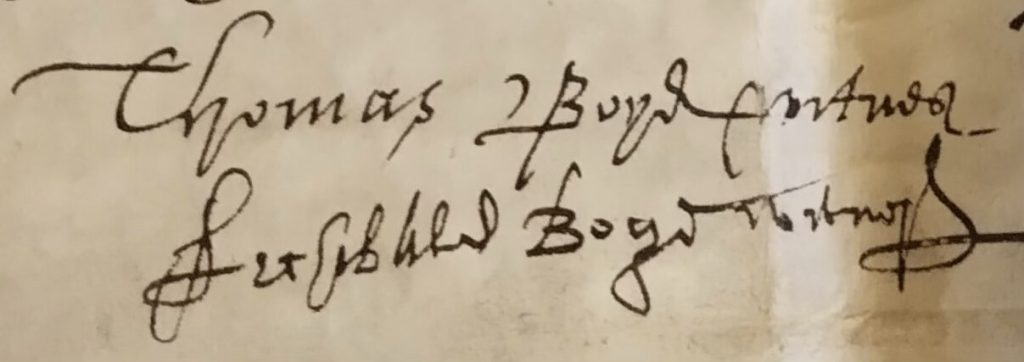
The signature of Archibald Boyd of Underhill as witness to a deed in the Hunterston Archives dating to 1609 – Courtesy of Angus Cochrane Patrick (Hunterston Archives)
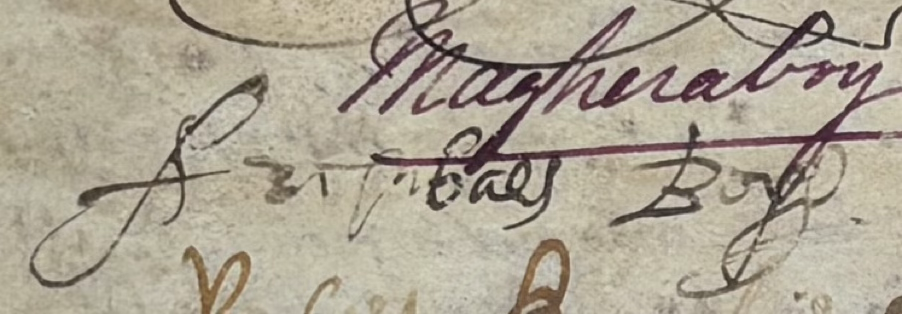
The signature of Archibald Boyd of Carncullagh as witness to the Magheraboy lease of 1637 to Thomas Boyd of Lisconnan
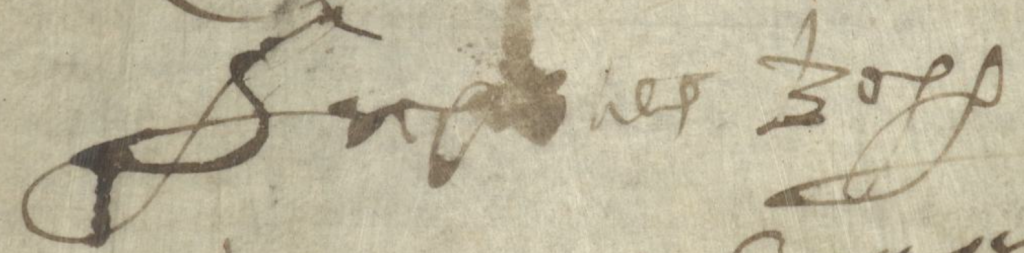
The signature of Archibald Boyd of Carncullagh as witness to the Knockans lease of 1637 to Thomas Boyd of Ballyneirie
Despite the wear of centuries there are remarkable similarities to the signatures in the ‘A’ of Archibald, the ‘rc’ of Archibald and of course the ‘B’ of Boyd.
Again from the Bill Books of the Chancery Court in Dublin we find an entry dated 24 April 1638 in which “Robert Care? (perhaps Karr/Kerr) is plaintiff and Patrick Taylor, Archibald Boyd and Archibald Stewart – Defendants”. Again it is difficult to be certain in identifying if the Archibald Boyd stated as co-defendant is of Carncullagh but his co-defendant Archibald Stewart may be that of Ballintoy.
By October 1641 the Irish Rebellion had begun and Co Antrim could not escape the events that would engulf most of Ireland., On 4 January 1642 they had reached the settlers residing near Ballintoy, Co Antrim. One account of what was alleged to have happened at that time was given by non other than Thomas Boyd Junior, son of Thomas Boyd of Carncoggy and is detailed in our previous post on Thomas Boyd of Carncoggy. However another testimony was recorded 10 March 1654 i.e. that of Gilduffe O’Cahan7:-
“The Examinacion of Gilduffe O Cahan of Dunseverick in the County of Antrim Gent taken before us at Colerane the tenth day of March 1653
Who being examined saith, That upon Sunday the 24th of October 1641 in the morning, he came from his house of Dunseverick unto the Towne of Dunluce with a little foot boy with an intent to heare a Masse at Dunluce, having no more Company with him, <A> that there being no Masse there that day he this Examinante went into James Stewarts house In Dunluce to drinke a Cupp o{f} wyne, that about ten of the Clock the same Sunday morn{ing} Henry McHenry his son in Law, and his owne sonne Ma{nus} O Cahan who had been visiting his said brother Henry mcH{enry} came vnto this Examinant unto the said house where they drun{k} three or foure pottles of wyne, That about one or two of the Clock the same Sunday in the afternoone Capten McPheadr{ie} Mr Archibald Boyd, & about ten or twelve horsemen more with swords and some Pistolls, came unto Dunluce and reported that Sir Phelomy roe O Neill and the Irish in Tirone, were risen in Rebellion, and the said Capten McPheadres and the rest with them made the Scotch in Dunluce arme themselves & draw downe into the new Pavement in the inner Court next the Draw=Bridge and outer gate of Dunluce Castle, which this Examinant hereofhearing of, and also being very soone after told by one Doole McSparran a highland Scotchman, who dwelt at Bushmills, & came into the said house, where hee this Examiannte and his said son in law Henry McHenry and his said son Manus were drinking <B> wyne, That five hundred of Argiles men were comming over the Bush Bridge (a mile distant from Dunluce) to take Dunluce Castle and command the Countrey. Upon which Newes this Examinante left his said sons drinking wyne in the said house, and went downe alone (having no weapone but his Rapier) about three of the Clock the same afternoone into the said Inner Court where the Scotch were gathered, and asked Capten McPheadres what newes brought him and the rest thither Capten McPheadres told him that Sir Phelomy Roe O’Neill and all the Irish in Tirone were risen in Rebellion, whereupon this Examinant told the said Capten McPheadres that he rather believed that the Scotch <C> and the said 500 men intended to joyne together to take the Castle of Dunluce Whereupon this Examinante alone went into the Castle and bolted the Outer gate, and staid there alone about halfe an houre, And then Anthony, Capten Digbyes man who had the key of the Castle came to the Outer gate, and this Examinante unbolted it, & lett him in, and demanded of him the key of the Inner gate, which he gave this Examinante And this Examinante opened it and went into the Castle, That about one quarter of an houre after, Capten Digby and his said sonns Henry McHenry & Manus O Cahan came downe unto the Castle with about eight English men belonging to the Earle of Antrim and Capten Digby to whom this Examinante opened the Castle gate, and lett them in, but he this Examinante saith, that both he & Capten Digby after his entrance refused to suffer the Scotch to come in, lest they should surprise the Armes in the Castle untill an Order came from the Deputy of Ireland or Earle of Antrim. And this Examinante being demaunded whether the newes was true that 500 of Argiles men were comming over the Bush=Bridge, saith that it was a false Alarum, and an untrue Report as he understood forthwith after hee this Examinante had entred the Castle as aforesaid. That bout ten of the Clock the same Sunday <symbol> at night, the Earle of Antrims brother Mr Alexander McDonnell <D> Archibald Stewart Esquire and this Examinants son Tirlagh Oge O Cahan came unto the new Pavement neer the Castle gate the Bridge of the Castle being drawne vp, and the Gate lockt & called into the Centinell. Wherevpon this Examinante went vp into an vpper Roome over the Castle gate and thrusting out his head, asked who they were, and what was their busines, The sayd Mr Alexander McDonnell answered this Examinante that he was there and Mr Archibald Stewart and his son Tirlagh Oge O Cahan, who desired to come into the Castle. And this Examinante and the said Capten Digby told them that they three might come in, provided none came with them, and promising none should enter but themselves, the Draw=bridg was lett downe and the gate opened at the said houre of the night, and then three three were admitted entrance. That after Mr Alexander McDonell with the said Mr Stewart and his this Examinants son Tirlagh were entred the Castle, Mr Alexander asked this Examinant wherefore he entred the Castle of Dunluce in such manner and kept out the Scotch, To which this Examinant answered That it was by reason of the foremencioned Report <E> of 500 of Argiles men that were comeing, whom with the Scotts, he feared would have surprized the Castle: That this Examinant and his sons Henry mcHenry and Manus O Cahan stayed in the said Castle untill Thursday following with the said Capten Digby & his men upon which day, a Lettre comming from the Earle of Antrim directed un{to} Capten Digby to take Charge of the said Castle, this Examinant and his said sonnes Henry McHenry and Manus O Cahan depa{rted} the Castle, and went to their owne homes. That he the this Ex {aminant} (from) that day vntill the Murder at Portnaw joyned with M{r} Archibald Stewart in keping the Roote in Peace and Qu{ie}tnesse: Which Murder was plotted by his son Tirlagh O{ge
} O Cahan, Alester McColl McDonnell, James McColl McDonnell and others now dead, as his said son Tirlagh and others told him, That the said Murder was committed by them and their men vpon the third day of January 1641, as he remembers, and that he heard there were 60. or 80. Of the Brittish there killed That after that Murder the Irish on the other side and this side the Bann having for their Chiefe Commanders James McColl Mc <ff> Donnell, Alester McColl McDonell, Patrick McHenry, Manus Roe O Cahan, John Mortimer, Tirlagh Oge O Cahan this Examinants sonne & divers others since dead did with fire & sword march through the Roote and killed the Scotch whereosever they gott them as he heard, That this Examinant being at his owne house at Dunseverick Alester McColl McDonnell, and other the Chiefe Commanders last mencioned about two dayes after Portnaw Murder comming over the Bush Water sent for this Examinant who dwelt but a mile thence to goe along with them unto Ballentoy; That he mett them neer Ballentoy and that the Garrison of Scotch there, being summoned to yield Ballentoy house by Alester McColl and the said Commanders they of the said Garrison refused to yield Vpon which the said Commanders to witt the said James McColl McDonnell, Alester McColl, John Mortimer and his sonne Tirlagh Oge O Cahan, with others now dead and their men, consisting of about 300 men marched that night to Craigballinoe and encamped there, & <G> this Examinante with Colonell Manus Roe O Cahan who came with his men overthe Bann after the Murder at Portnaw, went that night along with this Examinante unto his said house at Dunseverick, where his two sonnes, Henry McHenry and Brian Modder McHenry with their wives & families then Lived; That the next day the said Commanders and their men marched from Craigballinoe unto Dunluce, & compelled this Examinante to go alonge with them, to see if Captain Digby would take this Examinants Councell sooner then theirs to yeild the Castle of Dunluce unto them. That the said Capten Digby after summons sent by them & Councell given by this Examinant unto him by a boy to yield the Castle upon quarters he refused to yield it & to take quarters, After which some of the Common souldiers, without any Command to this Examinants knowledge, sett a house on fire, whereby the whole Towne was burnt. And he saith, That he did not see any kild that time at Dunluce, but he heard that one Scotchman called William Galt was killed by one of Collonell Manus roe O Cahans souldiers called McJasson by the new Buildings in the Court next the Castle. That the same night after Dunluce was sett on fire the said Commanders & their men quartered at Ballymagary a mile distant from Dunluce and that he this Examinant & his sonns in Law Henry mcHenry, and Brian Modder McHenry, stayed with them that <h> night, and that the next day the said Commanders & their men marched towards Old Stone, and this Examinante went home to his said house, but where his said sonnes in law went, or whether they went with the Army or no unto Oldstone he doth not know And this Examinant being demanded who killed John roe Spence, his Tennant, and his wife, and two or three more at Ballyallarty upon this Examinants Land neer his house; He saith That about two dayes after the Murder at Portnaw his son Tirlagh Oge O Cahan, came unto this Examinants house at Dunseverick late late in the night with some few soldiers, and told him that this Examinants said Tennant John Roe Spence, & his wife and three or foure more whose names he doth not remember were killed that night by his men. And this Examinante asked his said sonne Torlagh if he gave Commanded so to do, and he said <J> he did not give full Command, but he did not hinder it: Wherevpon this Examinant cursed them for killing his good Tennants And this examinant saith, That Alester McColl McDonnell sent orders unto this Examinante in the beginning of March 1641 to besiege assault & gett in the Church of Ballentoy then kept by the Brittish upon peril of his life; That soone after this Examinante not daring to do otherwise went into Ballentoy & he this Examinant & his {sonne
} Tirlagh Oges men and Donnell Grome & Dwaltagh mcAlest{ers} men who then lay about Ballentoy went & assisted him to g{ } the said Church That accordingly this Examinante and the same {}assaulted the Church seeking to force the doore, that three o{f} the Assailants were killed by shotts sent out of the Church {} this Examinante, he being under or neer the Church=Wall was {} upon his head=peece with a small stone throwne out of the said Church, whereupon he & the said men retreated. That soone after his said sonne Tirlagh Oge O Cahan, & his men, and the said McAlesters men, did againe assault the same Church, and endeavoured to breake the Wall with Pickaxes, but were beaten off with the Losse of two men. And this Examinants further saith That after the Irish had beate the Brittish in the Layny and killed very many and taken severall Colours he this Examinant & his sonnes Henry McHenry & Tirlagh Oge <K> O Cahan wrote a Letter unto Mr fullerton & Archibald Boyd then in Ballentoy house, for surrender of it, certifying (among other things) That Mr Stewart & Churches forces were all killed with no other forces then their owne & so wished them to surrender the house, and as they had soules to save they would Conduct them with a good Convoy for Colerane or Inver, which Letter containing much more, being now shewed unto this Examinante, he saith That he & his said two sonnes subscribed that Letter & sent it unto the said persons hoping that upon the Newes therein, they would surrender the said house. That the Brittish in the said house not not surrendering it upon the said Letter this Examinante said sonne Tirlagh Oge O Cahan & Alester McColl McDonnell, according as he was threatned in the same Letter, sonne after sent for a <L> Cannon & brought it against Ballentoy, and shott two shotts at the said house, and also caused a Sow to be made which they brought neer unto the house but did no service against the house either with the Cannon or Sow. And the Examinante being demanded which of the Irish Gentry commanded the Irish who encamped at Ballyreshane and straitened the Towne of Colerane & Besiedged the Brittish fled thither he saith, That James McColl McDonnell now prisoner at Carrickfergus and Alexander McColl McDonnell James McHenry & divers others now dead were the Chiefe Comanders of those who besieged the said Towne. And being demanded where Henry McHenry & Brian Modder McHenry his two sonnes in law then were, he saith they were sometimes with him this Examinante at his house at Dunseverick, and sometimes with the Irish Campe <M> at Ballyreshane aforesaid and that himselfe never came thither but once all the while the Irish Campe Lay there, and at that time he went to see his Gossip James McHenry whom he heard was sick. And the Examinante being demanded who killed James Kerr and a boy fetching water from the Spring neer Ballentoy Church, he saith he heard it was one Patrick O Levarty now in france & then a souldier of his son Tirlagh Oge O Cahan, And further saith not.”
The testimony of Gilduffe O’Cahan would seem to suggest that Archibald Boyd of Carncullagh was one of those who first warned the settlers in north Antrim of the outbreak of the Rebellion in October 1641 and later was one of the defenders of Ballintoy House against elements of the Rebellion later in January 1642. The settlers in north Antrim would remain under a very perilous situation until at least September 1642 when General Munro would land with a Scots Army at Carrickfergus, Co Antrim. This substantial force would hope to provide a degree of protection for the settlers of counties Antrim and Down but not without limitations. Unfortunately this army would also bring other difficulties in the challenge of feeding and housing such an army with limited resources.
Two further undated sources within the archives of the 1641 Deposition Project also mention Archibald Boyd. They include a letter from James McDonnell to Archibald Boyd and William Fullerton at Ballintoy asking them to surrender whereby they will be fairly treated8 and then a letter between William Fullerton and his brother concerning the situation in Ballintoy.9
It is not until 13 March 1645 before we hear of Archibald Boyd again but remarkably he appears to have turned his attentions to Coleraine, Co Londonderry and on that date the Acts of the Corporation10 record the following:-
“Att this Court upon the humble pettcon of Archibald Boyde, the sd Archibald was admitted & sworne a ffreeman of this Towne & is to pay to the towne for his fyne iiili ster: this fine was payde to Mr. Cuppage to be disposed for ye townes use” and later the same day
“Also at the same Court the sd Archibald Boyde was ellected & sworne a Burgesse of this Incorporcon.”
At a later meeting of the Corporation of Coleraine on 17 April 1645 we find:-
“Alsoe att this Court Archibald Boyde one of the Burgesses of this towne is elected & sworne Alderman of this lncorporacon”
Archibald Boyd remained in the role of an Alderman of Coleraine for nearly another three years before a meeting of the Corporation on 6 January 1648 when he was elected Mayor for the year following11 and he was duly sworn in to office on 25 March 1648. He remained in his role as Mayor until March 1649 when he was replaced by William Church Esq. and he returned to his role in the Corporation as an Alderman. The year 1649 was a major one in the period of the Civil War in England and elsewhere including Ireland. With the execution of Charles I, Presbyterian and Covenanter forces were inclined to side with the Royalist faction. By October 1649 the further implementation of the Engagement Oath was being promoted by the Parliament in Westminster and with a growing number of Presbyterians in Ulster refusing to take the oath, consequences were inevitable. By 6 December 1649 things came to a head at Lisnagarvey near Lisburn, Co Antrim. The combined Royalist/Covenanter force was routed and this left Coleraine effectively under the control of the Parliamentary faction with Lt Col Thomas Coote as Governor and Richard Brazier as Mayor. One suspects that a purge then ensued with the removal of anyone identified with the Scots/Royalist faction.
From the records of the Corporation it would appear that moves were made on 6 May 1650,12 under the guise of apparent breaches of rules for the awarding of freemen back as far as 1646, to remove sitting Aldermen and burgesses from their positions in the Corporation. We cannot be sure if they were removed because of their faith or even involvement with the Scots/Covenanter forces but we can say Alderman Archibald Boyd was amongst those removed.-
“It was further agreed and concluded at the same Court That Archibald Boyd Alderman and John Robinson and Hugh Miller Burgeses of this Corporacon shall for their faccons Conspiracies and breach of their Oathes in their places, and for their foule misdeameanors and Enormities perpetrated agt: the Major(Mayor) and this lncorporacon to the iminent subversion of its ffranchises priviledges and imunities and consequently the dissolucon of ye whole body politiqe, forfeit their said respective places, and be inacapable to sitt or act hencefourth in this Court, and also shall loose their ffreedomes in this Incorporacon.“
Suspicion was running high between the Parliamentary Authorities in Dublin and the Presbyterians / Covenanters. One solution was the removal of high ranking persons from amongst the Presbyterian community in Co Antrim to Leinster and Munster. On 23 May 1653 a list was drawn up13 of such persons and amongst those detailed as from the ‘Route Quarters’ we find:-
| Major John Stewart Lieut.-col. Robert Kennedy Capt. James Stewart Capt. Alex. Stewart Fergus Mac Dougall John Mac Dougall John Boyle John Getty Alex. Stewart, sen. (prob. of Ballintoy) James Maxwell Capt. Marmaduke Shaw John Henry Cornet Robert Knox Mr. Wm. Hutchin (prob. of Stranocum) Robert Henry Alexander Scott Lieut. James Moncrief Robert Harrute Andrew Rowan (prob. Rev. of Clough) | Thomas Boyd (prob. of Lisconnan) Samuel Dunbarr Alex. Delap Adam Delap Anthony Kennedy Major Hugh Montgomery Cornet John Gordon Captain John Huston Lieut.-col. Cunningham John Bell Mr. Adam Boyd (prob. of Bushmills) John Reid Lieut. Arch. Campbell Mr. John Peoples Mr. Cathcart Capt. Arch. Boyd (Snr or Jnr prob. of Carncullagh) Capt. John Robinson Lieut. Thomas Stewart Quart.-master Ro. Stewart |
In the end this proposed transplantation did not occur and we must presume that those named were free to stay on their lands, albeit with a marked degree of anxiety until the restoration of the Monarchy.
Sadly there are no further records after this that we can definitively ascribe to Archibald Boyd of Carncullagh. By the 1650s we must presume Archibald Boyd of Carncullagh to be in his 70s. We do not know when he died or indeed what became of his wife Jonet Peblis/Peebles. However within the surviving records of the Hearth Money Rolls of 1666 & 1669 for Co Antrim there is perhaps a clue. For the townland of Carncullagh Upper we find – “Boyd, Archibald (1666); Boyd, Wid; Boyd, William (1666)”. 14
It is of course virtually impossible to confirm if this is the family of Archibald Boyd of Carncullagh but we can say there are no other Boyds recorded in the Hearth Money Rolls for the Lower and Middle portions of Carncullagh. So it is possible to suggest that the widow Boyd might be wife Jonet and the others, sons i.e. Archibald Junior and William. A look at a deed15 from 5 June 1669 perhaps goes some way in providing further information.
The deed appears to be a mechanism for securing the remainder of an original lease of 1 December 1614 in which various lands were leased by the Earl of Antrim to George Hutcheon for 301 years. The lease passed to his son and heir William Hutcheson c1621 and then to his son and heir Archibald Hutcheson c1655. The next in line was Archibald Hutcheson (b. c1659) son of the previous Archibald Hutcheson who was likely only nine or ten years old at the time of the deed of 5 June 1669 which appeared to place the family’s estates in trust until the young Archibald came into his majority with the trustees being as follows –
Archibald Stewart of Ballintoy Esq., Major Alexander McAulay of Drumnagessan, William Hutchinson of Greensheilds, Archibald Boyd of Carncullagh and Gilbert McPhedris of Ballywillin, all of Co. Antrim.
The document has been badly damaged over the years, however at the foot of the deed around 80% of the signature of an Archibald Boyd survives and given we know that Archibald Boyd of Carncullagh was a party to the deed we must presume it to be his.
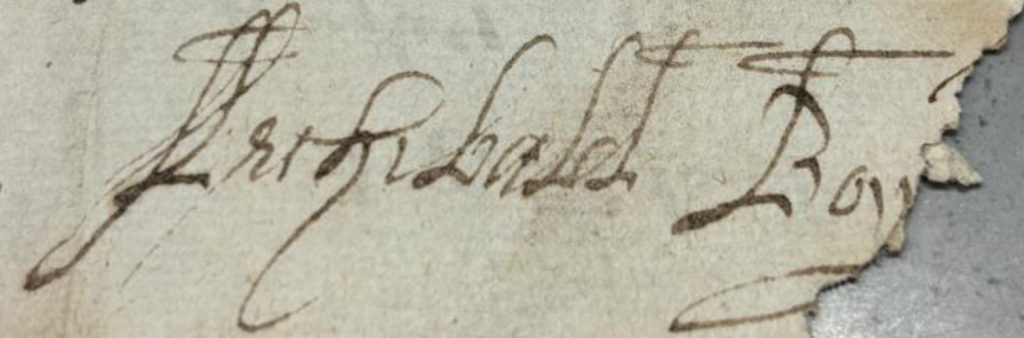
When we compare this signature with the ones above dating to 1609 and 1637 it is considerably different and we must presume it to be a different Archibald Boyd of Carncullagh. This may be the most important evidence of there being a son to Archibald Boyd of Carncullagh and his wife Jonet Peblis/Peebles i.e. Archibald Junior and that by 5 June 1669 Archibald Boyd Senior of Carncullagh and formerly of Underhill, Ayrshire was likely deceased. It should also be considered that unlike Thomas Boyd of Lisconnan, Archibald Boyd Senior of Carncullagh did not give a testimony to the authorities in 1653, despite them both being involved in the events of 1641/2. We may then consider that Archibald Boyd of Carncullagh and formerly of Underhill died sometime after 6 May 1650 and before 1653/4.
Before moving on to consider the children of Archibald Boyd of Carncullagh and Jonet Peblis/Peebles it is worth looking at the deed of 5 June 1669 again as in the bottom right of the deed we see a seal, which although showing some damage, it clearly shows the arms of what appears to be a Boyd.
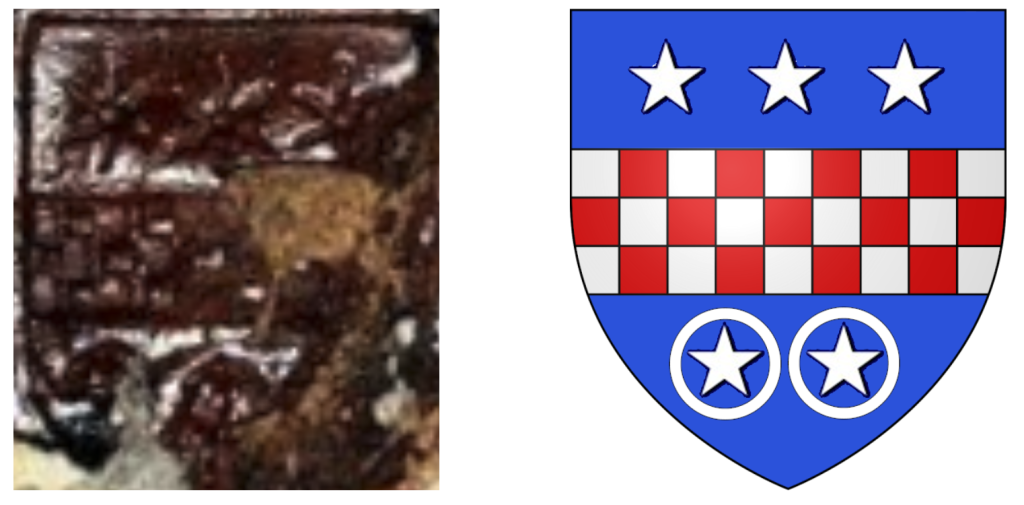
Seal and representation of Arms as shown on PRONI Ref. D2171/4 – Deed of 5 June 1669
If we compare this seal with the arms shown in the rubbing of the grave of Margaret Boyd (d.1625), daughter of Archibald Boyd of Carncullagh we see the remarkable similarity “a fess cheeky, and in base 2 annulets (?) or rings, charged with a mullet each” as described by Rev Hugh McNeill of the grave of Margaret Boyd. We turn now to look at the children of Archibald Boyd of Carncullagh, Co Antrim.
Margaret / Mary-Ann Boyd, likely eldest child of Archibald Boyd & Jonet Peblis/Peebles (d.1625)
As previously detailed in our post on the Boyds of Ardneil & Portencross the grave of Margaret / Mary-Ann Boyd is found in old Derrykeighan graveyard. The grave has featured in various transcripts from the 1830s16, 185817, 189018, 190819, 1960s20 and most recently 2012.21
The first transcript appears in “Extracts from Draft Memoir on the Ancient Topography by J. Stokes” in the Ordnance Survey Memoir for the Parish of Derrykeighan c1830-38. John Stokes states under the heading ‘Monuments in Derrykeighan Church’:-
The following are the most remarkable monuments: first, a tombstone raised from the floor of the old church after being pulled down in 1831. The inscription is as follows: “Heir lyeth the corpis of ane faithful sistir in the Lord calid Margrat Boyd, dochter to Archibald Boyd of Carncolach and sumtym wyf to William Huchsoun of Stronocum, who disist the 01 of June 1625,” The words are made in ancient character. This stone is now a little to the south east of the east end of the church.
These valuable remarks by John Stokes tell us that the gravestone to Margrat Boyd was originally in the floor of the old church and was subsequently moved to its current location after 1831 and before the Ordnance Surveyors arrived. Of course it poses the question why was the stone moved? Further study of the Ordnance Survey memoirs for Derrykeighan provides a clue. In ‘Extracts from Fair Sheets on Ancient Topography by Thomas Fagan, May and June 1838’ we find under the heading ‘Old Church of Derrykeighan’
After the completion of the new church at Dervock, 1831, the former was pulled down and the roof and furniture sold by auction. The removal of the church to Dervock was many years in contemplation before the grant or liberty of doing so was affected, and many full and troublesome meetings of the parishioners held in the old church on the occasion, in consequence of the parishioners being divided into 2 parties, one of which was for the erection of a new church at Dervock and the other for retaining it on the old ground in Derrykeighan. However, altercations on the subject ran so high that in order to destroy the old one altogether, some party unknown, about 12 years back (c1826), laid a match of powder beneath the flooring which, if ignited, according to design, would have blown the roof altogether off the church, together with destroying the furniture; but the match being laid in a damp passage leading to a vault beneath the floor, together with some broken panes in the windows, prevented its having the the designed effect. However, it blew up and otherwise injured some of the pews. The church was again repaired, but a report of the transaction subsequently made to the lord lieutenant secured his sanction to have the contemplated church erected at Dervock; agreeable to the wishes of one party, of which the gentlemen constituted part, but utterly at variance with the majority of the parishioners, who wished to retain it at Derrykeighan, where the ruins of the old church stands.
From this information we can surmise that the gravestone appears to be to a Margrat (otherwise Margaret) Boyd, daughter to Archibald Boyd of Carncullagh and sometime wife to William Hutcheson of Stranocum who died 1 June 1625. She was originally buried inside the walls and beneath the floor of the old church and subsequent to 1831 the gravestone was removed from the church and placed in its current location south east of the east gable of the old church. Remarkably this removal or moving of gravestones/memorials appears to have involved at least one other. The monument to Robert Kar who died 7 November 1676 is described by Stokes in the 1830s as being “inside and in the northern side wall” of the church. Today it is outside about 20 metres to the south of the mid point of the south wall. The reasons for the changes in location to these gravestones and memorials may never be truly known but it would not be unreasonable to suggest that they occurred either due to the original attempt to damage or destroy the church c1826 or in the years following its abandonment when the old church was left at the mercy of the weather.
We visited the gravestone in June 2025 in an attempt to make our own survey of the gravestone of Margaret Boyd and in particular any surviving wording relating to her name.
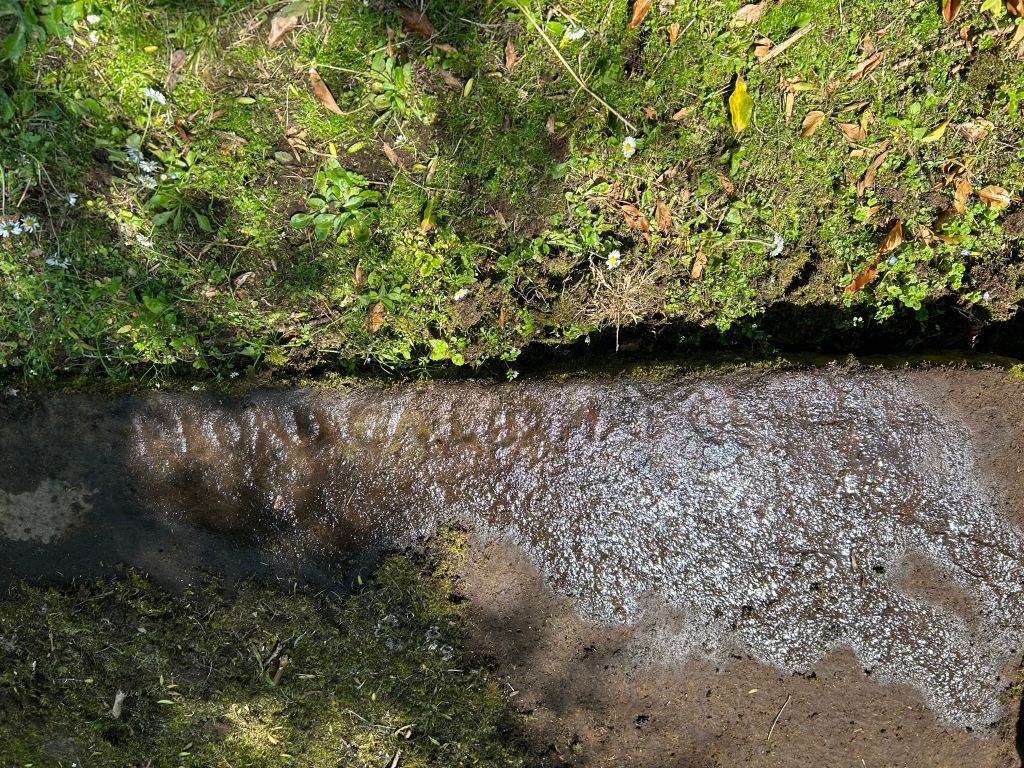
Picture taken of wording on RHS of gravestone to Margrat Boyd died 1 June 1625
In the picture above you can clearly see some of the surviving wording i.e. E LORD CALL…. which would appear to match with the phrase “the Lord calid…” which is quoted in the various transcriptions. Unfortunately the remaining wording relating to the name is very severely worn and would require a more technical examination, possibly using photogrammetry, in an effort to reveal it.
The numerous transcripts dating back to the 1830s would seem to leave little doubt that the daughter of Archibald Boyd of Carncullagh was called Margrat or Margaret however a curious letter to the editor of the Coleraine Chronicle22 dated 17 May 1865 creates some doubt. On the 22 April the paper had printed Rev George Hill’s narrative on the ‘Stewarts of Ballintoy’ including a section on the grave above except it is referred to as the grave of Christian Stewart. The author of the letter sought to correct this and confirm that it was to Margaret Boyd. The author did not give a name but referred to himself as “The Gt Gt Gt grand nephew of Mary Ann Boyd“. Given the various transcripts this intervention would seem to be over except that on 27 May 1865 the paper published a piece23 as follows:-
“THE STEWARTS OF BALLINTOY” – A misprint occurred in a letter which appeared in last Chronicle, under this heading. the name “Mary Anne Boyd” was printed ‘Margaret” in the body of the letter, rendering the meaning of our correspondent unintelligible. Readers interested in the historical series of papers on ‘the Stewarts of Ballintoy,’ which have appeared in the Chronicle of late, will please note the correction.
So the mysterious author of the letter had intended to state the grave was to a “Mary Ann Boyd, wife of William Hutchin, and mother of Archibald, who married Christian Stewart, who’s son Archibald became the eminent lawyer, and for many years the representative for Hastings in the English Parliament and who by his will directed that a large fortune he had accumulated should after the death of his wife be distributed among his poor relations and of which after having undergone two distributions there is still a considerable sum to the good.” The large fortune that the letter writer alluded to was what became known as ‘Hutchinson’s Charity’ which as we said previously will be the subject of another post but we can say that the research by Francis Dobbs Esq on behalf of the trustees to the Charity in the late 1790s clearly recorded that the wife of William Hutcheson was Mary Ann Boyd.
So we are left with a puzzle to solve. Was William Hutcheson of Stranocum married to two different woman i.e Margrat & Mary Ann Boyd or are they the same person and either the gravestone has been transcribed in error or did Francis Dobbs record the name wrongly during his research?
With regard to the grave we can deduce some information from relatively primary sources. Firstly reference to William Hutcheson of Stranocum. An entry in the Inquisitions of Ulster.24
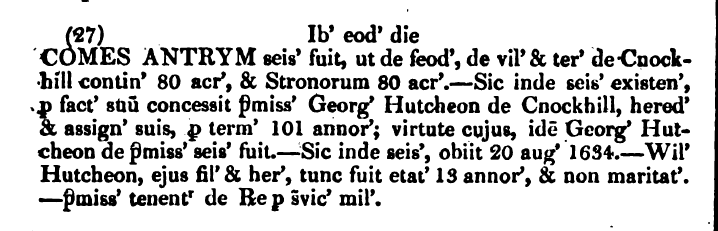
We can clearly see that William Hutcheon was son and heir of George Hutcheon and that William was 13 years of age on 20 August 1634 when his father died. This would put William’s birth c1621 and we can see 80 acres in Stronorum (Stranocum) as part of William’s inheritance.
A look at the Muster Roll of 1630 finds only one William Hutchon25 in the whole of Co Antrim. A further document in PRONI26 dated 1 May 1630 relates to a tithes dispute and includes amongst its parties “Wm Hutchin, Stranocum”. Finally the deed in PRONI27 dating to 1704 which we looked at previously, records the timeline of the lands of the Hutcheson family in Co Antrim from George in 1614 stating as follows:-
“And Whereas the Said Earle of Antrim by his Indenture bearing | date on or about the Sixth day of March in the year of our Lord one thousand Six hundred and thirty two and for the Consideration therein ment’ed did demise unto the Said William Hutcheson late of Stranocum dec’ed the onely Son and heir of the aforesaid George Hutcheson…“
So it would appear that William was the only son to George Hutcheon. Interestingly the deed also states:-
“And after the death of the Said George Hutcheson which was Some time before the year of our Lord one thousand Six hundred & twenty | two Administration of his Estate was Committed to Margaret Hutcheson als Fulton (probably Fullerton) widow of the Said George and Mother of the Said William who Soone afterwards Intermarried with one Thomas Boyd (probably of Carncoggy) and Severall differences having arisen between them the said Thomas & | Margaret his wife and the said William Hutcheson in relation to the Estate of the Said George Hutcheson dec’ed the Same were Composed, adjusted and Ended by the mediation of friends to whome the Said differences were ****** and the Said William Hutcheson did there deliver to the | Said Thomas Boyd and Margaret his wife Such part of the Goods & Chattles of the said George and also pay Such Sumes of money as was then agreed to in Satisfaction of their demands out of the Estate of the Said George Hutcheson. And the Said Thomas & Margaret his wife did | thereon by their deed duely Executed, assigne, Set over and release unto the Said William Hutcheson all their Estate, right, title and Interest in and to the aforesaid Lands and Corn mill demised as aforesaid to the Said George Hutcheson by the before recited Indenture of the fourth of | December one thousand Six hundred and fourteen which Said Letters of Administration and Deed of Assignment were losft in the former wars in Ireland which begune about the year of our Lord one thousand Six hundred & forty one and the Records of the Diocese of Downe & | Connor for the Said time, being also lost *** Entery of the Said Administration now is to be found there. And the Said William Hutcheson being as aforesaid by good title from and under his father the aforesaid George and by virtue of the before recited Indenture of Demise possessed of all the | aforesaid Lands and mill dyed and after his death Letters of Administration of his Estate were granted to Archibald Hutcheson late of Stranocum aforesaid gent dec’ed his eldest Son and heir and to Alice Hutcheson als Stewart his widow which Said Letters of Administration | bear date the fourteenth day of September in the year of our Lord one thousand Six hundred fifty and five.”
There would appear to be little doubt that the William Hutcheson of Stranocum said to be sometime wife of Margrat Boyd is the only son of George Hutcheon of Stranocum and around the time of her death in 1625 there appears to be little or no evidence to suggest there was another William Hutcheson living in Antrim. However another problem presents itself. The Inquisition suggests William Hutcheson was born c1621. If that was the case he could hardly have been married by 1625. Also the Muster Roll of 1630 probably excluded young men/boys under the age of around 15. If we go by the Inquisition William would have been around 9 years old which is highly unlikely. The 1704 deed stated that George Hutcheon was deceased some time before 1622 so we have a timeline 1614-22 for the death of George Hutcheon. If William is married before 1625 then we must surely believe he was born c1604 or earlier. One further piece of evidence may help to place a likely birth year for William and that is found in the work of John Lodge.28 Under a heading of ‘Pardons and Licenses of Alienation Charles I’

It states “Brice Dunlapp of Kirkermean, Gent 17 Novr 1632 mortgaged two Water-mills upon the Lands of Ballycastle & Carnetillagh to William Hutchone of Stronakham (Stranocum) Gent for £200 Sterl. Inqn as before. Fine £6 paid by Hutchone. July 14 1636 (same R 58).” So again if William Hutcheson had been aged 13 in 1634 as the Inquisition had earlier stated it would be unlikely that only two years later he would be involved in a mortgage.
So with all these sources we can say that the William Hutcheson referred to on the grave of Margaret/Mary Ann Boyd is very likely the only son of George Hucheon of Stranocum. Regarding the identity of Margrat/Margaret Boyd it is very compelling that so many sources over a period of nearly 200 years have quoted almost exactly the same transcription with no mention of Mary Ann Boyd. However the letter to the editor of the Coleraine Chronicle in 1865, someone alleging to be a descendant sows doubt and the fact that the name Mary Ann is the one quoted by Francis Dobbs, a Barrister, in his investigations on behalf of the ‘Hutchinson Charity’ is a proof of some considerable weight. We must turn therefore to look at the evidence for Mary Ann Boyd.
We have already covered the letter from the descendant so if we turn to the work of Francis Dobbs it may perhaps throw some light on the matter. Thankfully the First Report (1796) by Francis Dobbs Esq. BL was reprinted on behalf of Peter S Hutchinson by Impact Printing, Ballycastle, Co Antrim in 201829. An excellent commentary on its contents was published by Stephen N Stuart the same year. Under the heading of ‘Rejections’ on page 93 of the report Dobbs states the following:-
“George Hutchinson came from Scotland early in the 17th Century, and settled at, or near Stronocum, in the County of Antrim. He had a son William Hutchinson, who married Mary Ann Boyd, the daughter of Archibald Boyd, of Magheraboy, in said County, by whom he had three sons, Archibald, James and William.”
and then on page 100:-
“The evidence for her (Mary-Ann Boyd) who was daughter to Archibald Boyd, was given by several living witnesses near Stranocum and Ballymony; and the most material evidence on the other side was the dying declarations of a Robert Barclay, which he had before reduced to writing, with the intention of swearing to them, and in these declarations he does not name the person who Mary-Ann Boyd married, but only in general terms, that she was the grandmother of Archibald Hutchinson.“
From these extracts from the report and reading through the remainder it would appear that Francis Dobbs made no reference to documented sources during his investigations in so far as proving the line of the Hutcheson/Hutchinson family indeed he seems to have placed great emphasis on sworn testimonies where possible or hearings. Given the nature of his education and career we should not be surprised at this methodology but for those of us who do historical or genealogical research today an effort is always made to seek out primary documented sources where possible.
So on one hand we have a grave which appears to be to a Margrat/Margaret Boyd and on the other the work of Francis Dobbs and the testimonies of local people, Hutcheson descendants etc. and of course the letter of 1865 which state that William Hutcheson was married to Mary Ann/Mary-Ann Boyd.
On balance the most likely explanation is that Margrat/Margaret/Mary-Ann Boyd are the same person. One possibility may have been that they were both daughters of Archibald Boyd of Carncullagh but this would raise the issue of legality of such marriages. Today a widower marrying his deceased wife’s sister might be unusual but would certainly not be forbidden in law, Canon or otherwise. The restriction was removed in 1907. However in the early 1600s both the Church of England and Church of Scotland applied the ancient restrictions as stated in Leviticus and such a marriage was listed as a prohibited degree. Perhaps with a closer inspection of the grave it may be possible to confirm the exact name on the gravestone and that may provide an answer to this perplexing problem.
Archibald Boyd Jnr of Carncullagh Upper, Derrykeighan Parish, Co Antrim
We have already seen the evidence for this likely son of Archibald Boyd Snr of Carncullagh in the Hearth Money Rolls. He is almost certainly the Archibald Boyd who signed the deed of 1669 regarding the trusteeship of the Hutcheson estate during the minority of the young Archibald Hutcheson (later MP for Hastings, Kent), mentioned earlier.
William Boyd of Carncullagh Upper, Derrykeighan Parish, Co Antrim
Apart from his inclusion in the Hearth Money rolls, as mentioned earlier, William’s name appears in a curious incident detailed by Rev George Hill in his narrative on the ‘Stewarts of Ballintoy’30. He states:-
“There is record in the Commons’ Journals (Irish parliament) of a somewhat similar attempt by the same gentleman against another member of Parliament. Under date 10th of February, we have the following: ” Upon consideration had of the petition of Peter Beaghan, a member of this House, complaining against Archibald Stewart of Ballymacfin, parish of Billy, and William Boyd of Carnequllagh (now Carncullagh), for distraining petitioner’s tenants without just cause, upon the quarterland of Islandtickard, three quarters of Moycregmore, and three quarters of Lisnagall (Lisnagatt ?), in the County of Antrim, it is ordered upon question, that the said Archibald Stewart and William Boyd shall be summoned by the Serjeant at Arms forthwith to appear before the House and answer the contents of the said petition.” This affair probably terminated as the last had done (1662), by Stewart withdrawing his claim, of whatever nature it may have been, on the lands above named, as we find no further reference to the question in the Commons’ Journals.”
Sadly this incident and the Hearth Money Rolls are the only evidence found so far for William Boyd.
The Children of Archibald Boyd of Magheraboy as stated in the First Dobbs Report
As we mentioned earlier the details of the Dobbs Report will form a separate post but in recording the remaining children likely born to Archibald Boyd of Carncullagh we must refer to the Report.
The first thing we must address is the reference to Mary-Ann Boyd’s father being Archibald Boyd of Magheraboy. So is this Archibald Boyd the same person as Archibald Boyd Snr of Carncullagh (d. c1653) as outlined previously? This different residence i.e. Magheraboy other than Carncullagh is suggestive of these two Archibald’s being separate people. In an effort to investigate this dilemma we first examined the Hearth Money Rolls31 32 for Co Antrim to ascertain if there are any Boyds living in a townland called Magheraboy. Unfortunately there are a number of town lands called Magheraboy in Co Antrim as follows:-
Magheraboy – Parish of Ballintoy – no Boyds
Magheraboy – Parish of Billy aka Bushmills – no Boyds
Magheraboy – Parish of Derrykeighan aka Derrykeighan – George Boyd (1666 & 1669)
Magheraboy – Parish of Kilraghts – no Boyds
Magheraboy – Parishes of Dunaghy and Newton Crommellin – no Boyds
So we can see that from 1666-1669 a George Boyd was taxed on one hearth in the townland of Magheraboy / Derrykeighan. It is useful at this point to look at the ‘Downe Survey’ map of Derrykeighan (1656-59) to confirm that at that time the current townland of Derrykeighan was known as Magheribuy, No. 73 on the map and also indicating the presence of a church i.e. old Derrykeighan Parish Church.
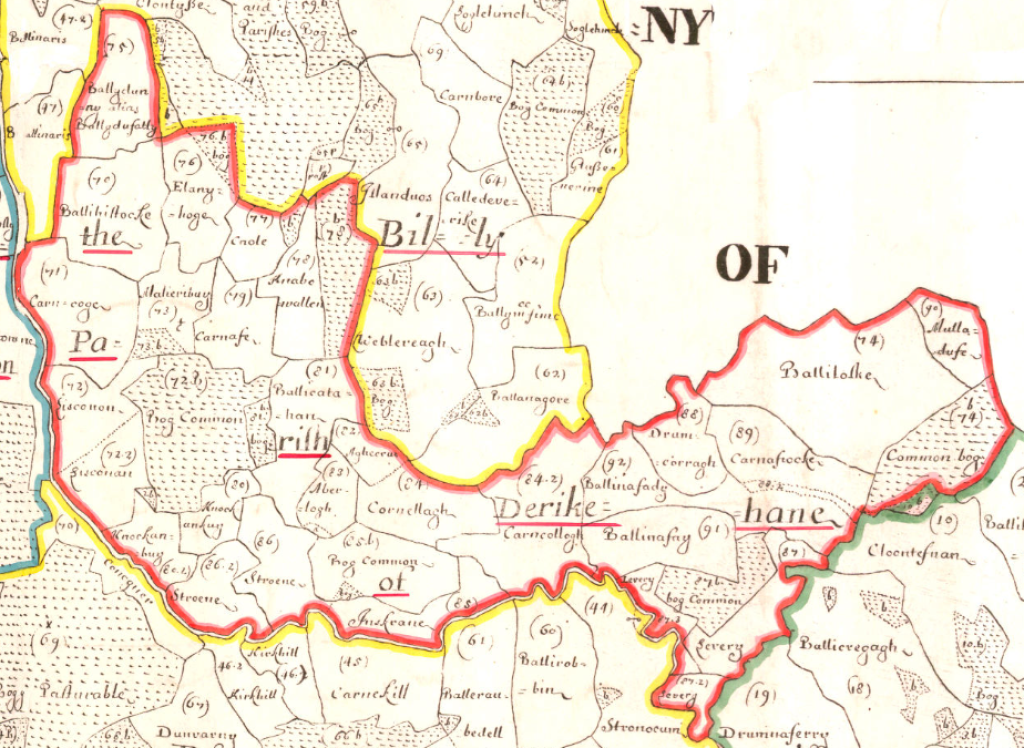
The Parish of Derrykeighan as per the Downe Survey (c1656-59) outlined in red
Now we mentioned earlier how Thomas, third son of Thomas Boyd of Carncoggy, acquired land in Magheraboy in 1637 so it is perhaps unsurprising to find a Boyd living there around 30 years later. We should also remember that this deed to Magheraboy was witnessed by Archibald Boyd Snr of Carncullagh. So it would appear our investigations have likely connected the Boyd family specifically to to the townland of Magheraboy / Derrykeighan townland in the Parish of Derrykeighan but is this enough to suggest that our two Archibald Boyds are one and the same person. If we look at the timeline of the generations of the two main progenitor families of the Dobbs Report i.e. George Hucheon and Archibald Boyd of Magheraboy and connect them down through the generations to people for which we can be fairly sure of their key dates i.e. likely birth, death etc. it may help in answering this question.
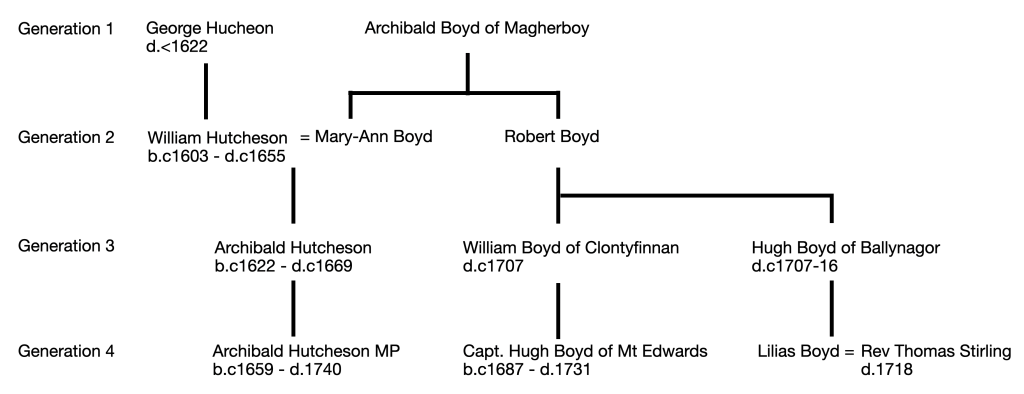
Generational Analysis of the Hutcheson and Boyd families named in the First Dobbs Report 1796
Above is a generational analysis of the Hutcheson and Boyd families named in the First Dobbs Report. We know from the 1704 deed mentioned earlier that George Hucheon had died some time prior to 1622. The same deed also stated that letters of Administration were granted for the estate of William Hutcheson, previously deceased, on 14 September 1655 and letters of Administration for the estate of Archibald Hutcheson Snr on 21 February 1670 then Archibald Hutcheson MP was buried in St James Piccadilly, London on 18 August 1740. With regard to Robert Boyd, said to be brother of Mary-Ann Boyd and son of Archibald Boyd of Magheraboy, we know he had, amongst other children, two sons, William Boyd of Clontyfinnan, Loughguile Parish, Co Antrim and Hugh Boyd of Ballynagor, Billy Parish, Co Antrim. We also know that William Boyd had a son Capt. Hugh Boyd of Mount Edwards, Layd Parish, Co Antrim who was buried at St James Parish Church, Clough, Co Antrim where a memorial records his death and those of other family members. Finally in regard to Hugh Boyd of Ballynagor, we know his daughter Lilias married Rev Thomas Stirling who was Minister of the Presbyterian Congregation of Derrykeighan / Dervock, Co Antrim between 1703 and his death in 1718.
This analysis seems to suggest a reasonably good match up in the generations between the Hutcheson and Boyd families and perhaps confirming that the Archibald Boyd of Magheraboy mentioned in the Report is of the same generation as George Hucheon. Given that all the evidence seen to date would suggest that there was only one Archibald Boyd i.e. of Carncullagh at the time of the 1630 Muster we believe it is highly likely that Archibald Boyd of Magheraboy in The Dobbs Report and Archibald Boyd of Carncullagh who received denization in 1617 and was Mayor of Coleraine in 1648-49 are one and the same person. Given this information it is not unreasonable therefore to assume that the children mentioned in the First Dobbs Report as of Archibald Boyd of Magheraboy are those of Archibald Boyd of Carncullagh.
Before we look at these children it is worth mentioning that the intention of the Report was to establish qualifying persons who could receive monies under the Charity of Archibald Hutchinson MP as being “poor and necessitous” i.e. “their being under the rank of Gentlemen, and living by their labour, either as farmers, Workmen, Servants, labourers, Soldiers or Sailors; or where claimants are in the line of Gentlemen, then they must either be in reduced state, or have large families, with very inadequate means to support them.” So given this information we know that the lineages given in the Report are likely incomplete either because the persons living in 1796 do not qualify or that by that time the lineage had died out.
The children quoted in the report as those of Archibald of Magheraboy are (in the order published) Mary-Ann, Robert, George, Alexander, Jane, Anaple and Elizabeth and accordingly, we believe, these are the remaining children of Archibald Boyd of Carncullagh, Co Antrim. We will look at the descendants of these children in future posts as some lines have been traced to the present day and living descendants.
- Scotlands People – Wills & Testaments – Allexander Cunynghame – Ref. CC9/7/8, (Glasgow Commissary Court) Images 177-179 ↩︎
- NRS Ref. GD3/1/7/16/1 ↩︎
- Hill, An Historical Account of the MacDonnells of Antrim, p. 392 ↩︎
- ‘Men and arms’ – The Ulster settlers, c. 1630 (2012), p.111, [f.149v], No.135, footnote 19 ↩︎
- PRONI Ref. D2977/3A/3/2/66/1 ↩︎
- PRONI Ref. D2977/3A/5/35/1 ↩︎
- Examination of Gilduffe O Cahan, 10/3/1654, 1641 Depositions, Trinity College Dublin, MS 838, fols 024r-026v, http://1641.tcd.ie/deposition/?depID=838024r018. Accessed 27 December 2025. ↩︎
- Letter to William Fullerton, undated, 1641 Depositions, Trinity College Dublin, MS 838, fols 239r-239v, http://1641.tcd.ie/deposition/?depID=838239r286. Accessed 27 December 2025. ↩︎
- William Fullerton to his brother, undated, 1641 Depositions, Trinity College Dublin, MS 837, fols 153v-, http://1641.tcd.ie/deposition/?depID=837153v120. Accessed 27 December 2025. ↩︎
- Acts of the Corporation of Coleraine 1623-1669, IMC, Brid McGrath, p.139 ↩︎
- Ibid, p.184 ↩︎
- Ibid, p.213 ↩︎
- A History of the Presbyterian Church in Ireland, Seaton Reid, pp.272-275, Appendix XIII ↩︎
- Heads and Hearths: The Hearth Money Rolls and Poll Tax Returns for Co. Antrim 1660-69, S T Carleton M.A. p.89 ↩︎
- PRONI Ref. D2171/4 ↩︎
- Ordnance Survey Memoirs of Ireland – Parishes of County Antrim V 1830-5, 1837-8, p.87 ↩︎
- Leanings in Northern Church-Yards – Author(s): George H. Reade Source: The Journal of the Kilkenny and South-East of Ireland Archaeological Society, 1858, New Series, Vol. 2, No. 1 (1858), pp. 48-54 Published by: Royal Society of Antiquaries of Ireland, p.49 ↩︎
- Memorials of the Dead in Ireland, Vol I (1890), p.291. ↩︎
- History of Derrykeighan parish for Three Centuries by Thomas Camac (1908), p.66 ↩︎
- McClay Papers – PRONI Ref.D3672/6 ↩︎
- Derrykeighan Old Church Graveyard, Dorothy Arthur (2012), p.100 ↩︎
- Coleraine Chronicle – 20 May 1865, p.4 ↩︎
- Ibid – 27 May 1865, p.5 ↩︎
- Inquisitionum in Officio Rotulorum Cancellariae Hiberniae Asservatarum Repertorium Vol II (Ulster), (Hardiman, 1829) ow Inquisitions of Ulster, Cha I, 27 – drawn primarily from the Inquisitions Post Mortem during the reigns of James I to Charles II ↩︎
- ‘Men and arms’ – The Ulster settlers, c. 1630 (2012), p.111, [f.149v], No.151 ↩︎
- PRONI Ref. D2171/1 ↩︎
- PRONI Ref. D2171/10 ↩︎
- NAI Lodge/18/2145 ↩︎
- Dobbs’ Report, viii + 103 pp., ISBN 9 781906 689872 (softback) and 9 781906 689889 (hardback), [2018]. The report and associated notes are available in the North of Ireland Family History Society, Research Centre, Randal Gill Library, Unit C4, Valley Business Centre, 67 Church Road, Newtownabbey BT36 7LS, Northern Ireland at Refs. IR 555/186 and IR 552/026 ↩︎
- The Stewarts of Ballintoy: With Notices of Other Families of the District in the Seventeenth Century. The Stewarts of Ballintoy, Author(s): George Hill – Source: Ulster Journal of Archaeology, Jan., 1900, Second Series, Vol. 6, No. 3 (Jul.,1900), p. 148 ↩︎
- Heads and Hearths: The Hearth Money Rolls and Poll Tax Returns for Co. Antrim 1660-69, S T Carleton M.A. ↩︎
- https://www.billmacafee.com/17centurydatabases.htm ↩︎