This post has arisen from the discovery of numerous Boyd burgesses of Glasgow throughout the late 16th and 17th centuries. The vast majority of those burgesses shared a common trade, that of being masons or Master Builders and there is evidence they were all from one family originating from an Andrew Boyd father of John Boyd Burgess of Glasgow who was pardoned for his involvement in the Battle of Langside in 1571. However the subject of our post stems from the senior line of the Boyds, a son of Robert 1st Lord Boyd and his grandson would become one of the key figures in the emerging mercantile life of Glasgow in the 16th century. However we start our post with the events in Scotland from 1460 and more particularly surrounding Robert 1st Lord Boyd, father of our subject by Mariota (Jane) Maxwell of Calderwood.
On 3 August 1460 during the Siege of Roxborough the King of Scotland, James II, died. His son James III, who was not yet 10 years old, was crowned just a week later at Kelso Abbey on 10 August 1460. With a child on the throne the grip on power was tenuous and a series of regencies began first with the young King’s mother Queen Mary of Guelders. However she died in December 1463 leaving James Kennedy, Bishop of St Andrews in control. With his death in May 1465 the regency appeared to pass to the Bishop’s brother Gilbert Lord Kennedy but this was not sanctioned by Parliament and the new regime became increasingly unpopular and the inevitable moves of competing noble families soon followed.
On 9 July 1466, whilst at an exchequer court in the palace of Linlithgow the young King James III was seized under the direction of Robert Lord Boyd and taken to Edinburgh.1 It is thought that Robert Lord Boyd’s brother Sir Alexander had played an important part in the plot as it is believed he had proximity to the young King as an instructor in the art of chivalry. This bold and audacious move could have had immediate serious consequences for Robert Lord Boyd. However on 13 October 1466 the young King was made to declare before Parliament in Edinburgh2:
“he had conceived no indignation, offense, or rancour of mind in any way against the same Lord Boyd, Adam Hepburn (son and heir apparent of Patrick, Lord Hailes), John, Lord Somerville, Andrew Ker (son and apparent heir of Andrew Ker of Cessford), or others being with the same Lord Boyd and the predefined persons; nor did he wish to conceive any in the future. Instead, he declared them to be entirely free of all harm and guilt regarding this kind of riding, which was done by the command of his Serenity, and he reputed them as his faithful lieges and held them dear. Thus, from this kind of riding, no prejudice, damage, molestation, or grievance should in any way be generated in future times for them, any one of them, or the persons then present with them.“
The Kings statement was recorded by Parliament on 25 October 14663 and the same day Robert Lord Boyd was appointed Governor of the King during his minority;
“James, by the grace of God, King of Scots, to all his good men to whom the present letters shall come, greeting. Because we, in our last parliament held at Edinburgh, declared our mind before the three estates of our Kingdom that it pleased us exceedingly that our kinsman, Robert, Lord Boyd, should have the governance and rule of our person, of our brothers, and of our fortresses as one of our most intimate councillors, in the execution of our Kingly authority and Justice, until our legitimate age of twenty-one years. For that reason, with the consent and deliberation of the other lords of our council, we have constituted and ordained, and by these presents do constitute and ordain, the said Robert, Lord Boyd, our kinsman, as governor of our person, of our brothers, and of our fortresses until our aforementioned age. Strictly inhibiting anyone from presuming at any time to act contrary to this our present ordinance, under every penalty which he might incur against our Royal Majesty in this regard.”
Unfortunately the now emboldened former Regent and now Governor or Great Chamberlain of the King, Robert Lord Boyd, began with what was possibly his greatest mistake. On 26 April 1467, having previously arranged for the elevation of his son Thomas as 1st Earl of Arran and also marriage to the King’s sister Princess Mary (1453-1488), who was likely only thirteen at the time, there then followed three charters granting huge swathes of land to the couple4. The Earl and Princess Mary had at least two children issue from their marriage, Margaret (c1468-1533) and James, 2nd Lord Boyd (c1469-1484).
Robert Lord Boyd’s next move was to solidify his position by arranging a suitable marriage for the young King which came through Princess Margaret, daughter of King Christian I of Denmark in 1469. The marriage was to have brought a substantial dowry, but unable to meet the initial deposit, the King of Denmark offerred the Islands of Orkney and Shetland as security until the full terms of the dowry were met. There is little doubt that rival nobles felt that the Boyd’s had gone too far with the Earl of Arran but unless they acted soon the situation could become irretreivable. A coup was attempted in April 1468 but without success. However in 1469 an opportunity arose whereby Robert 1st Lord Boyd and his son Thomas 1st Earl of Arran were both out of the country.
Remarkably it appears that King James III’s sister Princess Mary, wife of Thomas 1st Earl of Arran, warned her husband of impending moves to have him and his father seized. Accordingly Thomas escaped and his father did not return from what was believed to have been a diplomatic mission in England. The young King James III brought his minority to an end and Parliament was instructed to pass an act of attainder in November 1469 declaring Robert Lord Boyd, his brother Sir Alexander and son Thomas 1st Earl of Arran to be traitors, stripped of their titles and their lands forfeited entirely to the Crown. Sir Alexander Boyd did not escape the wrath of the King and was quickly captured and executed. Robert formerly Lord Boyd, is believed to have died at Alnwick in Northumberland, England in 1481. His son Thomas, formerly 1st Earl of Arran, is believed to have predeceased him in Antwerp in 1474. This whole historic and dramatic episode in the history of Scotland had finished a complete disaster for the Boyds. Not only had Robert Boyd, brother Alexander and his son Thomas been stripped of their titles, lands and holdings but through the traditional mechanisms of feudal patronage their extended family had also been stripped. Amongst Robert Boyd’s remaining children were Alexander, who would become Chamberlain and Bailie of Kilmarnock, Archibald, the subject of our post, John of whom little is known, Elizabeth who would marry (4 March 1467) Archibald Douglas, 5th Earl of Angus, Annabella who would marry Sir John Gordon 2nd of Lochinvar and finally Margaret, youngest daughter, who would become mistress to James IV.
From 1469 the registers of the Great Seal of Scotland record charters by which King James III granted former Boyd lands, or income from them, to others. Firstly in 1470 to his consort Margaret Queen of Scots5 then in 1475 to Stephen Lockhart6, a gentleman bodyguard of the King and again in 1477 a further ratification of extensive former Boyd lands to his Queen7. However by 1482 King James III was showing signs of coming to terms with the actions of the Boyds. In fact as far back as 1471 he had granted the 10 Merk land of Ernele (i.e. Ardneill, later Portencross) to Robert Boyd of Ernele which the family then held of the King directly rather than more traditionally through their feudal Lord Boyd, the connection of which was removed by the Act of Attainder in 1469. Now on 14 October 14828 he conveyed the former Boyd lands (excluding Ardneill) to his sister, now Lady Mary Hamilton, widow of James, 1st Lord Hamilton, who had died on 6 November 1479. Just eight days later we find the granting of heriditary sasine of the Barony and castle of Kilmarnock in favour of James 2nd Lord Boyd, son of the former Thomas 1st Earl of Arran and the Princess/Lady Mary:
“In the name of God. Amen. Let it appear evidently to all and be known by this present public instrument that in the year of the Incarnation of the Lord 1482, on the twenty-second day of the month of October, in the first indiction, and the twelfth year of the pontificate of the most holy father in Christ and our lord, the Lord Sixtus IV, by divine providence Pope. In the presence of me, the notary public, and the underwritten witnesses, personally appeared an honorable man, Robert Mure, Lord of Rowallan (noted as Powkelle/Polkelly in text), Sheriff in this part for Ayr and Bailie of Cunninghame for our Supreme Lord the King. By virtue of a certain precept of sasine from the King’s chancery directed to him, he went in person to the Castle of Kilmarnock. And there, he delivered, granted, and assigned to the noble and illustrious lord, James, Lord Boyd, hereditary sasine, state, and possession of all and singular the lands of the entire Barony of Kilmarnock, along with the aforesaid castle, its tenants, tenandries, and its other pertinents. This was done according to the tenor of the charter made for him by our said Supreme Lord the King, by the delivery of earth and stone, as is customary in such matters.
Reserving, however, the free tenement (life rent) of the said lands of the entire Barony of Kilmarnock, with the castle, tenants, tenandries, and their pertinents, to Mary, Lady Hamilton, mother of the said James, Lord Boyd, for the entire duration of the life of the said lady. Concerning all and singular of which things, the aforementioned James, Lord Boyd, requested me, the underwritten notary public, to make for him one or more public instruments. These things were done within the aforesaid Castle of Kilmarnock, at the iron gate of the same, at the eleventh hour before noon, or thereabouts, in the year, month, day, indiction, and pontificate as above. Being present there: George Maxwell of Carruchan, Alexander Boyd (uncle of the said Lord), Archibald Boyd, and John Boyd (brothers), Archibald Craufurd of Craufurdland, Robert Dalzell, Alexander Fowlfurd, Alexander Hamilton, Robert Craufurd, John Craufurd, Thomas Boyd, and James Moncreiff, witnesses called and specially required to the premises...“9
This was followed on the 25 & 26 October 1482 by two further grants10 of sasine to James Lord Boyd of various lands including Monfod, Flat, Ravisdalemure, Ormyscleuch, Chapelton, Bollynschaw, Dryrig, the Milnton, Crevoch, Dollywrae, Potterton, Cuttiswrae, Cokilbe, Corshil, Clerkland, the Blacklaw, the Hairshaw, and two merks of the half merk lands of Nether Robertland, in the Lordship of Stewarton. It appears that James’ uncle Archibald acted as his attorney in the transactions. The young James 2nd Lord Boyd did not enjoy his new found status for long as he was killed in a feud with Hugh Montgomery of Eglinton in 1484. As the teenage Lord had no heirs the likely outcome was that his estates would revert to the Crown. This appears to have been confirmed by an indenture dated 26 June 1508 in which the lordship and lands of Kilmarnock are conveyed under a lease of nine years to Alexander Boyd in Kilmarnock:
“This agreement, made at Edinburgh on the 26th day of June in the year of our Lord 1508, sets out, declares, and bears witness to a final contract and agreement. It is made between the right high and mighty princess Margaret, by the grace of God Queen of Scotland, with the consent and approval of her dearest spouse, the right excellent, high, and mighty prince James IV, King of Scots, on the one part; and Alexander Boyd in Kilmarnock on the other part, in the manner and form that follows: The said right excellent princess, with the consent of her high and mighty husband, leases and rents out to the said Alexander Boyd and his heirs (one or more) all and whole the lordship and lands of Kilmarnock, Dalry, Nodesdale, Kirkbride, the Flat, and Tarston, along with the annual revenue of Martnaham, together with all tenants, sub-tenants, and their properties belonging to the Queen and given to her as part of her marriage dowry, located within the territory of Cunninghame and the Sheriffdom of Ayr. This lease includes all manner of feudal casualties, wardships, reliefs, and marriage rights belonging to these lordships whenever they happen to fall vacant. The lease is to last for a fixed term of nine years, starting immediately from the feast of Whitsunday last past before the date of these letters. This feast of Whitsunday marked the official entry of Alexander and his heirs into the lordships, lands, tenants, and properties, and the lease shall continue from that point forward for the full nine years. Alexander and his heirs are to hold and possess the lordship and lands of Kilmarnock, Dalry, Nodesdale, Kirkbride, the Flat, Tarston, and the aforementioned annual revenue, along with all tenants, properties, and casualties, from the Queen for the duration of these nine years. This includes the entire length and breadth of the lands, along with any castles or fortifications belonging to them, or rightfully known to belong to them in any way. Alexander and his heirs also have the power to appoint sub-tenants and under-tenants beneath them, and to remove or install them at their own pleasure. In exchange, the said Alexander and his heirs shall pay to the Queen, or to her authorized chamberlains, attorneys, or factors in the town of Edinburgh, the sum of one hundred pounds in standard Scottish currency to settle the remaining balance of his previous financial account. This sum must be paid on the following deadlines: forty pounds at the feast of Lammas (the Feast of St. Peter in Chains) next coming, and the remaining balance of the sum at the feast of Martinmas in winter immediately following, without any further delay.
Furthermore, Alexander shall pay to the Queen, or to her chamberlains, attorneys, or factors, an annual rent of six hundred merks in standard Scottish currency. This must be paid within the town of Edinburgh in two equal portions at the two traditional term days: Martinmas in winter and Whitsunday. The first termly payment shall begin at the feast of Martinmas in winter next coming after the date of this document, and the next payment shall be at the feast of Whitsunday immediately following, continuing termly at Martinmas and Whitsunday until the nine years have fully expired. Alexander must find, for himself and his heirs, sufficient guarantors and debtors who are wealthy citizens (burgesses) of Edinburgh, or other financially responsible persons, to back these payments. The annual rent must be paid in Edinburgh on the deadlines stated above, or at the absolute latest, within a forty-day grace period following each deadline, paid to the Queen, her chamberlains, attorneys, factors, or anyone else she assigns to receive it. Alexander must also cause his guarantors to appear before the Lords of Council [the supreme civil court] to formally acknowledge this contract and legally bind themselves to fulfilling these terms and paying these sums on the stated dates. At the absolute latest, the winter rent (Martinmas mail) must be paid by the feast of St. Thomas the Apostle [21 December] yearly before Christmas, and the summer rent (Whitsunday mail) must be paid by the feast of St. Thomas the Martyr [7 July], without any longer delay, under the strictest legal form of obligation. If Alexander, his heirs, or his guarantors fail to pay these sums and annual rents on the specified dates, Alexander and his guarantors agree that this contract will immediately gain the full power and effect of a formal decree (judgment) issued by the Lords of Council. Consequently, the King’s letters can be written to immediately compel them and seize (distrain) the lands and goods of Alexander and his guarantors to satisfy the debt, treating it exactly like a debt already proven and recovered before the court. Furthermore, if Alexander, his heirs, or his guarantors fail to pay the rents termly and yearly as described above—or at the latest by St. Thomas’s Day before Yule for the winter rent, and St. Thomas the Martyr’s Day for the summer rent—this lease granted to Alexander will, from that moment on, be completely expired, void, null, and of no effect, as if it had never been made, subject entirely to the will and pleasure of the Queen. In return, the Queen promises that she will immediately and with all diligence cause the castle and estate of Kilmarnock to be thatched and made completely watertight, entirely at her own personal expense. Once it has been thatched and made watertight, Alexander and his heirs must maintain and uphold the castle in that condition until the end of the nine years.
If the Queen happens to visit the castle and estate of Kilmarnock, Alexander and his heirs must welcome her and her accompanying court. They must grant them free entry and exit to all rooms and buildings within the castle at their pleasure, and allow them to remain there as long as the Queen wishes, at her own personal expense. Furthermore, if the Queen’s chamberlains, factors, or servants visit the estate on business, Alexander must host them at his own expense—providing them with food, drink, and other necessities, and treating them with the respect appropriate to their rank. Alexander must also respect and maintain any existing leases (assedations) previously granted by the Queen or her commissioners to current tenants during the general leasing period. To witness this agreement, Alexander Boyd has affixed his personal seal and signed his name to the copy of this indenture kept by the Queen. To the copy kept by Alexander Boyd, the Queen has affixed her signet seal and signed her name. Finally, the King, as her husband, has signed this document to officially signify his consent, on the day, year, and place mentioned above.
(Signed) JAMES R. [James Rex/King]
(Signed) MARGARETT”11
Interestingly at no time does the indenture name Alexander as Lord Boyd so historians and writers sometime refer to him as titular or de jeur 3rd Lord Boyd. It is believed he died shortly after the date of this indenture. King James IV would later die at the Battle of Flodden and there is no record that Alexander Boyd was present at the time. We do however have confirmation that his eldest son Robert is known as Lord Boyd by 10 November 151312 at which time the Crown recognised that a James Boyd was accepted as an attorney on behalf of Robert Lord Boyd and his wife Margaret Colquhoun. Unfortunately the James Boyd has not as yet been clearly identified. However he may have been a son of Archibald Boyd the subject of our post. With the tumultuous events surrounding the Boyd family in the mid to late 1400s documented we can now turn to look at the third son of Robert 1st Lord Boyd.
Archibald Boyd (c1454-c1507) of Nerston and then in Bonshaw & Dririg
It is generally thought that Archibald Boyd was born c1454. He was about twelve years old when his father Robert 1st Lord Boyd seised power in Scotland becoming Governor to the young King James III. At that time he may have been receiving a good education and perhaps a career in law was the intention. The sasine of 25 October 1482 (see note 9) records “Archibald Boyd appeared as attorney“. He would have been twenty eight by that date and likely a fairly seasoned lawyer.
In an account by his brother Alexander Boyd, Chamberlain, Bailie, and keeper of the place and lordship of Kilmarnock, [rendered at Linlithgow], 25 June 1491 he states:
“And he does not charge himself with the rents of the other part of Naristoun because, as the accountant [Alexander Boyd] asserts, Archibald Boyd holds it by right of inheritance (hereditarie), except for an annual rent claimed by the Lord of Lachop; and the fourth day of the upcoming month of July is assigned to the said Archibald to show what right, if any, he has in the said lands, and that letters of the Lord King be issued to formally summon the said Archibald.”
Archibald Boyd is first recorded as of Narstoune (Nerston) when he appeared as a witness to a discharge by Cuthbert, Lord Kilmaurs, to Archibald, 5th Earl of Angus (his brother-in-law) on 7 August 1492.13 The transaction is transcribed by Fraser in the third of his volumes on the Douglas family. The earlier requirement by Alexander Boyd for Archibald to prove his right to the “the other part of Naristoun” seems to have occurred prior to 12 August 1492 along with his marriage to Christian Mure of Rowallan when we find a charter14 as follows:
“THE KING [James IV] confirmed to ARCHIBALD BOYD, and CHRISTIAN MURE his spouse, the western half of the lands of Naristoun, in the barony of Kilbride, County of Lanark;—which the same Archibald resigned: LEASED to the said Archibald and Christiane and with the right of survivorship in joint fief, and to the heirs lawfully begotten between them, of the King as Steward of Scotland.”
Map showing location of Nerston, East Kilbride, Lanarkshire, Scotland
Some of the children born to Archibald Boyd of Nerston and his wife Christian Mure were recorded in the Scots Peerage by James Balfour Paul.15 Unfortunately the text contains a dating error regarding the first appearence of Archibald Boyd as of Nerston. The volume states 7 August 1472 which should be 1492. Of the children recorded by Paul we have Robert, Patrick, an unamed daughter first married to Hugh Mure of Polkellie, Elizabeth who married Thomas Douglas, younger of Lochleven and Margaret who became mistress to James IV, King of Scotland. However we believe there were at least three additional children not recorded by Paul i.e. Archibald the younger, later in Bonshaw, John of Nerston and James.
In the Exchequer Rolls of Scotland we find recorded on 9 September 150216 details for the rent due under lease for the lands of Bonshaw and Dririg i.e.
“Bowaneschaw and Druig: £3 6s. 8d. Bowaneschaw is leased to Archibald Boyd and Christine, his spouse, for the terms as above. Druig [is leased] thereof for the money of £6 13s. 4d., grassum.”
This appears to confirm that by 9 September 1502 Archibald Boyd and his wife Christian Mure were no longer feudal holders of Nerston and instead tenants in the neighbouring lands of Bonshaw and Dririg and as such designated as ‘in Bonshaw & Dririg’ under the terminology of the time.
Map showing location of Bonshaw, Ayrshire, Scotland
A further entry from the Exchequer Rolls of Scotland17 dated 4 May 1507 records the transfer of the lease on Bonshaw and Dririg to Archobald Boyds now widow and sons Robert and Patrick:
“Bowaneschaw and Dryriggis: £6 13s. 4d. [These lands] are leased to Christine Mure, widow of the late Archibald Boyd, and to Robert Boyd and Patrick Boyd, her sons, for the terms as above; paying from this annually £6 13s. 4d., and for the grassum a like amount [£6 13s. 4d.], and for the entry of Robert and Patrick £6 13s. 4d., paid to the comptroller.”
Robert Boyd in Bonshaw & Dririg died before 28 January 1523 at which time his share of the lease on Bonshaw & Dririg passed to his brother Master Archibald Boyd18:
“Entry of Stewarton at Edinburgh on the twenty-eighth of January in the year of our Lord 1523, by the comptroller. Page 430. Bowaneschaw and Dririg: £6 13s. 4d. Which lands, indeed, were leased on the fourteenth of the month of May in the year 1517 to Christine Mure, widow of the late Archibald Boyd, Robert Boyd, and Patrick Boyd, her sons, for a term of five years, beginning at the feast of Pentecost next and immediately following the said day, paying annually according to the form of the rental as above, for the grassum a like amount. Now, by the death of the said Robert Boyd, Master Archibald Boyd is entered in his place, and for his entry £4 [was] paid to the comptroller.”
We turn now to Patrick Boyd second eldest son of Archibald Boyd of Nerston and Christian Mure.
Patrick Boyd (c1475-<1568) in Bonshaw & Dririg and then Clerkland & Hullerhill
As we seen above Patrick Boyd became co-lessee, with his mother and brother Robert, of Bonshaw & Dririg in 1517. However at the same time Patrick personally secured a lease19 on the mill at Clerkland paying annually 1 chalder of oatmeal and a substantial 20-shilling portion of land in Clerkland for an annual rent of 40s and a matching 40s grassum20.
Location of Clerkland, Ayrshire, Scotland
In 1987 in a publication by Margaret H B Henderson on ‘The People of Sixteenth Century Ayrshire’ she writes on a rental21 thought to predate 1539.
“Single-tenant farms tended to be let to a substantial tenant who may have been a non-resident
tackholder, such as a laird or one of his relatives, who sublet the ground to the inhabitants. Subtenants would also be present on some shared and jointly-held farms but they are likely to have been of less substance than those on a farm let to a single, non-resident tackholder….Hullerhill held by Patrick Boyd,
probably a distant relative of Lord Boyd.”
Although Henderson states that Patrick Boyd’s name appears as the holder of a single tenancy of Hullerhill the research also states that he may not have been resident.
Unfortunately we have been unable to identify the wife of Patrick Boyd but there is thankfully evidence for his children. On 15 December 1543 we find record of a pre-nuptial charter22 concerning Christine Boyd daughter of Patrick Boyd in Clerkland:
“The Queen [or King] etc., as Prince and Steward of Scotland, has granted to Christine Boyd, daughter of Patrick B[oyd] in Clerkland of Stewarton, in her pure virginity, for a marriage to be contracted between herself and John Nevin, son and heir apparent of James N[evin] of Kirkwood, in liferent (in vitali redditu); And to the said John Nevin heritably, and to the heirs male legitimately to be procreated between him and the said Christine, whom failing, to the heirs whomsoever or assignees of the said John — 18 shillings and 8 pence-land of the lands of Nether Auldhall [Nether Edgehill / Auldhall] of old extent, with the mansion, houses, buildings, tenants, etc. of the same, in the bailiary of Cunynghame, sheriffdom of Ayr; which lands the said James [Nevin] resigned.
On 11 December 1548 we see evidence23 of the ongoing feud between the Montgomerys and Boyds which also names a Boyd in Clerkland:
“Precept under the Privy Seal of remission to Robert, Master of Boyd, John Brisbane of Bishopland, David Fairlie younger of that ilk, Charles Mowat of Busby, Robert Boyd, junior, of Portincross, Robert Boyd in Clerkland, Archibald Boyle and William Blair for absence from the army upon Gledsmuir, 20 Aug last for resistance to our old enemies of England and for art and part in the civil murder of the late Neil Montgomery of Lainshaw.”
Could this Robert Boyd in Clerkland be a son of Patrick Boyd? Thanks to an instrument dated 17-20 Nov 1547 we appear to have confirmation;
“Instrument narrating that those to whom the election of parish clerk of Kilmernok pertained (names given), being assembled in the parish Kirk thereof, elected Alexander Boyd, son of Robert, master of Boyd of Kilmernok, to the office of parish clerk, vacant by the death of Thomas Boyd of Lynd, last parish clerk, and gave him possession thereof by delivery of the bell etc at the time of high mass. Witnesses: Robert Boyd, son of Patrick Boyd of Hungryhill, John Boyd of Nairstoun, James Cunyngham of Clonbaith, James Wylie and Robert Colvile. Notary: John Purdie, clerk, Glasgow diocese.”
The reference to Hungryhill is of course a variant spelling of Hullerhill or an error in transcription so through this source we can now add Robert as a son to Patrick Boyd in Clerkland and of Hullerhill.
Unfortunately no record has been found for Patrick Boyd’s death but he most likely died c1547-59. In an appendix24 to the aforementioned work by Margaret H B Henderson entitled ‘The Cunninghame Teind Lists of 1559-60 we can focus on the details recorded for Clerkland, Hullerhill and indeed Bonshaw:
CLERKLAND – Alexander Mure, John Blackwood
CLERKLAND HOUSE – John Cuthbertson, Janet Boyd, John Hunter, Robert Armour and Patrick Armour, Widow Alllson
CLERKLAND BOYD – Robert Boyd and John Hunter
BONSHAW – John Boyd
HULLERHILL – Cuthbert Rankin, Archibald Lyle, John Dyet
From the list it would appear that Robert, eldest son has taken over the lease on Clerkland, now referred to as Clerkland Boyd. The John Boyd in Bonshaw may be Patrick Boyd’s younger brother.
The next decade would be momentous in Scottish history with the Reformation and the power struggle between the reformist nobles and Mary Queen of Scots and her allies, which included the wider Boyd family. Mary’s forces were defeated at the Battle of Langside on 13 May 1568 but she escaped to England, never to return to Scotland. Her supporters continued to fight against those claiming to act in the name of her son, who had been crowned King James VI on 29 July 1567. Her supporters were however defeated and in an effort to establish peace in the country by acts or charters of remission or pardon we find on 8 September 1571 various persons amongst the Queen’s supporters recorded accordingly:
“Remission under the Great Seal, in favour of Robert, Lord Boyd, Thomas, Master of Boyd, Robert Boyd of Baddinhaith, his son, Adam Boyd of Pinkell, Mr James Boyd of Trochrig, his son, Robert Boyd of Portincross, Archibald Boyd, his son and apparent heir, Thomas Boyd of Pitcon, Robert Boyd, his brother, John Boyd of Boyneschaw, James Boyd of Hullirhill, Alexander Boyd in Craig, Robert Boyd, his son, Thomas Boyd of Kipps, James Boyd, his son, John Boyd in Kirkton of Kilmarnock, George Boyd, his son, Robert Boyd in Kilbride, William Boyd and John Boyd, merchants in Kilmarnock, John Boyd, burgess of Glasgow, Robert Boyd, of Cruikistoun, John Boyd in Gulutly Burne, William Boyd in Noddisdale, John Boyd in Gowanlea, Robert Boyd, in Wardlaw, Robert Boyd in Lyne, Robert Boyd, his son, William Boyd in Lasswade, Mungo Boyd, his brother, Alexander Boyd, servitor to the said Lord Boyd, Hugh Crawfurd of Kirkwood, Archibald Boyd in Bogile and Rysholme, Walter Crawfurd of Gairbraid, John Crawfurd in Whityburne, John Lindsay in Greenlees, Patrick Colquhoun, brother to John Colquhoun in Kilmardounie, John Crawford in Welstone, Thomas Ross in Borland, John Lockhart of Unthank, Thomas Auchloss of that ilk, Hugh Wallace of Mainford, Patrick Hamilton of Bogside, Archibald Kelso in Lingdok, Archibald Kelso in Newsyde, John Blair of Windyedge, William Blair, his son, John Blair in Whitecraig, William Blair, his son, William Blair in Langside, James Crawford of Middleton and John Montgomery in Flatt, Matthew Montgomery, his brother, John Montgomery, son of John Montgomery in Flatt, Andrew Wood in Larges, Archibald Kelso of Kelsoland, Alexander Hamilton, his servant, John Ross of Haining, John Fergushill of that ilk, Andrew Shaw, Sornbank, John Shaw, Robert Shaw, and _____ Shaw, the sons of the said Laird of Sornbank, John Kneland of Foscane, Oswald Kneland, Gavin and George Kneland, his brothers, Hugh Crawford of Kilbirnie, William Crawford and Patrick Crawford, his sons, David Barclay of Ladyland, John Barclay, his father, Patrick Crawford of Castletoun, David, his son, Robert Crawford, son of John Crawford of Kirkwood, Cuthbert Crawford, Auchencloych, David Barclay in Burnehill, Hugh Dillop in Crawfield, William Crawford in Munnock, John Crawford, son of John Crawford of Clobarhill, John Greenhill and Allan Dillop, servitors of the said Hugh Crawford of Kilbirnie, William Shaw in Munnock, for their participation in the battle of Langisde”
Of all the Boyd names listed above we find a James Boyd of Hullirhill who is certainly a son of Patrick Boyd, formerly of Bonshaw, Clerkland and Hullerhill. We can now create a family tree of the ancestors and descendants of Archibald Boyd of Nerston up to this generation.
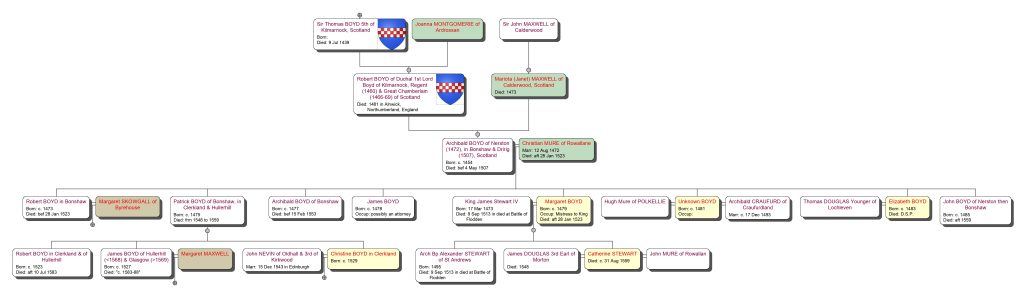
James Boyd (c1527-c1588) of Hullerhill and Glasgow
At some time prior to 24 November 1556 James Boyd of Hullerhill married Margaret Maxwell, probably of the family of Aikenhead. This is confirmed by an entry25 in the ‘Abstracts of Protocols of the Town Clerks of Glasgow’ as follows:
“336. JAMES BOYDE AND SPOUSE . 24 November, 1556 , 12 m.
David Hogisyairde and Katherine Allasoune sold to James Boyde, in Sillirhill [Hullerhill], and Mergaret Maxwell, his spouse, and 1.1. , a tenement of land, with yard, kiln, and pertinents, lying t.c. , between the tenement of John Clwne, junior, on the west, the lands or tenements of Mathy on the east, the lands of Mwtlande Croft on the north and the street on the south. Sasine given by David Lyoune, bailie, to the said James, and to William Hall, as attorney for his spouse. Judicially ratified by Katherine Allasoune, in absence of her husband. Witnesses : William Lyndesay, John Wilsoune, Mathew Heriot ; Mr. David Done, notary ; and William Young, serjeant.”
This purchase is for property in a key area in the developing city of Glasgow. A sketch map of Glasgow around the year 1547 was produced to accompany Volume I of the series on the Protocols of Glasgow which although not made contemporary to the period provides a useful insight. A further entry26 in the Glasgow Protocols provides a stong clue towards Margaret Maxwell’s family connections:
“1421 . BOYDE— MAXUELL . 6 December, 1561,
11 am . James Boyd of Hullirhill and Margaret Maxuell, spouses, produced a charter containing precept whereby Enieme Maxuell lady Akenheid charged Michael Fergussoun, as bailie in hac parte, to give them sasine of an annual rent of 10 merks Scots furth of the Manys of Cassiltoun, with tower, yards, orchards, and their pertinents, in the parish of Curmannoek and shire of Lanerk. Charter sealed with the granter’ s seal, and subscribed for her by a notary, because she could not write, 1 at Cassiltoun , on 6 December, 1561, in presence of Walter Steward, John Thomson dwelling in Cassiltoun, Rankin Clerk in Akinheid, and Donald M‘Ilgervy, servitor of the said James. Sasine given in terms of the precept.
Witnesses : Walter Steward, John Thomson dwelling in Cassilton, Rankin Clerk in Akinheid, and Donald M‘Ilgervy, servitor to the said James.
Enieme or Euphame Maxwell, Lady Aikenhead was the wife of Walter Maxwell of Aikenhead (d. before 9 July 1575) and it is fairly likely that Margaret Maxwell, wife of James Boyd of Hullerhill was their daughter. The above transaction likely describes an act to raise money by Lady Aikenhead. In return for an undisclosed payment she has placed a liferent on some of her property as security. This of course was not without risk as defaulting on the yearly liferent would allow the recipient the legal right to seize the property’s crops, livestock and rents. Risk of course could be reduced by entering into such arrangements with close family, in this case, her likely daughter and son-in-law.
1598. BOYDE— HULLIRHILL. 30 August, 1568, 8 a.m.
Joh Neving of Kirkwod, acknowledged the 40s land of Hullirhill, lying in the regality of Kilwynning and bailiary of Conyghame, conveyed to him by James Boyd of Hullirhill, to be lawfully redeemed by the latter. Witnesses: James Hammiltoun, prebendary of St. Mary of the city of Glasgow, Robert Hutchinsoun, merchant, and John Gilcrist, servitor of lady Craganis.
The above entry27 in the Glasgow protocols documents the redemption of a mortgage (lawfully redeemed) likely taken by James Boyd on his property in Hullerhill. The John Neving of Kirkwod mentioned in the protocol and mortgagee is most likely his brother-in-law and husband to his sister Christine. It would appear that James Boyd had called on his brother-in-law to help finance his transition to Glasgow and investment in property in the city.
On 23 April 1569 we see the first of two transactions whereby James Boyd of Hullerhill acts on behalf of his daughters to secure an income for them (annualrent):
“Elizabeth Boid, daughter of James Boid of Hullirhill, produced a charter containing precept whereby Eufame Maxuell, lady Akinheid, charged Patrick Boyd, as bailie in hac parte, to give her sasine of an annualrent of 20 marks furth of the £5 land of the Manis of Litle Akinheid, lying in the parish of Cathcart and shire of Lanark; but reserving the granter’s liferent. Charter subscribed and sealed at Glasgow, 23 April, 1569, in presence of Archibald Craufurd, merchant, Peter Bar, John Gibeoun, senior, and James Boid, father of Elizabeth. Subscribed : “I, Eufame Maxuell, lady Akinhcid, with my hand at the pen led be me notar underwrittin” – Henry Gibsoun, notary, because she was unable to write. Sasine given in terms of the precept. Witnesses : Archibald Craufurd, merchant, Peter Bar, and James Boyd, father of the said Elizabeth.”
A further entry28 from the Glasgow Protocols reveals to us that by 1569 he had become a significant party in the commercial life of Glasgow:
“1675. MAXUELL-NETHIR POLLOK. 9 September, 1569, 2 p.m.
John Maxuell of Nethir Pollok, knight, resigned in the hands of James Maxuell of Calderuod, as lord superior, an annualrent of £22 forth of the £10 land of Mekle Drippis, with the mill and astricted multures, lying in the shire of Lanerk; with the 5 merk land of Litill Drippis in special warrandiee; and that in favour and for new infeftment to be given to William Maxuell, son of John, but reserving the liferent of the latter. Done in the dwelling house of James Boyd, in the city of Glasgow. Witnesses : James Hammiltone of Craufurdjohne, knight, Gabriel Maxuell of Stanelie, Gavin Maxuell of Akinheid, John Maxuell of Auldhouse, and John Maxuell in Cowglen.”
In this remarkable transaction between various branches of the powerfull Maxwell family James Boyd appears to be the facilitator, hosting the deliberations in his own house in Glasgow. Amongst the witnesses we see Gavin Maxwell of Aikenhead, son and heir to Walter Maxwell and Boyd’s nephew by marriage.
On 22 June 1575 we find a registered contract29 involving James Boyd of Hullerhill and his daughter Isabel:
“Extract registered contract between Hugh, Earl of Eglinton on the one part and James Boyd of Hullirhill taking burden on him for Isabell Boyd, his daughter and she for herself on the other part whereby the said Earl in consideration of 300 merks obliges himself to infeft the said Isabell and her heirs heritably in the 30s land of old extent of the 5 merk land of the same extent of the Earl’s lands of Polnoine and the said James Boyd taking burden on him for his said daughter and as her tutor and administrator binds himself to deliver to the said Earl a sufficient letter of reversion to the said lands on payment of the above sum.”
This loan of 300 merks by James Boyd to Hugh Earl of Eglinton was repaid fifty years later on 19 January 1625 and wonderfully the record30 of the associated resignation reveals details of her spouse:
“Resignation granted by Isabella Boyd (therein designed relict of unquhile Mr Patrick Walkinsahw subdean of Glasgow) with consent of Mr James Walkinshaw her son for his interest of the Mains of Polnone contained in an obligation by deceased Hugh, Earl of Eglinton and charter and instrument of sasine following thereon on payment to them by Hugh, then Earl of Eglinton of the sum of 300 merks
Dated at Glasgow and Carnbrow and registered in the clerk of registers books at Glasgow, 1st March 1625. Witnesses: William Bailzie of Carnbro, James Cunninghame, notar in Glasgow etc.”
After further entries in the Glasgow protocols we find one31 dated 30 March 1583 in which Margaret Maxwell, wife of James Boyd, receives property in Glasgow from a daughter Jonet. Then in a final entry32 dated 22 April 1588 we have confirmation of the prior death of James Boyd:
“3127. PORTARFEILD, YOUNGER OF THAT ILK.
Eodem die et hora. Margaret Maxuell, relict of q.[the late] James Boyd of Hullirhill, liferenter and Jonet Boyd, her daughter, heritably vested in the property after mentioned, acknowledged that William Portarfeild of Dwchall had, by payment of 200 merks, lawfully redeemed a great fore tenement, under and above, lying t.c, on the west side of the street leading from the metropolitan church to the market cross, between the lands of Archibald Heygait on the north, and the lands of John Grahame of Hilderstoun on the south.’ Sasine of the property given by Mr. Adam Wallace, bailie, to Alexander Portarfeild, younger of Dwchall, with consent of William Portarfeild, his father. Witnesses: William Wallace, son of the bailie, and John Howstoun, servitor of the said William [Portarfeild.]”
Surprisingly no testament has been found for either James Boyd or his wife Margaret Maxwell. However with all of the surviving children of James Boyd of Hullerhill and Margaret Maxwell seemingly accounted for we can prepare a family tree accordingly:
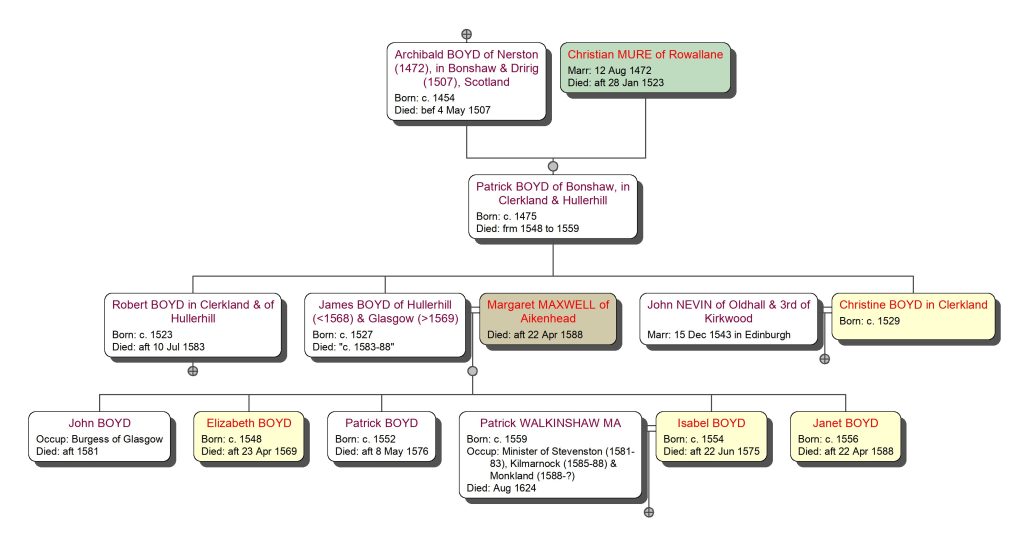
From the evidence from the protocols of Glasgow and elsewhere it would seem likely that James Boyd of Hullerhill’s strategy was to invest heavily in the growing city of Glasgow. He used this strategy to provide a secure income for his daughters through liferents and such like, associated with loans to distinguished local families. In addition he probably sought strategic marriages for his daughters and thankfully it has been possible to identify one of these in the marriage of Isabel to Patrick Walkinshaw, Sub-Dean of Glasgow. Unfortunately marriage records for Glasgow before 1611 are rare and if marriages for the remaining children are to be found it will be through other sources such as testaments etc. Before we look at James’ sons it is worth looking at the family of Isabel Boyd and Patrick Walkinshaw.
Patrick Walkinshaw (c1559-1624) and Isabel Boyd
The entry 33in the Fastii Eclesiae Scoticanae for Patrick Walkinshaw states:
PATRICK WALKINSHAW, M.A. – (Glasgow 1579); min. of Stevenston in 1581 ; trans, to Kilmaronock in
1583 ; trans, and adm. in 1588 ; pres. by James VI. in 1589 ; a member of Assembly in 1602 ; a member of the Court of High Commission 15th Feb. 1610 ; died Aug 1624, aged about 66, “in wealthy circumstances,” his inventory including debts owing to him amounting to £5783, 13s. Id. Scots. He marr. Isobel Boyd, and left issue —James, M.A., min. in Glasgow 1624; Jean (marr., cont. 4th Sept. 1610, Andrew, eldest son of William Stirling of Law) Christian ; Janet, who chose curators 2nd Nov. 1624 —Peter Walkinshaw in Barnehill, and Robert Boyd of Clerkland, nearest of kin on father’s and mother’s side. —[Reg. Assig. ; Booke of the Kirk ; Melvill’s Atitob. ; Hamilton Tests. ; Reg. of Deeds, lxxx., 12, 28th May 1596; Glasg. Com. Deeds, 27th Jan. 1624, 4th Sept. 1610 ; Reg. of Deeds, dl., 165.]
The testament34 of Patrick Walkinshaw is lengthy and it is unsurprising that the Fastii details his inventory amounting to neary £6,000 Scots. We suppose that some of this wealth made its way into the hands of his children and thanks to the Fastii and an article printed in the Scottish Antiquary35 in 1893 we can prepare a family tree accordingly:
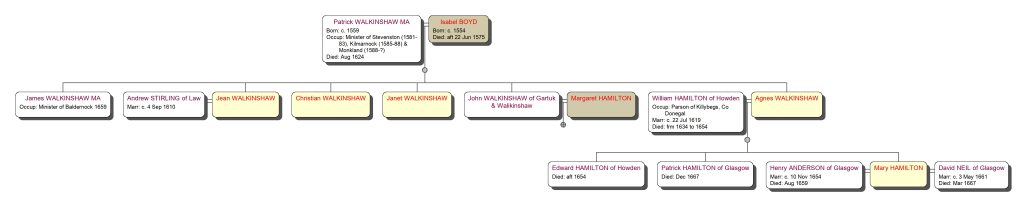
Of particular interest is the marriage of daughter Agnes Walkinshaw to William Hamilton of Howden who held a number of Clerical positions in Co Donegal, Ireland in the Diocese of Raphoe in the early to mid 1600s. It is very likely that Mungo Walkinshaw, curate of Dromore Parish, Diocese of Clogher 1670 and a W Walkinshaw, minister of the Presbyterian congregation of Benburb (1673-77) are almost certainly relations.
However returning to the testament of Patrick Walkinshaw in 1624, the reference to daughter Janet chosing curators is of great significance. Scots law of the time gave minors the right to protect their legacy in the event of their father’s death by chosing guardians/curators who could act in their interests. The curators were drawn by law through the courts from the nearest in blood, one from each side of their parents. Whilst immediately this confirms Janet as being under twenty one at the time of her father’s death the appointment of a Robert Boyd of Clerkland as her maternal curator would seem to confirm that her uncles John and Patrick Boyd had not only predeceased her but appear not have married or had any issue. To obtain a curator nearest in blood from her Boyd family it would seem that the search went back to the elder line of Janet’s maternal great grandfather, Patrick Boyd of Bonshaw and then down through his eldest son Robert Boyd in Clerkland & of Hullerhill who died after 10 July 1583. The name of the eventual curator, Robert Boyd of Clerkland, is most likely therefore to be his son or grandson making the curator either Janet’s 1st cousin once removed or second cousin.
John Boyd – Burgess and Freeman of Glasgow
We presume that John was eldest son of James Boyd of Hullerhill and in him we see potentially another part of the strategy adopted by his father. With Glasgow growing and trade increasing it was fertile ground for anyone seeking to establish a mercantile career. In the records of the Burgesses and Guild Brethren of Glasgow we find an entry36 dated 20 October 1581:
“Boyd, John, served heir to James B[oyd]. of Hullerhill, his father, and thereafter made B[urgess]. and F[reeman].“
Unfortunately confusion is inevitable when researching John Boyd as his life coincides with another Boyd family who would become predominant in the Guild of Masons over the course of the 17th century. In all likelyhood John Boyd, son of James Boyd of Hullerhill was more likely a general merchant. However returning to the situation mentioned earlier regarding Janet Walkinshaw it would seem John died without issue after 1581.
Patrick Boyd
Only one source has been identified so far with Patrick Boyd son of James Boyd of Hullerhill which was his attendance on 8 May 1576, perhaps on belhalf of his father, as a witness at Edinburgh in a decreet arbitral37 by James Boyd Archbishop of Glasgow. Sadly nothing further has been found and again as with his brother John he appears to have deceased after 1576 without issue.
- The Boyd Papers – Archaeological and Historical Collections relating to the Counties of Ayr and Wigton, Vol III, (Edin. 1882), p.110 ↩︎
- Ibid, p.121 – translation by Google AI ↩︎
- Ibid, p.122 – translation by Google AI ↩︎
- Ibid, pp.123-133 ↩︎
- Register of the Great Seal of Scotland Vol II (1424-1513), 992, p.205 ↩︎
- Ibid, 1200, p.244 ↩︎
- Ibid, 1340, p.273 ↩︎
- Ibid, 1519 & 1520, p.318 ↩︎
- The Boyd Papers – Archaeological and Historical Collections relating to the Counties of Ayr and Wigton, Vol III, (Edin. 1882), p.139 – translation by Google AI ↩︎
- Ibid, pp.141-143 ↩︎
- Ibid, pp.152-154, translation by Google AI ↩︎
- Ibid, pp.155-156 ↩︎
- Douglas Book by William Fraser, C.B. LLD in Four Volumes; Vol III – Charters, pp.135-136 ↩︎
- Register of the Great Seal of Scotland Vol II (1427-1513), 2111, p.446 ↩︎
- The Scots peerage; founded on Wood’s edition of Sir Robert Douglas’s peerage of Scotland; containing an historical and genealogical account of the nobility of that kingdom, James Balfour Paul (Edin. 1904), pp.145-146 ↩︎
- Exchequer Rolls of Scotland, Vol. 12, p.649 – translation by Google AI ↩︎
- Ibid, Vol. 14, pp.490-491 – translation by Google AI ↩︎
- Ibid, p.493 – translation by Google AI ↩︎
- Ibid, p.492 ↩︎
- Ibid, p.491 ↩︎
- The People of Sixteenth Century Ayrshire (1987), Margaret H B Henderson, p.314 ↩︎
- Register of the Great Seal of Scotland, Vol III, 2978, p.697 translation by Google AI ↩︎
- National Records of Scotland (NRS) Ref. GD8/140 ↩︎
- The People of Sixteenth Century Ayrshire (1987), Margaret H B Henderson, p.327 ↩︎
- Abstracts from the Protocols of the Town Glerks of Glasgow Vol 2, p.23 ↩︎
- Ibid, p.46 ↩︎
- Ibid, Vol. 5, p.111 ↩︎
- Ibid, Vol. 6, p.26 ↩︎
- ↩︎
- ↩︎
- Ibid, Vol. 8, p.79 ↩︎
- Ibid, Vol. 10, ↩︎
- Fastii Eclesiae Scoticanae Vol III, Glasgow & Ayr, p.273 ↩︎
- ScotlandsPeople – Ref. CC10/5/5, Hamilton & Campsie Commissary Court, Image 179-183 ↩︎
- The Scottish Antiquary, or, Northern Notes and Queries, Vol. 7, No. 27 (1893), pp.133-137 ↩︎
- Burgesses and Guild Brethren of Glasgow (1573-1750), p.11 ↩︎
- Report on manuscripts in various collections, No.62, p.27 ↩︎