In this post we look at the line of George (III) Boyd (c1667-1747) son of Jean (I) Boyd and Jeanne Pascaud. In our previous post we documented George’s birth likely c1667 in Bordeaux, France. However no records of his baptism have been found to date. Around the age of eighteen he likely travelled with his brothers Jacques (I), Jean (II) and Gabriel to England to be with their sister Magdalen and maybe their mother also. However unlike his brothers he appears to have remained in England and did not travel with them and other Huguenot refugees to Carolina in America in 1686. In Part 2 we also saw that George (III) Boyd received denization on 16 December 1687 suggesting a mercantile or other future in England was a considered objective. However it is the death of his father Jean (I) Boyd in Bordeaux in 1696 which prompts George to return home to Bordeaux and support his mother in the family business.
As with any relatively young man with an eye to business in the 17th century a well planned marriage was a primary objective. Such marriages where commonplace among the mercantile classes and were a means to financial security. On 7 February 1697 we find the marriage of George (III) Boyd to Marianne Vandamme de Loirac et Médoc. Coyne states1 that George “was a Bordeaux burgher residing in Périssac in Fronsadais” at the time. He further states “Marianne Vandamme, from Loirac in the Médoc, daughter of the late François Vandamme, squire, lord of Wees, and of Marianne Rousseau, from a family of Flemish Protestant capitalists involved in draining the marshes of the Lower Médoc. The dowry was 10,000 livres, of which 7,000 were given to Jeanne Pascaud in cash to be used for the refinery; the other 1,000 livres were allocated for the chattels”. This match would seem to be an ,example of the Boyd familiy’s connections to Franco-Dutch or Franco-Flemish families.
Sadly Marianne died on 30 March 1706 and there is no record of any issue from her marriage to George (III) Boyd. George did not remarry anytime soon but he was by now around forty years old and the need for an heir to the family’s sugar refinning business must have been on his mind. Accordingly we find his marriage to Anne Sauret of Bergerac on 30 November 1709 in the parish of St Remy in Bordeaux.
A translation of the entry of marriage (p.48-49 of 103 of the Register) for George (III) Boyd and Anne Sauret is as follows:
“The thirtieth of November 1709 in the Church of St. Remi after the celebration of the betrothal on the twenty-third of the present month in the aforementioned church and the proclamation of bans at the parish mass on the twenty-fourth of the present month in the same church. The dispensation was granted by my lord, the Archbishop of Bordeaux on the twenty-seventh of this month and received the nuptial blessing and Mr. George Boid widower of Marianne Vandame was free to contract in marriage, his father being deceased and acting with the consent of her mother, Miss Anne Sauret, was also free to contract in marriage, according to the certificate of freedom which was issued to us by Mr. fargeot, parish priest of Bergerac, dated the tenth of August 1709. Legalized by Mr. Boignet, vicar general of Monsignor Leveque of Périgueux, on the thirteenth of August 1709, acting, the said Miss Anne Sauret with the consent of her mother, according to the extract of the marriage contract which was delivered to us by the aforementioned, Mr. Lahane Royal Notary [blank] 1709 attended the said marriage. Mr Paschal Garat Bourgoise and merchant of said Bordeaux and Guilhaime Depay, courtier and brigadier of the King’s Grand Bureau, both inhabitants of this parish, Mr. George Boid Bourgoise and merchant living in the parish of St. Pierre, Mr. Jacques Boid, merchant of this parish, who after having been informed of the penalties imposed by the King’s declarations and ordinances against those who attest falsely in matters of marriage, have declared the spouses to be free in contract of Catholic marriage and the said Mr. George Boid Bourgoise merchant, inhabitant of the parish of St. Remy, and the said Miss Anne Sauret, native of the town of Bergerac, diocese of Périgueux, and inhabitant for several years in this parish, and the other facts above mentioned are a true statement etc. etc.”
An important aspect of this marriage is recognising that the outworkings of the Revocation of the Edict of Nantes were still in force. The wording of the entry makes it clear that as far as the authorties were concerned the marriage was conducted under the umbrella of the Catholic faith and the entry itself is found in the registers of the Catholic parish of St Remy in Bordeaux. The Banns were read at Mass and legal approval was given by the vicar general of Monsignor Leveque. Of particular interest are the signatures of the various parties:
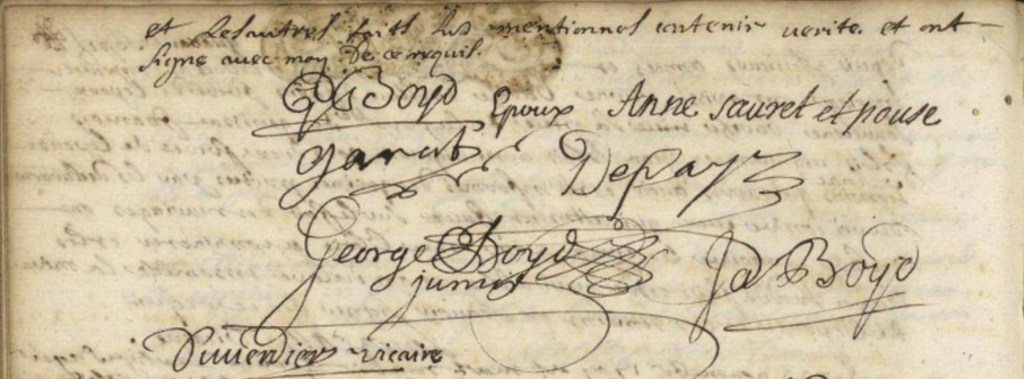
Apart from the signatures of the spouses, George (III) Boyd and Anne Sauret, we have the signatures of a George Boyd junior and Ja [Jacques] Boyd. Coyne in his dictionary of Protestant families was unable to identify these last two persons. The Jacques Boyd could be either George (III) Boyd’s brother or nephew but the George Boyd Junior presents a greater difficulty. One possibility is he may have been an undocumented relative. Prof Cullen believed him to have been born in Belfast from various Bordeaux records2 and referred to him as ‘Belfast’ George.
Prof Cullen states3 that George (III) Boyd remained firmly involved with the sugar refinary up until around 1713. He found little evidence of his travel outside Bordeaux up to then. However he believes George (III) Boyd changed his business interests likely after the Peace of Utrecht which allowed the Bordeaux wine trade to boom in the following years. This change in direction would also bring him into contact with a number of irish and scottish mercantile families including the Bartons and Skinners.
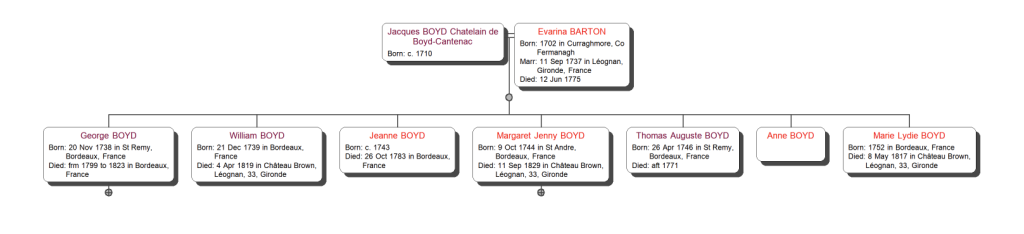
Following their marriage in 1709, George (III) Boyd and wife Anne Sauret had at least five children that we know of, Jacques, Jean Auguste, George (IV), Marguerite and Jeanne. Unfortunatley it has not been possible to locate the baptismal entries for the children so far. Prof Cullen states that Marguerite and Jeanne remained unmarried and at least in regard to Jeanne this is confirmed by her death in Bordeaux, about 29 October 1766 aged fifty as evidenced by her burial permit (p.55 of 114 of the register) suggesting she was born c1716. No burial permit has so far been located for Marguerite. Of the remaining children all married and we will look at them later.
Returning to George (III) Boyd it would seem he was turning his attentions to foreign trade and with Scotland as one destination in mind and with scottish roots it appears he made contact with the office of the Lord Lyon in Edinburgh in an effort to formalise his scottish ancestry, most likely with a view to obtaining trading benefits in Scotland. The exact date of this contact has not survived but a document4, a Testimonial of Arms, Genealogy or Birthbrief was recorded in the journals of the Lyon Office by Alexander Erskine of Cambo who held the office until July 1727 so its reasonable to assume the document is prior to that date so c1713-1726.
We are grateful to the office of the Lord Lyon for locating the document and for the assistance of Diane Baptie for transcribing it and Alistair Hill for his help in obtaining a latin translation as below:
| Universis et singulis ad quaes praesentes literae pervenerint Alexander Areskinus Baro de Cambo Eques et Baronettus apud Scotos Leo Rex armorum Salutem Plurimam Dicit: Quum mei muneris et officii ratio postulet ut cujusvis inter Scotos nobilis sive domisive apud exteros degentis qui a generoso aliquo stemmate Scoticano suam legitime ducunt originem lineas & genealogias testarem, atque in archiva mea referam[us] et pensata supplicatione ducunt originem mihi facta per generosum virum Georgeum Boyd Mercaturam facientam Burdigalice in Francie Regno ut cum meo testimonio de ejus prosapiae et Insigniis armoriis sibi propriis adornarem diligenti inquisitione et de re facta et declarationes authenticae se circa nobis exhibita et priestita certum igitur et notum esse volo et facio insignia gentilitia prefati Georgii Boyd ejus avus paternus Georgeus Boyd filius fuit legitimus Georgii Boyd fillis legitimi natu minimi generosi admodum viri ac Domimus D. Archibaldi Boyd de portencross in provincia Cunninghamiae et partibus Scotie occidentalibus sita qui suam legitime duxit originem ac per antiqua et perillustri familia Dominorum de Boyd quae jampridem titulo et honore Comitum de Kilmarnock condecendo(?) et a me approbata confirmata inque Archivis publicus mei officii inserta sequentibus lineis et Coloribus esse delineata, Portat enim, ob generis sui et virtutis propaginem in solo caerulis fuscium tessallatam de argento et rubro compositam ambiente limbo undulato aurio supra cassidem suo congruam gradui Chlymade rubra argento duplicata ornatum, et tortula et ejusdem coloribus pro Crista dat dexteram manua duobus primibus digitis porechis cum hoc simbulo senterio in taenia superius Virtuti Confido ut in margine magis lucide videntur Quas omnia sicuti ex se vera et certa Sicut apud omnes certiora et Testatiora fiant et pro authenticus haberutur sigilum mei officii praesentibus appendi curavi manu mea propria addita Datum apud Edinburgensum […]odecimo die mensis Novembris anno Domini […] | To all and sundry to whom these present letters shall come, Alexander Areskine, Baron of Cambo, Knight and Baronet, Lyon King of Arms in Scotland, extends many greetings: Whereas my office and duty require me to testify from my registers the lineage and genealogy of every noble living amongst Scots or amongst foreigners who legitimately derives his origin from noble Scottish stock, reviewing and considering a request made to me by an honourable man George Boyd, merchant in Bordeaux in the Kingdom of France, that with my testimony of his lineage I might equip him appropriately with armorial ensigns through careful inquiry and the things, facts and authentic declarations exhibited to me, and make known and certain the distinguished nobility of the aforesaid George Boyd whose paternal grandfather, George Boyd, was the lawful son of George Boyd the youngest lawful son of that most honourable man and lord Sir Archibald Boyd of Portencross in the province of Cunningham situated in the western part of Scotland, who was lawfully drawn by descent from the ancient and illustrious family of the Lords Boyd who have long held the title and honour of Earl of Kilmarnock [?] have approved and confirmed by me and inserted in the public registers of my office, delineated with the following lines and colours; that he shall bear for his breeding and virtuous upbringing on blue in chief (in solo) a fesse chequy (fuscium tessallatam) composed of silver and red, surrounded by a wavy border of gold; upon a helmet (cassidem) appropriate to his degree a mantle (chlymade – little cloak) repeating the red and silver, and a torse (tortula) [of] the same colours [and] for the crest (crista) shall be given a dexter hand pointing with the first two fingers and with this motto (simbulo senterio) in a ribbon above Virtututi Confido with a border, the better to be seen. For the additional certainty and authenticity of all of which, though true in itself, I have caused the seal of my office to be affixed to these presents, and added my own sign manual. Given at Edinburgh the [11-16] day of November in the year of the Lord […] |
The discovery of this important document along with ‘Judith’s Tree’ as mentioned in the ‘Boyds of France Part 1’ are vital in establishing the link between the Boyd family of France with that of Portencross.
From around 1699 George (III) Boyd had lived in Bordeaux alongside George Boyd de Jeune (Belfast George) in the same street in Bordeaux. We believe that Belfast George Boyd was most likely a descendant of either Thomas of Carncoggy or Archibald of Carncullagh and we will explore this in a later post. For now however we can record that Belfast George appears to have been sent out in previous years as an apprentice to Henry Lavie of Bordeaux and then took over his Compting House business when Lavie died5 on 13 March 1699 in the Rue de la Rouselle, in the parish of St Michel, Bordeaux. By 1699 Belfast George Boyd had taken on his own apprentice in John (III) Black (1682-1767) of the renowned Co Antrim and Belfast merchant family. Belfast George had established links to a number of Irish merchant families and it is likely that this had some influence on the focus of George (III) Boyd’s business interests. The strategy appeared to involve George (III)’s sons Jacques and Jean Auguste remaining in Bordeaux and expanding the family’s interest in the wine trade while third son George (IV) would move to Dublin and control the irish end of the business. Additional benefit would also be sought in strategic marriages with appropriate merchant families.
By the 1720s the outworkings of the strategy are evidenced in various records. It seems likely that George (III) Boyd had developed connections to the merchant business of ‘Cromie & Stevenson’ i.e. William Cromie and James Stevenson, in Dublin. ‘Cromie & Stevenson’6 represented a number of Belfast merchant families not least of which was Isaac McCartney son of ‘Black’ George McCartney (c1630-1702). Francis Cromie, brother of William Cromie had probably began the Cromie family’s mercantile interests in Dublin as he had apprenticed to ‘Black’ George McCartney and then married his daughter Alice.
It is worth mentioning that the Cromie family appear to descend from a Thomas Cromy who is listed in the 1630 Muster Roll for Dunluce, Co Antrim. It is likely a son, James Cromey of Tullaghgor, Ballymoney, Co Antrim, is recorded on the Pender Survey of 1659 and his likely son John Crumy7 is the same person who married Elizabeth Holland in 1686, widow of John Ash of Ashbrook. Through this marriage the Cromie family received substantial lands in and around Mullans in the parish of Finvoy, Co Antrim. Their son William Cromie of Mullans who died in 1725 was most likely father of brothers Francis and William Cromie of Dublin.
Francis Cromie died in 1691 and it seems his brother William then took over the business. William Cromie married Debora Adderley in St Michael’s Dublin in 1697 and on his death in 1723 the business passed to their son Michael. Just five years later in 1728 we find George (III) Boyd involved with Michael Cromie in a mortgage relating to lands in Co Louth, Ireland:8
“Deeds of Lease & Release, dated 27 & 28, February 1734, whereby George Boyd of Bordeaux, Merchant reconveyed to Michael Cromey of Dublin, Merchant The Towns & Lands of Gwytherston, Middlemore, & Nicholastown which had been mortgaged for £600 to said Cromey by Robert Parkinson of Dublin Esqr by Deeds of Lease and Release, dated 15 & 16 November 1728, redeemable on the 1 May 1729, and conveyed over by said Cromey by Deeds of Lease & Release, dated 18 & 19 February 1728; and the said Parkinson having paid the Mortgage Money of £600 2 May last to Cromey, and Cromey having paid the same to Boyd, the said Boyd by Deed, dated 6 April 1734, conveyed the premisses to Cromey; in which Deed, by mistake , the Consideration Money being only mentioned to be 10s the said Boyd by these Deeds, for the said sum of £600, sold & confirmed the premises to Cromey & his Heirs. Inrolled 2 June 1735”
On the 11 September 1737 Jacques Boyd, eldest son of George (III) Boyd and Ann Sauret married Evarina Barton in Bordeaux, France:
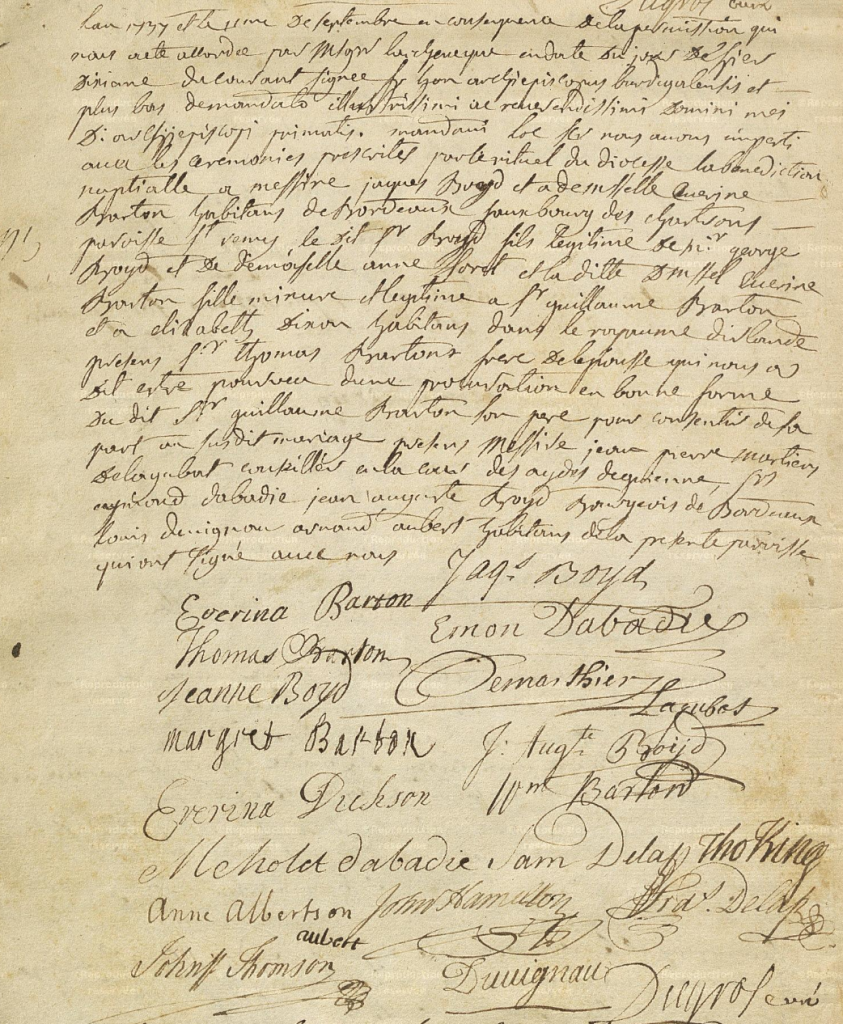
Evarina was given in marriage by her brother Thomas on behalf of her father William Barton and amongst the signatories of the witnesses we find the following viz. Thomas Barton (Evarina’s brother), Emon [Edmond] Dabadie, Jeanne Boyd (sister of Jacques Boyd), Margret Barton (Evarina’s sister-in-law), J Augt Boyd (Jacques’ brother), Evarina Dickson (poss. Evarina’s maternal grandmother), Wm Barton (poss Evarina’s nephew), Meholet? dabadie, Sam Delap (Evarina’s 2nd cousin), Tho King, Anne Albertson, John Hamilton, Fras Delap (prob Evarina’s 1st cousin once removed) and John Thomson.
The Barton, Delap and Dickson families where all connected by marriage and had plantation roots in ireland dating from the 17th century in counties Donegal and Fermanagh. Evarina’s father was William Barton of Curraghmore, Co Fermanagh, her mother Elizabeth Dickson of Ballyshannon, Co Donegal and maternal grandmother Everine Delap (orginally Dunlop) of Ballyshannon, Co Donegal. Her brother was Thomas Barton ‘French Tom’. The Barton family history connected with Bordeaux is covered in an excellent family book published in french.9
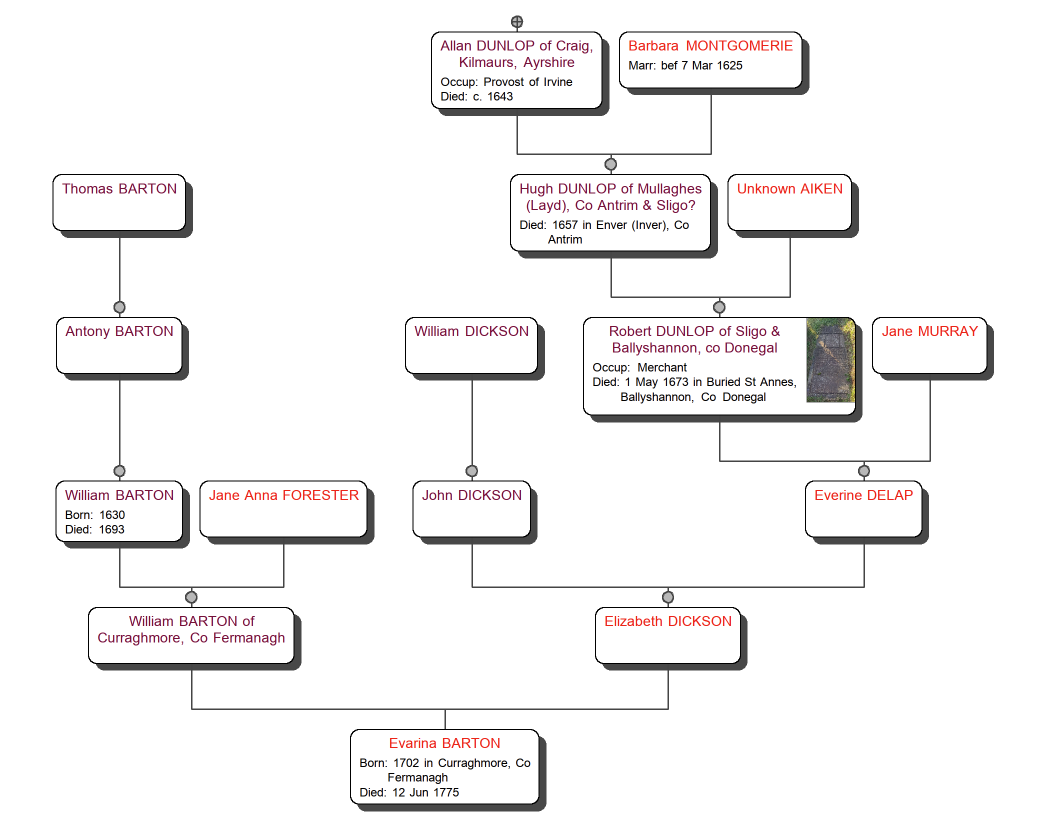
The Barton and Delap families both operated out of Dublin involved in the export of butter, fish and beef probably from the ports of Sligo and Londonderry to destinations throughout the British Isles, Europe and perhaps further afield. The Delap family would become heavily involved in the sugar trade of the West Indian island of Antigua and accordingly a strong association with the slave trade. Both they and the Bartons wanted to import or trade in wine from the Bordeaux region of France so Jacques Boyd and his father’s long established family connections in Bordeaux may have been behind the match between the families.
So by 1737 we have a well established mercantile connection between these various families in Dublin, Ireland and Bordeaux, France. Over the next fourteen years or so Jacques Boyd and Evarina Barton had issue at least seven children.
George (III) Boyd died on 8 October 1747 aged 80 in Bordeaux, France according to his burial permit (p.70 of 97 in Register). He was followed by his widow Anne on 24 February 1759 aged 80 in Bordeaux, France according to her burial permit (p.7 of 114 in Register).
Turning now to George (IV) Boyd it is likely he was born some time 1710-1715, probably in Bordeaux, France. As we said earlier his father had intended that he would send him to Dublin and manage the family business and distributions from there. As part of that management he appears to have initially formed a wine merchant partnership with perhaps one of the Hamilton brothers i.e. James and Galbraith (the brothers ran a grocery business initially in Abbey Street before moving to Ormond Quay c1759) at Abbey Street, Dublin by 1751.10 However he appeared to be trading alone in Abbey Street by 1752-53 before appearing in another partnership with perhaps Henry Meredyth in the following years. That partnership was dissolved in February 175711 and George (IV) Boyd died12 the following September at his home in Drumcondra Lane, near Dorset Street, Dublin. His will was administered on 13 October 1757 with his brother Jean Auguste likely executor. No record of a marriage involving George (IV) Boyd has been found as yet. However it appears likely that he had a son George (V) Boyd born c1726.
George (V) Boyd operated his father’s wine merchant business from the same premises at 44 Abbey Street, Dublin. On 26 June 1751 he married Ann Hamilton, daughter of Galbraith Hamilton of Dublin in St Annes, Dublin. George (V) Boyd continued operating from the Abbey Street site for over 30 years, his name appearing in various Dublin directories such as ‘Wilsons’ and ‘Watson’s Gentlemans & Citizens Almanac’. In 1769 he was recorded as a member of the Dublin Insurance Company.
Perhaps the most significant information on the business standing of George (V) Boyd is correspondance from the 1760s which can be found in the Wilmot Papers (T3019) in PRONI. The small collection of letters involving George (V) Boyd suggest a significant role in wine provision to the Irish Administration. In patricular Boyd’s letter of 14 October 1766 to Thomas Waite in which he expresses his pleasure to serve Bristol and his ability to provide both burgundy and champagne wines.
On 12 December 1772 Anne Boyd, daughter of Jacques Boyd and Evarina Barton married (page 119 of 277 of the register) Benjamin Woodward of Dublin in Bordeaux, France. The marriage entry is remarkable as it would appear to be signed by most of the extended Boyd family from Dublin and Bordeaux. The marriage would lead to the creation of the wholesale Wine Merchant business of Boyd & Woodward operating from the premises at 44 Abbey Street by at least 1784.
There was no surviving male issue of the marriage of George (V) Boyd and Ann Hamilton and the daughters born to the marriage that we know of were Lucy (b. 1752), Jane (b. c1755), Margaret (b. 1758) and Anne. Daughter Jane married Henry Lawes Luttrell (later 2nd Earl Carhampton) on 25 June 1776 but there was no issue from their marriage. Prof Cullen records that the marriage portion provided by George (V) Boyd was £20,000, an indication of the success of the Boyd business in Dublin at the time perhaps. This considerable dowry would indeed present as a considerable incentive but a clue to an altogether less financial motive may be found in a letter13 from Lady Louisa Connolly to the Duchess of Leinster on 11 July 1776 in which she writes:
“The little Duchess and I went to visit Mrs Luttrel t’other evening, but did not find her at home. I suppose you know that I am speaking of Miss Boyd that is married to Colonel Luttrel. It seems he has liked her for above three years, which I hope is a good omen of his constancy hereafter.”
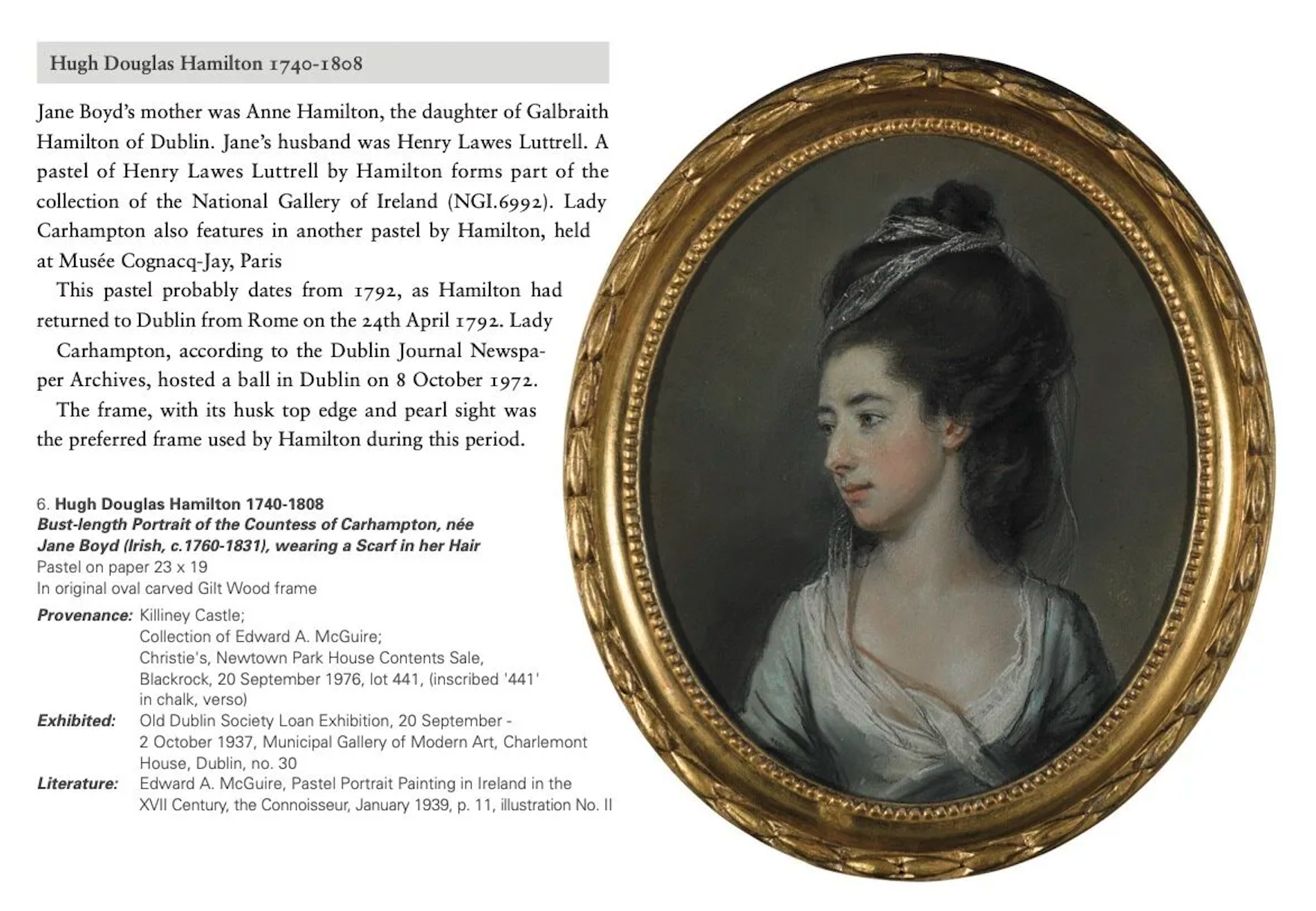
from the exhibition catalogue of the Gorry Gallery, Dublin – November 2021
The 2nd Earl of Carhampton appears to have been viewed by many as a negative character, considered excessive in his military actions during the United Irish Rebellion and disliked politically. By the end of the 19th century the Earl decided to sell his family seat at Luttrellstown and accordingly he and his wife Jane became the subject of one of the most remarkable private land sales of the 18th century.14 According to the biography of the purchaser, Luke White Esq. (one of Ireland’s early millionaires) the purchase price for the estate was £96,000.
Jane died at 17 Bruton Street, London on 7 April 1831. Her husband Sir Henry had predeceased her at the same address on 25 April 1821. Remarkably the Carhamptons home at 17 Bruton Street is believed to be the birthplace of Queen Elizabeth II on 21 April 1926. The Doweger Countess’ will was recorded in the Prerogative Court of Canterbury in which her third cousin once removed, Rear Admiral Sir John Brooke-Pechell was surviving executor.
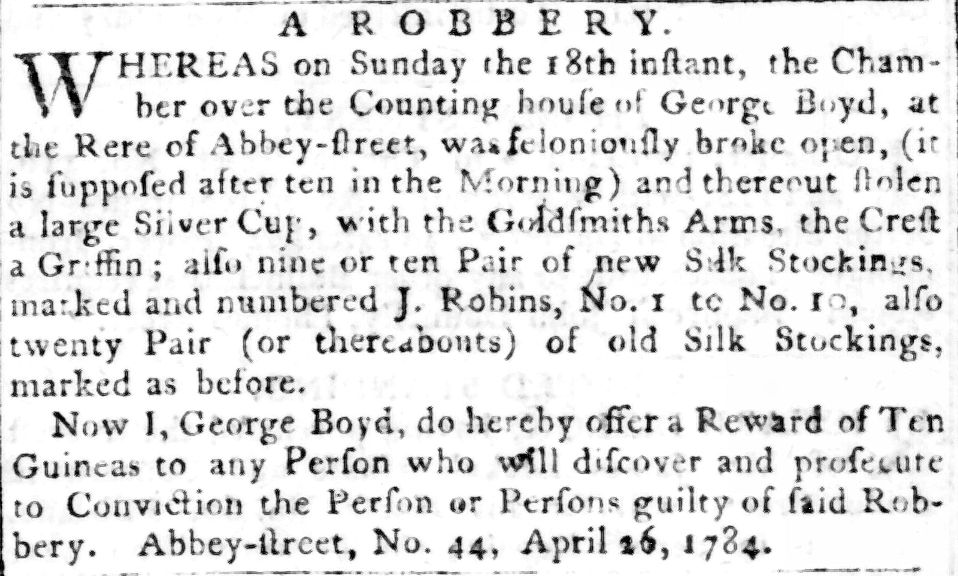
Returning to George (V) Boyd we see on 31 December 1781 he contributed £2 5s 6d to the Dublin Poor Relief Fund and on 30 April 1784 we see a notice of a robbery at the premises in 44 Abbey Street.
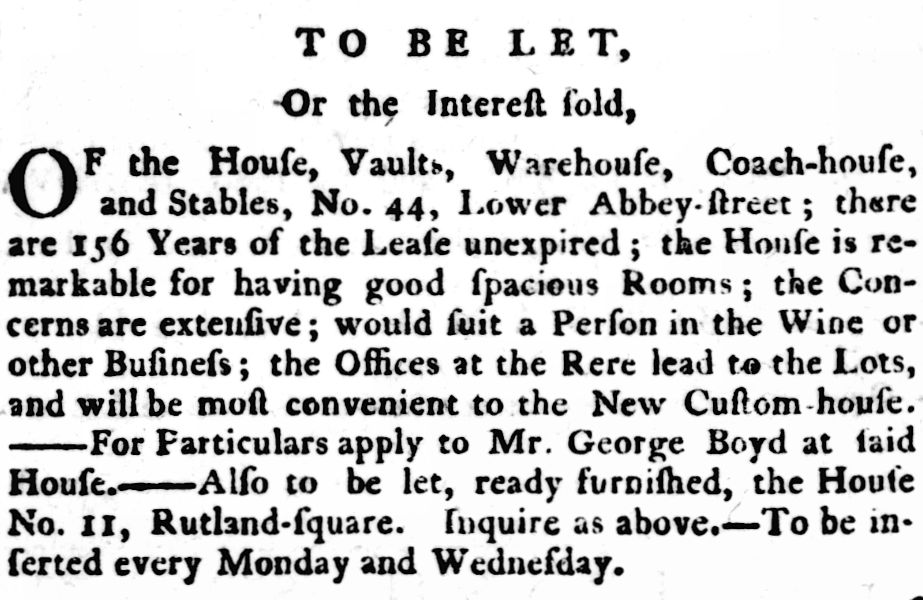
By 1787 it is likely that George (V) Boyd was experiencing poor health and a notice is placed to lett the premises in Abbey Street.
On 5 May 1788 we find a deed by which George (V) Boyd assigned the lease on 44 Abbey Street, Dublin to John Ferns, wine merchant, for £700. The following year we find notice15 of the death of George (V) Boyd at Cavendish Row, Dublin (the Dublin address of his son-in-law, Earl Carhampton) on 8 April 1789. With his death and with no known male heirs it would appear the line of George (III) Boyd through son George (IV) Boyd and grandson George (V) Boyd and a significant presence in the Dublin wine trade likely ended. The family’s business interests now focused on that of Jacques Boyd in Bordeaux who will be the subject of our next post, Boyd of France (Part 4).
- DICTIONNAIRE DES FAMILLES PROTESTANTES DE BORDEAUX AU XVIIe SIECLE, (2000), Paul Louis Coÿne, p. 80 ↩︎
- Archive Departmental de Gironde (ADG), C4473, Liste des Noms des Marchands Etrangers Emblis a Bordeaux. ↩︎
- Ireland, France, and the Atlantic in a Time of War – Reflections on the Bordeaux–Dublin Letters, 1757, Thomas M Truxes (2017), Chap. 2 The Boyds in Bordeaux and Dublin (Prof L M Cullen) ↩︎
- Office of the Lord Lyon, Volume 28, p8. – see also Scottish Record Society – ‘Index to genealogies, birthbriefs and funeral escutcheons recorded in the Lyon office‘ (Edin 1908), p.6 ↩︎
- DICTIONNAIRE DES FAMILLES PROTESTANTES DE BORDEAUX AU XVIIe SIECLE, (2000), Paul Louis Coÿne, p. 333 – see also Prerogative Will registered in Canterbury 15 September 1698 – PROB-11-455-180 ↩︎
- Belfast Merchant Families in the Seventeenth Century, Jean Agnew (1996), pp.184-185 ↩︎
- See ‘The Ash MSS by Lt Col Thomas Ash 1735‘ ↩︎
- Record of Irish land Records by John Lodge Vol 9, William I ↩︎
- Les Saga Des Barton, Anthony Barton and Claude Petit-Castelli (1991) ↩︎
- Wilson’s Dublin Diectory 1751 – Boyd and Hamilton (Wine Merchants), Abbey Street ↩︎
- Dublin Journal – 15 February 1757. ↩︎
- Burial Register of St Marys, Dublin – burial 27 September 1757 ↩︎
- CORRESPONDENCE OF EMILY, DUCHESS OF LEINSTER (1731-1814) VOL. Ill (IMC), p.211 ↩︎
- Irish Deed memorial No. 353855 – 26 August 1799 ↩︎
- Saunders News letter – 8 April 1789 ↩︎
Jonathan and Adrian:
I have been trying to obtain contact information for you since I virtually attended your impressive presentation: “The Boyds of Ballycastle and Beyond with Jonathan Gray, Ramoan Centre, Ballycastle, Co Antrim, N Ireland, 19 September 2024.”
At about the 51-minute mark, your slide includes the following:
“… by a concurrent deed transfer the estate to William [Boyd] and Rose [McNeale] … They receive the Quarterlands of “…, KNOCKANS …’ as payment for their portion …”
As a descendant of the BOYD family of KNOCKANS Townland, Armoy, I am eager for collaboration to determine how (if) my ancestors were connected the Boyds of Ballycastle. And, I even more eager than before to initiate collaboration because I will be in the area surrounding Ballycastle for several days, starting June 18.
Perry Streeter
Hi Perry
Adrian and I are delighted to hear from you.
We will try and pass on what we have on Knockans before your arrival on the 18th. Our current thinking is the Knockans Boyds are more likely to be Portencross Boyd but we are by no means certain on that.
The first thing we need to clear up is the occurence of more than one Knockans in Co Antrim. You mention you are of Knockans, Armoy Parish. However we also have Knockans of Finvoy and Layde Parishes as well as Rathlin Island.
The earliest reference we have for any Boyd and a townland of Knockans is 1637 when a Thomas Boyd of Ballyneirie in the Barony of Kilconway takes a lease for 21 years on Knockans in the Barony of Kilconway (probably Finvoy Parish) – see PRONI Ref. D2977/3A/5/35/1. He is likely the ancestor of the Boyds of Ballyhutherland and perhaps Clough, Co Antrim also. Interestingly there are no Boyds in any of the Knockans townlands in Co Antrim recorded on the Hearth Money Roll of 1669.
The earliest connection of Boyds residing in Knockans, Armoy Parish I can find is on a deed dating to 15 February 1750 (Irish Deed Memorial No. 132791) which involves an Andrew Boyd of Knockans. It seems this Andrew Boyd then moved to Cape Castle, Ramoan Parish within a few months (See Irish Deed Memorial No. 132792). There is possibly a relative, Alexander Boyd of Cape Castle mentioned also.
We would be interested to know about the most common christian names in your ancestry as it can yield some clues. When we look at the Boyds of Ballycastle for instance we do not find the names Thomas, David, Robert, Archibald or Andrew.
Talk soon
Jonathan
Jonathan:
Thank you for your rapid response! I can’t wait to learn more from you and Adrian!
In response to your questions …
I am aware of other townlands named Knockans but I have only researched the Boyd family of Knockans, Armoy, from whom I descend via the nearby McIlhatton family of Kingarriff, Loughguile.
With respect to christian (or given) names in the Boyd family of Knockans, Armoy, below is a brief excerpt from my research document regarding the Boyd family of Greenwood, Steuben County, New York. Three siblings and/or their children emigrated from Antrim:
“The ‘Greenwood’ Boyds had the following known sons, in the orders presented.
— Daniel: Alexander, Andrew and Daniel.
— Jane: Alexander, John and Andrew.
— Mary: J., John C., and Alexander.”
For a full copy of my research document, please contact me by email. As you will see, one or more articles are intended for The New York Genealogical and Biographical Record. Please see my humble website for articles with past successes in integrating documentary and DNA evidence.
Perry