As mentioned in Part 3, Jacques Boyd was the son of George (III) Boyd and his second wife Anne Sauret. Unfortunatley a record of his birth/baptism has not been found to date, however we believe he was born c1710 in Bordeaux, France. He and brother Jean ‘Auguste’ had remained in Bordeaux while brother George (IV) Boyd had gone to Dublin, Ireland to establish a base there for the families business interests. Jacques’ marriage to Evarina Barton in 1737 was part of the Boyd family’s determination to establish links with other mercantile families in Ireland and Scotland and he likely believed the family’s long established roots in France, now over 150 years, would place them on a firm footing. Prof Louis Cullen refered to the Bartons as “the largest irish wine business in Bordeaux“. Jacque’s marriage to Evarina Barton produced at least seven children, George (1738), Guillaume or William (1739), Jeanne (1743), Marguerite (1744), Thomas ‘Auguste’ (1746), Anne (1751) and Marie Lydie (1752).

Much of what we know of Jacques Boyd is drawn from the excellent research of Prof. Louis Cullen and we are grateful for his acclaimed work on Irish trade and its families, particularly covering the eighteenth century. Of particular note is his chapter in the 2017 publication ‘Ireland, France, and the Atlantic in a time of war : reflections on the Bordeaux-Dublin letters, 1757’. A synopsis of which is as follows:
“In March 1757–towards the beginning of the Seven Years’ War–a British privateer intercepted the ship The Two Sisters of Dublin as it returned from Bordeaux with a cargo of wine in defiance of government prohibitions forbidding trade with France. Amongst the cargo seized were 125 letters from members of the Irish expatriate community, which were to lay undisturbed in the British archives for the next 250 years. Re-discovered in 2011 by Dr. Truxes, this cache of (mostly unopened) letters provides a colorful, intimate and revealing glimpse into the lives of ordinary people caught up in momentous events. Taking this correspondence (published by the British Academy in 2013) as a shared starting point, the ten essays in this volume are not so much ‘about’ the Bordeaux-Dublin letters themselves, but rather reflect upon on themes, perspectives, and questions embedded within the mail of ordinary men, women, and children cut off from home by war. The volume’s introduction situates these essays within a broad Atlantic context, allowing the succeeding chapters to explore a range of topics at the cutting edge of early-modern British and Irish historical scholarship, including women in the early-modern world, the consequences of war across all classes in society, the eighteenth-century penal laws and their impact, and Irish expatriate communities on the European Continent. Leavening these broad themes with the personal snapshots of life provided by the Bordeaux-Dublin letters, this edited collection enlarges, complicates, and challenges our understanding of the mid-eighteenth-century Atlantic World”
Prof Cullen’s chapter entitled ‘The Boyds in Bordeaux and Dublin’ is a tremendous source for the notarial documents which mention the family in the archives of La Rochelle and Bordeaux and we would also like to acknowledge Vivien Costello for her reknowned work into the Huguenot diaspora of Ireland and elsewhere which continues to be a vital source in our ongoing research.
The Barton marriage must have placed considerable resources at the hands of Jacques Boyd and indeed his brother Jean Auguste. Prof Cullen believes it likely gave the Boyds access to a large Dublin clientele and no doubt brother George (IV) Boyd operating from Abbey Street would act as the local factor. With the death of George (III) Boyd in Bordeaux in 1747 it now fell to Jacques, we presume as eldest son, to take the business forward and Prof Cullen mentions a number of recorded businesses in Bordeaux1 from 1748 carrying the Boyd name such as ‘Boyd Frères‘, we presume with brother Jean ‘Auguste’.
By 1754 it appears Jacques Boyd made the bold move of acquiring his own vineyard in Cantenac in the Medoc. With the Boyd family historically involved in sugar refining this venture suggests a significant element of risk so we must assume that they called on the expertise of others in the extended family such as the Bartons as well as mercantile partners. Prof Cullen writes:
“Successful merchants purchased wine properties, something very evident in the case of the Lynches, Germons, Kirwans, and MacCarthys. The Boyds made the same transition, one remembered today ,with the grand cru, third growth château of Boyd-Cantenac in the Margaux district (not far from another Irish property, later known as Château Kirwan). Jacques Boyd had consciously sought a property in Cantenac, a notarial act from 1761 recording how “‘ayant désiré depuis quelques années d’acquórir un bien de campagne dans la paroisse de Cantenac en Medoc à cause de la qualité des vins qui s’y recueillent,” [having desired for some years to acquire a country property in the parish of Cantenac in Medoc because of the quality of the wines produced there] he first rented a property for nine years with effect from November 3, 1753, for the purpose of verifying the quality of the wines. This was his first venture in Cantenac – and close to the date of 1754 claimed in modern sources as the founding date for Boyd-Cantenac. His venture must have reassured him as to the qualities of the wine. In 1761, finally purchasing a property in Cantenac, he cancelled the last two years of the lease.2 Further land purchases in Cantenac followed in 1762 and 1775.3“
Despite what appeared to be a growing success in their wine business it concealed an overall indebtedness within the Boyd family in Bordeaux, perhaps stretching back before the death of George (III) Boyd in 1747. A five year loan4 of 40,000 livres in 1761 followed by further loans of 30,000 and then 67,000 livres in 1769 suggests liquidity issues with their business. Previously in 1766 the extended family had sold property worth 55,000 livres. All indications are that the business and indeed the family were in a periless financial situation.
In the midst of this crisis Jacques Boyd arranged the marriage of three of his children, firstly daughter Marguerite to David Skinner on 15 April 1765 (page 63 of 139), then son George to Marie Skinner (David’s sister) in Bordeaux, France on 31 March 1771 (page 63 of 139 in the register) and finally daughter Anne to Benjamin Woodward on 12 December 1772 (page 119 of 277 in the register). All of these marriages involved other families in the wine business. The Skinners were a scottish family from Montrose and Benjamin Woodward would become a business partner to George (V) Boyd in Dublin by 1784.
To add to the family’s difficulties Evarina died and was buried (page 27 of 115 in the register) on 12 June 1775, aged 58. This growing crisis both financial and familial would only require the emergence of negative market forces to tip matters out of their control and this came after 1780 and the effect of the American War of Independence on international trade. Interestingly it also appears a contributing factor in the Boyd family’s ill fortune may have been the character of Jacques Boyd himself. In a letter of Richard Hennessy in February 1782 he states “this unfortunate poor man is very indolent and uncommonly headstrong which has been his and family’s ruin“. In the midst of this seemingly dire financial situation Prof Cullen highlights a remarkable and seemingly cruel intervention from Jacques Boyd’s in-laws, the Bartons. Thomas Barton (Jacques Boyd’s brother-in-law) died on 10 October 1780 and his son William Barton returned from Ireland and set about aggressively improving the Barton family’s fortunes, in particular by recovering debts. Pro Cullen writes:
“While Jacques Boyd had congratulated himself that “his last year’s récolte [i.e., 1781 vintage] which amounted to very near 40,000 livres would set him at his ease”, things merely went from bad to worse. As Hennessy recorded, “Vintage was no sooner finished than the scoundrel W. Barton laid a seizure onhis wines, house, furniture etc in the country for about 23,000 livres [which] his father [Thomas] had lent old Boyd [the third George], but some time before he died gave under his hand that he forgave
this some [sum] and ordered thar it should never be demanded of him.” This demand must have referred to a debt contracted many years before as “old Boyd” had died in 1747.“
On 26 October 1783 Jacques Boyd’s daughter Jeanne died (see page 87 of 115 of the register) aged just 40. She does not appear to have married.
By the end of the 18th century Jacques and the Boyd family in Bordeaux in general were now heavily reliant on the Skinner family for financial support. Family relationships also appear to have been strained and it seems the Skinner family support was targeted at Jacque’s children wrather than him.
Strangley much of the notarial evidence found by Prof. Cullen suggested that Guillaume or William Boyd was the sole heir to the Boyd estates. However we know that Guillaume’s brother George was the eldest son. An entry5 dated 3 June 1789 in the Registers of Bordeaux provides further evidence of George’s status as Jacques and Evarina Boyd’s eldest son and marriage to Marie Skinner in 1771 but also of their extensive family of ten children who were all still living at the time along with their dates of birth.

Immediately previous to this entry is also recorded the previous marriage of David Skinner and Marguerite Boyd in 1765 and their family of four children who were all still living at the time along with their dates of birth.
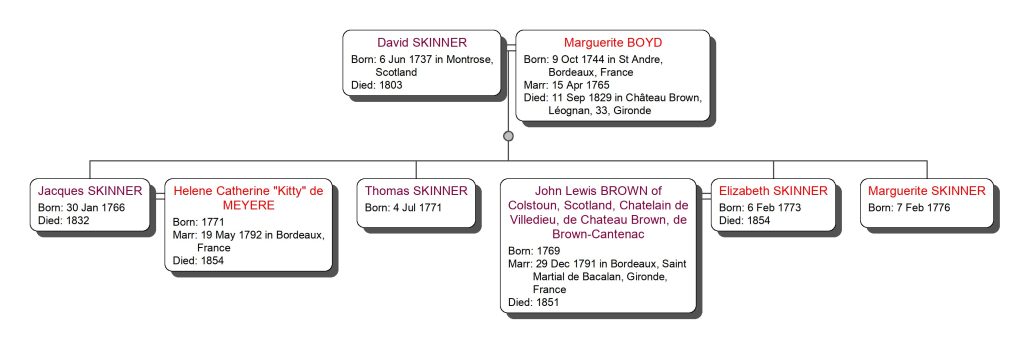
The reason for these two entries is still yet to be confirmed but it is likely that they relate to the political upheavel and revolution in France at the time, beginning with the convocation of the Estates General the previous month. The entries may have been some sort of confirmation demanded by the new and developing authorities in the city that the two marriages and associated children’s births were legitimate and had taken place in France. The entries were taken before Joseph-Sébastien de Laroze6, who was President of the Presidial Court in Bordeaux at the time and witnessed by Richard Harford (said to be a Royal Courtier), Robert Fenwick (an American Negotiant), Walter Johnson (an Irish Negotiant and nephew of Thomas Barton (1694-1780)), and an Unknown? Martin.
In 1791 another family was brought within the sphere of the Boyd and Skinner families with the marriage of David Skinner and Marguerite Boyd’s daughter Elizabeth Skinner to John Lewis Brown, originally from Colstoun in Scotland. This marriage would be the foundation on which the shared fortunes of the Boyd, Skinner and Brown families would later rest.
Sadly it seems likely that Jacques Boyd had died some time prior to 17937 although no record of his death has been found to date. Instead we must presume his death from the absence of his name from official documents.
A remarkable collection of documents has just recently come to light which provides some insight into the situation of the Skinner family in 1797. Amongst the correspondance etc. of the Home office held in the UK National Archives we find a petition from David Skinner to the British Home Secretary, the Duke of Portland. Firstly there is a witnessed statement from David Skinner empowering his son-in-law John Lewis Brown to recover debts on his behalf:
“We Certify that David Skinner has been prevented from leaving this place for upwards three years past, First by arrestation & confinement by superior power during many months, Next by adverse indisposition having received a hurt on his leg which brought on a mortification & occasioned his being dangerously ill for near two years & from which he is not yet recovered so as to undertake any long journey.
He the said David Skinner therefore gives full power to his son-in-law John Lewis Brown to recover all outstanding debts whatsoever belonging to the house of Skinner Fenwick & Brown as well as what may also belong to the house while under the firm & concern Skinner & Fenwick this intended not only to enable him to pay any just demands on the house but also to reimburse himself J L Brown the Value of Fifty thousand French livres equal to Two thousand two hundred & fifty pounds sterling of Great Britain which the said David Skinner is lawfully due him in Virtue of a Contract on the marriage of his daughter Elizabeth Skinner in Bordeaux the 25 April 1797.“
The statement of David Skinner is witnessed by a Mitchel Galwey M.D. who perhaps speaks to the health of David Skinner at the time alongside the signed and sealed statements of three consular officials Wüstenberg [Prussia], von Hemert [Denmark] and Harmensen [Sweden], we presume to lend weight and validity to the request. Then we have the petition that acompanys the statements which requests a licence to recover the debts:
“John Lewis Brown an English subject, petitions his Grace the Duke of Portland for three licenses to enable the underwritten merchants to pay to said John Lewis Brown the undermentioned sums due by them to the house Skinner Fenwick & Brown at Bordeaux. The said merchants being willing to pay when authorised by a license –
Ramsay Williamson Co at Leith – £3678.12.6
Robert Duff at Dundee – 473 – -
Alexander Tulloh in London – 440 – –
Sterling £4591.12.6
This sum is destined to pay sums due in Great Britain & for the maintenance of a numerous family all faithful subjects to his majesty.“
Unfortunately we do not know if the licenses were issued accordingly and the debts recovered. Regardless, by the time of David Skinner’s likely death in Bordeaux in 1803 the Skinner family fortunes, like the Boyd’s, had also turned and they became indebted to the Browns. Prof Cullen writes:
“In a series of transactions in an 13 ( 1806), winding up debt, and transferring property, Brown finally acquired Boyd-Cantenac. Guillaume was indebted to him, and Marie Lidye Boyd was also to settle with Brown when she sold her property.” These transactions, recorded in much detail, were the inevitable sequel to a growing mass of notarial acts of the immediately preceding years. The upshot was that Boyd-Cantenac became a Brown property, though retairning the name of the Boyd family for posterity, perhaps in recognition of the repute of its wine and as a bittersweet acknowledgement of the success of Jacques Boyd forty to fifty years previously.“
The remaining family property was likely left to eldest son George. William however died at Château Cantenac-Brown on 4 April 1819, aged 79. He was predeceased by his spinster sister Marie Lydie Boyd who also died at Château Cantenac-Brown on 8 May 1817, aged 65. Marguerite Skinner nee Boyd died at Château Cantenac-Brown on 11 September 1829.
The vineyard purchased by Jacques Boyd c1754 as we have seen passed out of the Boyd family by 1806, however it still exists today and still proudly bears the family name as Château Boyd-Cantenac. Today the estate is in the hands of the Guillemet family who acquired it in 1932.
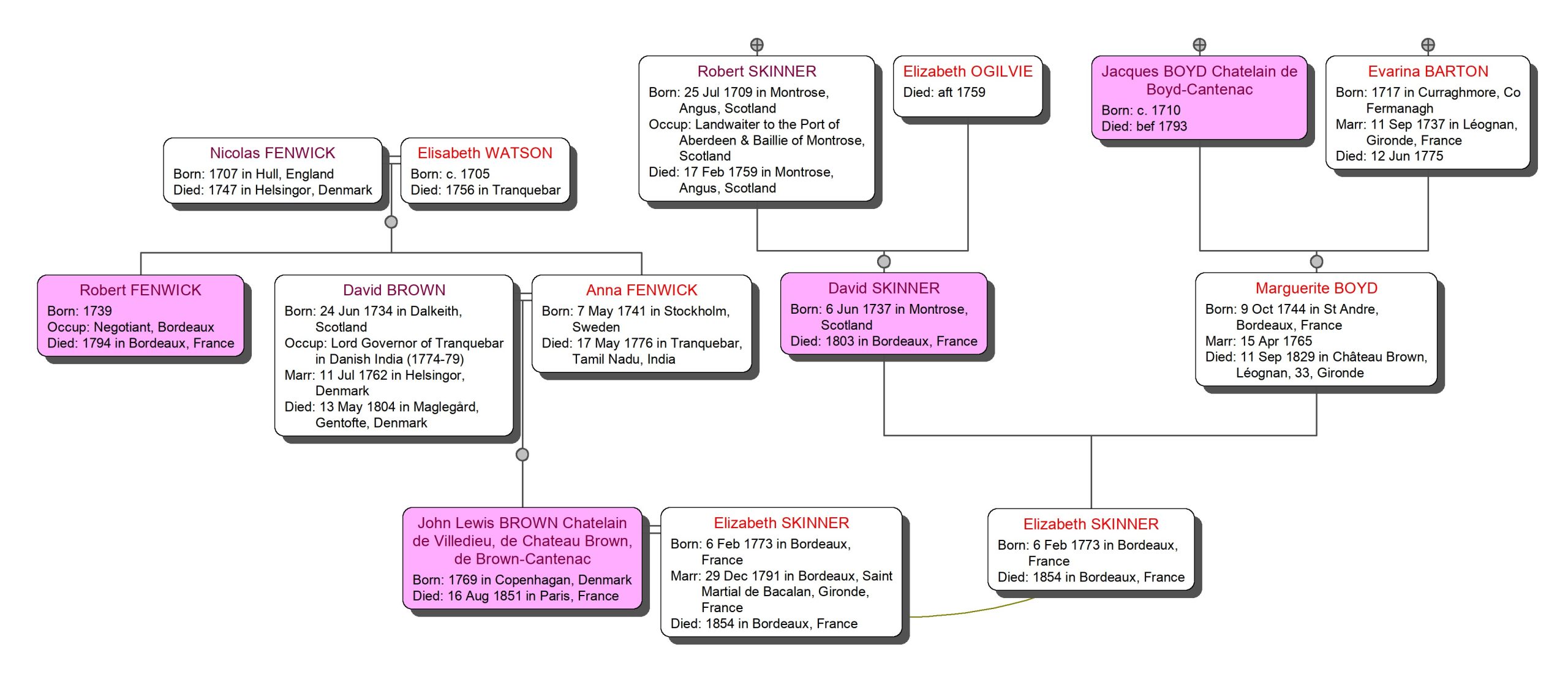
Previous research into the Boyds of Bordeaux has tended to end with the period under the Brown family in the early 1800s. However it appears the life of George Boyd, wife Marie Skinner and their children has been overlooked. Despite having a large family, many of whom were living in 1789, details are limited. We know that the eldest child of George and Marie, Evarine, acquired a passport on 7 February 1800 to travel to Altona, Hamburg, Germany on family business. Unfortunately nothing further has been found to date.
However Evarine’s younger brother Jacques or James as he probably became known appears to have taken a commission in the Bengal Army through the Honourable East India Company (HEIC). We are particularly grateful for the research of Shayne Van Rensburg into the family and descendants of Jacques/James Boyd and whilst we are not aware of a source directly connecting him as Jacques Boyd (b.1773, in Bordeaux), son of George Boyd and Marie Skinner, we believe the associated evidence discovered by Shayne is very compelling.
Looking retrospectively at the life of Jacques/James Boyd we find his death recorded in the Asiatic Journal and Monthly Register in which under deaths for 1817 it states “Nov 15 At Allahabad, Mr J Boyd, Conductor of Ordnance, leaving a widow and six children“. Allahabad is now known as Prayagraj in the State of Uttar Pradesh, India. Interogation of various online databases revealed the likely six children referred to in the notice of 1817 i.e. George David, Evarinade, Caroline, Margaret Rosalind, Unknown? and William Hercules. Three of these names are of particular notice, George, Evarinade and Hercules all of which bare a remarkable similarity to those amongst the children of George Boyd and Marie Skinner.
Turning to look at the associated evidence for the children of Jacques/James Boyd we find daughters Evarinade and Caroline, parents James Boyde Conductor of Ordnance and Hannah his wife, both baptised on 1 June 1810 at Fort William, Bengal, India by Rev Henry Martyn, Chaplin, Cawnpore. We then find the baptism of Margaret Rozerland on 4 May 1828 (b.1807), daughter of the late James Boyde, Conductor of Ordnance and of Hannah Elizabeth his wife. Unfortunatley one of the children’s names is unknown and baptisms are lacking for the apparent eldest child George David and possibly youngest William Hercules. However for George David Boyd it would appear he married firstly Louisa Charlotte Hall on 4 January 1833 in the Chaplaincy Station of Calcutta, West Bengal, India and secondly Martha Allen on 19 January 1848 at St Johns Parish Church, Calcutta, West Bengal, India. The marriage register of 1848 states that George David’s father was a James Boyd.
Regarding William Hercules Boyd we find his marriage to Tarsile Louise Antoinette Douyere on 22 May 1849 in St Johns Parish Church, Calcutta, West Bengal, India. The register also states that William Hercules’ father was a James Boyd. However it is William Hercules’ subsequent will of 5 October 1857 which provides us with some remarkable clues as to his family and ancestry. A transcription of the will is as follows:
“This is the last Will and Testament of me William Hercules Boyd at present of the Town of Calcutta.
First – After payment of all Lawful debts I bequeath to my mother Elizabeth Hannah Boyd Company Rupees (4) four a month being a portion of Interest accruing upon a Note of Hand of the value of Company Rupees (1000) One thousand.
Second – To Arabella Dickson the eldest daughter of my eldest Sister Evarinade Dickson I bequeath the Sum of Company Rupees (100) One hundred payable from the proceeds of sale of my Property.
Third – To Julia Boyd the second daughter of my eldest Sister Evarinade Dickson aforesaid I bequeath a Sum of Company Rupees (100) One hundred payable from the account due me from her husband Alexander Charles Boyd.
Fourth – To A. C. Boyd my nephew the eldest son of G. D. Boyd I bequeath the Sum of Company Rupees (40) forty 35 Rs being the remaining portion of his debt to me and 5 Rs being payable from the proceeds of the Sale of my Property.
Fifth – I bequeath to my brother George David Boyd the Gold brooch which I Received from the late Brigadier James Skinner C.B.
Sixth – To my Sister Margaret Robinson I bequeath a Sum of Company Rupees (50) fifty the proceeds of the sale of my property.
Seventh – The Remainder of whatsoever Property or money I may die possessed of with the exception of a Gold watch hereinafter mentioned I give and bequeath to my God daughter Jane Sophia Moody to be applied by her Father for the purposes of her education or otherwise as may seem most conducive to her welfare.
Eighth – I give and bequeath to my friend John Moody Bailiff of the Sudder Court a Gold watch and I appoint him Executor of this my last Will and Testament empowering him also as such to Recover whatever Sums may be due to me at the time of my demise especially a Sum of Company Rupees (600) Six hundred due me by Baboo Nobookristo Mittsee of Fillah Hooghly Dhouakhalee Thannah Bhanarhattee Mungolepore parah as per documents and my account Book.
In witness whereof I do hereunto affix my hand this fifth day of October in the year of our Lord One Thousand Eight hundred and fifty seven. etc etc.”
Thanks to the survival of this Will it would seem we have the neccessary information to make a reasoned link with Jacques Boyd, son of George Boyd and Marie Skinner. Not only does it confirm his mother’s name and the name of his surviving siblings in 1857 but perhaps most remarkable of all is the reference to the Gold brooch which he received from Brigadier James Skinner C.B. This James Skinner (1778-1841) can be none other than the historical figure whose name is still recognised today within military circles of modern India. James Skinner was the son of Lieutenant-Colonel Hercules Skinner (c. 1735–1803) and grandson of Robert Skinner (1709-59) and Elizabeth Ogilvie making him first cousin once removed of William Hercules Boyd. This information would also suggest that it was likely the Skinner family who possibly arranged for Jacques Boyd to recieve a commission in the HEIC.
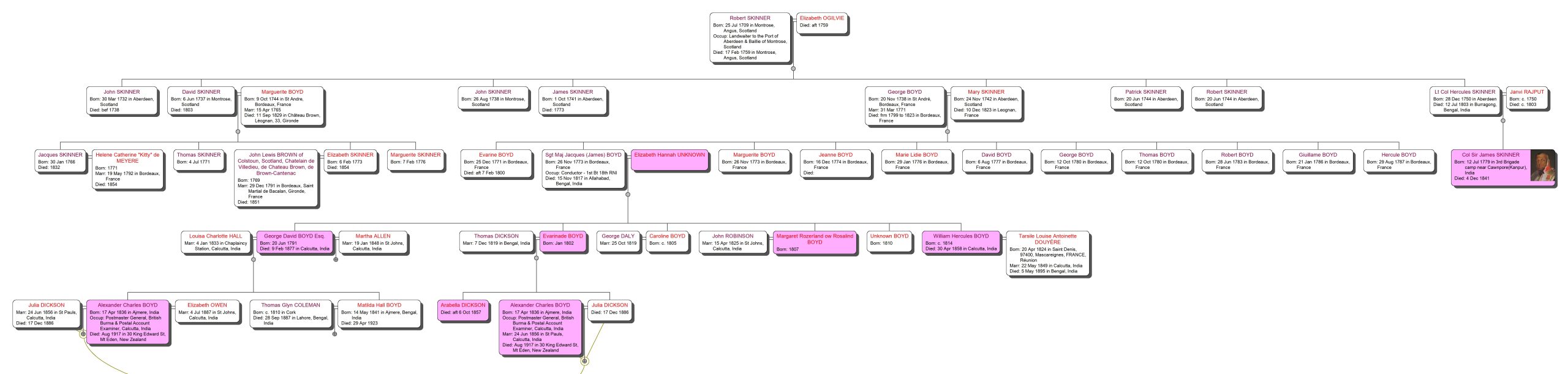
Today the descendants of George Boyd and Marie Skinner of Bordeaux can be found from South Africa to New Zealand.
- Archives Departmentale de Gironde (ADG), Étude Cheyron, 3E 13050, Jun 11, 1767 ↩︎
- ADG, Étude Guy, 3E 13246, Résiliment, Apr. 17, 1761 ↩︎
- ADG, Étude Guy 3E 13247, Acquisition, Jul. 12, 1762; ADG, ADG, Étude Guy 3E 13269, Acquisition, Aug. 22, 1775. ↩︎
- ADG, Etude Guy, 3E 13246, Aug. 22, 1761 ↩︎
- ADG, BORDEAUX GG 870 – Non Catholiques. – Registre des baptêmes, mariages et sépultures – 17 février-31 décembre 1789 – pp.63-64 of 139 ↩︎
- Archives historiques du département de la Gironde – 1895 (1), p.298 ↩︎
- Ireland, France, and the Atlantic in a time of war : reflections on the Bordeaux-Dublin letters, 1757 – 2 The Boyds in Bordeaux and Dublin, Prof. Louis Cullen (2017), p.64 ↩︎